Adaptio vs EasyLeadz 2026: Which B2B Sales Tool Wins?
Adaptio vs EasyLeadz, compared head-to-head: signals and AI prioritization versus direct-dial contact data. See which fits your 2026 outbound motion.
Choosing between Adaptio and EasyLeadz comes down to one question: do you need a smarter way to decide who to contact, or a faster way to get the phone number once you know? The two tools sit on opposite ends of the same outbound workflow, and picking the wrong one means paying for capability you'll never touch.
TL;DR#
- EasyLeadz is a B2B contact-data provider built around verified direct dials and mobile numbers, strongest for teams that already know their target accounts and just need reliable phone and email contacts.
- Adaptio leans toward AI-driven prioritization and buying-signal workflows — it helps you decide which accounts and people deserve attention before you ever dial.
- They solve different stages of prospecting: Adaptio answers "who and when," EasyLeadz answers "how do I reach them."
- For most SMB and mid-market outbound teams, the deciding factor is data depth versus workflow intelligence, not raw feature count.
- If your real gap is verified email coverage rather than dials or signals, a dedicated email finder often beats both on cost-per-valid-contact.
What is EasyLeadz?#
EasyLeadz is a B2B contact intelligence platform best known for its "Mr. E" browser extension, which surfaces direct phone numbers and emails from LinkedIn profiles and company pages. Its core promise is direct dials — the mobile and desk numbers that are hardest to source and most valuable for sales development reps who live on the phone.
The product is data-first. You point it at a person or a company, and it returns contact details drawn from its database and enrichment partners. Teams that run high-volume cold-calling motions tend to gravitate to it because reaching a decision-maker's mobile beats a generic switchboard every time. You can read independent user reviews on G2 to gauge how coverage holds up by region.
Where EasyLeadz is honest about its lane: it is not a sequencer, not a CRM, and not an intent-signal engine. It is a contact-data source you plug into the rest of your stack.
What is Adaptio?#
Adaptio positions itself around AI-assisted sales execution — prioritizing accounts, interpreting buying signals, and guiding reps toward the prospects most likely to convert now. Rather than handing you a raw list, the emphasis is on workflow intelligence: scoring, sequencing logic, and surfacing the next best action.
This is a fundamentally different bet than EasyLeadz. Adaptio assumes you can already source contacts (or that sourcing is a smaller problem) and that your real bottleneck is rep focus — too many accounts, too little signal about which ones are warm. If your team wastes hours deciding who to call instead of calling, that's the problem Adaptio aims at.
A fair caveat: Adaptio's public documentation and pricing are less standardized than EasyLeadz's, so validate current capabilities and limits directly with the vendor and on review sites like Capterra before committing budget.
Adaptio vs EasyLeadz: how do they compare?#
Think of it like equipping a delivery fleet. EasyLeadz hands you accurate street addresses for every house on your route. Adaptio tells you which houses are most likely to open the door today. Both are useful — but only if they match where your team is losing time.
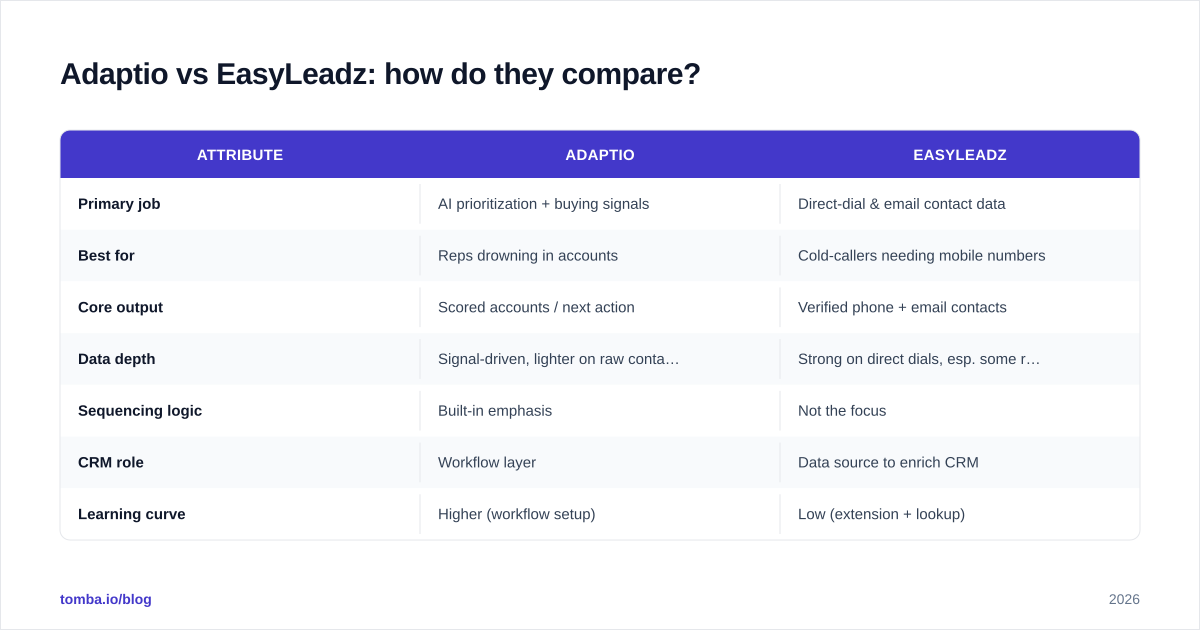
| Attribute | Adaptio | EasyLeadz |
|---|---|---|
| Primary job | AI prioritization + buying signals | Direct-dial & email contact data |
| Best for | Reps drowning in accounts | Cold-callers needing mobile numbers |
| Core output | Scored accounts / next action | Verified phone + email contacts |
| Data depth | Signal-driven, lighter on raw contacts | Strong on direct dials, esp. some regions |
| Sequencing logic | Built-in emphasis | Not the focus |
| CRM role | Workflow layer | Data source to enrich CRM |
| Learning curve | Higher (workflow setup) | Low (extension + lookup) |
| Pricing transparency | Often quote-based | Published tiers, credit-based |
The table makes the split obvious. These are not two versions of the same product — they're two different links in the chain. A team that buys Adaptio and still can't find a working mobile number hasn't solved its problem. A team that buys EasyLeadz and still can't decide which of 4,000 contacts to call hasn't either.
)
Which one is more accurate for finding contacts?#
For raw contact accuracy — getting a phone number that actually rings the right person — EasyLeadz is the more direct answer, because that's its entire reason to exist. Direct-dial accuracy is notoriously hard to maintain (people change jobs, numbers churn), so no provider hits 100%, but a data-first tool will generally out-cover a signals-first tool on contactability.
Adaptio's accuracy question is different. You're not really asking "is this number right?" — you're asking "is this account actually in-market?" That's a prediction, not a fact, and it should be judged on conversion lift over time, not on a single lookup. Both kinds of accuracy matter; they just aren't comparable on the same scale.
This is also where a lot of teams discover a third gap. If your outbound runs more on email than phone, neither tool may be your cheapest path to verified addresses. Running contacts through a dedicated email verifier before a campaign protects your sender reputation regardless of where the contact came from — and a domain search can fill company-wide gaps that a profile-by-profile extension misses.
How do they fit into a real outbound workflow?#
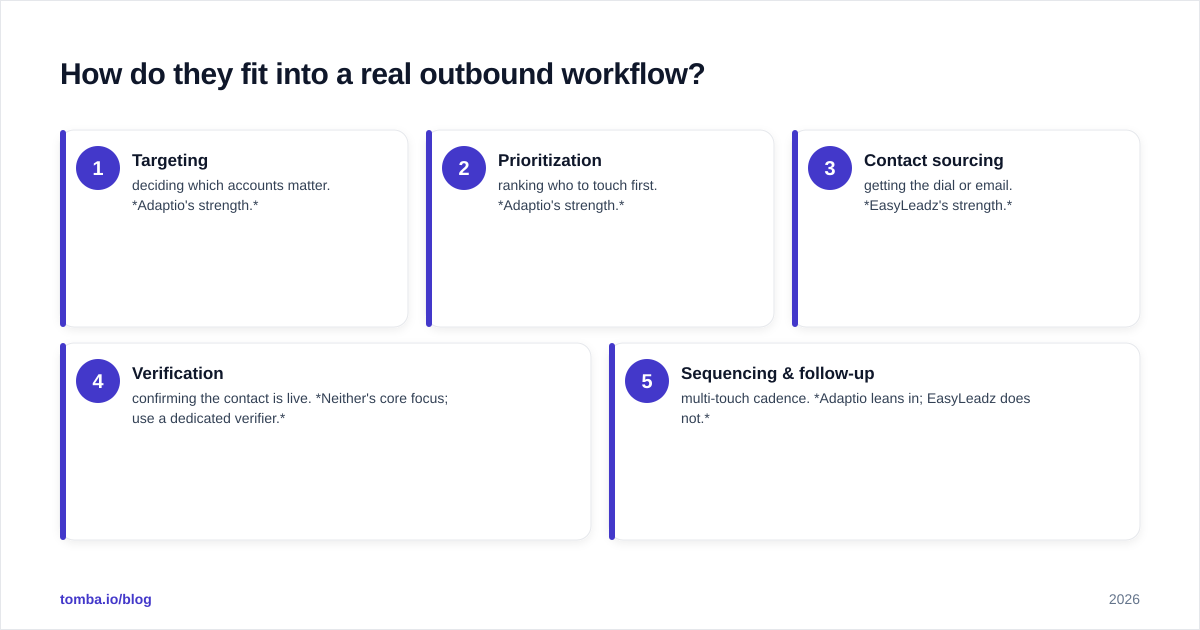
Map your funnel, then map the tools onto it:
- Targeting — deciding which accounts matter. Adaptio's strength.
- Prioritization — ranking who to touch first. Adaptio's strength.
- Contact sourcing — getting the dial or email. EasyLeadz's strength.
- Verification — confirming the contact is live. Neither's core focus; use a dedicated verifier.
- Sequencing & follow-up — multi-touch cadence. Adaptio leans in; EasyLeadz does not.
The honest takeaway: many high-performing teams don't choose between these tools — they slot a signals layer and a data layer into the same pipeline. The mistake is buying two overlapping tools that both claim to do "prospecting" without checking which funnel stage each actually owns.
If you want a primer on the broader category before deciding, our roundup of B2B sales tools breaks down where data, signals, and automation each pay off.
What about pricing?#
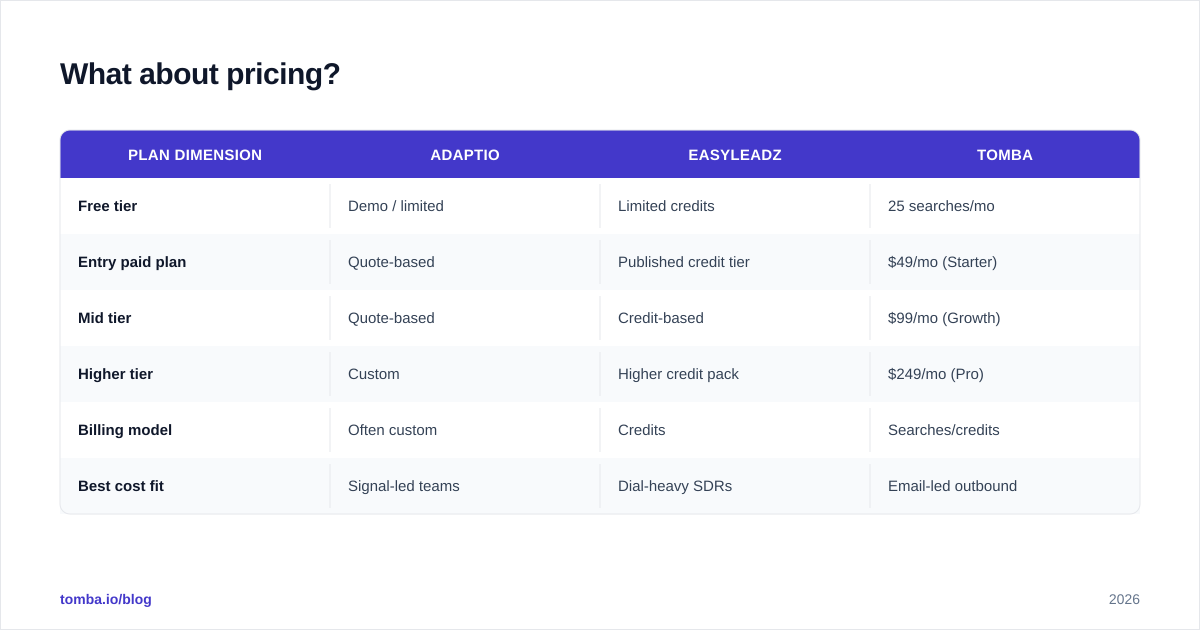
Pricing is where the comparison gets practical. EasyLeadz typically publishes credit-based tiers, so you can estimate cost per contact before you commit. Adaptio more often runs quote-based, which makes apples-to-apples budgeting harder and usually signals a more sales-assisted, higher-touch buying process.
| Plan dimension | Adaptio | EasyLeadz | Tomba |
|---|---|---|---|
| Free tier | Demo / limited | Limited credits | 25 searches/mo |
| Entry paid plan | Quote-based | Published credit tier | $49/mo (Starter) |
| Mid tier | Quote-based | Credit-based | $99/mo (Growth) |
| Higher tier | Custom | Higher credit pack | $249/mo (Pro) |
| Billing model | Often custom | Credits | Searches/credits |
| Best cost fit | Signal-led teams | Dial-heavy SDRs | Email-led outbound |
Two caveats so you don't quote me as gospel: vendor pricing changes, and quote-based tools vary by seat count and contract length. Always confirm live numbers on each vendor's site — for EasyLeadz that's easyleadz.com — and check current Tomba pricing if email coverage is your real constraint. The point of the table isn't the exact dollar figure; it's the shape of each model. Credit-based pricing rewards predictable, high-volume usage. Quote-based pricing rewards teams that want a packaged workflow and don't mind a sales conversation.
)
Who should pick Adaptio?#
Choose Adaptio if:
- Your reps have more accounts than they can work and waste time deciding where to start.
- Buying signals and timing matter more to your motion than raw contact volume.
- You want prioritization and next-best-action baked into the workflow, not bolted on.
- You're comfortable with a heavier setup and a quote-based buying process.
Adaptio is the wrong call if your actual pain is "I can't find a working phone number" — a signals engine won't fix a data gap.
Who should pick EasyLeadz?#
Choose EasyLeadz if:
- You run a phone-heavy SDR motion and need direct dials and mobiles.
- Your team already knows its target accounts and just needs contacts fast.
- You want a low-friction browser extension over a complex platform.
- Predictable, credit-based pricing matters for budgeting.
EasyLeadz is the wrong call if your bottleneck is focus, not data — handing reps more contacts without prioritization can make the "too many accounts" problem worse, not better.
What if neither is the right fit?#
Here's the uncomfortable middle ground: a large share of teams shopping "Adaptio vs EasyLeadz" actually have an email coverage and deliverability problem, not a signals or dials problem. They're cold-calling because their emails bounce, or they're chasing direct dials because their email list is stale.
If that's you, the cheaper fix is upstream. A focused email-finding stack — find email addresses by name or company, then verify emails before send — often delivers more booked meetings per dollar than either a premium signals platform or a premium dial database. You can layer a signals tool on later once your core contact data is clean. For teams enriching at scale, bulk lead generation handles list-wide finding and verification in one pass.
The framework: fix the data layer first, add the intelligence layer second. Buying a Ferrari engine for a car with no wheels is a familiar B2B mistake.
The bottom line on Adaptio vs EasyLeadz#
Adaptio and EasyLeadz aren't really competitors — they're neighbors. Adaptio wins on prioritization and AI-guided workflow; EasyLeadz wins on direct-dial contact data. Decide which funnel stage is actually costing you meetings, then buy the tool that owns that stage. Buying both before you've diagnosed the bottleneck is how SaaS budgets quietly bleed.
And before you commit to either, pressure-test whether your gap is email coverage in disguise. If your outbound lives and dies by inbox deliverability, start with the Tomba Email Finder — find and verify professional emails by domain, name, or company on a free tier (25 searches/mo) and paid plans from $49/mo, then layer signals or dials on top once your contact data is rock-solid. Get the foundation right, and the rest of the stack gets cheaper and easier to justify.
// get started
Find, verify and enrich your first contacts today
Start on the free plan with 25 searches a month, then scale when your team is ready.
Free plan · No credit card required · GDPR & CCPA
Get the Tomba newsletter
Product and data updates
// about the author