Adaptio vs Emailverifyio: Which Sales Tool Wins in 2026?
Adaptio focuses on adaptive AI outreach, EmailVerify.io on list hygiene. We break down features, pricing, accuracy, and where each fits your 2026 B2B stack.
Adaptio vs Emailverifyio is not really a head-to-head between two versions of the same tool. One is an AI-driven outreach and sales-engagement layer; the other is a dedicated email-verification engine. Picking between them only makes sense once you know which job you actually need done — sending smarter, or cleaning your list before you send at all.
TL;DR#
- Adaptio is built for adaptive outreach: AI-assisted sequencing, messaging, and engagement timing across email and other channels.
- EmailVerify.io is a single-purpose email verification service focused on bounce reduction and list hygiene at scale.
- They solve different problems — many teams run something like Adaptio for sending and a verifier like EmailVerify.io for hygiene at the same time.
- Neither one finds new prospect emails for you, which is the gap most cold-outreach teams hit first.
- If you want finding, verifying, and enrichment in one stack, a platform like Tomba covers the part both of these tools leave open.
What is Adaptio?#
Adaptio positions itself as an AI sales-engagement platform. Instead of static, one-size-fits-all sequences, the pitch is that it adapts messaging, cadence, and timing based on how each prospect behaves — opens, replies, clicks, and engagement signals feed back into what gets sent next.
In practice, tools in this category aim to replace the manual work of A/B testing subject lines, guessing send times, and rewriting follow-ups. You load contacts, define an objective, and the system optimizes the outreach motion around it. That makes Adaptio a top-of-funnel activity tool: it governs how you talk to people you already have contact data for.
What Adaptio is not is a data source. It assumes you arrive with a list of contacts and valid email addresses. If those addresses are stale or guessed, no amount of adaptive messaging fixes a hard bounce.
What is EmailVerify.io?#
EmailVerify.io sits at the opposite end of the workflow. It is a focused email verification tool: feed it a list, and it checks each address for syntax validity, domain and MX records, mailbox existence (via SMTP probing), and risk flags like disposable domains, role accounts, and catch-all servers.
The output is a clean, deliverable list with a clear verdict per address — valid, invalid, risky, or unknown. The goal is simple and measurable: drop your bounce rate, protect your sender reputation, and keep your domain off blocklists.
Verification tools like this matter because mailbox providers punish high bounce rates. A list with 8% invalids will tank your inbox placement fast, no matter how good the copy is. EmailVerify.io exists to stop that before your first send.
What EmailVerify.io is not is a finder or an outreach engine. It validates what you give it. It does not discover new contacts, write messages, or send anything.
Adaptio vs Emailverifyio: how do they actually differ?#
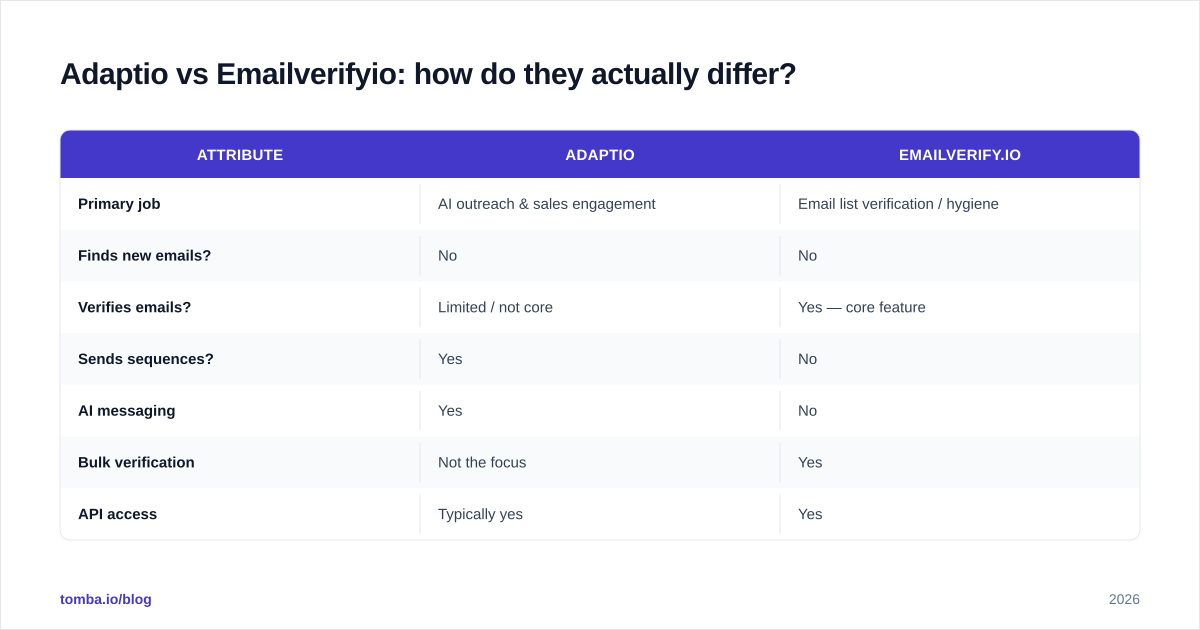
Here is the core of the adaptio vs emailverifyio decision laid out side by side. Note the columns rarely overlap — that is the whole point.
| Attribute | Adaptio | EmailVerify.io |
|---|---|---|
| Primary job | AI outreach & sales engagement | Email list verification / hygiene |
| Finds new emails? | No | No |
| Verifies emails? | Limited / not core | Yes — core feature |
| Sends sequences? | Yes | No |
| AI messaging | Yes | No |
| Bulk verification | Not the focus | Yes |
| API access | Typically yes | Yes |
| Best for | SDR teams running cadences | Marketers cleaning lists |
| Where it sits | Top of the send workflow | Pre-send guardrail |
The takeaway: these are complementary, not competitive. You could genuinely run both. The real question is what is missing from a stack that has only these two — and the answer is the sourcing step.

Which one should you choose for your workflow?#
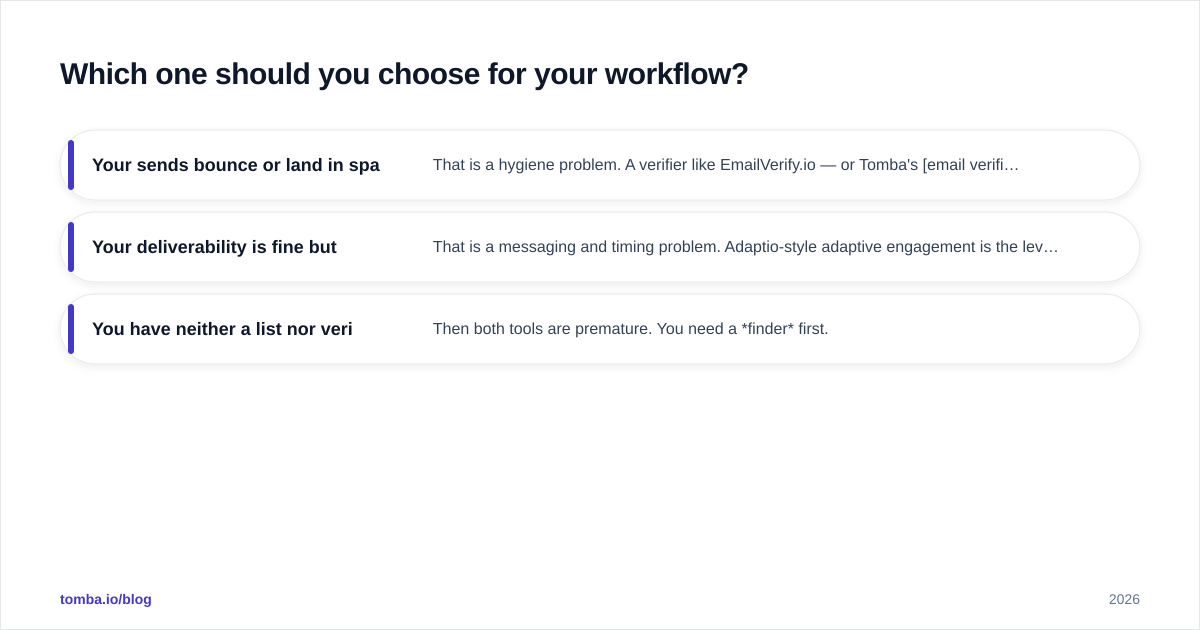
Conclusion first: choose based on which symptom you have right now.
- Your sends bounce or land in spam. That is a hygiene problem. A verifier like EmailVerify.io — or Tomba's email verifier — is the fix. No outreach tool repairs a dirty list.
- Your deliverability is fine but replies are flat. That is a messaging and timing problem. Adaptio-style adaptive engagement is the lever, assuming your data is already clean.
- You have neither a list nor verified data. Then both tools are premature. You need a finder first.
That third scenario is where most cold-outreach teams actually live, and it is the gap that neither Adaptio nor EmailVerify.io closes. You can adapt messaging beautifully and verify a list perfectly — but if you do not have the prospects' addresses in the first place, you are optimizing an empty pipeline.
This is why the smarter framing is not Adaptio or EmailVerify.io. It is: find → verify → engage, three stages, and you map each tool to a stage.
How does pricing compare?#
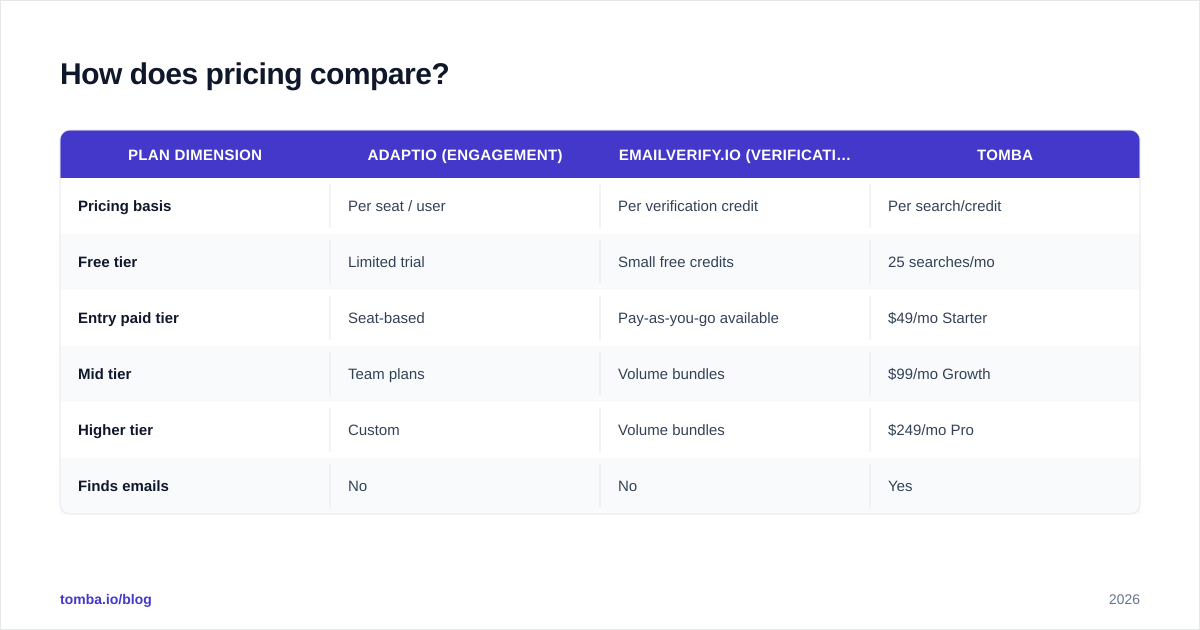
Pricing models differ because the products differ. Outreach platforms like Adaptio usually price per seat or per active user, since value scales with the number of reps sending. Verification tools like EmailVerify.io price per verification credit, since value scales with list volume.
| Plan dimension | Adaptio (engagement) | EmailVerify.io (verification) | Tomba |
|---|---|---|---|
| Pricing basis | Per seat / user | Per verification credit | Per search/credit |
| Free tier | Limited trial | Small free credits | 25 searches/mo |
| Entry paid tier | Seat-based | Pay-as-you-go available | $49/mo Starter |
| Mid tier | Team plans | Volume bundles | $99/mo Growth |
| Higher tier | Custom | Volume bundles | $249/mo Pro |
| Finds emails | No | No | Yes |
Always confirm current numbers on each vendor's own pricing page, since these change. For Tomba specifically, the public Tomba pricing runs from a free tier (25 searches/month) up through Starter at $49/mo, Growth at $99/mo, and Pro at $249/mo, with Enterprise custom. The relevant point for budgeting: if you pay separately for finding, verifying, and sending, three line items add up fast — consolidating the first two often saves more than it costs.
What about accuracy and deliverability?#
For a verification tool, accuracy is the entire product. The questions that matter for EmailVerify.io — or any verifier — are how it handles catch-all domains, how aggressively it SMTP-probes, and how it labels "unknown" results. A verifier that marks everything ambiguous as "valid" flatters its own numbers and burns your domain later.
Catch-all handling is where most verifiers struggle, because a catch-all server accepts every address at the SMTP layer whether the mailbox exists or not. If a large share of your list sits on catch-all domains, a basic verifier will return a wall of "accept-all" results that you cannot act on. Dedicated tooling like a catch-all verifier exists precisely to squeeze more certainty out of those cases.
For Adaptio, "accuracy" means something different — it is about send-time optimization and message relevance, not address validity. Adaptio can improve open and reply rates, but it inherits whatever deliverability baseline your list and infrastructure give it. Good background reading on why hygiene drives deliverability is available from HubSpot and general references like Wikipedia's overview of email verification. For peer reviews of both categories, G2 is a reasonable neutral starting point.
Where does Tomba fit in the Adaptio vs Emailverifyio picture?#
Tomba covers the stage both of these tools assume you have already handled: getting accurate contact data in the first place, and verifying it in the same motion.
The practical workflow looks like this:
- Find — use the email finder or domain search to source addresses by name, company, or domain. For large jobs, the bulk email finder processes lists at scale.
- Verify — run those addresses through Tomba's email verifier so what reaches your sending tool is already clean. This is the EmailVerify.io job, built into the same platform.
- Engage — push verified contacts into your sequencing tool of choice — including an Adaptio-style engagement layer — through the Tomba API or native integrations.
In other words, Tomba does not try to be your sequencer. It removes the need to buy a separate verifier and a separate finder by handling stages one and two together, then hands clean data off to whatever sends your mail.
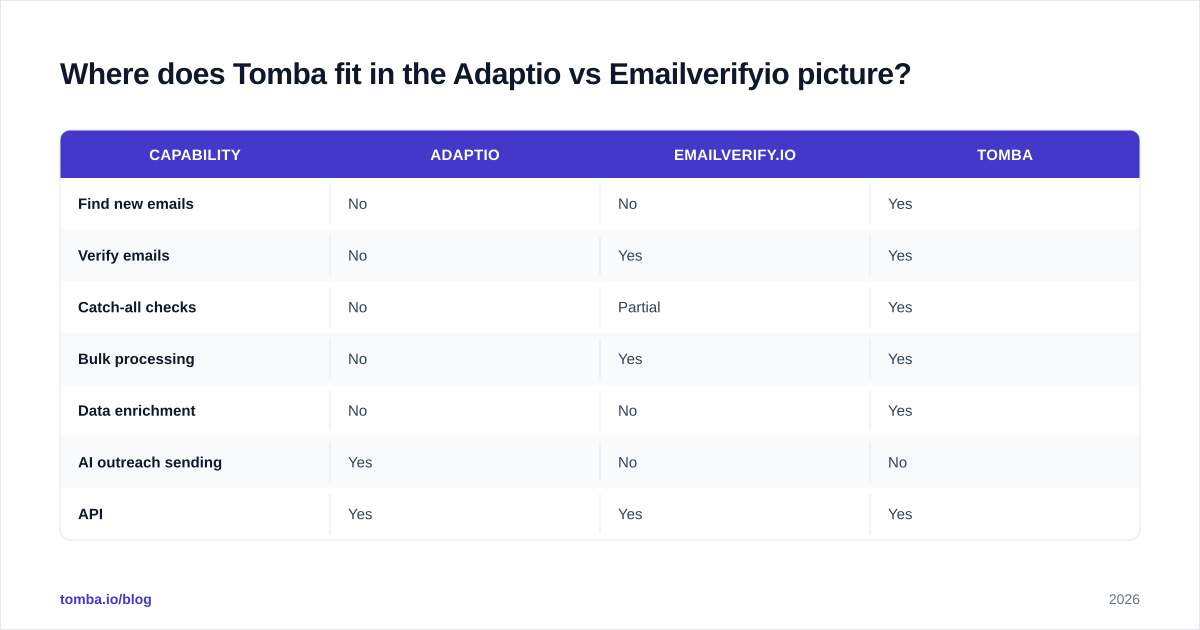
| Capability | Adaptio | EmailVerify.io | Tomba |
|---|---|---|---|
| Find new emails | No | No | Yes |
| Verify emails | No | Yes | Yes |
| Catch-all checks | No | Partial | Yes |
| Bulk processing | No | Yes | Yes |
| Data enrichment | No | No | Yes |
| AI outreach sending | Yes | No | No |
| API | Yes | Yes | Yes |
The honest read: Tomba and Adaptio are complementary, not rivals — Tomba feeds the pipeline Adaptio runs. Tomba and EmailVerify.io do overlap on verification, and there Tomba's advantage is that the same credit pool also finds and enriches, so you are not paying two vendors for two halves of the same step.
Can you use all three together?#
Yes, and for some teams that is the right answer. A common high-volume stack looks like:
- Tomba for sourcing and verification (find + verify, one tool).
- A sending platform — Adaptio-style — for adaptive sequencing and engagement.
- Optional standalone verifier only if compliance requires a second, independent validation pass before a high-stakes campaign.
For most small and mid-size teams, though, three tools is one too many. Folding finding and verifying into a single platform removes a handoff, a second invoice, and a whole class of "which tool has the latest list" confusion. You keep your sending tool, and you collapse everything upstream of it.
If your real pain is sourcing accurate contacts and keeping them deliverable — not writing sequences — start where the pipeline starts. Try the Tomba Email Finder to pull verified professional emails by domain or name, run them through the built-in verifier, and hand a clean list straight to whatever you use to send. The free tier gives you 25 searches a month to test the data quality before you commit, and you can see exactly where Tomba gets its data before you trust it with a campaign.
The bottom line on adaptio vs emailverifyio: stop treating it as a binary. Map each tool to its stage — engage, verify — then make sure something owns the find stage that comes before both. That is the link that turns three disconnected tools into one working pipeline.
// get started
Find, verify and enrich your first contacts today
Start on the free plan with 25 searches a month, then scale when your team is ready.
Free plan · No credit card required · GDPR & CCPA
// about the author