Adaptio vs Exellius 2026: B2B Sales Platform Comparison
Adaptio vs Exellius compared on pricing, data, automation, and fit. See which B2B sales platform wins for your team in 2026 — and where a leaner stack beats both.
Choosing between Adaptio and Exellius comes down to one question most comparison pages dodge: do you need an all-in-one GTM suite, or do you need a few sharp tools that do their jobs and get out of the way? This breakdown answers that with concrete attributes — pricing, data, automation, and the migration tax nobody warns you about.
TL;DR#
- Adaptio leans toward workflow automation and pipeline orchestration — strong if your bottleneck is process, not data.
- Exellius leans toward data and enrichment depth — strong if your bottleneck is finding and qualifying contacts.
- Both carry suite pricing: you pay for modules you may never switch on.
- For most lean teams, a focused email finder plus a CRM you already own beats either platform on cost-per-result.
- Run a 14-day pilot against your own ICP list before signing an annual contract — vendor demo data always looks perfect.
What are Adaptio and Exellius?#
Both Adaptio and Exellius position themselves as end-to-end B2B revenue platforms: contact data, sequencing, pipeline management, and reporting under one login. The pitch is consolidation — fewer vendors, one bill, one support queue.
That pitch is real, but so is the trade-off. Consolidated suites win on convenience and lose on depth. A platform that does eight things rarely does any single one better than the specialist tool built for that job. Your decision is less "which suite is better" and more "is suite convenience worth the depth I give up?"
Think of it like a multi-tool versus a dedicated chef's knife. The multi-tool is always in your pocket, but when you actually need to cut something precisely, you reach for the knife. Most revenue teams have one or two cuts that matter most — usually data accuracy and deliverability — and that's where specialists like a dedicated email finder earn their keep.
How do Adaptio and Exellius compare on features?#
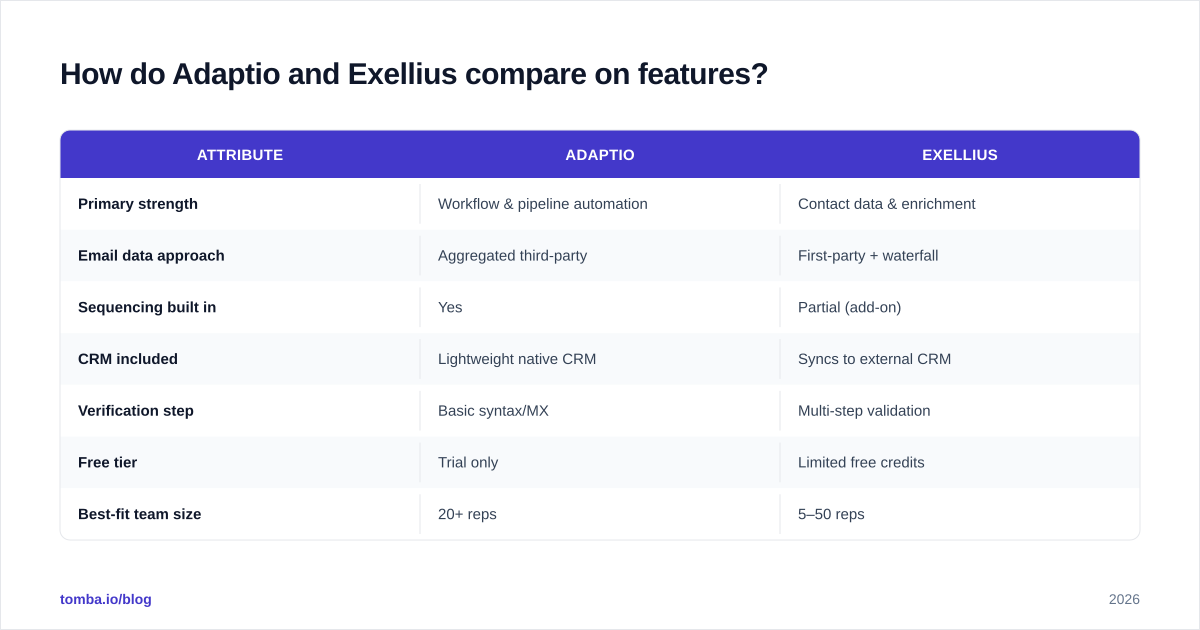
Here's the head-to-head on the attributes that actually change your win rate. Treat any vendor-published accuracy number as a ceiling, not a floor — independent tests almost always land lower.
| Attribute | Adaptio | Exellius |
|---|---|---|
| Primary strength | Workflow & pipeline automation | Contact data & enrichment |
| Email data approach | Aggregated third-party | First-party + waterfall |
| Sequencing built in | Yes | Partial (add-on) |
| CRM included | Lightweight native CRM | Syncs to external CRM |
| Verification step | Basic syntax/MX | Multi-step validation |
| Free tier | Trial only | Limited free credits |
| Best-fit team size | 20+ reps | 5–50 reps |
| Annual lock-in | Common | Common |
Read the table as a tendency, not gospel — both vendors ship features quarterly and your mileage depends on your region and industry. The pattern that holds across most reviews on G2 and Capterra: Adaptio buyers praise automation and complain about data gaps; Exellius buyers praise data and complain about thin workflow tooling.

Which has better data accuracy?#
Data accuracy is the single attribute that decides whether either platform pays for itself. A sequence engine is worthless if 30% of your emails bounce — you'll torch your sender reputation before the automation ever helps.
Exellius generally edges ahead here because it treats verification as a pipeline, not a checkbox. A "waterfall" approach — query multiple sources, cross-check, then validate the SMTP response — catches more bad addresses than a single-source lookup. Adaptio's strength is what happens after you have a good contact, not getting one.
But neither replaces a dedicated verification layer. If deliverability is your real constraint, pairing any platform with a standalone email verifier and running a catch-all verifier on ambiguous domains will do more for your bounce rate than switching suites. The expensive lesson teams learn: suite-bundled verification is "good enough" until your domain lands on a blocklist.
A practical test before you commit: export 200 known-good contacts from your CRM, run them through each platform's enrichment, and measure how many it returns correctly. That number — not the demo — is your accuracy.
How does pricing compare?#
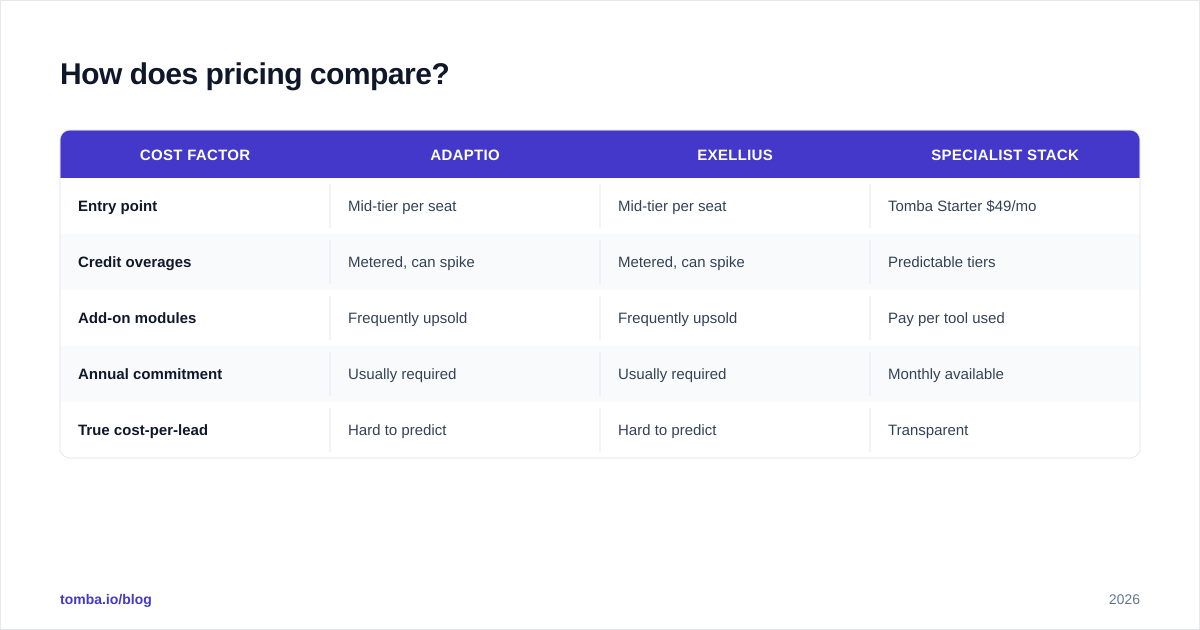
Both Adaptio and Exellius use the classic suite model: a per-seat base fee, plus credit or contact-volume tiers, plus add-ons for the modules that were "included" in the sales deck but metered in the contract. Sticker price and real price diverge fast.
| Cost factor | Adaptio | Exellius | Specialist stack |
|---|---|---|---|
| Entry point | Mid-tier per seat | Mid-tier per seat | Tomba Starter $49/mo |
| Credit overages | Metered, can spike | Metered, can spike | Predictable tiers |
| Add-on modules | Frequently upsold | Frequently upsold | Pay per tool used |
| Annual commitment | Usually required | Usually required | Monthly available |
| True cost-per-lead | Hard to predict | Hard to predict | Transparent |
The honest comparison isn't Adaptio vs Exellius on list price — it's either suite versus assembling the two or three tools you'll actually use. A focused stack built around an email finder, a verifier, and your existing CRM often comes in below a single suite seat. Tomba's pricing is public and unbundled: a Free tier with 25 searches per month, Starter at $49/mo, Growth at $99/mo, Pro at $249/mo, and Enterprise custom. You can see the full Tomba pricing without booking a call — which is more than most suites offer.
Adaptio vs Exellius: which workflow fits your team?#
Match the tool to your actual bottleneck, not the feature list. The flow below maps the decision most teams should run before they sign anything.
Choose Adaptio if:
- Your reps already have decent data but waste hours on manual follow-up and pipeline hygiene.
- You have 20+ seats and want one admin surface for the whole motion.
- You're consolidating away from a tangle of point solutions and value one bill over best-in-class depth.
Choose Exellius if:
- Your core problem is finding and qualifying the right contacts.
- You run outbound where data freshness directly drives reply rate.
- You already have a CRM you like and just need a strong enrichment layer feeding it.
Choose a specialist stack if:
- You're under 25 reps and every dollar of cost-per-lead matters.
- You want monthly billing and no annual lock-in while you're still finding product-market fit.
- Your wins come from accurate emails and clean lists, not from a sequencer's bell count.
For that third path, the building blocks are simple: a domain search to map every contact at a target company, an email finder to get verified addresses, and your CRM for the rest. You can wire it together with native integrations to HubSpot, Pipedrive, or Salesforce so the data lands where your reps already work.
What do reviewers say about Adaptio vs Exellius?#
Cut through the star ratings and the recurring themes look like this:
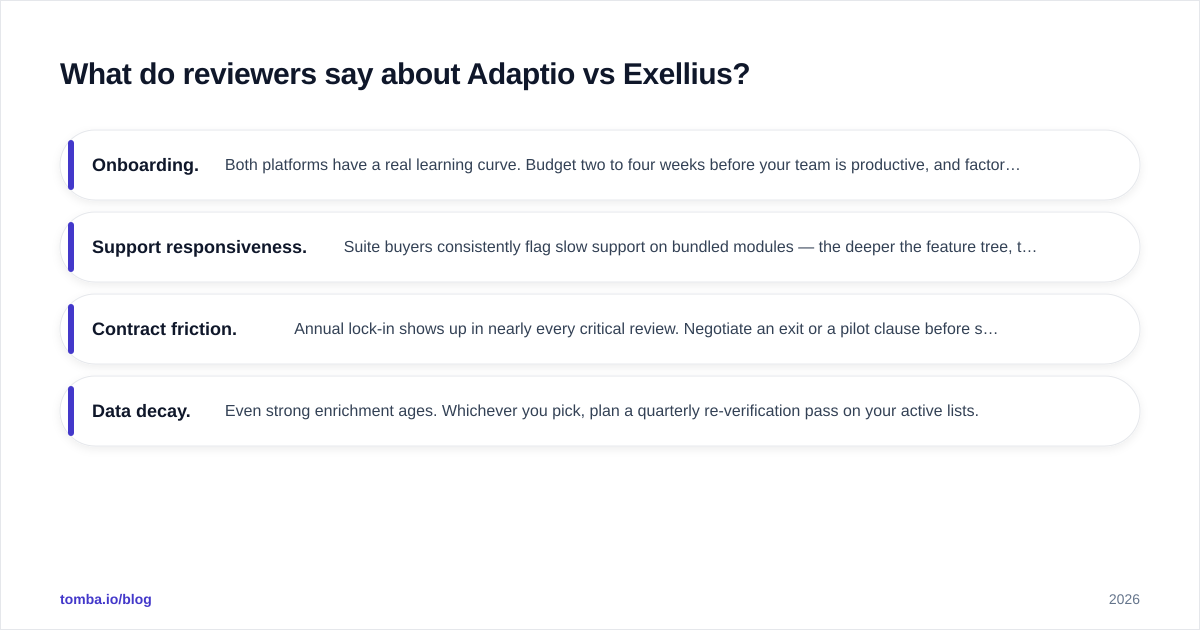
- Onboarding. Both platforms have a real learning curve. Budget two to four weeks before your team is productive, and factor that ramp into ROI math.
- Support responsiveness. Suite buyers consistently flag slow support on bundled modules — the deeper the feature tree, the thinner the expertise per branch.
- Contract friction. Annual lock-in shows up in nearly every critical review. Negotiate an exit or a pilot clause before signing.
- Data decay. Even strong enrichment ages. Whichever you pick, plan a quarterly re-verification pass on your active lists.
Cross-reference any vendor claim against a neutral directory like Gartner Peer Insights and weight recent reviews over old ones — both products iterate quarterly, so a 2024 complaint may already be fixed.
Can you avoid the suite trade-off entirely?#
Yes — and for many teams it's the smarter play. The reason suites feel necessary is integration pain: nobody wants to glue five tools together. But modern APIs and native connectors have made that gluing nearly free.
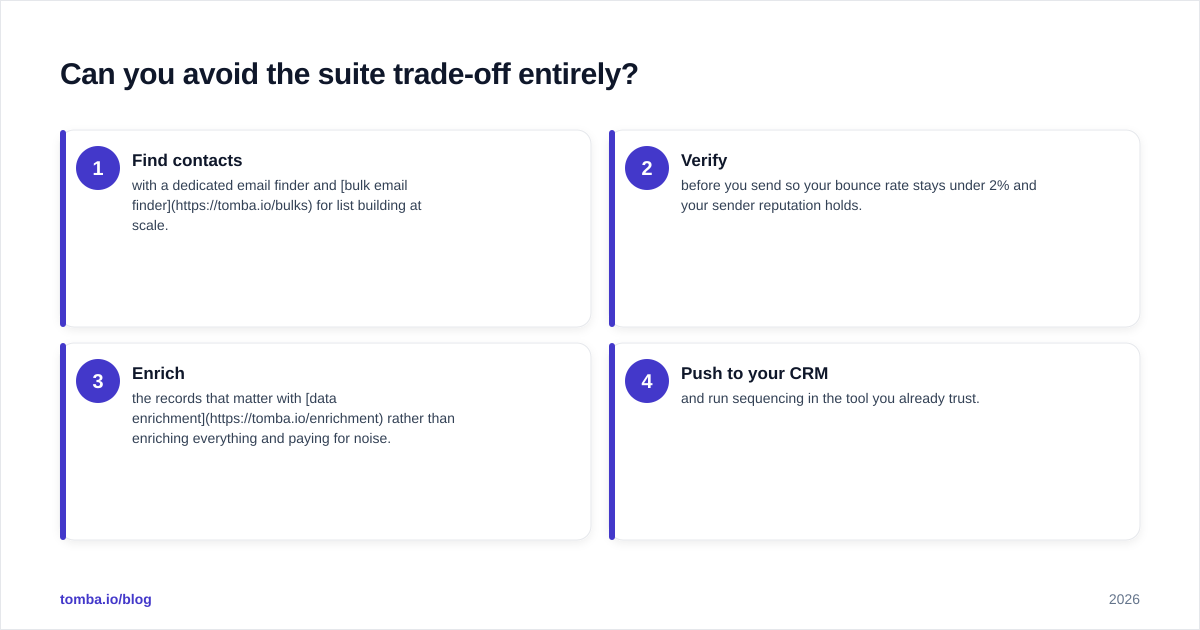
A lean alternative to either Adaptio or Exellius looks like this:
- Find contacts with a dedicated email finder and bulk email finder for list building at scale.
- Verify before you send so your bounce rate stays under 2% and your sender reputation holds.
- Enrich the records that matter with data enrichment rather than enriching everything and paying for noise.
- Push to your CRM and run sequencing in the tool you already trust.
This stack costs less, locks you in less, and lets you swap any single component without re-platforming your whole motion. The convenience tax of a suite is real money — and you only feel it after you've signed.
If your honest bottleneck is data — and for most outbound teams it is — start by fixing the input, not the workflow. Garbage contacts run through a beautiful sequence are still garbage contacts.
The bottom line#
Adaptio wins on automation, Exellius wins on data, and both charge suite prices with annual lock-in for the privilege. Pick Adaptio if process is your constraint and you have the seats to justify it. Pick Exellius if data is your constraint and you want enrichment depth. But before you sign either, run the 200-contact accuracy test and price out the leaner alternative — most teams discover the specialist stack covers 90% of the need at a fraction of the cost.
If finding and verifying accurate B2B emails is what actually moves your pipeline, start there. The Tomba Email Finder gives you verified professional emails by name, domain, or company — with a free tier to test against your own ICP before you spend a cent, and transparent pricing from $49/mo with no annual handcuffs. Run it against the same list you'd hand Adaptio or Exellius, and let the bounce rate pick the winner.
// get started
Find, verify and enrich your first contacts today
Start on the free plan with 25 searches a month, then scale when your team is ready.
Free plan · No credit card required · GDPR & CCPA
// about the author