Adaptio vs Hunter (2026): Which B2B Sales Tool Wins?
A neutral, hands-on comparison of Adaptio vs Hunter—what each does well, where each falls short, pricing, and which fits your outbound workflow in 2026.
TL;DR
- Adaptio and Hunter solve different parts of the same problem. Hunter is a mature email-finding and outreach platform built around domain search and verification. Adaptio positions itself as an AI-driven sales platform focused on assisting reps and automating workflow, not raw contact data.
- If your bottleneck is finding and verifying business emails at scale, Hunter is the more direct fit. If your bottleneck is rep coaching, sequencing, and AI-assisted selling, Adaptio's framing is closer to what you need.
- Pricing models differ: Hunter sells search/verification credits in tiers; Adaptio leans toward per-seat sales-software pricing. Compare on cost-per-verified-contact, not headline price.
- Many teams run a dedicated email finder alongside either tool to keep data fresh and deliverable. That's where a specialist like Tomba earns its place.
- Don't pick on brand reputation alone. Pick on the one job you most need done this quarter, then layer the rest.
What are Adaptio and Hunter?#
The short version: these two tools sit in the same neighborhood but do different jobs. Treating them as direct substitutes is the most common mistake teams make when they shortlist "Adaptio vs Hunter."
Hunter is one of the best-known names in B2B email discovery. Its core is domain search (give it a company domain, get back the email addresses and patterns it knows for that company), an email finder (give it a name plus a domain, get the most likely address), and an email verifier that checks whether an address is deliverable before you send. Hunter also bundles a lightweight cold-email campaign tool and a Chrome extension. You can think of it as a data-and-outreach utility: it gets contacts into your funnel and helps you email them.
Adaptio markets itself as an AI-powered sales platform. Rather than competing primarily on the size or freshness of a contact database, its pitch centers on helping sales teams work better — surfacing guidance, automating repetitive steps, and applying AI to the selling motion itself. If Hunter is a shovel for digging up contacts, Adaptio is closer to a foreman that tells reps where to dig and how.
That distinction matters. A shovel and a foreman aren't rivals; they're parts of the same crew. Below, we'll be specific about where each genuinely shines so you can decide which gap in your stack is actually open.
What does Hunter do best?#
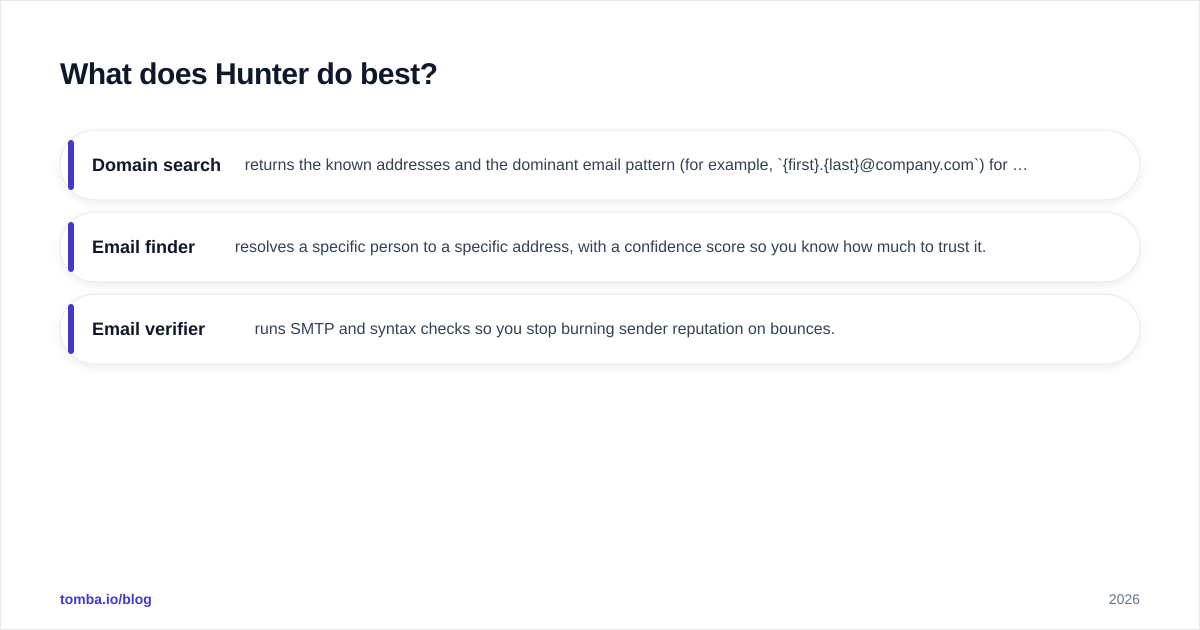
Hunter's strength is straightforward, repeatable contact discovery. Its three pillars hold up well:
- Domain search returns the known addresses and the dominant email pattern (for example,
{first}.{last}@company.com) for a target company. This is the fastest way to map the people behind a website. - Email finder resolves a specific person to a specific address, with a confidence score so you know how much to trust it.
- Email verifier runs SMTP and syntax checks so you stop burning sender reputation on bounces.
Hunter is also genuinely easy to adopt. The interface is clean, the Chrome extension is useful while browsing LinkedIn or company sites, and the API is well documented for engineers who want to build discovery into their own apps. For small teams that need a single tool to go from "I have a company name" to "I have a deliverable address," Hunter is a defensible default.
Where Hunter gets thinner: its built-in campaign tool is basic compared with dedicated sequencers, and credit consumption can climb quickly once you move from prospecting one account at a time to building lists in bulk. You can verify how reviewers weigh these trade-offs on independent directories like G2 and Capterra before committing.
What does Adaptio do best?#
Adaptio's value lives further down the funnel — in what reps do with contacts once they have them. Its positioning emphasizes AI assistance across the selling motion: prioritizing accounts, recommending next steps, and reducing the manual busywork that eats a rep's day.
For a sales leader, the appeal is consistency. A coaching-and-workflow layer can help newer reps follow a proven motion, keep activity logged, and apply the same qualification logic across the team. That's a different return than "we found 2,000 more emails this month." It's about win rate and ramp time rather than raw top-of-funnel volume.
The honest caveat: a platform built around assisting the selling process is only as good as the data feeding it. If your contact records are stale or unverified, even the smartest AI guidance is acting on bad inputs. This is exactly why teams that adopt an AI sales layer usually still need a reliable source of accurate contacts underneath it — a point we'll return to.
Because Adaptio competes on workflow rather than database breadth, the most useful evaluation is a hands-on trial with your own pipeline, not a feature checklist. Capabilities in this category move fast, so confirm current functionality directly with the vendor rather than relying on a comparison post — including this one.
Adaptio vs Hunter: how do the features compare?#
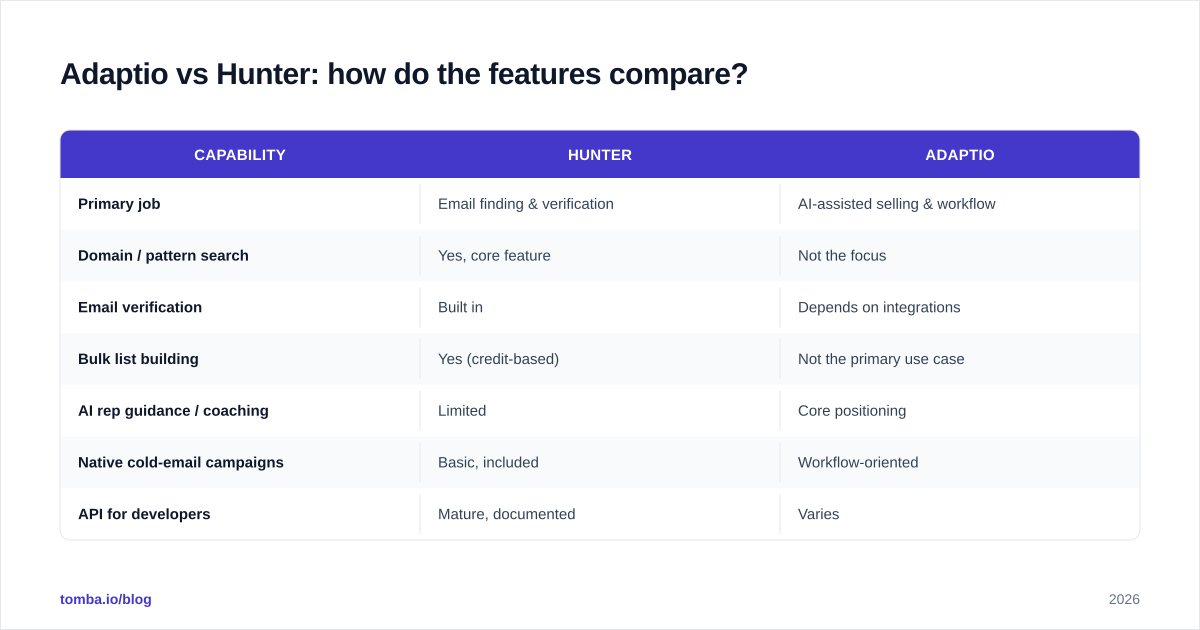
Here's the head-to-head on the dimensions that actually drive a buying decision. Treat the Adaptio column as directional — verify specifics with the vendor, since AI sales tooling iterates quickly.
| Capability | Hunter | Adaptio |
|---|---|---|
| Primary job | Email finding & verification | AI-assisted selling & workflow |
| Domain / pattern search | Yes, core feature | Not the focus |
| Email verification | Built in | Depends on integrations |
| Bulk list building | Yes (credit-based) | Not the primary use case |
| AI rep guidance / coaching | Limited | Core positioning |
| Native cold-email campaigns | Basic, included | Workflow-oriented |
| API for developers | Mature, documented | Varies |
| Best-fit buyer | SDRs, founders, growth teams | Sales teams wanting AI workflow |
The pattern is clear: Hunter wins on getting accurate contacts into the pipeline; Adaptio's pitch is about what happens after. If you only have budget for one and your funnel is starving for contacts, the data tool wins. If your funnel is full but conversion and rep consistency are the problem, the workflow tool is the better spend.
How do Adaptio and Hunter price?#
Pricing is where the two diverge most, and where a fair comparison gets tricky because they meter different things.
Hunter prices around search and verification credits across tiers — a free plan for light use, then paid tiers that scale credit allotments and seats. Adaptio, as a sales-workflow platform, leans toward per-seat software pricing, where cost tracks the number of reps rather than the number of lookups.
That difference means the only honest way to compare is by outcome cost: for Hunter, cost per verified contact; for Adaptio, cost per rep per month against the lift in win rate or ramp you expect. A $99 data plan and a $99 per-seat platform are not the same purchase.
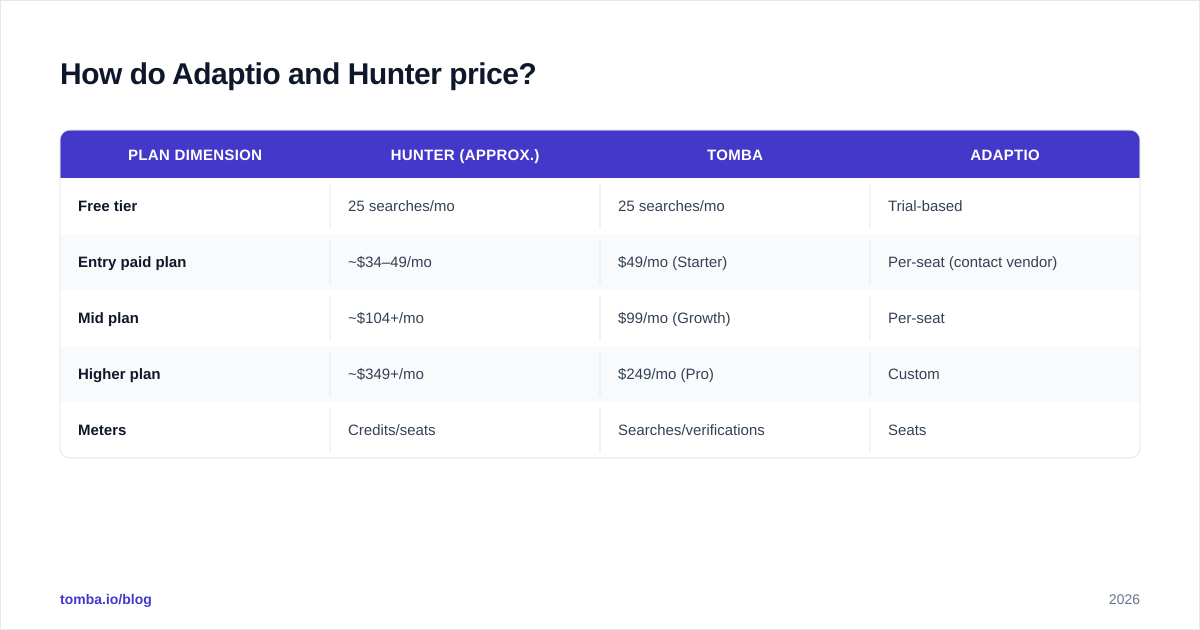
| Plan dimension | Hunter (approx.) | Tomba | Adaptio |
|---|---|---|---|
| Free tier | 25 searches/mo | 25 searches/mo | Trial-based |
| Entry paid plan | ~$34–49/mo | $49/mo (Starter) | Per-seat (contact vendor) |
| Mid plan | ~$104+/mo | $99/mo (Growth) | Per-seat |
| Higher plan | ~$349+/mo | $249/mo (Pro) | Custom |
| Meters | Credits/seats | Searches/verifications | Seats |
Hunter and Adaptio figures shift over time, so confirm current numbers on their sites before budgeting. For the email-data layer, you can see full Tomba pricing without guessing — the Free tier gives 25 searches a month and the Starter plan is $49/mo.
Which should you choose — Adaptio or Hunter?#
Conclusion first: choose based on your single biggest bottleneck this quarter, not on which brand is more famous.
Use this rule of thumb:
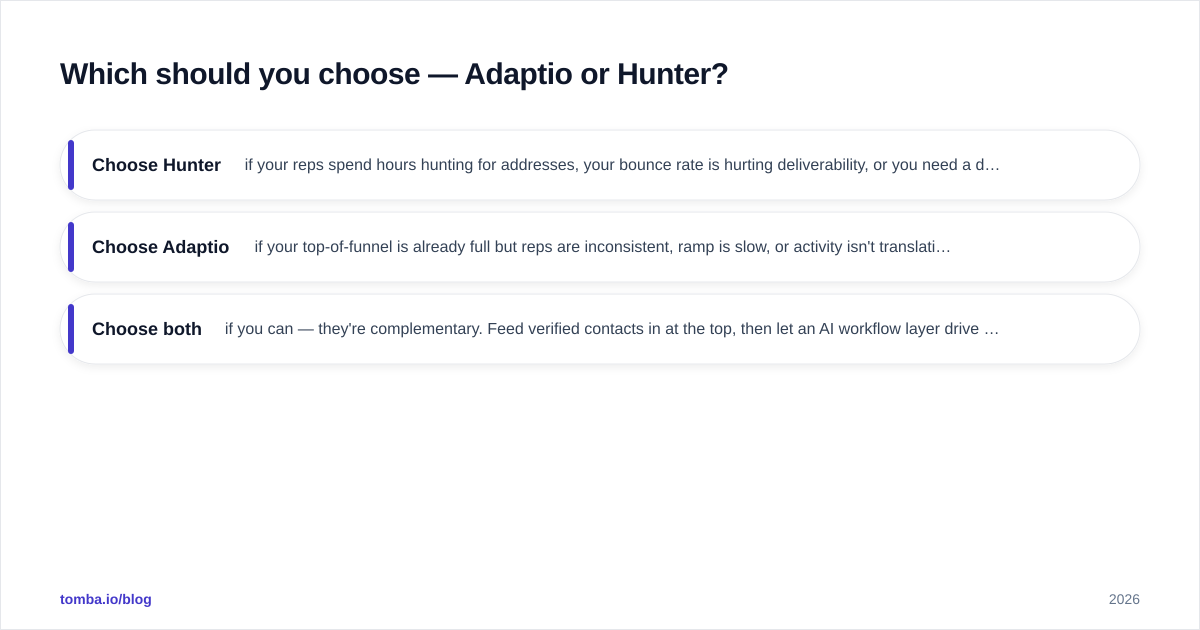
- Choose Hunter if your reps spend hours hunting for addresses, your bounce rate is hurting deliverability, or you need a developer-friendly API to pull contacts into your own product. Hunter is the more direct answer to "I need accurate emails, fast."
- Choose Adaptio if your top-of-funnel is already full but reps are inconsistent, ramp is slow, or activity isn't translating into pipeline. Its AI-workflow framing targets execution, not discovery.
- Choose both if you can — they're complementary. Feed verified contacts in at the top, then let an AI workflow layer drive the motion.
The trap to avoid: buying an AI sales platform to fix what is actually a data problem. If addresses bounce or contacts are out of date, no amount of AI coaching saves the sequence. Verify the foundation first. That's also why a focused email verifier often pays for itself faster than a broad platform — it removes the failure mode everything else depends on.
Where does a dedicated email finder fit alongside Adaptio or Hunter?#
Here's the part most comparison posts skip: even after you pick a winner, you'll likely want a specialist data layer underneath it. Hunter does email finding well, but if you've standardized on Adaptio for workflow, you still need a dependable source of accurate, current contacts feeding the machine.
This is the role a focused tool like Tomba plays. Instead of being a do-everything platform, it concentrates on the data job: an email finder for resolving people to addresses, domain search for mapping every contact at a target company, and verification to keep your sends deliverable. For list-building motions, the bulk email finder handles volume without manual one-off lookups, and the Tomba API lets engineers wire discovery directly into whatever sales stack you've chosen — Adaptio, Hunter, or your own CRM.
The mental model: think of contact data as the fuel and your sales platform as the engine. A great engine still stalls on bad fuel. Keeping a dedicated, accuracy-focused finder in the mix protects every downstream tool — including whichever of these two you buy.
Adaptio vs Hunter: frequently asked questions#
Are Adaptio and Hunter direct competitors? Not really. Hunter is primarily an email-finding and verification tool; Adaptio is positioned as an AI sales-workflow platform. They overlap at the edges but solve different core problems, which is why some teams use both.
Which is better for cold email? For sourcing and verifying the addresses you'll send to, Hunter (or a dedicated finder) is the stronger fit because deliverability starts with clean data. For orchestrating and improving the selling motion around those sends, Adaptio's framing is closer.
Is Hunter's free plan enough to start? For light, one-account-at-a-time prospecting, yes — both Hunter and Tomba offer a 25-search free tier to test quality before paying. Bulk list building will push you to a paid plan quickly.
Can I use a tool like Tomba with either one? Yes. Tomba's API and integrations let it feed verified contacts into most sales stacks, so it complements an AI workflow platform like Adaptio or sits beside Hunter as a second data source.
How should I compare the prices? By outcome, not headline. Compare Hunter on cost per verified contact and Adaptio on cost per seat against expected win-rate or ramp gains. Check the vendor's homepage for current numbers, since both change.
The bottom line#
Adaptio vs Hunter isn't a fight with one winner — it's a question of which gap in your stack is open right now. If you're starved for accurate contacts, Hunter (or a dedicated finder) is the move. If your funnel is full but execution is shaky, Adaptio's AI-workflow angle is the better spend. Most growing teams eventually want both layers, plus a specialist data source keeping everything deliverable.
If the real problem is finding and verifying business emails you can actually reach, start there. The Tomba Email Finder resolves names and companies to verified addresses, with a free tier of 25 searches a month and a $49/mo Starter plan — enough to pressure-test data quality before you commit budget to any larger platform. Get the foundation right, and whichever sales tool you layer on top works far harder for you.
// get started
Find, verify and enrich your first contacts today
Start on the free plan with 25 searches a month, then scale when your team is ready.
Free plan · No credit card required · GDPR & CCPA
// about the author