Adaptio vs Infofree 2026: Which B2B Data Tool Wins?
Adaptio vs Infofree, compared head-to-head on data freshness, accuracy, pricing, and workflow fit so you can pick the right B2B sales-data platform in 2026.
TL;DR
- Infofree is a budget, unlimited-volume database play: flat monthly access to a large pool of business and consumer records, built for high-volume cold callers and small businesses who want a lot of names for a low price.
- Adaptio positions itself as a modern, AI-assisted GTM and data layer — fewer raw records, more emphasis on signals, enrichment, and fit scoring for targeted outbound.
- Accuracy is the real fight. Volume means nothing if 30–40% of the records bounce. Neither platform escapes the same decay problem every static database faces.
- Choose Infofree if you need raw breadth on a tight budget and your team dials by hand. Choose Adaptio if you run precise, signal-driven outbound and care more about hit rate than list size.
- Either way, verify before you send. Pair whatever you pick with a dedicated email verifier so your sender reputation survives the campaign.
What are Adaptio and Infofree?#
Quick answer: they solve the same problem — getting contact data into your sales motion — from opposite ends of the market.
Infofree is a long-running provider of unlimited sales leads, business and consumer databases, and a lightweight CRM. Its pitch has stayed consistent for years: pay one flat monthly fee, pull as many leads as you want, and start dialing. It's aimed squarely at small businesses, insurance agents, and inside-sales reps who measure success in call volume.
Adaptio is the newer entrant, built around the assumption that buying a giant list is not the same as building pipeline. It leans on enrichment, intent and firmographic signals, and AI-assisted targeting to surface accounts that actually fit your ICP. The promise is fewer, better-qualified contacts rather than a bottomless well of names.
Think of it like fishing. Infofree hands you a giant net and a big ocean — scoop up everything and sort later. Adaptio hands you a sonar map and a spear — go after the fish you actually want. Both can fill the cooler; they just cost different amounts of effort and money.
How do Adaptio and Infofree compare head-to-head?#
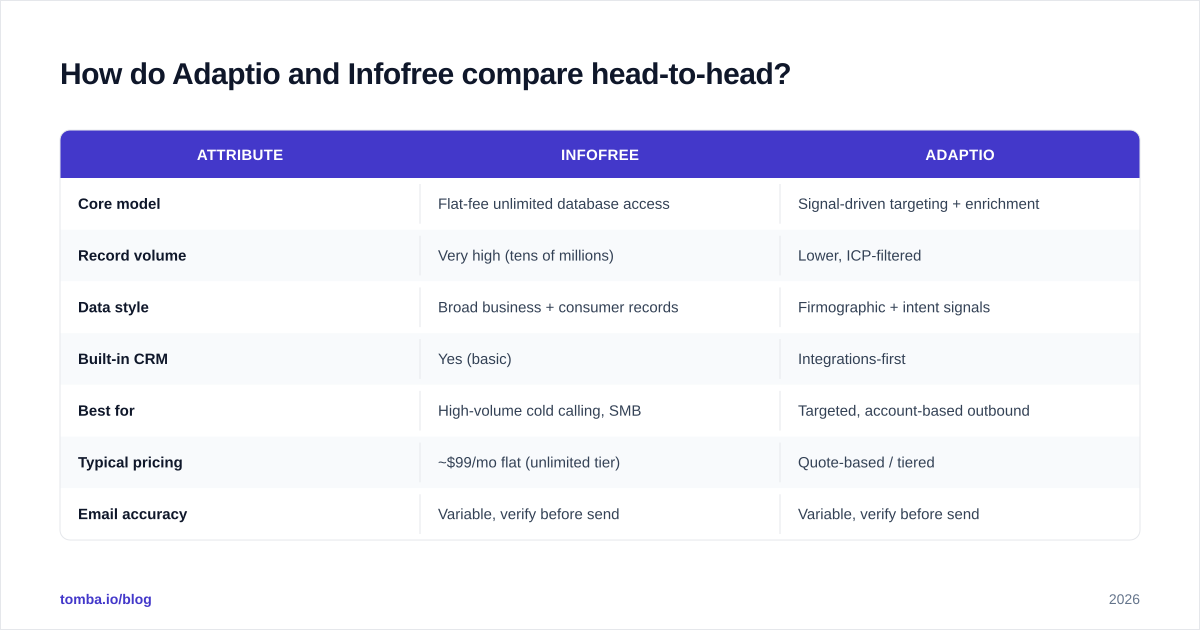
Here's the side-by-side. Treat the specifics as a directional snapshot for 2026 — vendor packaging changes often, so confirm current terms before you commit.
| Attribute | Infofree | Adaptio |
|---|---|---|
| Core model | Flat-fee unlimited database access | Signal-driven targeting + enrichment |
| Record volume | Very high (tens of millions) | Lower, ICP-filtered |
| Data style | Broad business + consumer records | Firmographic + intent signals |
| Built-in CRM | Yes (basic) | Integrations-first |
| Best for | High-volume cold calling, SMB | Targeted, account-based outbound |
| Typical pricing | ~$99/mo flat (unlimited tier) | Quote-based / tiered |
| Email accuracy | Variable, verify before send | Variable, verify before send |
| Learning curve | Low | Moderate |
The honest read: Infofree wins on price-per-record and simplicity. Adaptio wins on precision and modern workflow. Neither is a verification engine, which is why the last two rows of that table say the same thing.
Which has more accurate data?#
Conclusion first: neither platform should be trusted blind — accuracy depends on how fresh the underlying records are, and both decay the same way.
B2B contact data rots fast. Industry estimates put职 record decay at roughly 2–3% per month, which compounds to 25–30% per year as people switch jobs, companies rebrand, and domains change. A database advertising "unlimited" volume is not advertising "unlimited fresh." Volume and freshness are different axes, and the marketing pages rarely separate them.
Infofree's breadth means you'll find a record for almost anyone — but a meaningful slice of those emails and phone numbers will be stale, especially for consumer data and smaller businesses. Adaptio's narrower, signal-led approach tends to surface more recently active accounts, but it is not immune; an enriched record is only as good as its last refresh.
This is the gap a dedicated finder-plus-verifier closes. Tools like the Tomba Email Finder re-derive and validate an address at the moment you need it, rather than serving whatever was scraped months ago. If you want to understand why source freshness matters so much, Tomba documents where its data comes from — the kind of transparency worth demanding from any vendor.
)
Is Adaptio better than Infofree?#
It depends on how you sell. "Better" is a function of your motion, not a property of the tool.
Adaptio is better when:
- You run account-based or ICP-tight outbound and care about reply rate over raw reach.
- Your reps' time is expensive, so feeding them 50 right accounts beats 5,000 random ones.
- You want intent and firmographic signals baked into targeting, not bolted on later.
- You already operate a modern stack and want the data layer to plug into it.
Infofree is better when:
- You dial in volume and need a deep, cheap pool of numbers to work through.
- Budget is the hard constraint and a flat ~$99/mo unlimited plan is attractive.
- You want an all-in-one with a basic CRM so you don't stitch tools together.
- Your TAM is broad and local — think SMB services, insurance, home services.
A useful gut check: if you can name your 200 target accounts, Adaptio's model fits. If your strategy is "call everyone in this ZIP code with a pulse," Infofree's economics win.
What do they cost?#
Conclusion first: Infofree competes on a predictable low flat fee; Adaptio competes on value-per-qualified-account and typically quotes you.
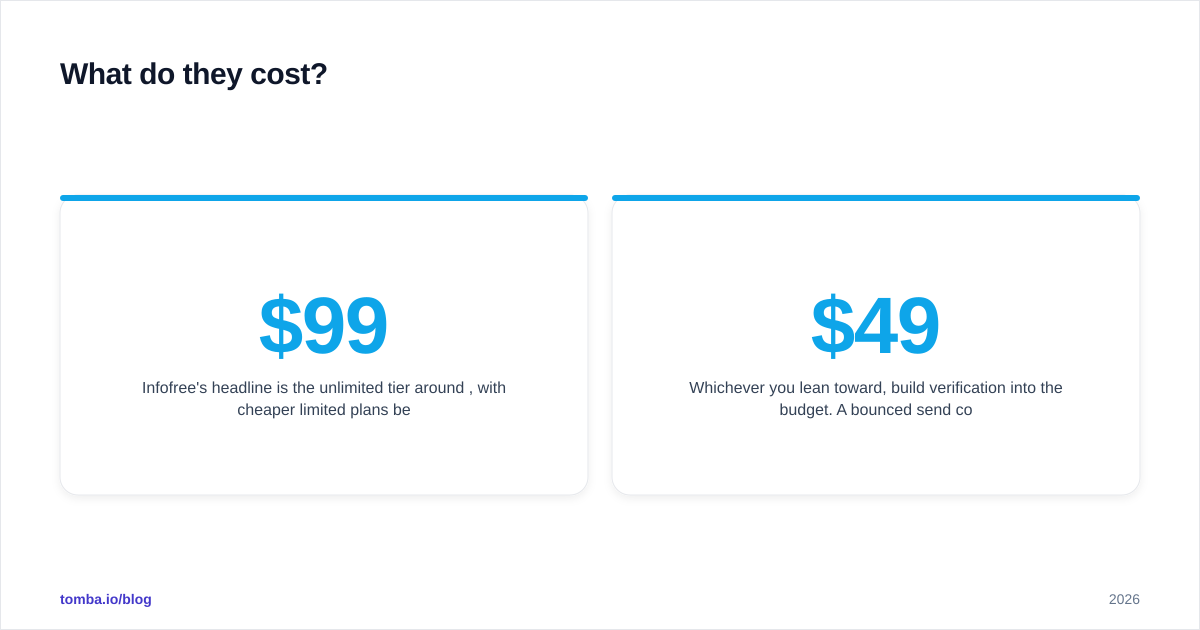
Infofree's headline is the unlimited tier around $99/mo, with cheaper limited plans below it. The appeal is zero marginal cost per lookup — pull 10 records or 10,000, the bill is the same. That predictability is genuinely valuable for high-volume teams.
Adaptio leans toward tiered or quote-based pricing scaled to seats, data volume, and signal access. You're paying for filtering and enrichment, not raw count, so direct per-record comparisons mislead. The right way to evaluate it is cost-per-meeting-booked, not cost-per-record.
Whichever you lean toward, build verification into the budget. A bounced send costs more than a verification credit — it dents your sender reputation and drags down every future campaign from that domain. For reference on transparent, usage-based pricing, see Tomba pricing: a free tier with 25 searches/month, Starter at $49/mo, Growth at $99/mo, and Pro at $249/mo.

How do they fit into a real sales workflow?#
Short answer: Infofree is a closed loop; Adaptio is a node in a stack. That distinction matters more than any feature list.
Because Infofree bundles a basic CRM, a solo rep or tiny team can run end-to-end inside it — pull a list, work the calls, log outcomes. The trade-off is that bundled CRMs are rarely as capable as a dedicated one, and you may outgrow it.
Adaptio expects to sit alongside your existing CRM and sequencer, feeding qualified, enriched contacts into tools you already run. That's more powerful for teams with real RevOps maturity, but it assumes you have the surrounding stack. For context on how the data layer connects to the rest of the engine, the discipline of revenue operations is exactly about making these handoffs clean.
A neutral, third-party way to sanity-check either vendor's fit is to read current user reviews on G2 and cross-reference against your own pilot. Marketing pages tell you the ceiling; reviews and a 50-contact test tell you the floor.
A practical middle path#
You don't have to treat this as either/or with your entire data strategy. Many teams use a volume database for top-of-funnel breadth, a signal tool for prioritization, and a verification-grade finder to clean whatever they actually send to. Tomba's data enrichment and B2B database are designed to slot into exactly that gap — filling missing fields and confirming the address is real before it ever hits your sequencer.
What are the main pros and cons?#
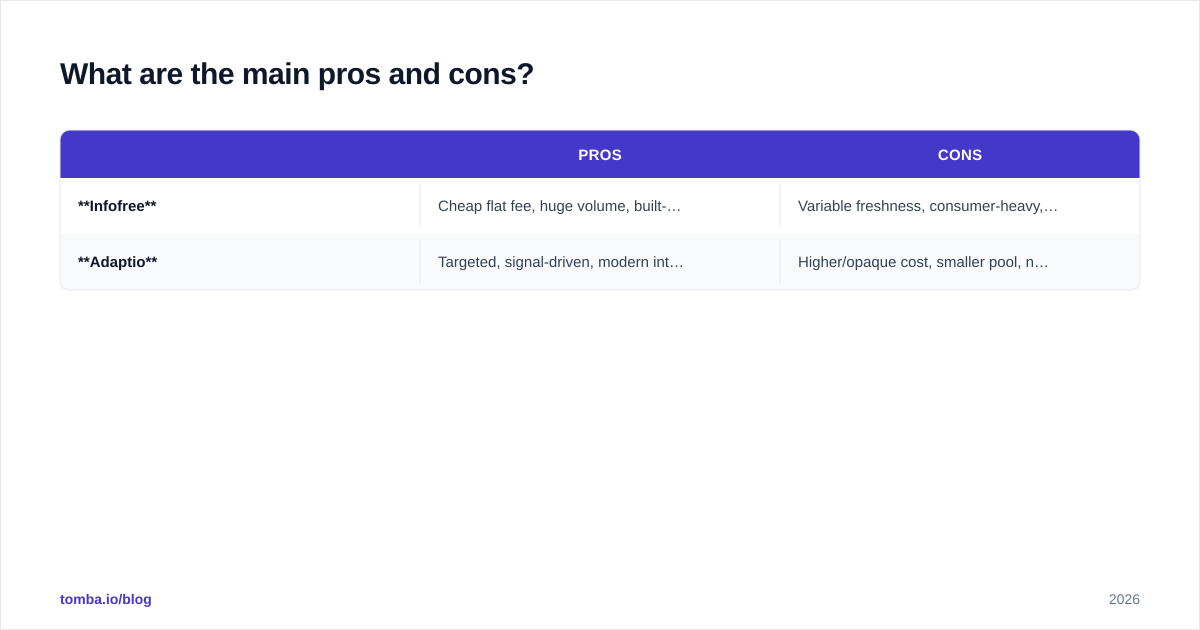
| Pros | Cons | |
|---|---|---|
| Infofree | Cheap flat fee, huge volume, built-in CRM, simple | Variable freshness, consumer-heavy, basic CRM, verify-before-send |
| Adaptio | Targeted, signal-driven, modern integrations, ICP fit | Higher/opaque cost, smaller pool, needs surrounding stack, learning curve |
The pattern is symmetrical: each tool's greatest strength is the other's weakness. Infofree's volume is its accuracy risk; Adaptio's precision is its cost and complexity.
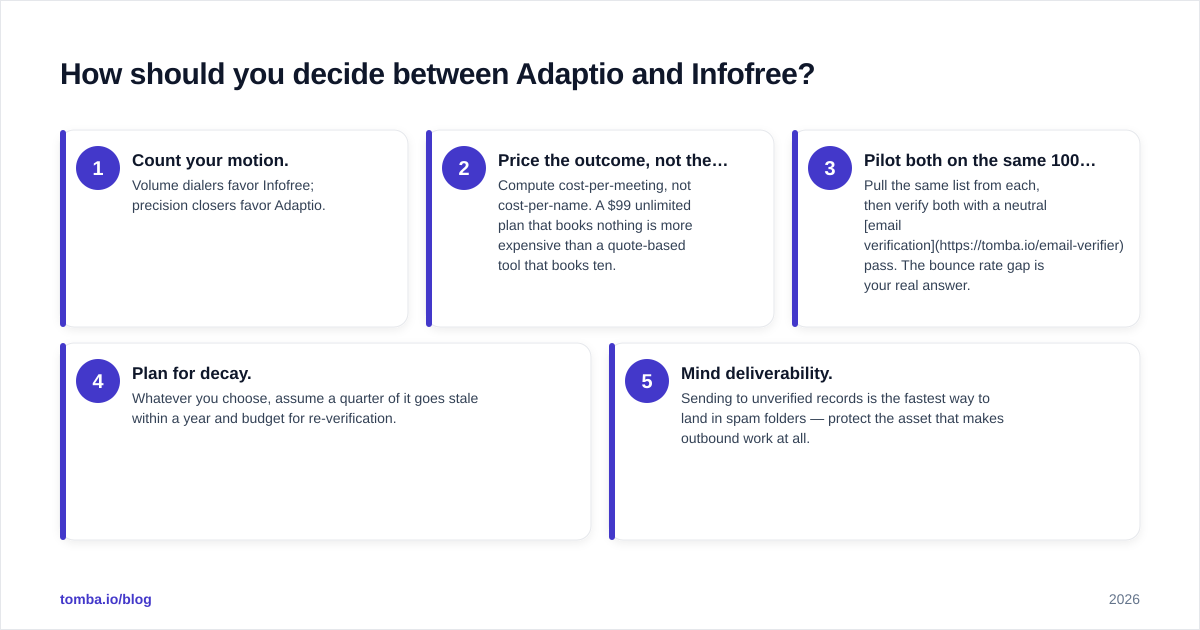
How should you decide between Adaptio and Infofree?#
Decide by working backward from your funnel math, not the feature grid.
- Count your motion. Volume dialers favor Infofree; precision closers favor Adaptio.
- Price the outcome, not the record. Compute cost-per-meeting, not cost-per-name. A $99 unlimited plan that books nothing is more expensive than a quote-based tool that books ten.
- Pilot both on the same 100 accounts. Pull the same list from each, then verify both with a neutral email verification pass. The bounce rate gap is your real answer.
- Plan for decay. Whatever you choose, assume a quarter of it goes stale within a year and budget for re-verification.
- Mind deliverability. Sending to unverified records is the fastest way to land in spam folders — protect the asset that makes outbound work at all.
Do that, and the "winner" stops being a debate and becomes a number on your own dashboard.
The bottom line#
Adaptio and Infofree aren't really competitors so much as answers to different questions. Infofree answers "how do I get a lot of leads cheaply?" Adaptio answers "how do I reach the right accounts efficiently?" Pick based on which question your quarter actually asks.
But both leave the same job undone: making sure the contact you found is reachable today. A giant list or a smart-filtered one still bounces if the email is dead. That's the layer to never skip.
Ready to stop guessing whether your data is real? Run your Infofree or Adaptio exports through the Tomba Email Finder and verifier before you send. Start free with 25 searches a month, confirm every address against fresh sources, and protect your sender reputation while you scale outbound. Find the email, verify it, then sell — in that order.
// get started
Find, verify and enrich your first contacts today
Start on the free plan with 25 searches a month, then scale when your team is ready.
Free plan · No credit card required · GDPR & CCPA
// about the author