Adaptio vs Lead Carrot: B2B Lead Tool Comparison 2026
Adaptio and Lead Carrot both promise B2B leads on tap, but they solve different problems. Here's an honest 2026 breakdown of data accuracy, pricing, and the verification gap neither tool fully closes.
Choosing between Adaptio and Lead Carrot usually comes down to one question your sales team is too busy to ask out loud: do I want a workflow tool or a data tool? They get lumped together because both promise "more B2B leads," but they sit on different sides of that line. This breakdown cuts through the marketing copy so you can pick the one that actually matches how your team prospects in 2026.
TL;DR#
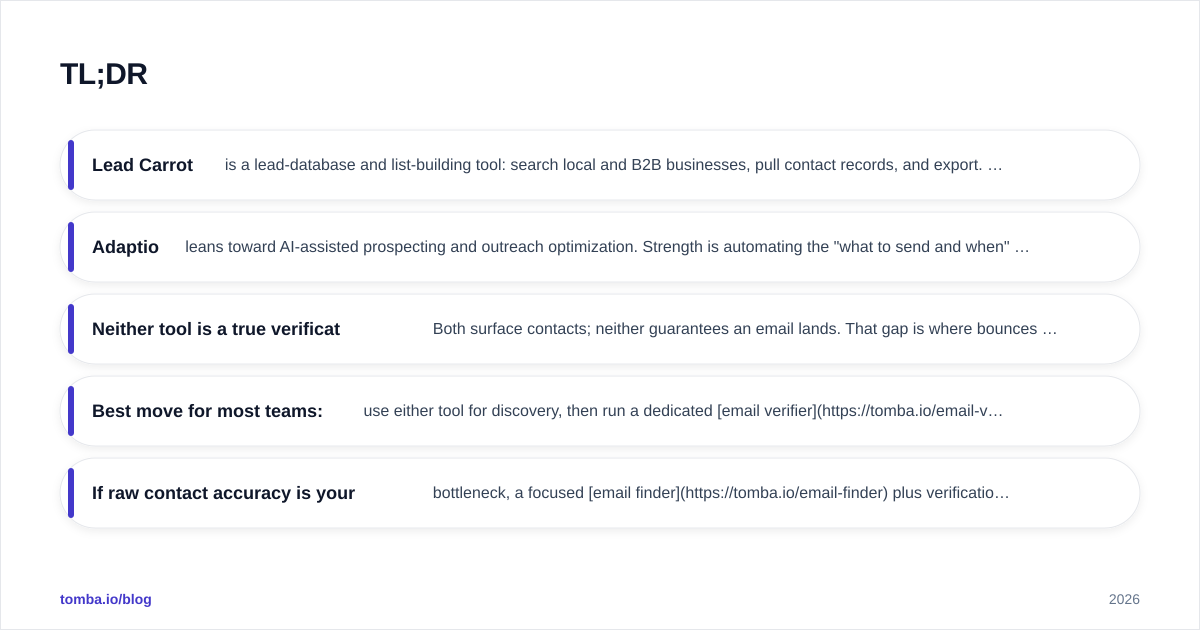
- Lead Carrot is a lead-database and list-building tool: search local and B2B businesses, pull contact records, and export. Strength is breadth of scraped business data; weakness is data freshness and email verification.
- Adaptio leans toward AI-assisted prospecting and outreach optimization. Strength is automating the "what to send and when" layer; weakness is that it depends on the quality of the contact data you feed it.
- Neither tool is a true verification engine. Both surface contacts; neither guarantees an email lands. That gap is where bounces and domain-reputation damage come from.
- Best move for most teams: use either tool for discovery, then run a dedicated email verifier before you send. Garbage-in still equals garbage-out.
- If raw contact accuracy is your bottleneck, a focused email finder plus verification often beats paying for a broad platform you only half-use.
What is Adaptio?#
Adaptio positions itself around the activation side of prospecting. Instead of just handing you a list, it focuses on helping you act on contacts: prioritizing accounts, suggesting messaging angles, and automating sequencing logic so reps spend less time deciding who to contact next.
Think of Adaptio like a GPS for outreach. It doesn't dig the roads (the underlying contact data) — it tells you the fastest route given the roads that exist. That's powerful when your data is already solid, and frustrating when it isn't, because a perfect route to a wrong address still gets you nowhere.
Its natural buyer is an outbound team that already has a data source and wants to squeeze more replies out of it through smarter targeting and automation.
What is Lead Carrot?#
Lead Carrot is a list-building and B2B data tool. You search by industry, location, or business type, and it returns business records — company name, website, phone, social profiles, and contact emails where available. It built its reputation with agencies and local-services sellers who need volume: hundreds of plumbers, dentists, or roofers in a metro, exported to CSV in minutes.
Lead Carrot is the shovel. It's built to dig wide and fast. The trade-off with most scraped-database tools is depth and freshness: business records age, owners change, and a meaningful slice of the emails are role-based catch-alls or stale.
If your motion is "build a big list of SMBs and work it hard," Lead Carrot is squarely in its lane.
Adaptio vs Lead Carrot: how do they compare?#
Here's the head-to-head on the attributes that actually change your pipeline. Pricing tiers below are representative ranges — always confirm current numbers on each vendor's own page, since both iterate frequently.
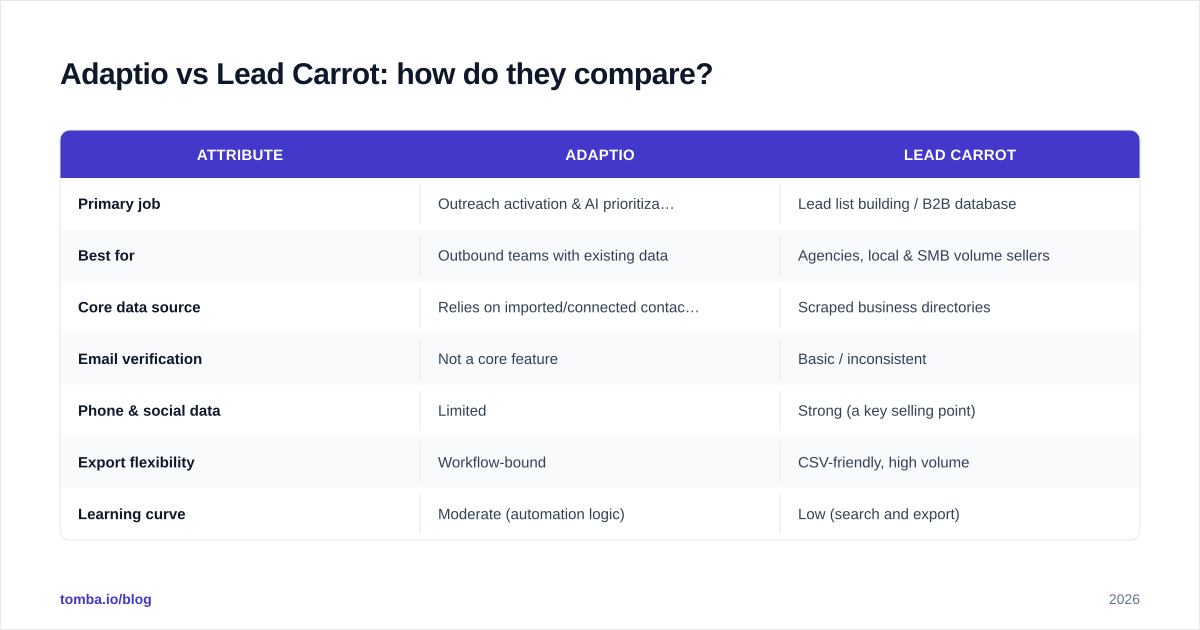
| Attribute | Adaptio | Lead Carrot |
|---|---|---|
| Primary job | Outreach activation & AI prioritization | Lead list building / B2B database |
| Best for | Outbound teams with existing data | Agencies, local & SMB volume sellers |
| Core data source | Relies on imported/connected contacts | Scraped business directories |
| Email verification | Not a core feature | Basic / inconsistent |
| Phone & social data | Limited | Strong (a key selling point) |
| Export flexibility | Workflow-bound | CSV-friendly, high volume |
| Learning curve | Moderate (automation logic) | Low (search and export) |
| Pricing model | Per-seat / subscription | Subscription, volume-oriented |
The pattern in that table is the whole story: Adaptio optimizes the action, Lead Carrot supplies the raw material. They overlap less than their marketing suggests, which is also why some teams end up evaluating them when they really need a third thing entirely — clean, verified contacts.
Which tool has better data accuracy?#
Short answer: neither should be trusted to send without verification. This is the single most important point in the comparison, so don't skim it.
Lead Carrot's accuracy challenge is structural. Scraped directory data is a snapshot, and snapshots rot. Studies on B2B data decay consistently put annual contact-data degradation in the 20–30% range — people change jobs, companies rebrand, and domains shift. A list that was 90% accurate in January can be meaningfully worse by mid-year. According to Gartner and other analyst commentary on data quality, poor data is one of the most common silent drains on sales productivity.
Adaptio's accuracy challenge is dependency. Its automation is only as good as the contacts you connect to it. Smart sequencing pointed at dead inboxes still produces bounces — and bounces hurt your sender reputation, which quietly tanks deliverability for every good email you send afterward.
This is the verification gap. Both tools get you a contact. Neither reliably confirms the inbox is real, active, and safe to hit. That's why a standalone verification step isn't optional housekeeping — it's the difference between landing in the inbox and landing on a blocklist. Running discovered contacts through an email verification pass before any campaign is the cheapest insurance in your stack.
How does pricing compare in 2026?#
Both tools use subscription pricing, but they meter value differently. Lead Carrot charges for access and volume — you're paying to pull lists. Adaptio charges more like a seat-based workflow tool — you're paying per rep for the automation layer.
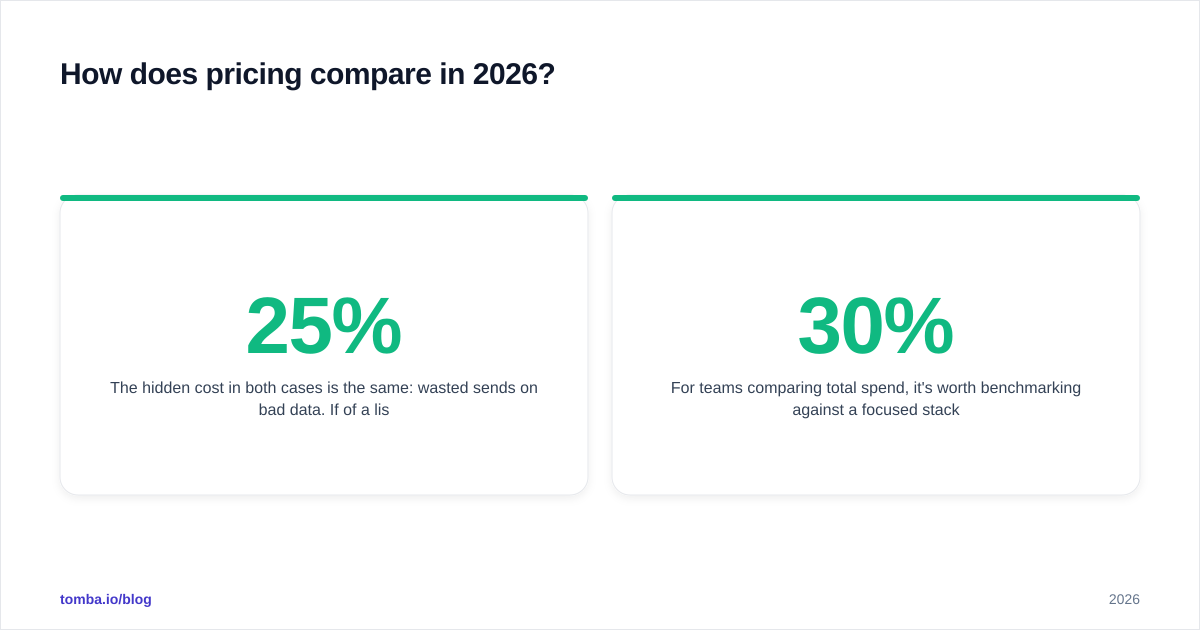
The hidden cost in both cases is the same: wasted sends on bad data. If 25% of a list bounces, you didn't just waste the list cost — you paid in domain reputation, in deliverability for your clean contacts, and in rep time chasing ghosts. When you model total cost of ownership, factor in the verification and re-work, not just the sticker price.
For teams comparing total spend, it's worth benchmarking against a focused stack. A dedicated finder-plus-verifier setup is often cheaper than a broad platform you only use 30% of. You can see transparent tier pricing on the Tomba pricing page as a reference point — a Free tier with 25 searches/mo, Starter at $49/mo, Growth at $99/mo, and Pro at $249/mo — and contrast it with what each platform charges for comparable monthly volume.
When should you choose Lead Carrot?#
Pick Lead Carrot when volume and breadth of business records is your bottleneck, especially for local and SMB targeting. Specifically:
- You're an agency or local-services seller building large geographic lists.
- You need phone numbers and social profiles, not just emails.
- Your workflow is export-to-CSV, then process elsewhere.
- You're comfortable adding your own verification step before sending.
Where it falls short: enterprise-grade contact depth, email deliverability guarantees, and freshness on fast-moving roles. If you sell to VP-level buyers at mid-market or enterprise accounts, scraped SMB directories won't have the precision you need.
When should you choose Adaptio?#
Pick Adaptio when execution, not discovery, is your bottleneck. Specifically:
- You already have a reliable contact source (a CRM, an enrichment feed, a verified finder).
- Your reps waste time deciding sequencing and prioritization.
- You want AI assistance on messaging and timing rather than raw lists.
- You value reply-rate optimization over list size.
Where it falls short: it isn't a data vendor. If you adopt Adaptio expecting it to find contacts, you'll be disappointed — and you'll still need a finder feeding it. Adaptio amplifies good data; it can't create it.
What's the smarter alternative for most teams?#
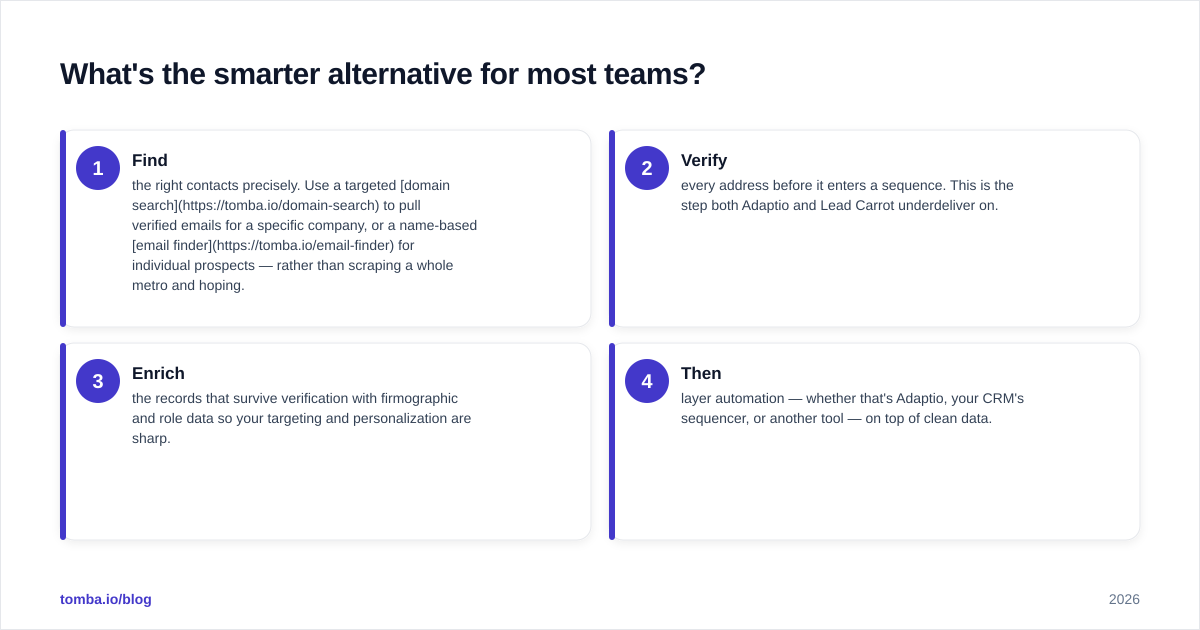
For a lot of teams, the honest answer is "a different category." The Adaptio-vs-Lead-Carrot debate assumes you need either a big scraped list or an automation layer. But the most common real-world failure isn't list size or sequencing sophistication — it's contact accuracy. Fix that, and a modest stack outperforms an expensive one.
A lean, high-accuracy approach looks like this:
- Find the right contacts precisely. Use a targeted domain search to pull verified emails for a specific company, or a name-based email finder for individual prospects — rather than scraping a whole metro and hoping.
- Verify every address before it enters a sequence. This is the step both Adaptio and Lead Carrot underdeliver on.
- Enrich the records that survive verification with firmographic and role data so your targeting and personalization are sharp.
- Then layer automation — whether that's Adaptio, your CRM's sequencer, or another tool — on top of clean data.
This is the same logic top RevOps teams follow: clean inputs first, automation second. HubSpot's own research on data quality repeatedly lands on the same conclusion — bad data is the tax that quietly erodes every downstream metric, from reply rate to forecast accuracy.
How do these tools handle deliverability and bounces?#
This is where the verification gap becomes a money problem. Email service providers and mailbox systems judge you on bounce rate. Cross the danger zone — often cited around 2–3% — and your domain reputation drops, throttling delivery of your legitimate mail.
- Lead Carrot gives you volume, which is exactly what makes unverified sending dangerous. A 10,000-record list with even a 15% invalid rate is 1,500 potential bounces — more than enough to wreck a sending domain in one campaign.
- Adaptio automates sending, which means it can scale a bad-data problem faster than a human would. Automation without verification is a bounce amplifier.
The fix is identical for both: insert verification between discovery and send. Tools like G2 reviews repeatedly flag deliverability as the make-or-break factor users wish they'd protected earlier. Verifying first — and removing risky catch-all and invalid addresses with a catch-all verifier — keeps your bounce rate in the safe zone regardless of which discovery tool you chose.
Frequently asked questions#
Is Adaptio better than Lead Carrot? Neither is universally "better" — they do different jobs. Lead Carrot builds lists; Adaptio optimizes outreach. If you need contacts, Lead Carrot is closer to your need. If you need to act on contacts you already have, Adaptio fits. Most teams need clean, verified data more than either, which is why a finder-plus-verifier stack is worth evaluating alongside both.
Can I use Adaptio and Lead Carrot together? Yes, and for some teams that's the logical combo: Lead Carrot for discovery, Adaptio for activation. Just don't skip verification in the middle — pipe lists through an email verifier before Adaptio automates the sends.
Do either of these tools verify emails? Not robustly. Both surface emails, but neither is a dedicated verification engine. Treat any email from either tool as unconfirmed until you've verified it.
What's the cheapest reliable setup? For most SMB and mid-market teams, a precise email finder plus verification beats a broad scraped database on cost-per-usable-contact, because you pay for contacts you can actually reach rather than volume you have to clean.
The bottom line#
Adaptio and Lead Carrot answer two different questions. Lead Carrot answers "where do I get a lot of B2B contacts fast?" Adaptio answers "how do I work the contacts I have more intelligently?" If you mismatch the tool to your bottleneck, you'll pay for capability you don't use while the real problem — data accuracy — goes unsolved.
Before you commit to either, run a small honesty test: take 100 contacts from your current source and verify them. The bounce-risk percentage you see is the percentage of your budget, reputation, and rep time you're currently lighting on fire. Fix that first.
Ready to close the verification gap? Start with the Tomba Email Finder to pull precise, professional emails by name, company, or domain — then verify them in the same workflow so every contact you hand to Adaptio, Lead Carrot, or your CRM is one you can actually reach. The Free tier gives you 25 searches a month to test accuracy against your own list before you pay a cent. Find clean, send clean, and let your automation work on data that won't bounce.
// get started
Find, verify and enrich your first contacts today
Start on the free plan with 25 searches a month, then scale when your team is ready.
Free plan · No credit card required · GDPR & CCPA
// about the author