Adaptio vs LeadGibbon (2026): Which Lead Tool Wins?
Adaptio vs LeadGibbon compared head-to-head: data accuracy, pricing, workflows, and which B2B prospecting tool actually fits your sales motion in 2026.
Choosing between Adaptio and LeadGibbon comes down to a single question: do you want an AI-driven prospecting workflow layered on top of B2B data, or a lean LinkedIn-to-email extraction tool that gets contacts into a spreadsheet fast? They solve overlapping problems in very different ways, and picking the wrong one wastes both budget and pipeline.
This is a neutral, hands-on comparison. We'll look at what each tool actually does, where the data comes from, how pricing scales, and which sales motions each one fits. We'll also be honest about where a dedicated email-finding engine beats both.
TL;DR#
- Adaptio leans into AI-assisted prospecting and signal-based targeting — better if you want workflow automation and intent baked into your list-building.
- LeadGibbon is a simpler LinkedIn email finder and B2B list tool — better if you just need names, titles, and verified emails exported quickly.
- Data accuracy is the real tiebreaker, and neither tool publishes hard, independently verifiable bounce-rate numbers — verify before you trust.
- Pricing: LeadGibbon is the lower-commitment entry point; Adaptio is positioned for teams that want more automation per seat.
- If your core need is finding and verifying emails at scale, a specialist like Tomba Email Finder with a free tier and transparent Tomba pricing is worth testing alongside both.
What is Adaptio?#
Adaptio positions itself as an AI-powered prospecting and outbound platform. The pitch is that it does more than hand you a contact record — it helps you build targeted lists, layers in buying signals, and assists with the outreach workflow itself. Think of it less like a phone book and more like a research assistant that builds your prospect list and nudges you on who to contact next.
For revenue teams running a modern outbound sales motion, that's appealing. The promise is fewer tools stitched together: targeting, enrichment, and sequencing in one place. The trade-off is that all-in-one platforms tend to be jacks-of-all-trades — the email data underneath the slick AI layer is only as good as the sources feeding it.
What is LeadGibbon?#
LeadGibbon is a B2B lead generation and email-finding tool best known for its LinkedIn integration. You browse profiles or a list, and LeadGibbon surfaces business email addresses and company data you can export to CSV or push into your CRM. It also offers list-building from its own B2B database.
The mental model here is simpler: LeadGibbon is the bridge between "I found this person on LinkedIn" and "this person's email is now in my outreach tool." It doesn't try to run your whole prospecting strategy. For a lot of small teams and solo founders, that focus is a feature, not a limitation — you can learn it in an afternoon.
Adaptio vs LeadGibbon: how do they compare?#
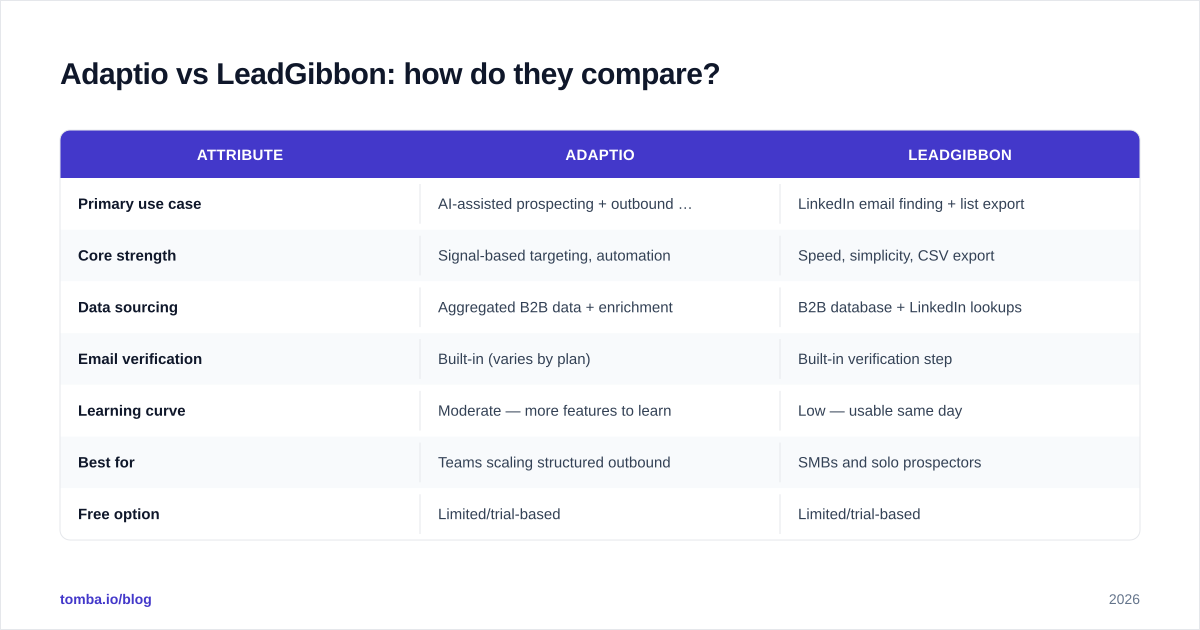
Here's the head-to-head on the attributes that actually change your buying decision. Treat any single-tool accuracy claim skeptically until you run your own test list — vendors measure "accuracy" differently.
| Attribute | Adaptio | LeadGibbon |
|---|---|---|
| Primary use case | AI-assisted prospecting + outbound workflow | LinkedIn email finding + list export |
| Core strength | Signal-based targeting, automation | Speed, simplicity, CSV export |
| Data sourcing | Aggregated B2B data + enrichment | B2B database + LinkedIn lookups |
| Email verification | Built-in (varies by plan) | Built-in verification step |
| Learning curve | Moderate — more features to learn | Low — usable same day |
| Best for | Teams scaling structured outbound | SMBs and solo prospectors |
| Free option | Limited/trial-based | Limited/trial-based |
| CRM/export | CRM integrations + sequencing | CSV + common CRM exports |
The pattern is clear. Adaptio wins on breadth and automation; LeadGibbon wins on speed-to-value and a gentler price commitment. Neither one is automatically "better" — it depends on whether you're buying a workflow or buying a list.
)
Sorry, that should render as a plain image:

Which tool has more accurate data?#
Accuracy is the metric that decides everything downstream, and it's also where marketing language gets slippery. A tool can claim "95% accuracy" while measuring only syntactically valid addresses, not deliverable ones. Those are different things — a syntactically valid email can still hard-bounce.
What actually drives accuracy:
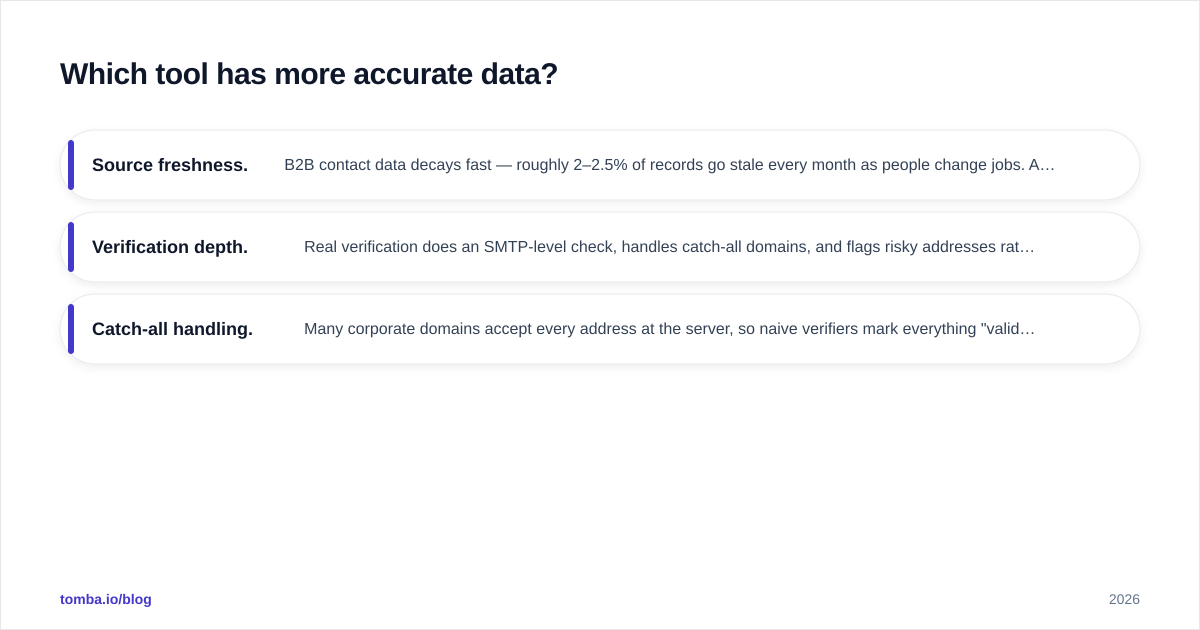
- Source freshness. B2B contact data decays fast — roughly 2–2.5% of records go stale every month as people change jobs. A database refreshed quarterly is already partly wrong.
- Verification depth. Real verification does an SMTP-level check, handles catch-all domains, and flags risky addresses rather than passing them through.
- Catch-all handling. Many corporate domains accept every address at the server, so naive verifiers mark everything "valid." Honest tools tell you when a result is uncertain.
Both Adaptio and LeadGibbon verify emails, but neither publishes an independently audited bounce rate you can hold them to. The only reliable test is your own: pull 100 contacts in your exact target segment from each tool, run them through a neutral email verifier, and compare hard-bounce rates after a real send. If a vendor's data can't survive that, the dashboard polish doesn't matter.

This is also where a dedicated finder earns its keep. Specialist tools live or die on data quality alone, so they tend to invest more in source diversity and catch-all verification than all-in-one platforms whose data is one feature among many.
How does pricing compare?#
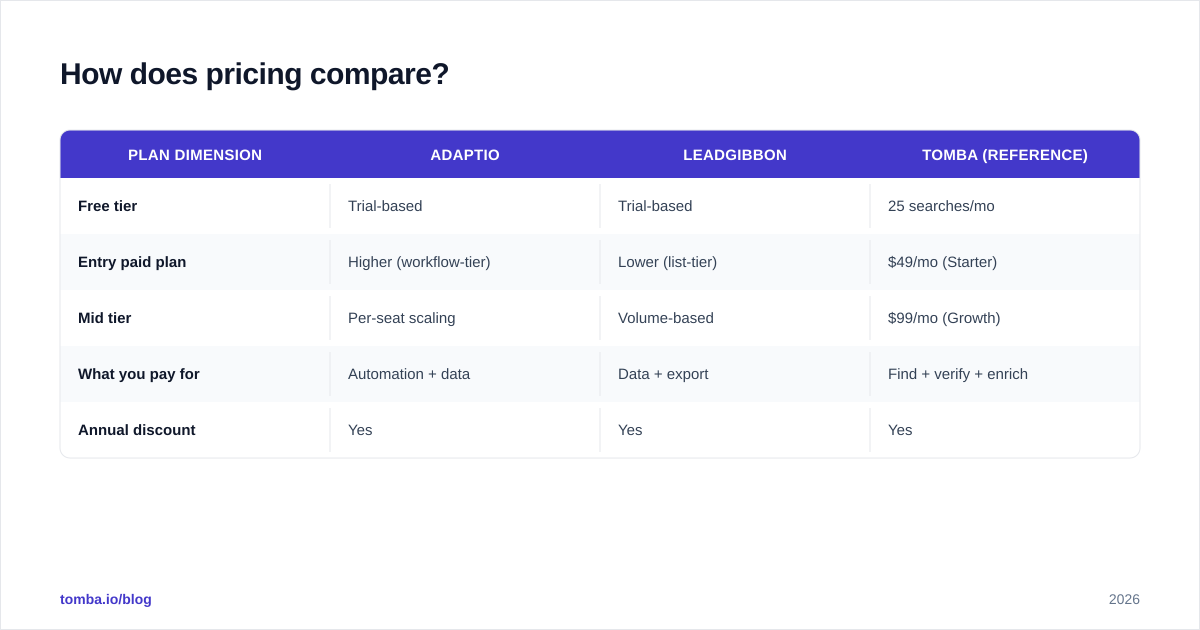
Pricing is where the two tools diverge in philosophy. LeadGibbon is built for a lower entry commitment — it's the kind of tool a solo SDR or founder can expense without a procurement conversation. Adaptio's automation-heavy positioning targets teams willing to pay more per seat for workflow consolidation.
A few rules that hold regardless of sticker price:
- Credits aren't equal. One vendor's "credit" might be a single email reveal; another's might bundle verification and enrichment. Normalize to cost-per-verified-deliverable-contact before comparing.
- Watch the annual lock-in. Monthly-to-annual jumps often hide a steep discount that only pays off if you actually use the volume.
- Verification may be metered separately. If finding and verifying are billed apart, your effective cost can double.
| Plan dimension | Adaptio | LeadGibbon | Tomba (reference) |
|---|---|---|---|
| Free tier | Trial-based | Trial-based | 25 searches/mo |
| Entry paid plan | Higher (workflow-tier) | Lower (list-tier) | $49/mo (Starter) |
| Mid tier | Per-seat scaling | Volume-based | $99/mo (Growth) |
| What you pay for | Automation + data | Data + export | Find + verify + enrich |
| Annual discount | Yes | Yes | Yes |
For full transparency on a specialist's numbers, Tomba pricing lists every tier publicly, including the free 25-search tier and a $49/mo Starter — useful as a baseline when you're decoding the two vendors' quote-on-request language.
Which one fits your sales motion?#
The honest answer is that "best tool" is the wrong frame. Match the tool to how your team actually sells.
Pick Adaptio if you're running structured, repeatable outbound and you want targeting signals plus automation in one platform. If your SDRs currently juggle a data tool, an enrichment tool, and a sequencer, Adaptio's consolidation can reduce tool sprawl — provided the underlying data clears your bounce test.
Pick LeadGibbon if you prospect heavily on LinkedIn and your bottleneck is simply turning profiles into exportable, verified emails. It's fast, it's cheap to start, and it doesn't make you learn a whole platform to get a list out the door.
Pick a dedicated finder if your real constraint is data quality and volume — for example, you need bulk email finding across thousands of domains, an email finder API wired into your own stack, or domain search to map every contact at a target account. That's a different job than either Adaptio or LeadGibbon optimizes for.

What about deliverability after you get the data?#
A clean list is necessary but not sufficient. Even perfect data bounces if your sending infrastructure is weak. This is the part both Adaptio and LeadGibbon largely leave to you — and it's where a lot of "the data is bad" complaints actually originate.
Before you blame any tool's accuracy, confirm:
- Your domain has proper SPF, DKIM, and DMARC records.
- Your sender reputation is healthy and your domain is warmed up.
- You're verifying right before send, not relying on a list pulled weeks ago.
A useful sanity check: industry deliverability guidance from providers like Google's sender guidelines and reputation tools at G2 make clear that list hygiene and authentication matter as much as the source of the email. No finder, Adaptio or LeadGibbon included, can save a misconfigured domain.
How do you actually decide between Adaptio and LeadGibbon?#
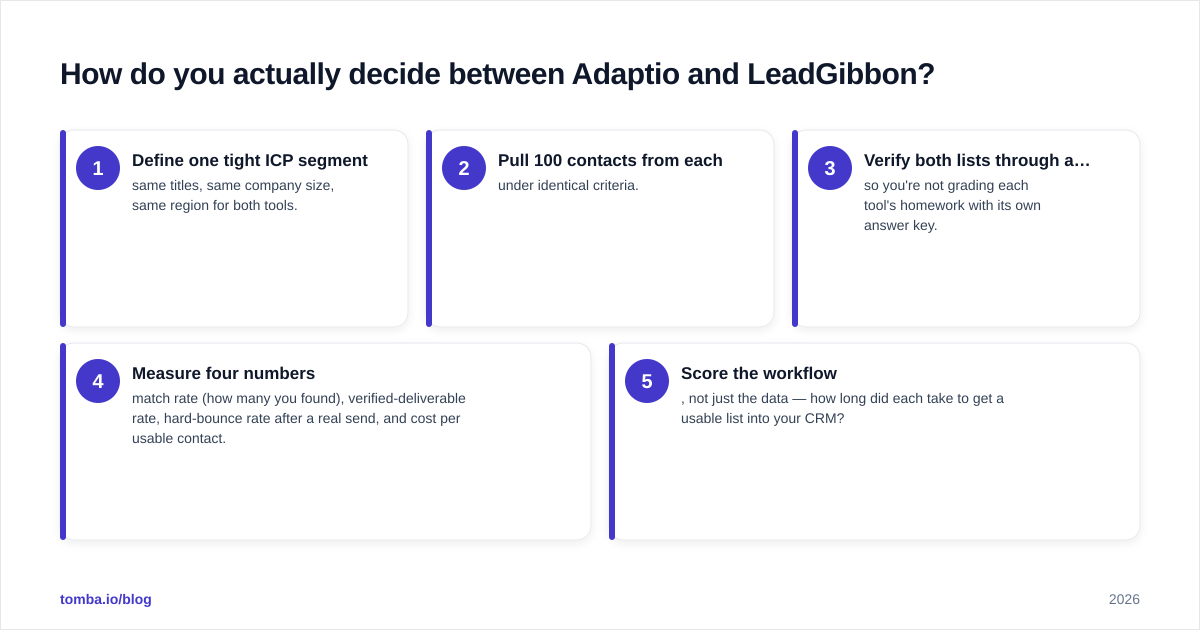
Run a structured 14-day bake-off instead of trusting any review (including this one). The framework below removes the guesswork.
- Define one tight ICP segment — same titles, same company size, same region for both tools.
- Pull 100 contacts from each under identical criteria.
- Verify both lists through a neutral third party so you're not grading each tool's homework with its own answer key.
- Measure four numbers: match rate (how many you found), verified-deliverable rate, hard-bounce rate after a real send, and cost per usable contact.
- Score the workflow, not just the data — how long did each take to get a usable list into your CRM?
Whichever tool wins your numbers wins your business. If both underwhelm on accuracy, that's your signal to test a specialist finder before committing budget.
Here's how the email-finder comparison shakes out when accuracy is the deciding axis:

Common questions#
Is Adaptio better than LeadGibbon? Not universally. Adaptio is stronger for teams wanting AI-assisted, automated outbound; LeadGibbon is stronger for fast, low-cost LinkedIn email extraction. Your sales motion decides it.
Does LeadGibbon work without LinkedIn? It offers database list-building too, but its standout strength is the LinkedIn-to-email workflow. If you don't prospect on LinkedIn, you're underusing it.
Can I use one for data and another for sending? Yes, and many teams do — use a finder for accurate contacts, then your own sequencer for outreach. Decoupling data from sending often beats an all-in-one whose data lags.
What if both miss too many contacts? Test a dedicated finder. Tools like Tomba's domain search and LinkedIn finder are built specifically for high match rates and verification depth.
The bottom line#
Adaptio and LeadGibbon are both legitimate tools aimed at different buyers. Adaptio sells a workflow; LeadGibbon sells speed and simplicity. Run the 14-day bake-off, measure cost per verified-deliverable contact, and let your own numbers decide — not the marketing.
If that test exposes data-quality gaps in either tool, start a free trial of the Tomba Email Finder before you sign an annual contract. With a free 25-search tier, a $49/mo Starter plan, built-in email verification, and an email finder API for scaling, it's a low-risk way to benchmark what "accurate B2B data" should actually cost you — and a strong default when finding and verifying emails is the real job to be done.
// get started
Find, verify and enrich your first contacts today
Start on the free plan with 25 searches a month, then scale when your team is ready.
Free plan · No credit card required · GDPR & CCPA
// about the author