Adaptio vs Leadmine (2026): Which Email Finder Wins?
A neutral, data-driven breakdown of Adaptio vs Leadmine in 2026 — accuracy, pricing, verification, and which B2B email finder actually fits your outbound stack.
Choosing between Adaptio and Leadmine usually comes down to one question: which tool returns more valid, deliverable emails per dollar without wrecking your sender reputation? This guide answers that directly, then breaks down where each tool earns its keep.
TL;DR — Adaptio vs Leadmine at a glance#
- Adaptio leans into enrichment and workflow automation — strong if you live inside a CRM and want contacts pushed to you automatically.
- Leadmine leans into raw discovery volume and a cheaper entry point — strong for high-volume list building when you'll verify separately.
- Accuracy is close, but both publish "find rates," not deliverability rates. Always layer an independent verification step before you send.
- Pricing diverges at scale: Leadmine wins the entry tier; Adaptio's per-credit cost flattens out faster on higher plans.
- If you want one platform that combines finding and verification with transparent pricing, a third option like the Tomba Email Finder is worth benchmarking against both.
What are Adaptio and Leadmine?#
Both are B2B email-finder tools: you give them a name and a company (or a domain), and they return a likely business email address, usually with a confidence score.
Adaptio positions itself as a contact-data and enrichment platform. The pitch is workflow: connect your CRM, define an ideal customer profile, and let the tool surface and enrich matching contacts. Email finding is one feature inside a broader "data operations" story.
Leadmine positions itself as a lean prospecting tool. The pitch is volume and speed: search by role, company, or domain, pull a list, and export. It competes on price-per-find and a low barrier to entry rather than on deep CRM integration.
That difference in positioning matters more than any single feature, because it predicts where each tool will frustrate you. Adaptio asks you to commit to its workflow. Leadmine hands you data and assumes you'll handle the rest of the pipeline yourself.

How accurate are Adaptio vs Leadmine?#
Accuracy is the headline number, and it's also the most misleading one. Here's the trap: most vendors report a find rate (the percentage of searches that return any email) rather than a deliverability rate (the percentage of returned emails that actually land in an inbox). A tool can show a 90% find rate and still hand you 20% bounces if it guesses aggressively on catch-all domains.
Think of it like a metal detector at the beach. One detector beeps on everything — it "finds" more, but half the beeps are bottle caps. The other beeps only when it's reasonably sure it's a coin. The second detector "finds" less but wastes less of your time digging. Adaptio behaves more like the cautious detector; Leadmine tends to return more results and leaves the filtering to you.
In practice, that means your real accuracy depends on verification, not just discovery. Both tools include some level of validation, but neither replaces a dedicated email verifier when you're about to load a domain you've never mailed before. The single biggest lever on bounce rate is catch-all handling — see our breakdown of catch-all verification for why "valid" doesn't always mean "deliverable."
A simple rule of thumb: treat any finder's confidence score as a prioritization signal, not a send/no-send decision. Verify before you send, every time.
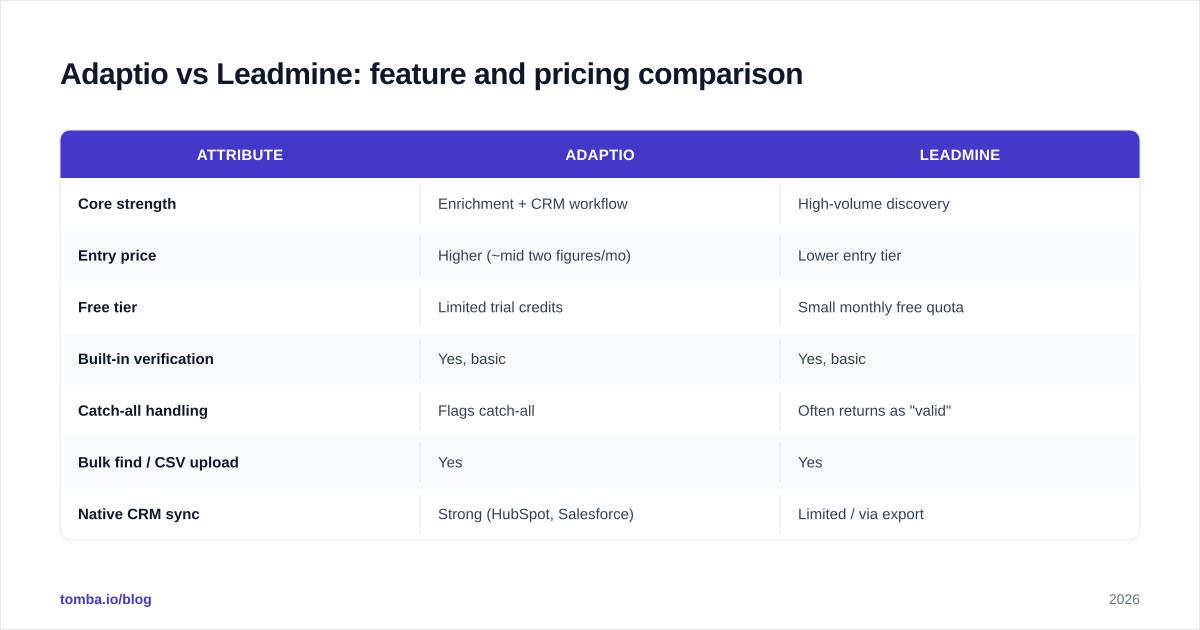
Adaptio vs Leadmine: feature and pricing comparison#
The table below maps the attributes that actually change your cost-per-meeting, not the marketing checklist items.
| Attribute | Adaptio | Leadmine |
|---|---|---|
| Core strength | Enrichment + CRM workflow | High-volume discovery |
| Entry price | Higher (~mid two figures/mo) | Lower entry tier |
| Free tier | Limited trial credits | Small monthly free quota |
| Built-in verification | Yes, basic | Yes, basic |
| Catch-all handling | Flags catch-all | Often returns as "valid" |
| Bulk find / CSV upload | Yes | Yes |
| Native CRM sync | Strong (HubSpot, Salesforce) | Limited / via export |
| API access | Higher tiers | Most tiers |
| Best for | RevOps & enrichment teams | SDRs building raw lists |
A few honest caveats. Vendor pricing shifts often, so confirm current numbers on each official site before you commit — Adaptio and Leadmine both list plans publicly, and third-party directories like G2 and Capterra carry user-reported pricing and reviews that are worth cross-checking. The pattern that tends to hold across cycles: Leadmine is cheaper to start, Adaptio is cheaper to scale once you factor in the enrichment you'd otherwise buy separately.

Which tool fits which workflow?#
The right answer depends less on the tools and more on your motion. Use this framework to place yourself before you place a tool.
You're an SDR building lists by hand. Leadmine's lower entry price and faster search-to-export loop will feel better day to day. You're going to verify and sequence elsewhere anyway, so you're paying for discovery volume, and that's exactly what Leadmine optimizes for.
You're in RevOps or marketing ops feeding a CRM. Adaptio's native HubSpot integration and Salesforce sync save you the glue code. When contacts enrich automatically on record creation, the per-credit premium pays for itself in saved engineering hours.
You're doing account-based outbound at a named-account list. Neither tool's "spray a role across 5,000 companies" mode helps you. You want depth on a short list — multiple contacts per account, phone numbers, and reliable verification. Here you'd combine a finder with a domain search to pull every addressable contact at each target account.
You're a solo founder or small team. Start on a free tier, send a real campaign, and measure your bounce rate on your segment. Published accuracy numbers are averages across industries; your niche may behave very differently. The tool that's accurate on SaaS execs may be weak on, say, regional manufacturing.
How do Adaptio and Leadmine handle verification and deliverability?#
This is where "find rate" meets reality. Both tools verify at the point of discovery, but neither markets itself primarily as a verification platform — which means their validation is a safety net, not a guarantee.
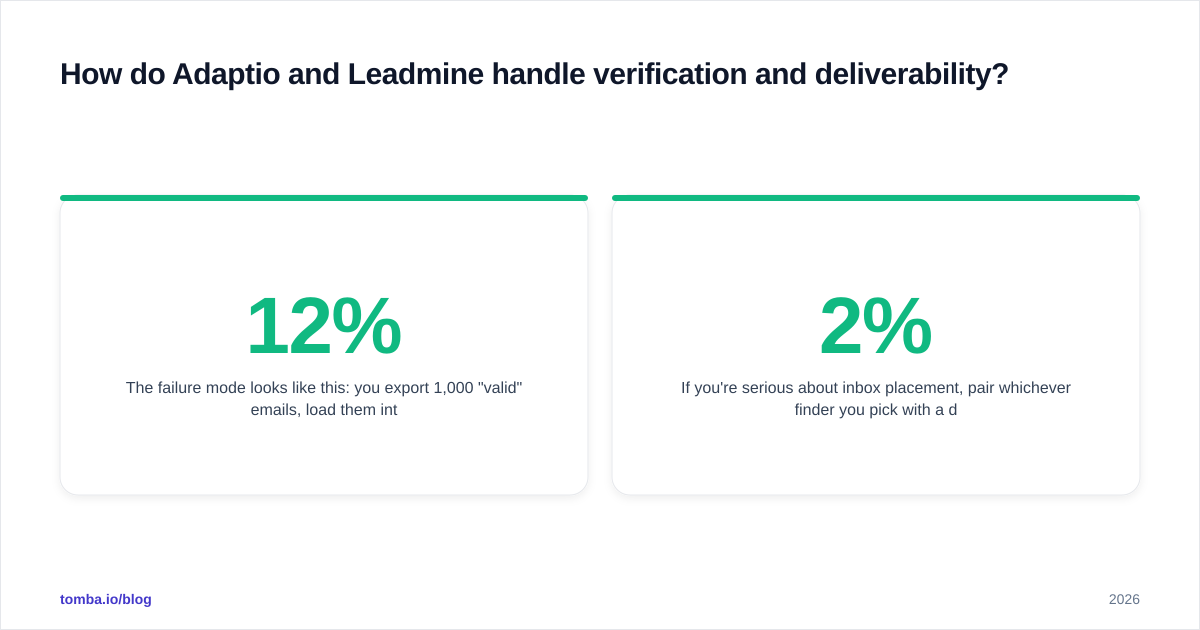
The failure mode looks like this: you export 1,000 "valid" emails, load them into a cold-email tool, and watch a 12% bounce rate torch your domain reputation in week one. The emails weren't fake; they were unverifiable catch-all addresses that the finder optimistically labeled "valid."
To protect deliverability, treat finding and verifying as two separate gates:
- Find with Adaptio or Leadmine (or both, deduped).
- Verify with an independent validation pass that explicitly classifies catch-all, role-based, and risky addresses.
- Warm up any new sending domain before volume — no verifier saves you from a cold domain.
If you're serious about inbox placement, pair whichever finder you pick with a dedicated verification step and read up on the fundamentals in this primer on email deliverability. The math is brutal but simple: a 2% bounce rate is recoverable; a 10% bounce rate gets you filtered to spam for everyone on the domain.

Is Adaptio better than Leadmine?#
Neither tool is universally "better" — they optimize for different jobs, and the honest verdict depends on what you're solving for.
Pick Adaptio if:
- You want enrichment and finding in one platform.
- Your team works inside a CRM and values automatic contact creation.
- You're scaling and the per-credit economics improve on higher tiers.
- You'd otherwise pay separately for a data-enrichment vendor.
Pick Leadmine if:
- You want the lowest entry price to start prospecting today.
- You build lists manually and verify/sequence in other tools.
- You value search speed over deep integration.
- Your volume is bursty and you don't want an annual enrichment commitment.
Consider a third option if: you're tired of paying for finding and verification separately, or you want transparent, predictable Tomba pricing instead of credit math that changes by tier. A combined finder-plus-verifier platform often beats stitching two point tools together — fewer integrations to maintain, one dedupe step, one bill.
What does a combined approach look like?#
Here's a workflow that sidesteps the Adaptio-vs-Leadmine binary entirely and just optimizes for cost-per-deliverable-email.
Start with domain search on your target accounts to pull every public contact pattern, then run names through an email finder that returns a confidence score and a verification status in the same call. Push the valid, non-catch-all results straight into your sequencer, and route catch-all or risky addresses to a manual review queue instead of mailing them blind.
The advantage isn't magic — it's that you stop paying two vendors and reconciling two exports. One platform, one credit pool, one source of truth for "is this address safe to send." For teams running this at scale, the Tomba API lets you wire finding and verification directly into your own enrichment jobs, which is usually cheaper than buying Adaptio's enrichment add-on or bolting a separate verifier onto Leadmine.
That said, single-tool consolidation isn't always right. If you've already standardized on Adaptio's CRM workflow or Leadmine's search UI and your team is fast in it, switching has a real cost. Tool migration only pays off when the data quality or the price delta is large enough to justify retraining. Run a side-by-side test on 200 real prospects before you rip anything out.
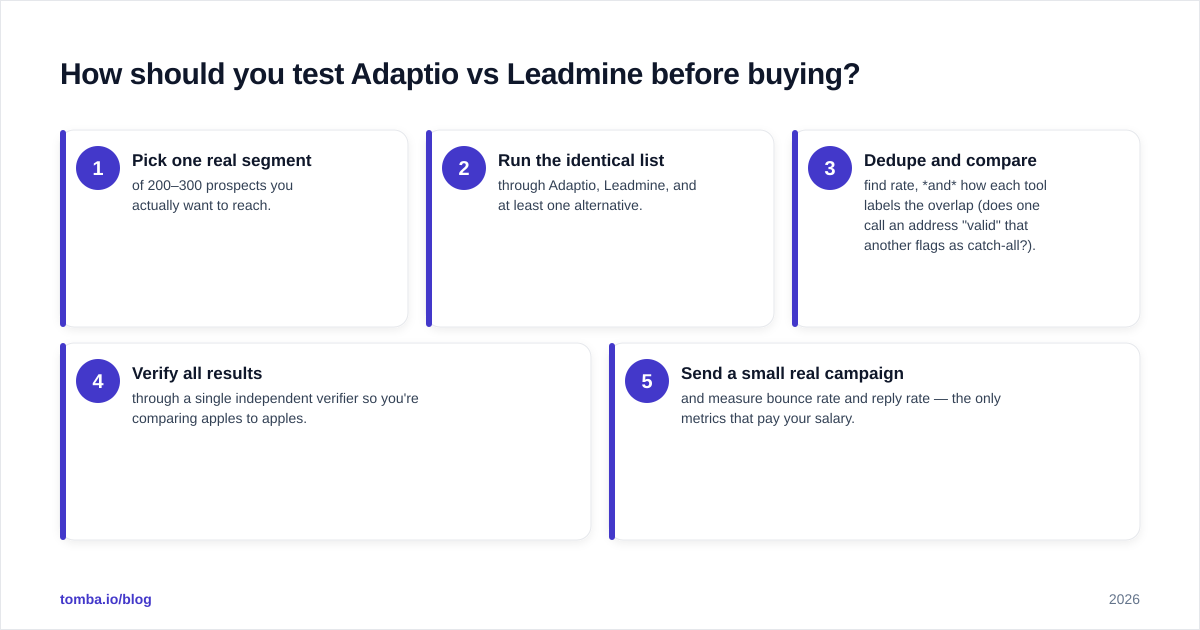
How should you test Adaptio vs Leadmine before buying?#
Don't trust any comparison post — including this one — over your own data. Run a controlled bake-off:
- Pick one real segment of 200–300 prospects you actually want to reach.
- Run the identical list through Adaptio, Leadmine, and at least one alternative.
- Dedupe and compare find rate, and how each tool labels the overlap (does one call an address "valid" that another flags as catch-all?).
- Verify all results through a single independent verifier so you're comparing apples to apples.
- Send a small real campaign and measure bounce rate and reply rate — the only metrics that pay your salary.
The winner is whichever tool produces the most replies per dollar, not the most raw emails. A tool that finds 30% more addresses but bounces twice as often is more expensive, not less, once you price in the reputation damage.
The bottom line#
Adaptio is the enrichment-and-workflow choice; Leadmine is the volume-and-value choice. Both are legitimate, and both publish find rates you should treat skeptically until you've verified their output on your own segment. Whichever you lean toward, separate finding from verification, warm your domain, and measure replies — not raw counts.
If you'd rather not run two tools, start free with the Tomba Email Finder: find professional emails by name, domain, or company, get verification and catch-all detection built into the same lookup, and scale on transparent plans — Free (25 searches/mo), Starter at $49/mo, Growth at $99/mo, and Pro at $249/mo. Run it head-to-head against Adaptio and Leadmine on your next 200 prospects and let the bounce rate pick the winner.
// get started
Find, verify and enrich your first contacts today
Start on the free plan with 25 searches a month, then scale when your team is ready.
Free plan · No credit card required · GDPR & CCPA
// about the author