Adaptio vs Leadzenai 2026: Which B2B Sales Tool Wins?
Adaptio vs Leadzenai compared head-to-head for 2026: data coverage, AI features, pricing models, and which fits your outbound motion best.
Choosing between Adaptio and Leadzenai usually comes down to one question: do you need an AI layer that decides who to target, or a data engine that tells you how to reach them? Both platforms promise to feed your pipeline, but they solve different halves of the same problem — and picking the wrong one means paying for capabilities your team never touches.
This breakdown compares Adaptio vs Leadzenai across data coverage, AI workflows, pricing structure, integrations, and real-world fit, so you can match the tool to your actual go-to-market motion instead of the marketing copy.
TL;DR#
- Adaptio leans toward AI-driven targeting and account intelligence — strong if you run account-based plays and want signals on which accounts are in-market.
- Leadzenai leans toward contact discovery and lead data volume — strong if you need raw prospect records to fuel outbound at scale.
- Neither is a dedicated email-verification engine. If deliverability is your bottleneck, you still need a specialist layer like a real email verifier on top.
- Pricing models differ in kind, not just amount — Adaptio trends toward custom/quote-based packaging, Leadzenai toward credit-based tiers. Compare on cost-per-usable-contact, not sticker price.
- For pure email finding accuracy, a focused tool like the Tomba Email Finder often beats a bundled feature inside a broader suite.
What is Adaptio?#
Adaptio positions itself as an AI-first go-to-market platform. The core pitch is intelligence: instead of handing you a static list, it tries to interpret intent and account signals so your team spends time on accounts that are actually moving. Think of it less like a phone book and more like a scout that points at the doors worth knocking on.
That orientation shapes everything. Adaptio is most useful when your sales motion is account-based — fewer, larger deals where knowing the timing of an account matters more than the sheer number of contacts. The trade-off is that you are buying a decision layer, and decision layers are only as good as the signals feeding them.
If your reps already drown in lists but can't tell which prospect to call first, that prioritization is the value. If your problem is that you don't have enough contacts to begin with, a targeting brain doesn't help an empty database.
What is Leadzenai?#
Leadzenai is built around lead discovery and contact data. The center of gravity is volume and reach: pull company and contact records, filter by firmographic criteria, and export prospects into your outbound stack. It is closer to a data faucet than a strategy engine.
This makes Leadzenai a natural fit for high-volume outbound teams, agencies running campaigns for multiple clients, and anyone whose growth depends on consistently topping up the funnel with fresh records. The risk with any volume-first tool is the same across the category — quantity can mask quality, and unverified records quietly burn your sender reputation.
The honest framing: Leadzenai gets you a pile of contacts faster, but the pile still needs cleaning before it touches your mailbox. That's where a dedicated email verification step earns its keep.
)
Adaptio vs Leadzenai: side-by-side comparison#
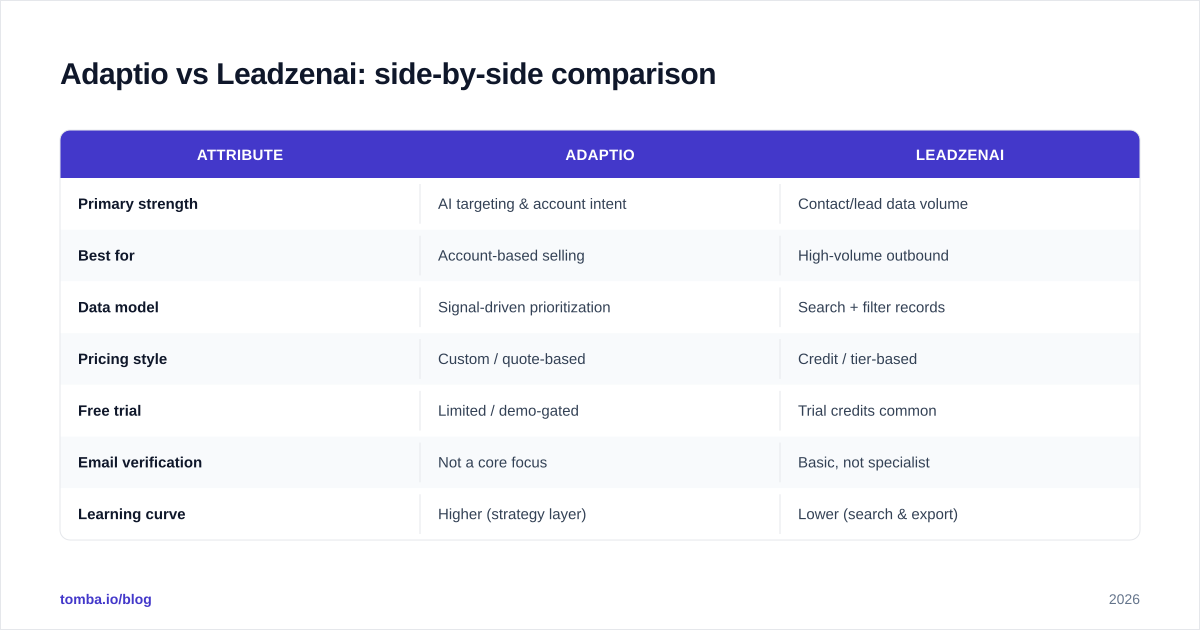
Here's the head-to-head on the attributes that actually change your buying decision. Treat the pricing rows as directional — both vendors adjust packaging frequently, so confirm current numbers on their live pages and on review sites before committing.
| Attribute | Adaptio | Leadzenai |
|---|---|---|
| Primary strength | AI targeting & account intent | Contact/lead data volume |
| Best for | Account-based selling | High-volume outbound |
| Data model | Signal-driven prioritization | Search + filter records |
| Pricing style | Custom / quote-based | Credit / tier-based |
| Free trial | Limited / demo-gated | Trial credits common |
| Email verification | Not a core focus | Basic, not specialist |
| Learning curve | Higher (strategy layer) | Lower (search & export) |
| Ideal team size | Mid-market to enterprise | SMB to mid-market |
The pattern is clear: Adaptio asks you to commit to a methodology, Leadzenai asks you to commit to a usage volume. Your choice should follow how your team already sells, not the other way around.
Is Adaptio better than Leadzenai for accuracy?#
Accuracy means different things for each tool, so a single "winner" is misleading. Adaptio's accuracy is about signal precision — did it correctly flag an account as in-market? Leadzenai's accuracy is about record correctness — is this email and title actually right and current?
Both struggle with the same underlying reality: B2B data decays fast. Industry estimates put contact data decay at roughly 2–3% per month, which compounds to a quarter or more of any database going stale within a year. No platform escapes this; they just manage it differently. You can sanity-check vendor accuracy claims against third-party reviews on G2 and Capterra rather than taking marketing numbers at face value.
The practical takeaway: whichever you pick, assume the emails need an independent verification pass. Bundled verification inside a broad suite is rarely tuned the way a specialist engine is, and catch-all domains in particular trip up generalist tools. A dedicated catch-all verifier resolves the addresses that generic checks mark "unknown" and silently let through.
How do Adaptio and Leadzenai handle pricing?#
Pricing is where the two diverge most, and it's the easiest place to overpay.
Adaptio's quote-based model means cost scales with seats, data scope, and the intelligence features you switch on. That's flexible for enterprises but opaque for smaller teams — you can't self-serve your way to a number, and you're negotiating against a sales process. Budget for onboarding time, not just license fees.
Leadzenai's credit or tier model is more transparent: you roughly know what a batch of lookups costs. The trap is consumption creep. Credits evaporate during big campaigns, and the effective cost-per-usable contact climbs once you subtract bad records you can't email.
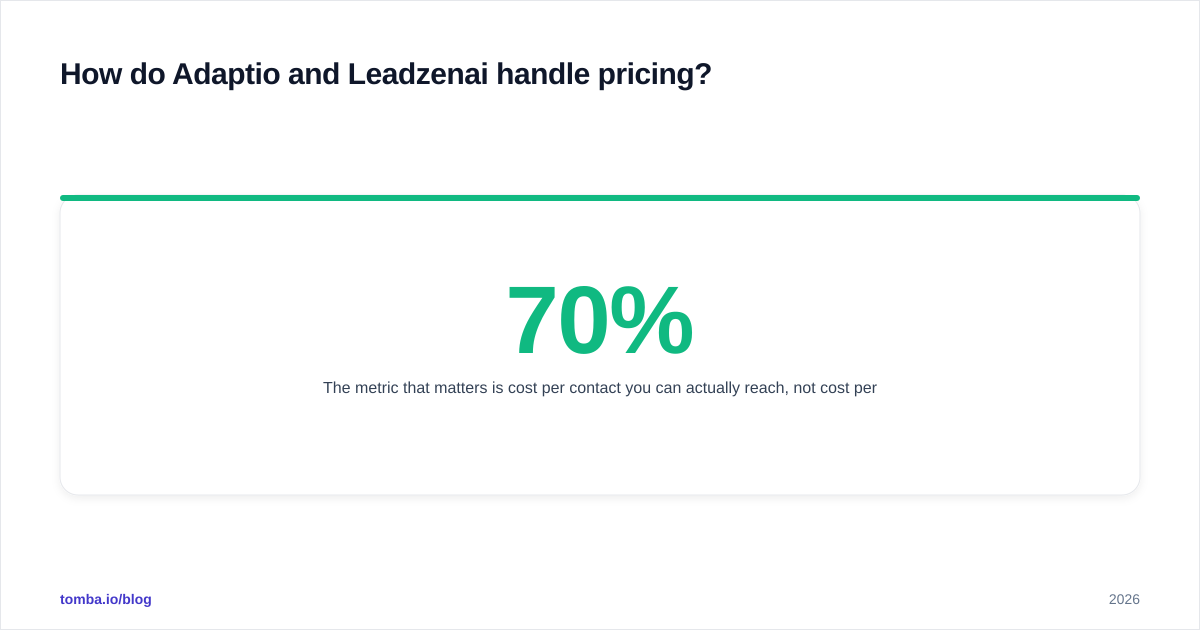
The metric that matters is cost per contact you can actually reach, not cost per record pulled. A cheaper list with a 70% deliverable rate can cost more than a pricier list at 95% once bounces, wasted send volume, and reputation damage are priced in. For reference, transparent per-plan pricing like Tomba pricing — a free tier at 25 searches/mo, Starter at $49/mo, Growth at $99/mo, and Pro at $249/mo — gives you a clean baseline to benchmark either vendor's effective rate against.
)
Which tool fits your use case?#
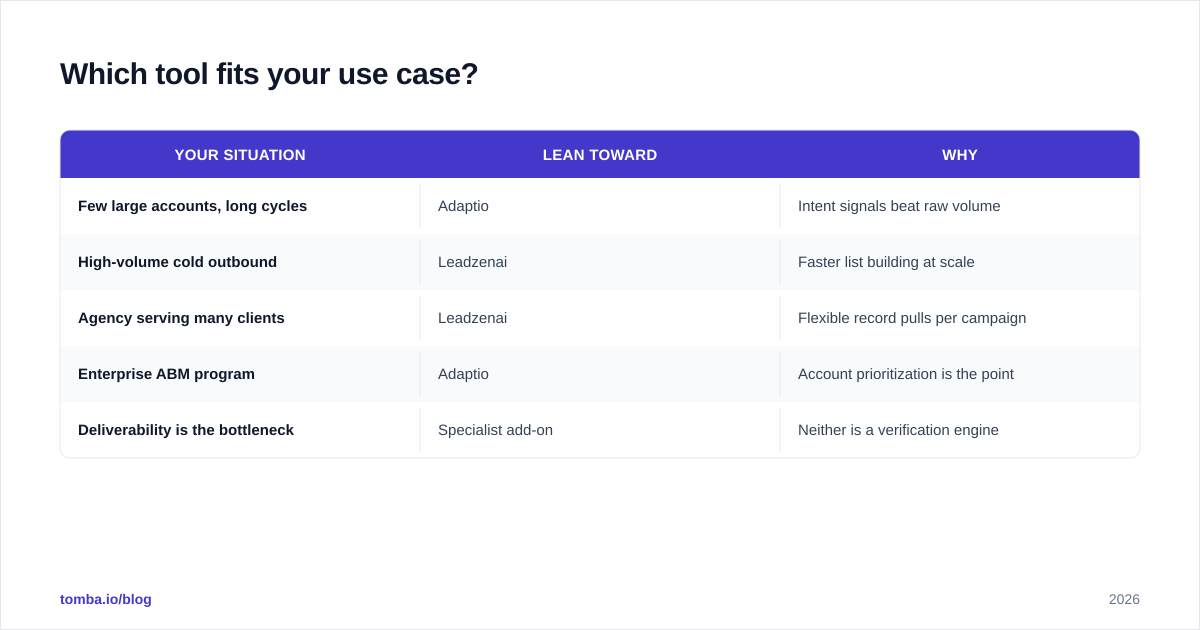
Match the tool to the motion. Here's the decision framework most teams land on:
| Your situation | Lean toward | Why |
|---|---|---|
| Few large accounts, long cycles | Adaptio | Intent signals beat raw volume |
| High-volume cold outbound | Leadzenai | Faster list building at scale |
| Agency serving many clients | Leadzenai | Flexible record pulls per campaign |
| Enterprise ABM program | Adaptio | Account prioritization is the point |
| Deliverability is the bottleneck | Specialist add-on | Neither is a verification engine |
Notice the last row. The single most common mistake in the Adaptio vs Leadzenai decision is assuming either one fully solves email quality. They don't — and that's not a knock on them, it's a category boundary. Targeting tools target; data tools list; verification tools verify. You generally want the right specialist for the part that touches your sender reputation.
For teams whose real constraint is finding and verifying the actual email addresses behind their target accounts, a focused finder is the missing piece. You can layer it on top of either platform: use Adaptio or Leadzenai to decide who, then resolve and validate the how-to-reach with a tool built for exactly that. A domain search pulls every reachable contact at a target company, and bulk workflows handle the scale once you've picked your accounts.
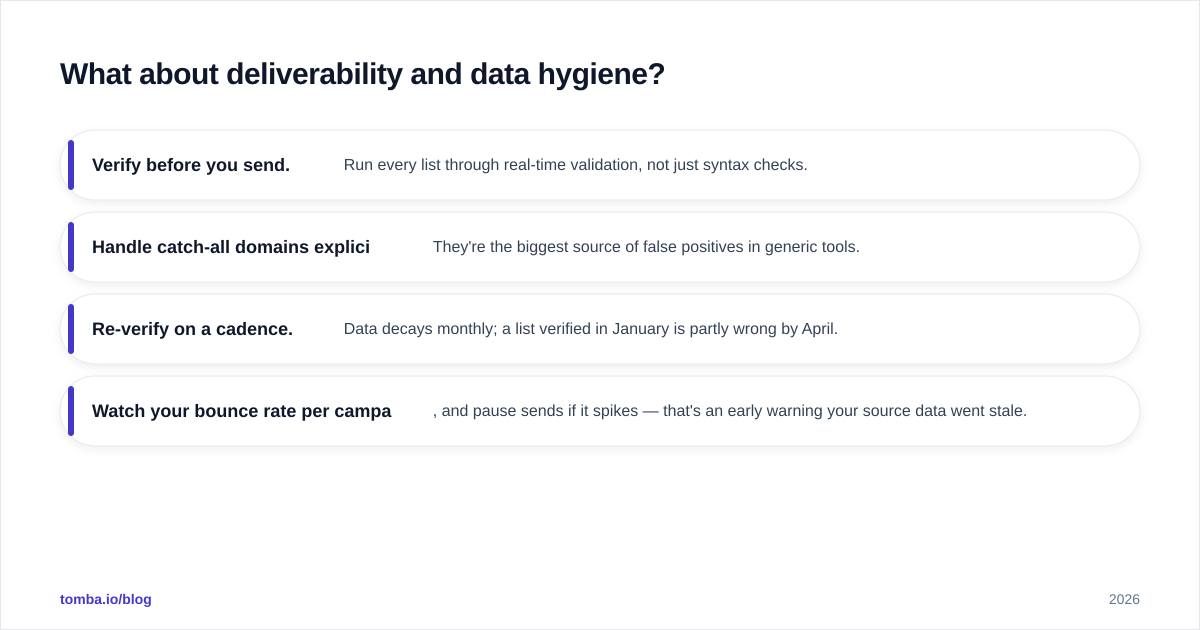
What about deliverability and data hygiene?#
This is the quiet failure mode no comparison chart shows. You can buy the best targeting and the biggest database and still tank your campaign if your emails bounce. Mailbox providers watch bounce rates closely — push past roughly 2–3% and your sender reputation degrades, dragging even your good sends into spam.
Neither Adaptio nor Leadzenai is engineered as a hygiene layer. Their job ends at "here's a contact." The hygiene job starts there:
- Verify before you send. Run every list through real-time validation, not just syntax checks.
- Handle catch-all domains explicitly. They're the biggest source of false positives in generic tools.
- Re-verify on a cadence. Data decays monthly; a list verified in January is partly wrong by April.
- Watch your bounce rate per campaign, and pause sends if it spikes — that's an early warning your source data went stale.
Authoritative guidance from analysts like Gartner consistently ties revenue-tech ROI to data quality, not feature count. The tool with the longest feature list rarely wins; the workflow with the cleanest data does.
Adaptio vs Leadzenai: the honest verdict#
There's no universal winner, and any review claiming one is selling something. The right answer depends on which half of the problem is your bottleneck:
- Choose Adaptio if your accounts are few and high-value, your cycles are long, and knowing timing and intent changes how reps spend their day.
- Choose Leadzenai if your growth depends on volume — consistent, filterable contact records feeding a high-throughput outbound machine.
- Choose neither as your verification layer. Whichever you buy, pair it with a specialist for email finding and validation, because that's the part that decides whether your messages actually land.
The teams that win in 2026 aren't the ones with the most expensive intelligence suite. They're the ones who match the right tool to the right job and refuse to let unverified data touch their domain reputation.
Where Tomba fits#
If your real gap is turning "here's a target account" into "here's the verified inbox of the decision-maker," that's exactly the job the Tomba Email Finder is built for. Use Adaptio or Leadzenai for targeting and discovery, then let Tomba find and verify the addresses — by name, company, or domain search — so the contacts you worked hard to identify actually become conversations. Start free with 25 searches a month, scale to Starter at $49/mo when you're ready, and stop letting bad data quietly burn your pipeline.
// get started
Find, verify and enrich your first contacts today
Start on the free plan with 25 searches a month, then scale when your team is ready.
Free plan · No credit card required · GDPR & CCPA
// about the author