Adaptio vs Nymeria (2026): Which Email Finder Wins?
Adaptio and Nymeria both promise accurate B2B contact data—but they win on different jobs. Here's a neutral 2026 breakdown of accuracy, pricing, coverage, and the best-fit alternative.
TL;DR
- Adaptio (Adapt.io) is a B2B sales-intelligence database built for outbound teams that want firmographic filters, a prospector, and a Chrome "Lead Builder" — it shines on company-level targeting at scale.
- Nymeria is a contact-enrichment tool that excels at pulling personal and work emails plus social profiles, especially from LinkedIn, at a low entry price.
- On email accuracy, both lean on pattern matching and database lookups; neither guarantees verified-at-send-time deliverability without an extra verification step.
- Pricing models differ sharply: Nymeria is transparent and credit-light; Adaptio is mostly custom-quote and credit-based, which favors larger teams.
- If you want verified emails, transparent pricing, and a real-time verifier in one stack, a focused tool like Tomba is the cleaner fit — covered at the end.
If you're choosing between Adaptio vs Nymeria in 2026, the honest answer is that they solve overlapping but not identical problems. This guide breaks down what each does well, where they fall short, and how to pick based on your actual workflow rather than a feature checklist.
What are Adaptio and Nymeria?#
Think of these two tools like two different fishing setups. Adaptio is the trawler — you cast a wide net using filters (industry, headcount, location, tech stack) and haul in lists of companies and contacts to work through. Nymeria is the spear — you already know the person (usually from LinkedIn), and you want their email and phone fast.
Adaptio (commonly written Adapt.io) is a B2B contact and company database. Its core pieces are a searchable prospector, a Chrome extension ("Lead Builder") that pulls contacts while you browse LinkedIn or company sites, and CRM push integrations. It's positioned for SDR teams and demand-gen folks who build lists by segment.
Nymeria is a contact-enrichment platform. Its standout is a browser extension that reveals personal email, work email, and phone numbers from social profiles, plus a bulk enrichment flow and an API. It tends to surface personal Gmail/Yahoo addresses more often than most competitors, which is useful for recruiters and founders doing high-touch outreach.
Both ultimately answer the same question — "how do I reach this person?" — but they get there differently.
How accurate is the email data from each?#
Accuracy is where most teams get burned, so be precise about what "accurate" means. There are two separate questions: did the tool find an email at all (coverage), and will that email actually deliver (validity).
Adaptio and Nymeria both rely on a mix of crawled data, contributed data, and email-pattern inference (e.g., first.last@company.com). That approach is fast and high-coverage, but pattern-inferred addresses are guesses until something verifies them. Neither tool is primarily a verification engine — they are finders. If you push raw output straight into a cold campaign without a verification pass, you'll see bounce rates climb and your sender reputation take the hit.

The practical takeaway: treat finder output as a hypothesis, not a fact. Run found addresses through a dedicated email verifier before sending, and use a catch-all verifier for domains that accept everything (catch-all servers can't be confirmed by a simple SMTP ping). This single habit does more for your deliverability than any tool choice.
A quick reality check on claimed accuracy numbers: every vendor markets a high percentage, but those figures measure different things (syntax validity vs. deliverability vs. coverage). Trust your own bounce data over any homepage stat.
Adaptio vs Nymeria: side-by-side comparison#
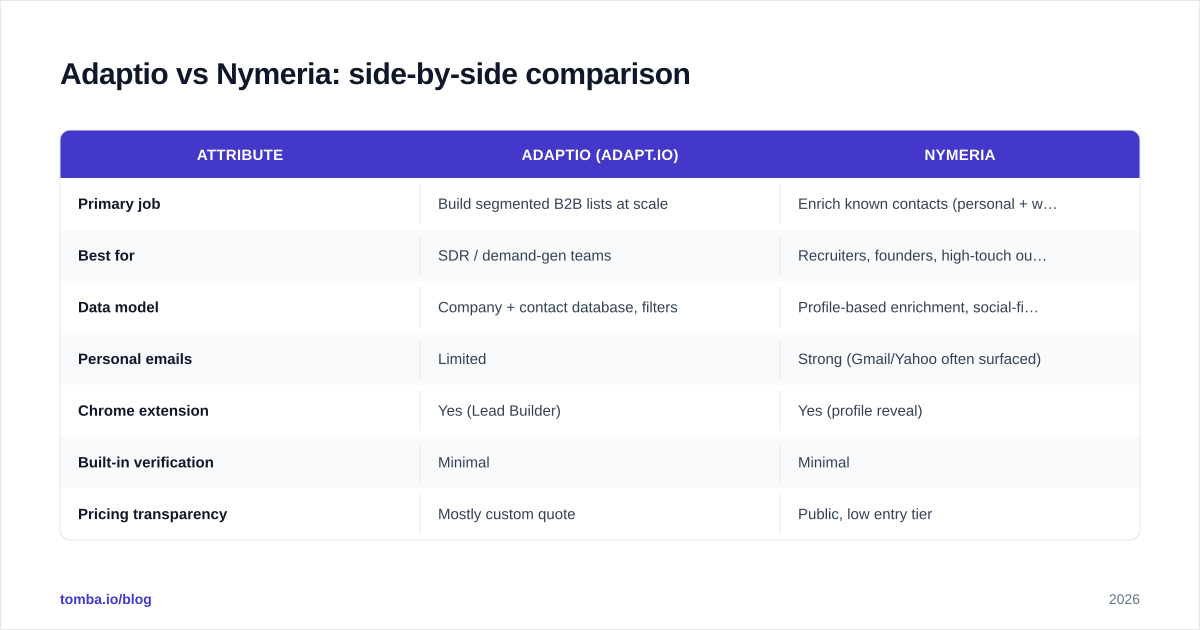
Here's the head-to-head across the attributes that actually change your day-to-day. Pricing for Adaptio is largely quote-based, so treat those cells as directional rather than a published rate card.

| Attribute | Adaptio (Adapt.io) | Nymeria |
|---|---|---|
| Primary job | Build segmented B2B lists at scale | Enrich known contacts (personal + work email) |
| Best for | SDR / demand-gen teams | Recruiters, founders, high-touch outreach |
| Data model | Company + contact database, filters | Profile-based enrichment, social-first |
| Personal emails | Limited | Strong (Gmail/Yahoo often surfaced) |
| Chrome extension | Yes (Lead Builder) | Yes (profile reveal) |
| Built-in verification | Minimal | Minimal |
| Pricing transparency | Mostly custom quote | Public, low entry tier |
| Entry price | Quote-based / credit packs | ~$39/mo starter range |
| API access | Yes (higher tiers) | Yes |
| CRM integrations | Salesforce, HubSpot, others | Via API / exports |
Two patterns fall out of this table. First, Adaptio is a team tool — its value compounds when several reps work shared segments and push to a CRM. Second, Nymeria is an individual-operator tool — it's cheap to start, fast per-lookup, and great when you already know who you want.
If your motion is account-based and list-driven, Adaptio's filtering wins. If your motion is "I found someone on LinkedIn and need their email now," Nymeria wins.
Which one is better for cold outreach deliverability?#
Neither tool is a deliverability solution on its own, and that's the most important sentence in this article.
Finders get you addresses. Deliverability depends on three things they don't fully control: list hygiene (verification), sending infrastructure (SPF/DKIM/DMARC, warmup), and message quality. A 100,000-row list from any database is worthless if 18% bounce — the bounces themselves signal to mailbox providers that you're a low-quality sender.
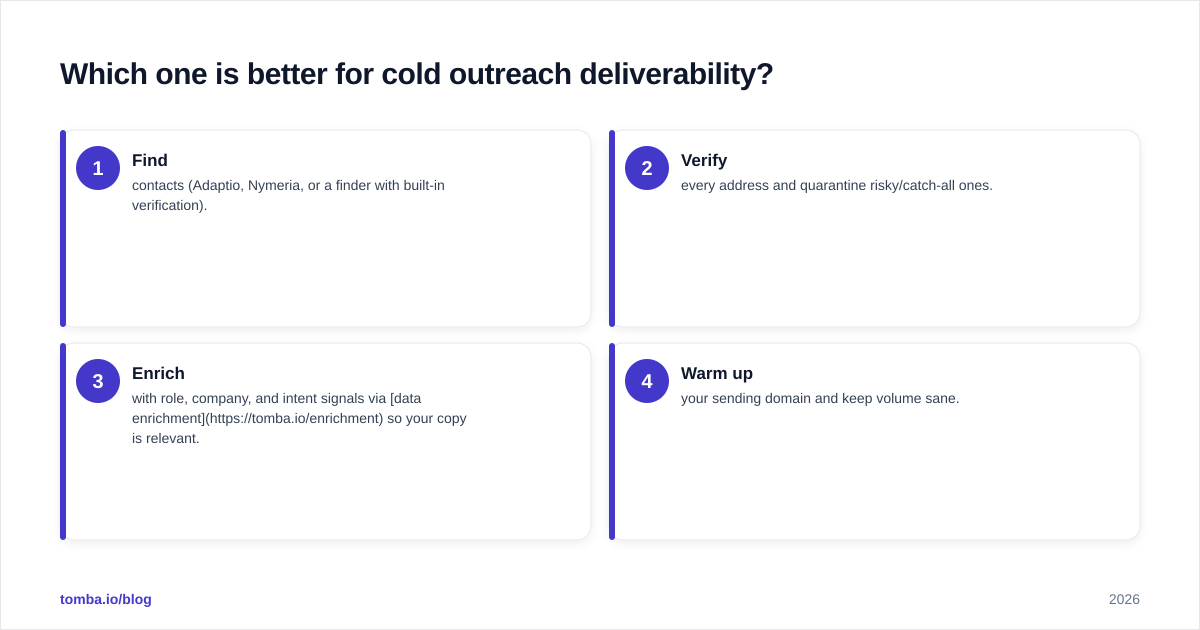
So the better question isn't "Adaptio or Nymeria for deliverability" — it's "what does my full stack look like?" A defensible stack looks like:
- Find contacts (Adaptio, Nymeria, or a finder with built-in verification).
- Verify every address and quarantine risky/catch-all ones.
- Enrich with role, company, and intent signals via data enrichment so your copy is relevant.
- Warm up your sending domain and keep volume sane.
Adaptio and Nymeria cover step 1 well. They're thinner on step 2, which is exactly where bounce-driven reputation damage originates. Plan to bolt on a verifier regardless of which finder you pick.
How does pricing compare for Adaptio vs Nymeria?#
Pricing philosophy is where these tools diverge the most, and it tells you who each is built for.
Nymeria publishes its plans and starts low (roughly $39/mo at the entry tier in recent cycles), with credits scaling by plan. That transparency is friendly to solo operators and small teams who want to try before committing budget.
Adaptio leans on custom quotes and credit packs negotiated per seat/volume. That's standard for sales-intelligence platforms aimed at mid-market and enterprise, but it means you'll talk to a rep and you won't get a clean per-lookup number up front. Budget-conscious solo users often find this friction annoying; larger teams find the negotiated volume worthwhile.
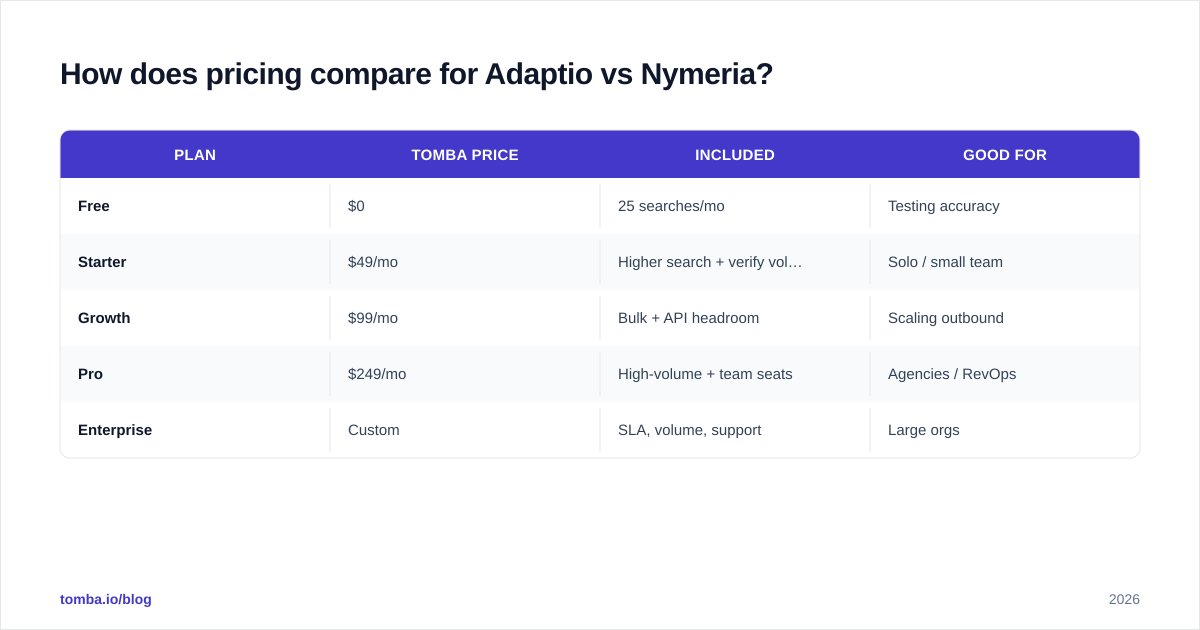
For comparison, here's how a focused finder/verifier like Tomba structures things — published and credit-based, with a free tier to test real output:
| Plan | Tomba price | Included | Good for |
|---|---|---|---|
| Free | $0 | 25 searches/mo | Testing accuracy |
| Starter | $49/mo | Higher search + verify volume | Solo / small team |
| Growth | $99/mo | Bulk + API headroom | Scaling outbound |
| Pro | $249/mo | High-volume + team seats | Agencies / RevOps |
| Enterprise | Custom | SLA, volume, support | Large orgs |
Note the correct Tomba starter price is $49/mo, not the cut-rate numbers you sometimes see quoted in stale listicles. You can see current Tomba pricing for exact credit allotments. The point of including it here isn't to crown a winner on price alone — it's to show what transparent pricing looks like next to a quote-based model like Adaptio's.
When should you choose Adaptio over Nymeria (and vice versa)?#
Use this as a quick decision guide rather than a feature war.
Choose Adaptio if:
- You run account-based or segment-driven outbound and need firmographic filters.
- Multiple reps share lists and push to Salesforce or HubSpot.
- You're a mid-market/enterprise buyer comfortable with a custom quote.
- Company-level coverage matters more than personal emails.
Choose Nymeria if:
- You work one prospect at a time, usually from LinkedIn.
- You need personal emails (recruiting, founder-led sales, partnerships).
- You want transparent, low-entry pricing and fast per-lookup reveals.
- You're a solo operator or a small team that values speed over filtering.
Choose neither — and look at a dedicated finder/verifier — if:
- Verification matters as much as discovery (most cold-email teams).
- You want one transparent stack instead of a finder plus a separate verifier subscription.
- You need a clean API, bulk lead generation, and a Chrome extension under one roof.
There's no universally "best" tool here — there's a best tool for your motion. A recruiter and an enterprise SDR manager should rationally land on different answers.
What about data coverage and compliance?#
Coverage and compliance are the unglamorous tiebreakers.
On coverage, Adaptio's strength is breadth of company records and segmentation; Nymeria's strength is depth on individual profiles, including personal channels. Run the same 50 target contacts through both during a trial and measure two things: hit rate (how many returned an email) and bounce rate after verification (how many were real). That two-number test beats any marketing claim. You can sanity-check where each vendor sources data and compare it to how Tomba documents its data sources.
On compliance, B2B contact data sits under GDPR/CCPA obligations when you process personal data. Both vendors operate within standard B2B-data norms, but your outreach is where compliance is won or lost: maintain a lawful basis, honor opt-outs, and don't scrape beyond terms. Read each vendor's own documentation rather than relying on third-party summaries — start at the official Adapt.io site and Nymeria's site, and cross-reference verified user reviews on G2 for real-world data-quality reports.
The verdict: Adaptio vs Nymeria in 2026#
Here's the conclusion first: Adaptio wins for list-driven team prospecting; Nymeria wins for fast, personal-email enrichment by individuals. Both are legitimate tools that lose value the moment you skip verification.
But if your real goal is clean, send-ready B2B emails with predictable pricing, the finder-only framing is too narrow. You want discovery and verification in the same workflow so you're not stitching two subscriptions together and still bouncing 15% of your list.
That's the gap Tomba is built to close. The Tomba Email Finder finds professional addresses by name, domain, or company, and pairs natively with a real-time verifier, domain search, bulk processing, and an email finder API — with a free tier so you can benchmark accuracy against Adaptio and Nymeria on your own list before paying a cent. Start with 25 free searches, run the two-number test (hit rate and post-verification bounce rate), and let your own data pick the winner.
// get started
Find, verify and enrich your first contacts today
Start on the free plan with 25 searches a month, then scale when your team is ready.
Free plan · No credit card required · GDPR & CCPA
// about the author