Adaptio vs Oceanio (2026): Which GTM Platform Wins?
A neutral, feature-by-feature breakdown of Adaptio vs Oceanio for 2026 — data quality, automation, pricing, and the data layer both platforms quietly depend on.
Choosing between Adaptio and Oceanio usually comes down to one question that neither vendor's homepage answers cleanly: which one actually fits the way your revenue team already works? Both pitch themselves as all-in-one go-to-market platforms. Both promise more pipeline with less manual work. The differences only surface once you look at data quality, automation depth, and what each one costs at scale.
This is a neutral, hands-on comparison. No winner is crowned by default — the right pick depends on team size, motion, and how much you care about data accuracy versus workflow breadth.
TL;DR — Adaptio vs Oceanio at a glance#
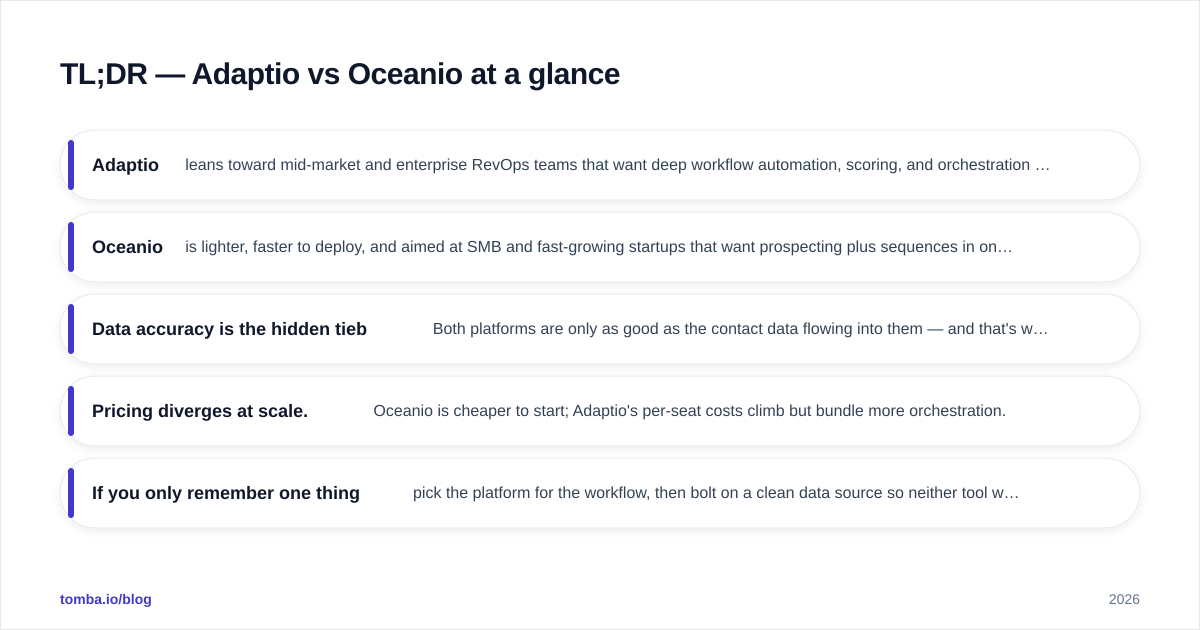
- Adaptio leans toward mid-market and enterprise RevOps teams that want deep workflow automation, scoring, and orchestration across an existing CRM.
- Oceanio is lighter, faster to deploy, and aimed at SMB and fast-growing startups that want prospecting plus sequences in one place.
- Data accuracy is the hidden tiebreaker. Both platforms are only as good as the contact data flowing into them — and that's where a dedicated email finder and email verifier earn their keep.
- Pricing diverges at scale. Oceanio is cheaper to start; Adaptio's per-seat costs climb but bundle more orchestration.
- If you only remember one thing: pick the platform for the workflow, then bolt on a clean data source so neither tool wastes credits on bad contacts.
What are Adaptio and Oceanio?#
Both Adaptio and Oceanio sit in the same broad category: revenue operations and go-to-market (GTM) platforms that try to combine prospecting, engagement, and pipeline analytics under one login.
Adaptio positions itself as an orchestration-first platform. The core idea is that your CRM stays the system of record, and Adaptio sits on top, scoring accounts, routing leads, triggering plays, and reporting on what's working. It's the kind of tool a RevOps lead buys to standardize a messy sales motion across multiple reps and regions.
Oceanio takes the opposite starting point. It's prospecting-first: find contacts, build lists, fire sequences, and track replies — all without needing a heavyweight CRM behind it. It appeals to founders and small sales teams who want to go from "empty pipeline" to "first meetings booked" in an afternoon.
That philosophical split — orchestration vs prospecting — drives almost every other difference between them.
How do Adaptio and Oceanio compare feature by feature?#
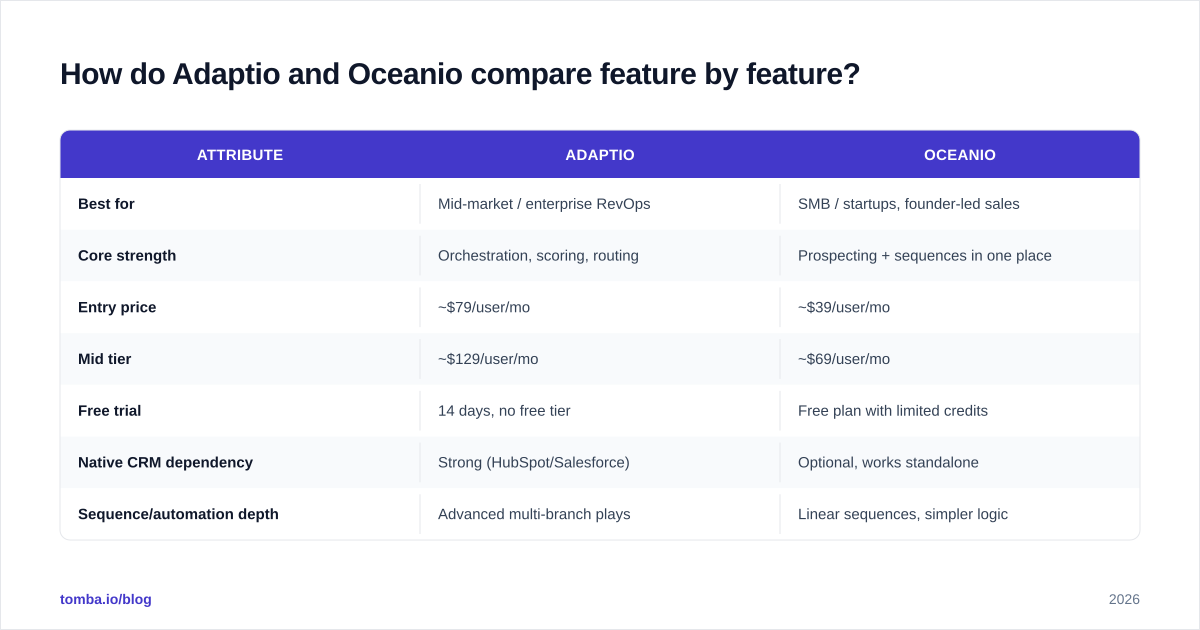
Here's the core comparison. Treat the pricing as representative of 2026 public tiers — always confirm current numbers on each vendor's site and on review hubs like G2 before you commit.
| Attribute | Adaptio | Oceanio |
|---|---|---|
| Best for | Mid-market / enterprise RevOps | SMB / startups, founder-led sales |
| Core strength | Orchestration, scoring, routing | Prospecting + sequences in one place |
| Entry price | ~$79/user/mo | ~$39/user/mo |
| Mid tier | ~$129/user/mo | ~$69/user/mo |
| Free trial | 14 days, no free tier | Free plan with limited credits |
| Native CRM dependency | Strong (HubSpot/Salesforce) | Optional, works standalone |
| Sequence/automation depth | Advanced multi-branch plays | Linear sequences, simpler logic |
| Built-in contact data | Limited, expects enrichment | Bundled but variable accuracy |
| Reporting & attribution | Deep, multi-touch | Basic pipeline metrics |
| Setup time | Days to weeks | Hours |
The pattern is consistent: Adaptio rewards teams that invest in setup and want control; Oceanio rewards teams that want speed and simplicity. Neither is "better" — they optimize for different buyers.
Is Adaptio better than Oceanio for data quality?#
Short answer: neither wins outright, and that's exactly why this section matters most.
Adaptio generally assumes you bring your own data — it expects enriched, deduped records to flow in from your CRM or a dedicated data provider. Its strength is what it does with that data, not sourcing it. Oceanio bundles contact data so you can start prospecting immediately, but bundled databases age fast, and accuracy varies by region and seniority.
This is the Drake-meme reality of modern GTM:
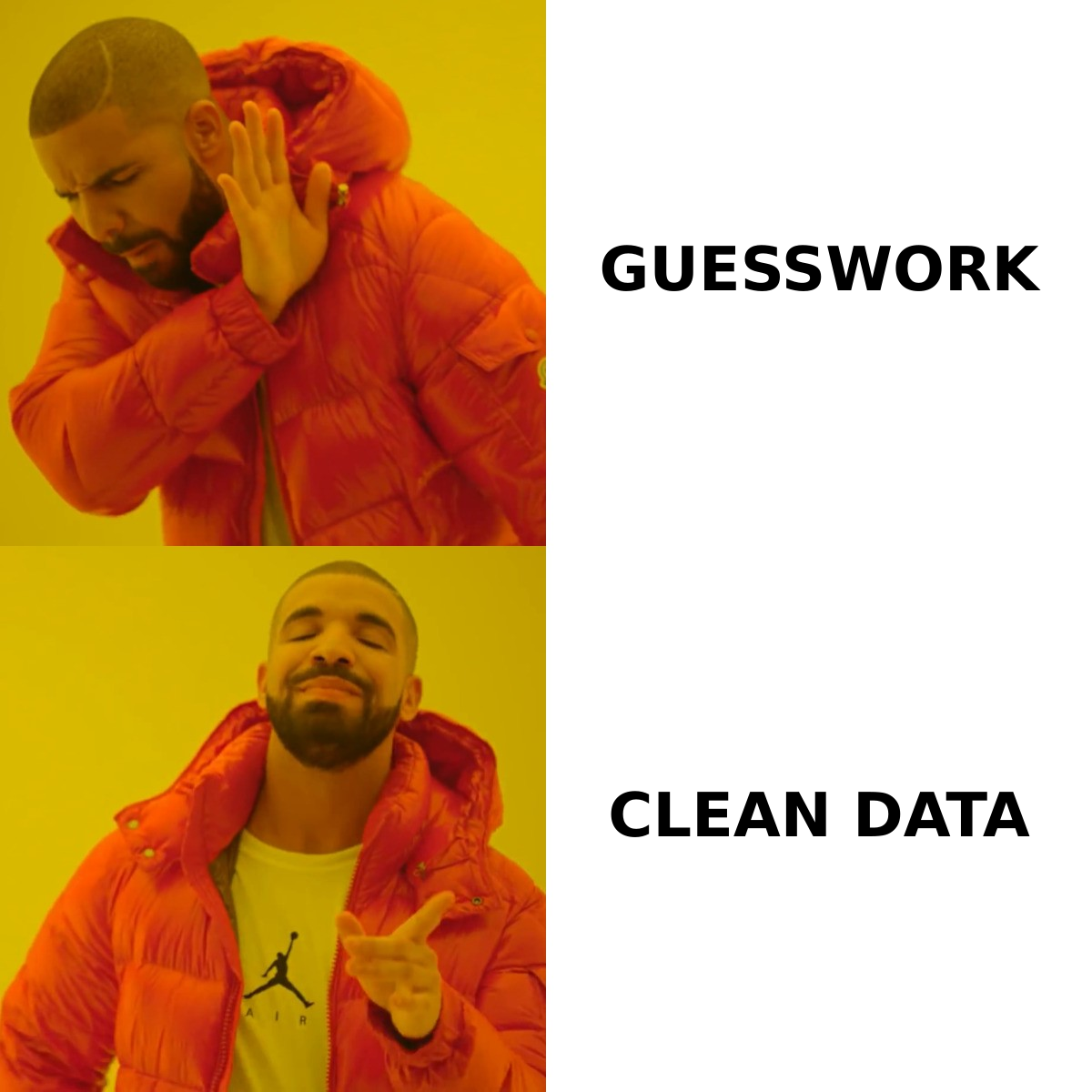
When either platform fires a sequence at a stale or guessed email, three bad things happen at once:
- Your bounce rate climbs, which hurts sender reputation.
- Your email deliverability drops for every future send, including to good contacts.
- You burn paid credits on contacts that were never reachable.
That's why experienced teams treat the GTM platform and the data layer as two separate decisions. You pick Adaptio or Oceanio for the workflow, then feed it verified contacts from a specialized source. Running every address through an email verifier before it enters a sequence is the single cheapest insurance policy in outbound.
Which platform automates outreach better?#
Automation is where Adaptio and Oceanio feel genuinely different in daily use.
Adaptio gives you branching logic. A reply, a website visit, a closed deal, or a lead-score change can each trigger a different next step. You can route a hot account to an AE while a cold one drips on nurture. This power comes with a cost: you have to design the plays, and badly built branches create silent failures that are hard to debug.
Oceanio keeps it linear. Step one, wait, step two, wait, step three. For a founder sending 50 personalized emails a day, that's often all you need — and the simplicity means fewer ways to break it. The ceiling is lower, but so is the learning curve.
A useful rule: if you can't describe your sales motion as a flowchart yet, Oceanio's simplicity will serve you better. If your motion already is a flowchart with five branches, Adaptio will stop you from hard-coding it across ten reps.

How do Adaptio and Oceanio handle integrations?#
Integrations decide whether a platform becomes your hub or just another tab.
Adaptio is built to live inside an existing stack. Native, bidirectional sync with major CRMs is the headline, and it generally plays well with enrichment tools, calendar apps, and BI dashboards. If you run Salesforce or HubSpot as your source of truth, Adaptio slots in as the orchestration layer above it.
Oceanio connects to the essentials — CRM push, calendar, common inboxes — but treats those connections as outputs rather than a two-way nervous system. That's fine for a lean team, less ideal once multiple systems need to stay in lockstep.
Wherever you land, your contact data still has to get into the platform cleanly. Tools like the Tomba API and native integrations let you pipe verified emails and enriched records straight into either workflow, so you're not manually pasting CSVs that go stale the moment they're exported. For teams already in HubSpot or Salesforce, pushing clean data upstream via a data enrichment step keeps both your CRM and your GTM platform honest.
What do Adaptio and Oceanio cost in practice?#
Sticker price and real cost are different animals. Here's how to think about total cost of ownership for each.
Oceanio wins on day-one affordability. A free plan plus a low per-seat entry tier means a two-person team can be live for the price of a few lunches. The hidden cost shows up later: bundled data that needs supplementing, and a ceiling you'll eventually hit as your motion gets more complex.
Adaptio costs more per seat and usually involves onboarding time. But for a 15-rep team replacing three point solutions with one orchestration layer, the consolidated bill can come out lower — and the standardized motion is worth real money in win-rate terms. Watch the win rate impact, not just the invoice.
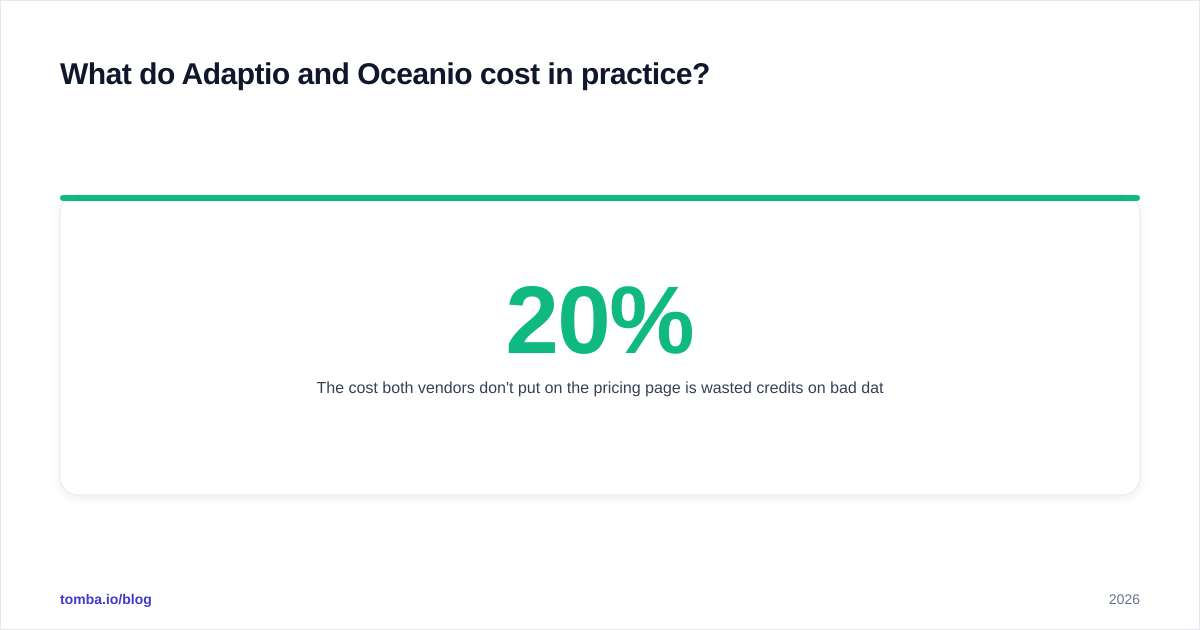
The cost both vendors don't put on the pricing page is wasted credits on bad data. If 20% of your contacts bounce, you're effectively paying a 20% tax on every campaign regardless of which platform you chose. A predictable, transparent data source — see Tomba pricing, which starts free at 25 searches/mo and scales from $49/mo — removes that tax by making sure credits only get spent on reachable people.
Adaptio vs Oceanio: which should you choose?#
Here's the decision boiled down.
Choose Adaptio if you:
- Run a mid-market or enterprise team with a defined sales process
- Already use Salesforce or HubSpot as your system of record
- Need branching automation, lead routing, and multi-touch attribution
- Have the time to invest in setup for long-term control
Choose Oceanio if you:
- Are a startup or SMB that needs pipeline this week
- Want prospecting and sequences without a heavy CRM
- Value simplicity and a low entry price over deep customization
- Have a single, linear sales motion
Choose neither — yet — if you haven't solved your data layer. The most expensive mistake in this comparison is spending weeks evaluating Adaptio vs Oceanio while feeding both unverified contacts. Fix the input first; the platform decision gets easier and cheaper once your data is clean.
Frequently asked questions#
Is Oceanio cheaper than Adaptio? At the entry level, yes — Oceanio offers a free plan and lower per-seat pricing. At scale, Adaptio can consolidate multiple tools and come out competitive, especially for larger teams replacing several point solutions.
Can I use Adaptio or Oceanio without a CRM? Oceanio works standalone for prospecting and sequencing. Adaptio technically can, but it's designed to orchestrate on top of a CRM, so you lose much of its value without one.
Do Adaptio and Oceanio find email addresses for me? Both include some contact data, but coverage and accuracy vary. Most serious teams pair their GTM platform with a dedicated find email addresses tool and verify before sending to protect deliverability.
Which has better deliverability? Deliverability depends far more on your data quality and sending hygiene than on the platform's logo. Verify every address, warm up your domain, and keep bounce rates low regardless of which tool you pick.
The data layer that makes either platform work#
Whether you land on Adaptio's orchestration or Oceanio's speed, the platform is only the engine — clean contact data is the fuel. Bad emails throttle both equally.
That's where Tomba fits, no matter which side of this comparison you choose. Use the Tomba Email Finder to source professional emails by name, company, or domain search, then verify them before they ever touch a sequence. You can start free with 25 searches a month and scale on transparent Tomba plans from $49/mo — so the contacts flowing into Adaptio or Oceanio are reachable, not guessed. Pick your GTM platform for the workflow; let Tomba make sure that workflow is firing at real people.
// get started
Find, verify and enrich your first contacts today
Start on the free plan with 25 searches a month, then scale when your team is ready.
Free plan · No credit card required · GDPR & CCPA
// about the author