Adaptio vs Salesgenie: B2B Data Platform Showdown (2026)
Adaptio vs Salesgenie compared on data freshness, coverage, pricing, and workflow fit — plus where a focused email finder beats both for outbound teams in 2026.
Choosing between Adaptio and Salesgenie usually comes down to one question: do you need a modern, API-friendly B2B contact dataset, or a classic local-business lead database with a long sales-and-marketing heritage? They look similar on a feature grid, but they were built for different buyers, different decades, and different motions.
This guide breaks down the real differences — data freshness, coverage, pricing model, and workflow fit — so you can pick the right tool instead of the louder one. And because most teams comparing these two are really trying to solve "get verified contacts into my sequence fast," we'll also cover where a focused email finder beats a full platform.
TL;DR#
- Salesgenie (by Data Axle) is a mature lead-list and local-business marketing database — strong for SMB, retail, and direct-mail-style campaigns, sold mostly on subscription/quote.
- Adaptio (in the Adapt.io family of B2B contact tools) leans modern: API access, contact/company enrichment, and Chrome-extension prospecting for tech-forward sales teams.
- Data freshness is the deciding factor. Static, periodically refreshed lists age fast; real-time verified lookups protect your sender reputation.
- Neither is the cheapest path to verified emails. If your core need is "find and verify a known contact," a specialized email finder is faster and far less expensive.
- Pick on use case: broad local lists → Salesgenie; modern B2B enrichment + API → Adaptio; precise, verified outreach → a dedicated finder/verifier stack.
What is Adaptio?#
Adaptio sits in the modern B2B contact-data category alongside the Adapt.io toolset: a searchable database of business contacts and companies, a Chrome extension for prospecting on LinkedIn and company sites, and enrichment/API endpoints that push data into your CRM. The pitch is built for sales and marketing teams who live inside their pipeline tools and want contact data to flow automatically rather than arrive as a downloaded spreadsheet.
Its strengths are the things older databases struggle with: filtering by technographic and firmographic signals, enriching a record the moment it enters your CRM, and programmatic access so engineering can wire data into internal systems. If your team thinks in terms of "API-first" and "enrich on capture," Adaptio speaks your language.
What is Salesgenie?#
Salesgenie is a long-running lead-generation service from Data Axle (formerly Infogroup), aimed squarely at small businesses, agencies, insurance/financial reps, and anyone running local or direct-marketing campaigns. It's known for deep U.S. business and consumer coverage, list-building by geography and SIC/NAICS, and add-ons for direct mail, email campaigns, and even telemarketing lists.
If you've ever built a "all dentists within 25 miles" or "homeowners in these ZIP codes" list, Salesgenie is the tool that motion was designed around. Its consumer-data heritage and breadth of local-business records are genuinely hard to match. You can read more on the official Salesgenie site, and cross-check user sentiment on G2.
The trade-off: it's a list-centric product. The classic workflow is search → build list → export, which is excellent for batch campaigns but less suited to the real-time, per-record enrichment that modern outbound stacks expect.
)
Adaptio vs Salesgenie: how do they compare?#
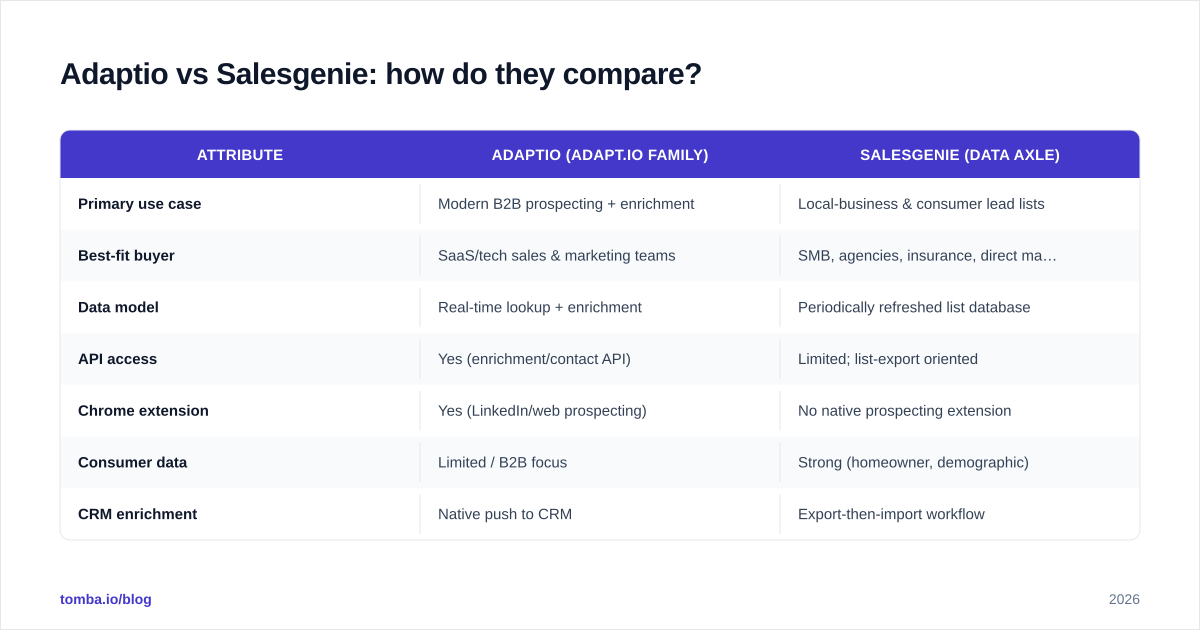
Here's the head-to-head on the attributes that actually change your results. Treat exact pricing as directional — both vendors quote based on seats, records, and contract length, so confirm current numbers before you buy.
| Attribute | Adaptio (Adapt.io family) | Salesgenie (Data Axle) |
|---|---|---|
| Primary use case | Modern B2B prospecting + enrichment | Local-business & consumer lead lists |
| Best-fit buyer | SaaS/tech sales & marketing teams | SMB, agencies, insurance, direct mail |
| Data model | Real-time lookup + enrichment | Periodically refreshed list database |
| API access | Yes (enrichment/contact API) | Limited; list-export oriented |
| Chrome extension | Yes (LinkedIn/web prospecting) | No native prospecting extension |
| Consumer data | Limited / B2B focus | Strong (homeowner, demographic) |
| CRM enrichment | Native push to CRM | Export-then-import workflow |
| Pricing model | Tiered/credit + quote | Subscription/quote-based |
| Free trial | Limited free/trial tier | Trial available |
| Strongest at | Tech-stack & firmographic targeting | Geographic/local saturation lists |
The pattern is clear: Adaptio is built for the live, integrated workflow; Salesgenie is built for breadth and batch. Your decision should follow your motion, not a feature checkbox.
Which one has better data accuracy?#
Accuracy depends less on database size and more on when the record was last verified. This is where the two philosophies diverge.
Salesgenie's depth in local-business and consumer data is a real asset, but list databases age between refresh cycles. A phone number or email that was valid at the last compile can be stale by the time you mail or dial. For direct mail that matters less — a returned postcard is cheap. For cold email, a stale address is expensive: it can trigger bounces that damage your domain.
Adaptio's real-time lookup model is designed to reduce that decay, returning a fresher record at the moment you query. But "real-time" still isn't "verified" — a returned email can be syntactically valid and still bounce. That's why mature teams separate finding from verifying and run a dedicated email verifier before any record hits a sequence.
Before you trust any vendor's accuracy claim, do the obvious test: pull 100 records, verify them independently, and measure your real bounce rate. Marketing copy isn't evidence; your bounce log is. For context on why this matters, see the fundamentals of email deliverability — bounce rate is one of the first signals mailbox providers use to throttle a sender.
Is Adaptio or Salesgenie better for cold email?#
Honest answer: neither is purpose-built for cold email, and that's the catch.
Salesgenie's email and direct-mail tools are oriented toward volume campaigns to local lists — closer to a marketing-blast mindset than to targeted, deliverability-conscious outbound. Sending cold email to a large, unverified local list is one of the fastest ways to land in spam folders and burn your domain.
Adaptio gets you closer with fresher B2B contacts and CRM integration, but you still need to verify before sending and warm your domain properly. A platform that hands you an address has done half the job; protecting your sender reputation is the other half.
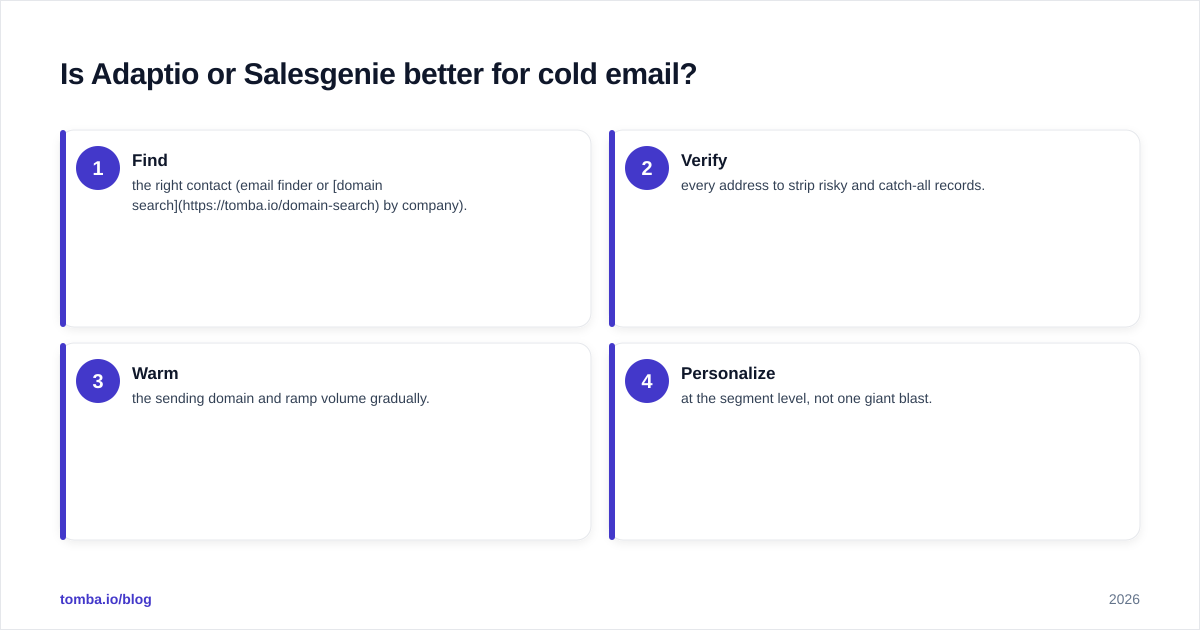
For a cold-email motion, the winning stack usually looks like this:
- Find the right contact (email finder or domain search by company).
- Verify every address to strip risky and catch-all records.
- Warm the sending domain and ramp volume gradually.
- Personalize at the segment level, not one giant blast.
Notice that "buy a big list" isn't on that list. Smaller, verified, well-targeted beats large and stale every time.
)
How much do Adaptio and Salesgenie cost?#
Both lean on quote-based pricing, which makes apples-to-apples comparison hard and often pushes you toward annual commitments before you've proven ROI.
- Salesgenie historically sells via monthly/annual subscriptions with tiers tied to how many records you can download and which channels (email, mail, phone) you unlock. Higher tiers and unlimited-style plans get expensive, and you're frequently committing up front.
- Adaptio-style B2B platforms typically use credit or seat-based tiers, sometimes with a limited free entry point, then scale into sales-led enterprise quotes for API volume and large exports.
The practical issue for a lean team: you're paying for a whole platform when your actual need might be "find and verify a few thousand contacts a month." That's where transparent, usage-based pricing wins. For example, you can compare Tomba pricing — a Free tier with 25 searches/month, Starter at $49/mo, Growth at $99/mo, and Pro at $249/mo — against an opaque enterprise quote and instantly see your cost per verified contact. You can sanity-check both vendors' plans against reviews on Capterra before committing.
When should you choose a focused email finder instead?#
Choose a specialized finder + verifier when your bottleneck is verified contact data for outreach, not list breadth or consumer demographics. That covers most B2B SDR, founder-led sales, and recruiting workflows.
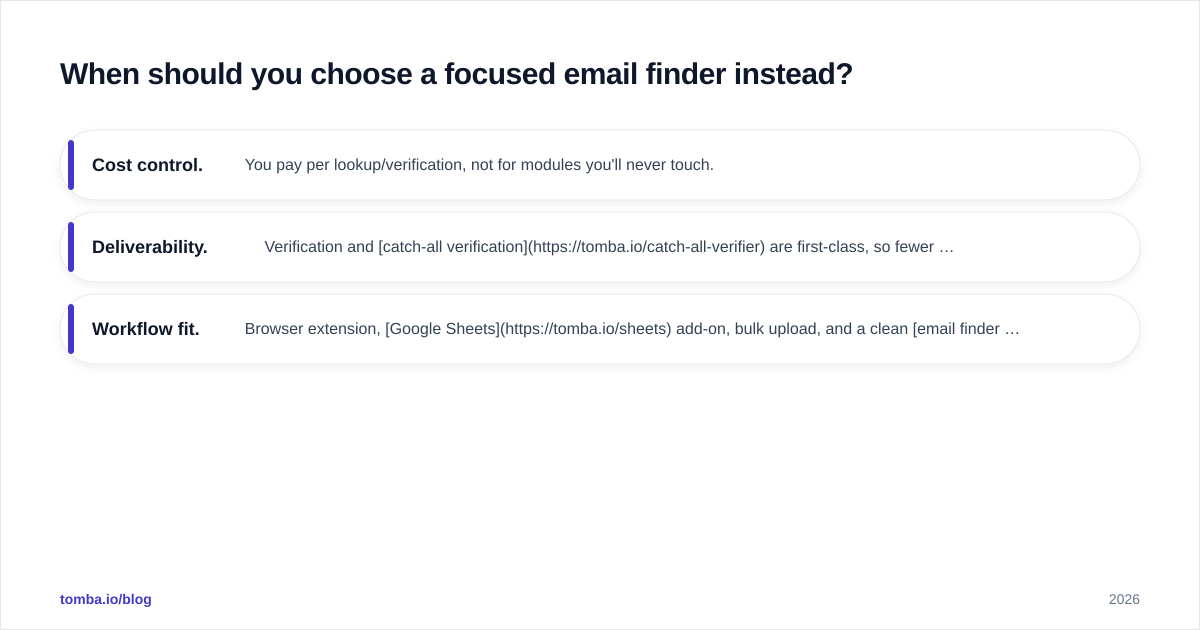
A focused stack gives you three advantages over a heavyweight platform:
- Cost control. You pay per lookup/verification, not for modules you'll never touch.
- Deliverability. Verification and catch-all verification are first-class, so fewer bounces reach your sequence.
- Workflow fit. Browser extension, Google Sheets add-on, bulk upload, and a clean email finder API mean the data lands wherever you already work.
Use the simple decision rule below.
| Your priority | Best fit |
|---|---|
| Broad local/consumer lists, direct mail | Salesgenie |
| Modern B2B enrichment + API in CRM | Adaptio |
| Verified emails for cold outreach | Dedicated email finder + verifier |
| Lowest cost per verified contact | Usage-based finder (e.g., Tomba) |
| One-off list of a few thousand contacts | Finder with free/Starter tier |
What's the verdict on Adaptio vs Salesgenie?#
There's no universal winner — there's a winner for your motion.
- Pick Salesgenie if your campaigns are local, demographic, or direct-mail heavy and you value Data Axle's coverage depth over real-time freshness.
- Pick Adaptio if you run modern B2B outbound, want API-driven enrichment inside your CRM, and your reps prospect from the browser.
- Pick a focused finder/verifier if your real job is getting accurate, verified emails into sequences without paying platform prices for features you won't use.
The most common mistake is buying the biggest database and assuming volume equals results. In cold outreach, the opposite is true: a tightly targeted list of verified contacts outperforms a sprawling stale one, and it protects the domain you'll be sending from for years.
Ready to skip the platform tax?#
If your goal is verified B2B emails — not a sprawling data subscription — start with the Tomba Email Finder. Search by name, company, or domain; verify every address before it enters a sequence; and push results to your CRM, Sheets, or sequencer through a clean API. The Free tier lets you test real accuracy on your own target accounts before you spend a dollar, and paid plans scale on usage instead of locking you into an annual platform contract. Run 100 of your own prospects through it, check the bounce rate, and let the data decide.
// get started
Find, verify and enrich your first contacts today
Start on the free plan with 25 searches a month, then scale when your team is ready.
Free plan · No credit card required · GDPR & CCPA
// about the author