Adaptio vs Span Global Services: 2026 B2B Data Comparison
A neutral, side-by-side breakdown of Adaptio vs Span Global Services in 2026 — data accuracy, compliance, pricing models, and which B2B data partner fits your go-to-market motion.
Choosing a B2B data partner is one of those decisions that quietly sets the ceiling on every campaign you run for the next year. Pick a provider with stale records and you pay for it in bounce rates, wasted SDR hours, and a sender reputation that takes months to rebuild. This guide puts Adaptio vs Span Global Services side by side so you can match the right model to your actual go-to-market motion — not to a sales pitch.
TL;DR#
- Span Global Services is a managed B2B data and marketing-services vendor: it sells curated contact lists, data append, and done-for-you campaign support, typically priced by quote and by volume.
- Adaptio sits closer to the self-serve platform end — programmatic data access and enrichment workflows aimed at RevOps and growth teams who want to build segments themselves.
- The real split is service model: Span leans "we'll build the list for you," Adaptio leans "give us the tools and API."
- For either path, the data is only as good as its verification layer — uncleaned lists wreck deliverability no matter who sold them.
- Many teams pair a primary database with a real-time email verifier and on-demand email finder instead of buying one giant static list.
What are Adaptio and Span Global Services?#
Both names show up when buyers search for B2B contact data, but they solve the problem from opposite ends.
Span Global Services is a long-standing data and marketing-services company. Its core offering is human-curated and appended B2B contact lists — segmented by industry, title, technology stack, geography, and company size — plus adjacent services like data cleansing, email/phone append, and managed multichannel campaigns. You typically tell their team your ideal customer profile, and they return a targeted list or run the outreach for you. Pricing is quote-based and scales with record volume and the depth of service.
Adaptio positions itself nearer the self-serve, platform side of the market: programmatic access to B2B records, enrichment of your existing CRM rows, and segment-building you control directly rather than through an account manager. The pitch is closer to "infrastructure for your data workflows" than "a list delivered to your inbox."
That difference — managed service versus self-serve platform — is the lens that should drive your decision more than any single feature checkbox.
How do Adaptio and Span Global Services compare?#
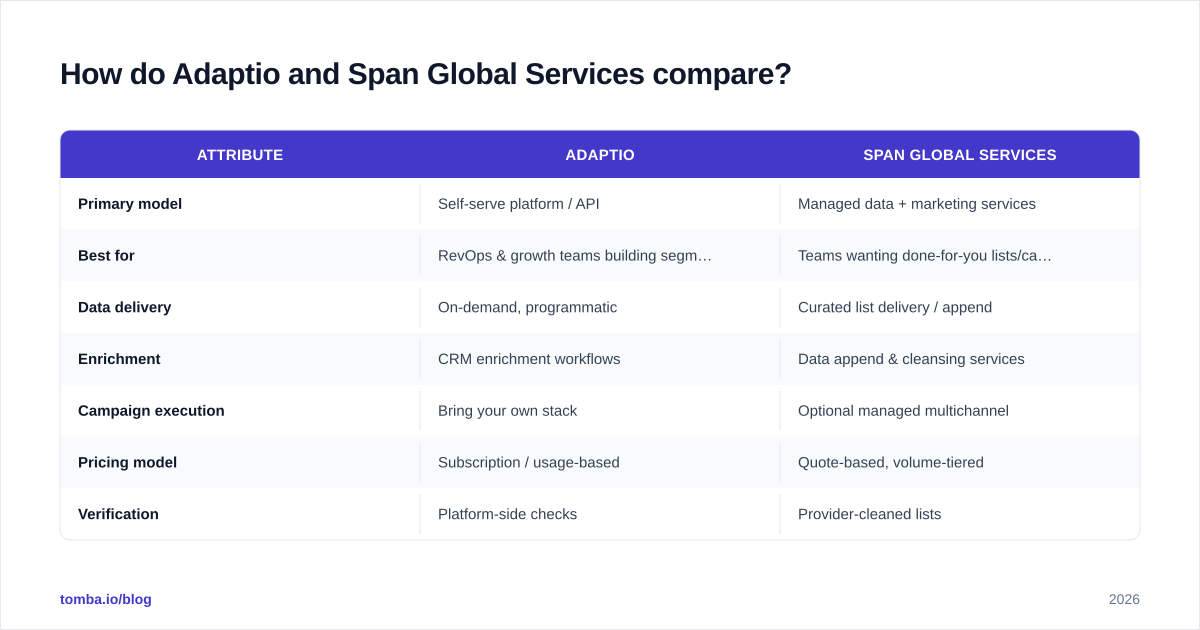
Here is the honest, attribute-by-attribute view. Treat specific pricing as indicative — both vendors quote based on volume and scope, so confirm current numbers directly.
| Attribute | Adaptio | Span Global Services |
|---|---|---|
| Primary model | Self-serve platform / API | Managed data + marketing services |
| Best for | RevOps & growth teams building segments | Teams wanting done-for-you lists/campaigns |
| Data delivery | On-demand, programmatic | Curated list delivery / append |
| Enrichment | CRM enrichment workflows | Data append & cleansing services |
| Campaign execution | Bring your own stack | Optional managed multichannel |
| Pricing model | Subscription / usage-based | Quote-based, volume-tiered |
| Verification | Platform-side checks | Provider-cleaned lists |
| Time to first list | Minutes (self-serve) | Days (scoped engagement) |
| Support style | Product + docs | Dedicated account team |
The pattern is consistent: Adaptio optimizes for speed and control, while Span optimizes for hands-off delivery. Neither is universally "better" — they fit different team shapes.
What is Adaptio best for?#
Adaptio fits you if your team already owns its outbound stack and just needs a clean data layer feeding it.
You'll get the most value if:
- You have a RevOps or growth function that lives in the CRM daily and wants to build and iterate on segments without a back-and-forth email thread.
- You care about freshness over volume — pulling records on demand instead of buying a static list that decays the moment it's exported.
- You want enrichment to run as a workflow (fill missing titles, company size, technographics on existing rows) rather than as a one-time append job.
- You have engineering or ops capacity to wire an API or integration into your pipeline.
The trade-off: self-serve means you own the quality control. There's no account manager double-checking that your "VP Marketing, fintech, 200–500 employees" segment is actually clean before it hits your sequencer. That responsibility shifts to you — which is exactly why a verification step matters (more below).

What is Span Global Services best for?#
Span Global Services fits you if you'd rather hand off the data work entirely.
It tends to win when:
- You're running a campaign into a market you don't have lists for, and you want a vendor to scope, build, and deliver a targeted list against your ICP.
- Your team is lean on ops headcount and the managed-service model is genuinely worth paying for — someone else owns segmentation, cleansing, and sometimes execution.
- You need data append or cleansing on a large existing database and want it done as a project, not a self-managed task.
- You value a dedicated account contact over a self-serve dashboard.
The trade-off runs the other way: quote-based, project-style engagements are slower to start and less transparent on unit economics. You're trusting the provider's process, and the quality of any list you buy hinges entirely on how recently it was verified — a list curated last quarter can already carry meaningful decay by the time you mail it.
How accurate is the data, really?#
Accuracy is where most B2B data buyers get burned, and it's the question both vendors' marketing tends to answer vaguely.
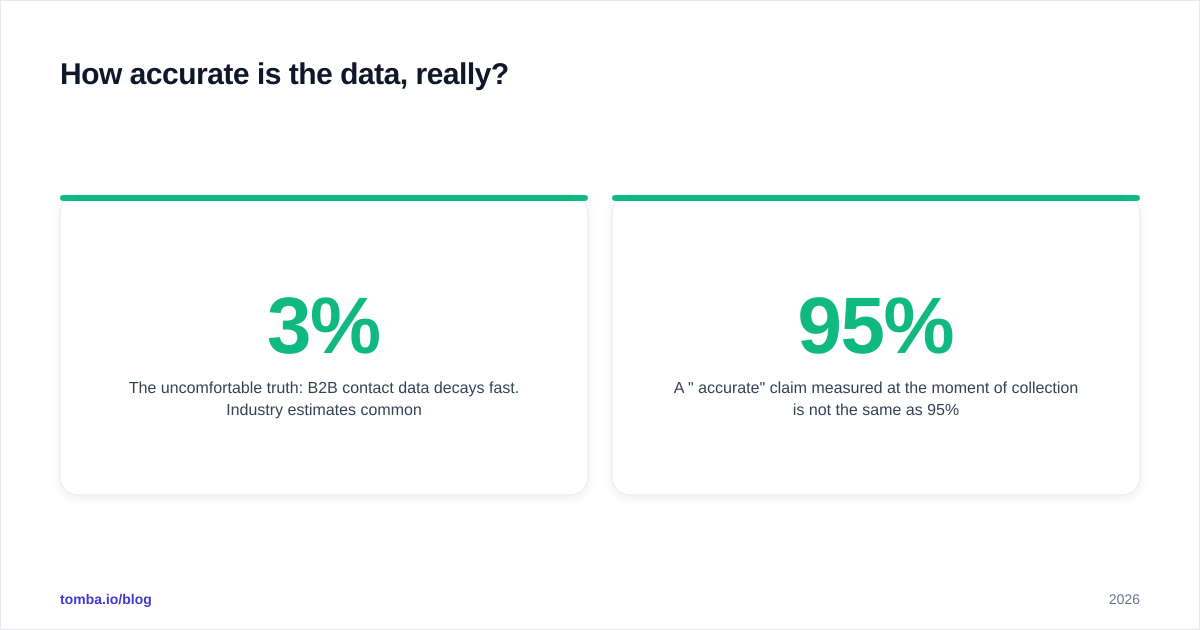
The uncomfortable truth: B2B contact data decays fast. Industry estimates commonly cite roughly 2–3% of records going stale every month as people change jobs, companies rebrand, and domains migrate — which compounds to a large chunk of any list within a year. Independent reviews on platforms like G2 and Capterra consistently show the same story across the whole category: claimed accuracy and observed bounce rates rarely match.
What this means in practice:
- A "95% accurate" claim measured at the moment of collection is not the same as 95% accurate when it lands in your sequencer weeks later.
- A managed list from Span is only as fresh as its last cleanse cycle.
- A self-serve pull from Adaptio is fresher by design, but you still need to confirm each address is deliverable before you send.
This is why experienced teams treat any purchased or platform-sourced data as a starting point, not a finished asset. You run it through a verification pass that checks syntax, domain validity, MX records, and catch-all status before a single email goes out. You can read more about how source quality is built and maintained on Tomba's data sources page, which is a useful reference point for evaluating any provider's claims.
What about compliance and deliverability?#
If you sell into the EU, UK, or California, compliance isn't optional — it's a precondition.
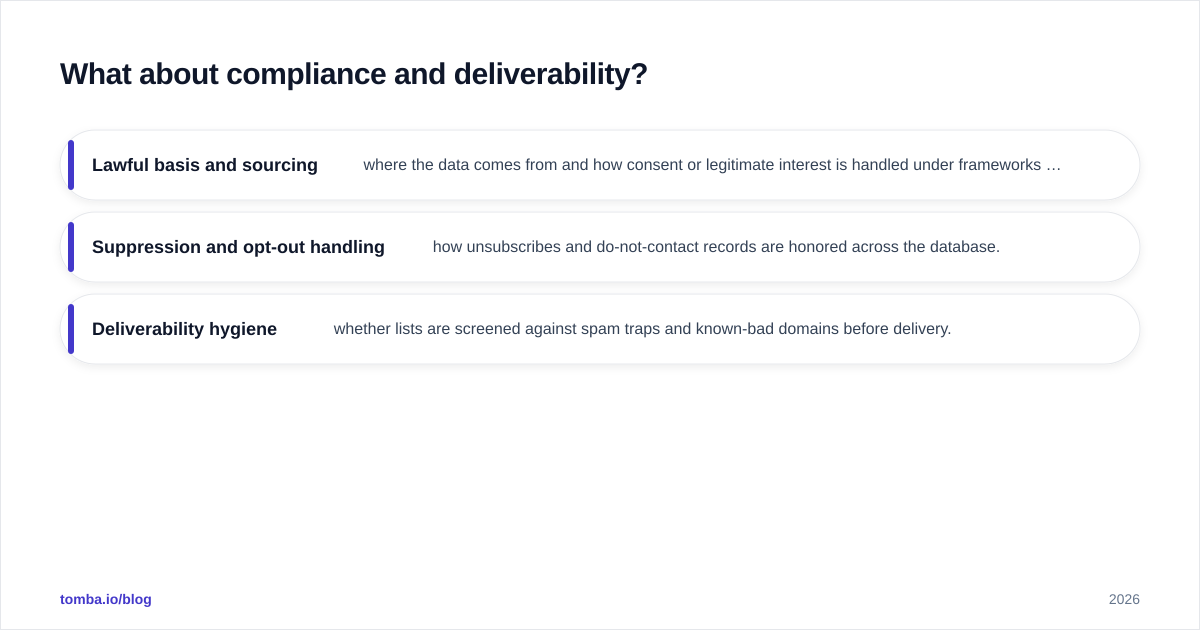
Any B2B data partner you choose should give you clear answers on:
- Lawful basis and sourcing — where the data comes from and how consent or legitimate interest is handled under frameworks like GDPR and CAN-SPAM.
- Suppression and opt-out handling — how unsubscribes and do-not-contact records are honored across the database.
- Deliverability hygiene — whether lists are screened against spam traps and known-bad domains before delivery.
Managed providers like Span typically fold suppression and cleansing into the engagement, which is part of what you're paying for. Self-serve platforms like Adaptio put more of that responsibility on you — which, again, is manageable if you own the verification step.
Deliverability is the downstream consequence of all this. Send to a decayed list and your bounce rate spikes, mailbox providers throttle you, and your sender reputation takes a hit that affects every future campaign — including the ones to your good contacts. Protecting deliverability is the single best argument for verifying data regardless of which vendor supplied it.
Pricing: how do they stack up?#
Neither vendor publishes simple flat-rate pricing, which itself tells you something about how they sell.
- Span Global Services uses quote-based, volume-tiered pricing. Cost scales with record count and the depth of service (raw list vs. append vs. full managed campaign). Expect a scoping conversation before you see a number.
- Adaptio leans toward subscription or usage-based pricing typical of self-serve platforms, where you pay for access and consumption rather than a per-project quote.
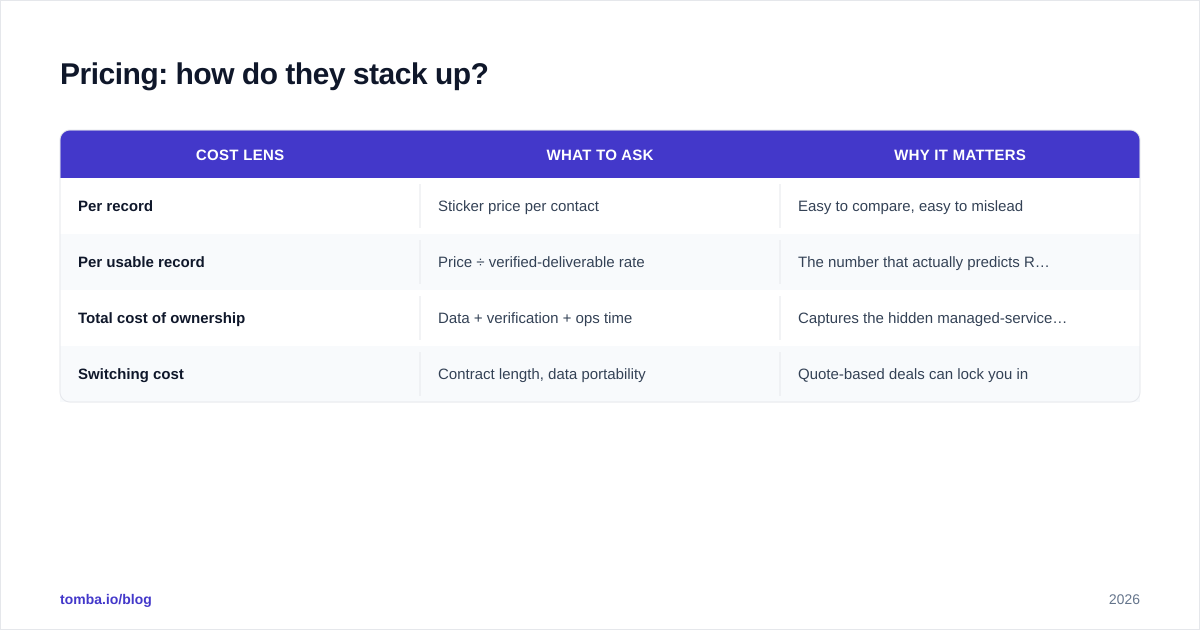
The right way to compare is cost per usable contact, not cost per record. A cheap list with a 25% bounce rate is more expensive than a pricier list you can actually mail, once you account for burned sender reputation and SDR time chasing dead addresses.
A pragmatic way to model it:
| Cost lens | What to ask | Why it matters |
|---|---|---|
| Per record | Sticker price per contact | Easy to compare, easy to mislead |
| Per usable record | Price ÷ verified-deliverable rate | The number that actually predicts ROI |
| Total cost of ownership | Data + verification + ops time | Captures the hidden managed-service savings |
| Switching cost | Contract length, data portability | Quote-based deals can lock you in |
Which should you choose between Adaptio and Span Global Services?#
Conclusion first: pick by team shape, not by feature list.
- Choose Adaptio if you have an ops/RevOps function, you want fresh data on demand, you're comfortable owning verification, and you value control and unit-economics transparency.
- Choose Span Global Services if you want a managed engagement, you're short on internal data ops, you need append/cleansing on a large existing database, or you want a vendor to run the campaign end to end.
- Choose neither as a monolith if your real need is narrower — specific contacts at specific accounts, enriched on demand — because a focused finder-plus-verifier stack often beats a big static list on both cost and freshness.
Can you skip the big-list model entirely?#
For a lot of teams, yes — and this is the option neither vendor's pitch foregrounds.
If your motion is precise outbound (named accounts, specific roles) rather than spray-and-pray volume, you don't need to buy or subscribe to a massive database. You need to find the right contacts when you need them and confirm they're real before you send. That stack looks like:
- Find — pull verified professional emails by name, company, or domain with an email finder or domain search instead of importing thousands of records you'll never touch.
- Verify — run every address through an email verifier for syntax, MX, and catch-all checks before it enters a sequence.
- Enrich — fill the gaps (title, company size, technographics) on the contacts that matter with data enrichment rather than buying enrichment on a list that's mostly noise.
This approach trades raw volume for freshness and deliverability — usually the better trade for modern outbound, where mailbox providers punish sloppy sending hard.
FAQ#
Is Adaptio or Span Global Services more accurate? Neither can promise lasting accuracy on its own, because B2B data decays continuously. Span's managed cleansing helps at delivery time; Adaptio's on-demand model is fresher by design. Either way, verify before you send.
Which is cheaper? It depends on volume and model. Span's quote-based pricing can be efficient at high volume with managed service; Adaptio's usage-based model suits teams that pull data continuously. Compare cost per usable contact, not per record.
Do I need a separate verification tool? Almost always, yes — especially with self-serve data. A real-time verification pass is the cheapest insurance you can buy for your sender reputation.
Can I use both? Sure. Some teams use a managed provider for broad market lists and a self-serve finder for precise, named-account outreach. They're complementary, not mutually exclusive.
The bottom line#
Adaptio vs Span Global Services comes down to whether you want a self-serve platform you control or a managed service that does the data work for you. Both can deliver — and both live or die on how fresh and verified the underlying records are.
If your outbound is precise and you'd rather pay for clean, current contacts than a decaying database, start with the Tomba Email Finder. Find professional emails by name, domain, or company; verify them before they hit your sequencer; and enrich only the contacts worth your reps' time. Check the Tomba pricing tiers — a free plan with 25 searches a month lets you test the approach before you commit a budget to any big-list contract.
// get started
Find, verify and enrich your first contacts today
Start on the free plan with 25 searches a month, then scale when your team is ready.
Free plan · No credit card required · GDPR & CCPA
Get the Tomba newsletter
Product and data updates
// about the author