Adaptio vs Tomba 2026: B2B Prospecting Data Compared
Adaptio vs Tomba: one optimizes how reps sell, the other supplies the verified contact data they sell to. Here's which you actually need in 2026 — and why most teams run both.
TL;DR
- Adaptio and Tomba solve different problems. Adaptio is a sales enablement and workflow layer that helps reps sell smarter; Tomba is a data layer that finds and verifies the email addresses those reps actually contact.
- If your pipeline is starving for accurate contacts, start with Tomba. No amount of coaching or sequencing fixes a list of bounced, guessed, or stale emails.
- If your reps have data but lack process, lean toward an enablement tool. The two are complements far more often than substitutes.
- On price, Tomba is transparent and self-serve — a free tier (25 searches/mo) and a Starter plan at $49/mo — while enablement platforms typically quote custom, seat-based pricing.
- The winning play for most teams: run a verified-data engine underneath whatever enablement layer you choose.
Why are people comparing Adaptio vs Tomba?#
Short answer: because both show up when you search "tools to fix our outbound," but they fix different parts of it.
Think of outbound sales like running a restaurant. Adaptio-style platforms are the kitchen workflow — recipes, timing, who plates what, how to upsell dessert. Tomba is the supplier that delivers fresh ingredients to the back door every morning. A flawless kitchen process cooking spoiled ingredients still sends bad plates to the table. That's the core of the adaptio vs tomba question: you're usually not choosing between them, you're deciding which gap is bleaking the most revenue right now.
This post breaks down what each tool actually does, where each one wins, honest pricing, and a simple framework for deciding what to buy first.
What is Adaptio?#
Adaptio positions itself in the sales enablement and workflow space — the category of tools that sit on top of your CRM and outreach to help reps execute better. Tools in this lane generally focus on:
- Guided selling and playbooks that tell a rep the next best action
- Sequence and cadence orchestration across email, calls, and social
- Coaching signals, call review, and rep performance analytics
- Adapting messaging or timing based on prospect behavior
The value proposition is execution quality: take the contacts and accounts you already have and convert more of them by improving how, when, and what reps communicate. It's a layer that makes existing pipeline more efficient.
What enablement platforms in this category do not typically do is source and verify net-new contact data at scale. They assume the contacts are already in your CRM. That assumption is exactly where Tomba enters.
What is Tomba?#
Tomba is a B2B email finder and lead-enrichment platform. Its job is to turn a name, a domain, or a company into a deliverable, verified email address — and to do it accurately enough that your sender reputation survives.
The core toolset:
- Email Finder — find professional emails by name + company or domain
- Email Verifier — validate addresses before you send to protect email deliverability
- Domain Search — pull every known email pattern and contact for a company
- Catch-all verifier, phone finder, and data enrichment alongside the core finder
- Tomba API, CLI, and spreadsheet add-ins for bulk and programmatic workflows
In the restaurant analogy, Tomba is the ingredient supplier with a quality-control lab attached. It doesn't tell your reps how to sell — it makes sure every address they touch is real.
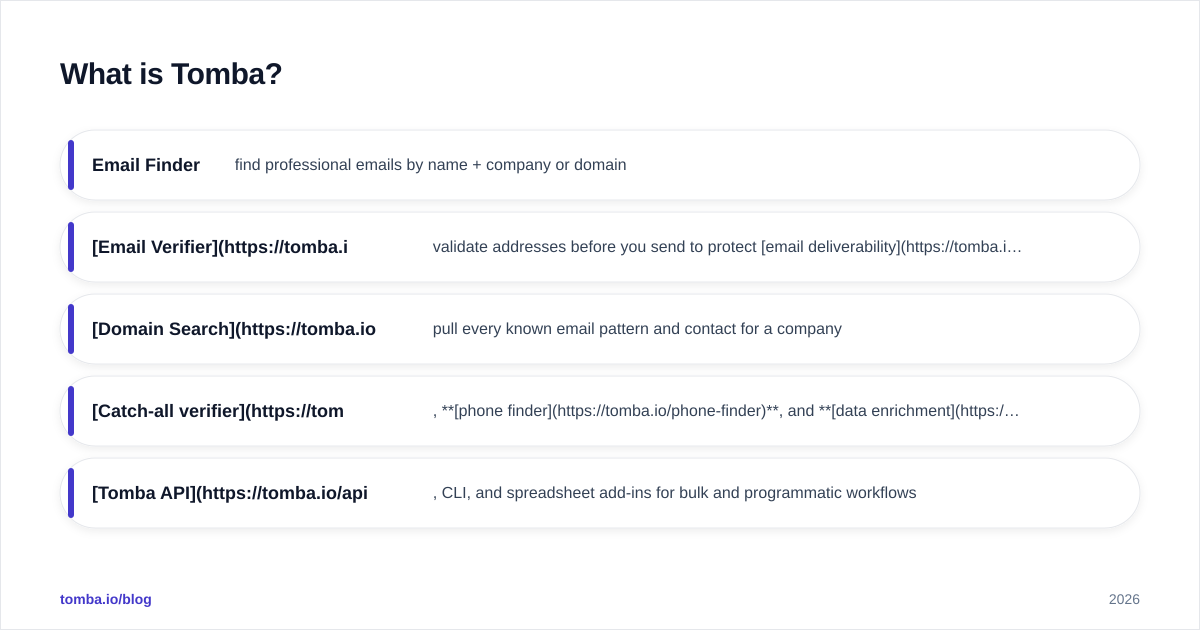
Adaptio vs Tomba: head-to-head comparison#
Here's the honest side-by-side. Note that these tools sit in different categories, so "better" depends entirely on which gap you're filling.
| Attribute | Adaptio (enablement layer) | Tomba (data layer) |
|---|---|---|
| Primary job | Improve how reps sell | Find & verify who reps contact |
| Category | Sales enablement / workflow | Email finder / lead enrichment |
| Net-new contact sourcing | No | Yes — finder + domain search |
| Email verification | No | Yes — verifier + catch-all |
| Entry price | Custom / seat-based (typical) | Free tier, then $49/mo Starter |
| Free tier | Rarely | Yes — 25 searches/mo |
| API access | Varies | Yes — REST API, CLI, MCP |
| Bulk processing | N/A for data | Yes — bulk finder & verifier |
| Best for | Teams with data, weak process | Teams with process, weak data |
| Replaces the other? | No | No |
The takeaway from the table: this isn't Coke vs Pepsi. It's closer to "espresso machine vs coffee beans." You can argue about which matters more, but you don't run a café with only one.

Is Adaptio better than Tomba?#
Wrong question — but here's the useful version of the answer.
Ask instead: what is currently breaking your outbound? Run this quick diagnostic.
- Bounce rate above 3%? Reps complaining about wrong or missing emails? Your data is the bottleneck. Fix that first with a verified email finder. An enablement tool can't coach a rep into a deliverable inbox.
- Good data, but inconsistent messaging, no follow-up discipline, low response rate? Your process is the bottleneck. An enablement layer earns its seat cost here.
- Both broken? Sequence it: data integrity first (so you're not optimizing a process that emails dead addresses), enablement second.
The reason data usually comes first is mechanical. Sender reputation degrades fast when you hit invalid addresses and spam traps. Once your domain reputation tanks, even perfectly coached reps land in spam. You can't out-sell a blocklist. That's why teams who "fixed their process" before fixing their list often see the gains evaporate within a quarter.
How accurate is the data, and why does it matter?#
Accuracy is the whole game for the data layer, so it deserves its own section.
A single percentage point of bounce difference compounds. Send 10,000 emails a month at a 1% bounce rate and you've got 100 bad sends. At 6% — common with unverified, scraped, or guessed lists — that's 600, and mailbox providers notice the pattern long before you do. The cost isn't the wasted sends; it's the silent throttling of every email after them.
This is where verification stops being optional. Tomba pairs its finder with an email verifier and a dedicated catch-all finder so you're scoring deliverability before the send, not discovering it from your bounce report. You can see how the underlying data sources are assembled rather than treating accuracy as a black box.
Enablement tools, by design, don't touch this. They trust the data in your CRM. So if you're evaluating adaptio vs tomba purely on "which improves reply rates," remember that verified data improves reply rates structurally — by keeping you out of spam — while enablement improves them behaviorally. You want both, but only one of them protects the channel itself.
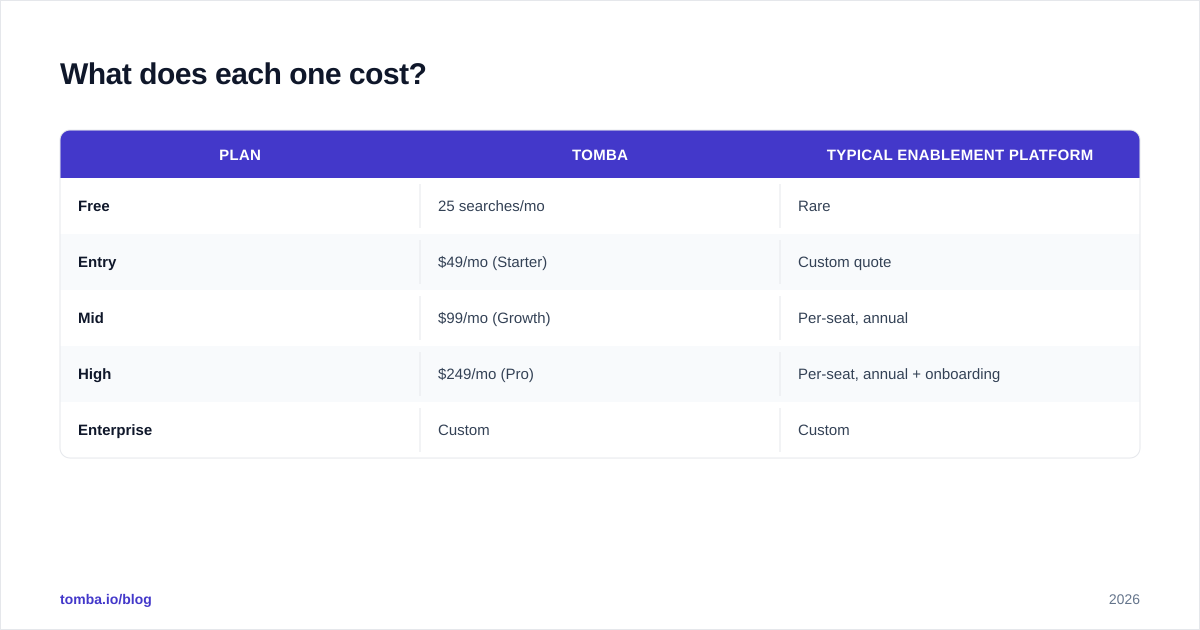
What does each one cost?#
Pricing philosophy is one of the clearest differences between the two categories.
| Plan | Tomba | Typical enablement platform |
|---|---|---|
| Free | 25 searches/mo | Rare |
| Entry | $49/mo (Starter) | Custom quote |
| Mid | $99/mo (Growth) | Per-seat, annual |
| High | $249/mo (Pro) | Per-seat, annual + onboarding |
| Enterprise | Custom | Custom |
Tomba is self-serve and transparent — you can start free and scale per usage without a sales call. Full Tomba pricing is public. Enablement platforms (Adaptio included, based on the category norm) typically price per seat with annual commitments and onboarding, because the value is tied to rep headcount and rollout services rather than data volume.
Practical implication: a small team or a solo founder can stand up a verified-data engine for the price of a couple of lunches. A seat-based enablement contract usually only pencils out once you have a rep team large enough to justify the process investment. Match the spend to the stage you're in.
When should you choose each one?#
A clean decision rule, by situation:
Choose a data-first tool like Tomba when:
- You're building lists from scratch or your CRM is stale
- Bounce rates or deliverability are visibly hurting you
- You need bulk lead generation or programmatic enrichment via API
- You're a lean team that needs self-serve, usage-based pricing
- You want to enrich inbound or website visitors before routing them
Choose an enablement layer like Adaptio when:
- Your contact data is already solid and verified
- You have enough reps that consistency and coaching move the number
- Your problem is execution: follow-up discipline, messaging, cadence
- You can justify seat-based annual spend and a rollout
Run both when: you're scaling outbound seriously. Tomba feeds verified contacts and enrichment into your CRM via native integrations — including HubSpot and Salesforce — and the enablement layer governs how reps work those contacts. Clean inputs, disciplined process. That's the stack.
How do you combine them into one workflow?#
Here's a concrete pipeline that uses each tool for what it's good at:
- Source — use domain search or the bulk email finder to pull contacts for your target accounts.
- Verify — run every address through the email verifier and flag catch-all domains so you never send blind.
- Enrich — append firmographic and role data with data enrichment so segmentation is accurate.
- Sync — push verified, enriched contacts into your CRM through [
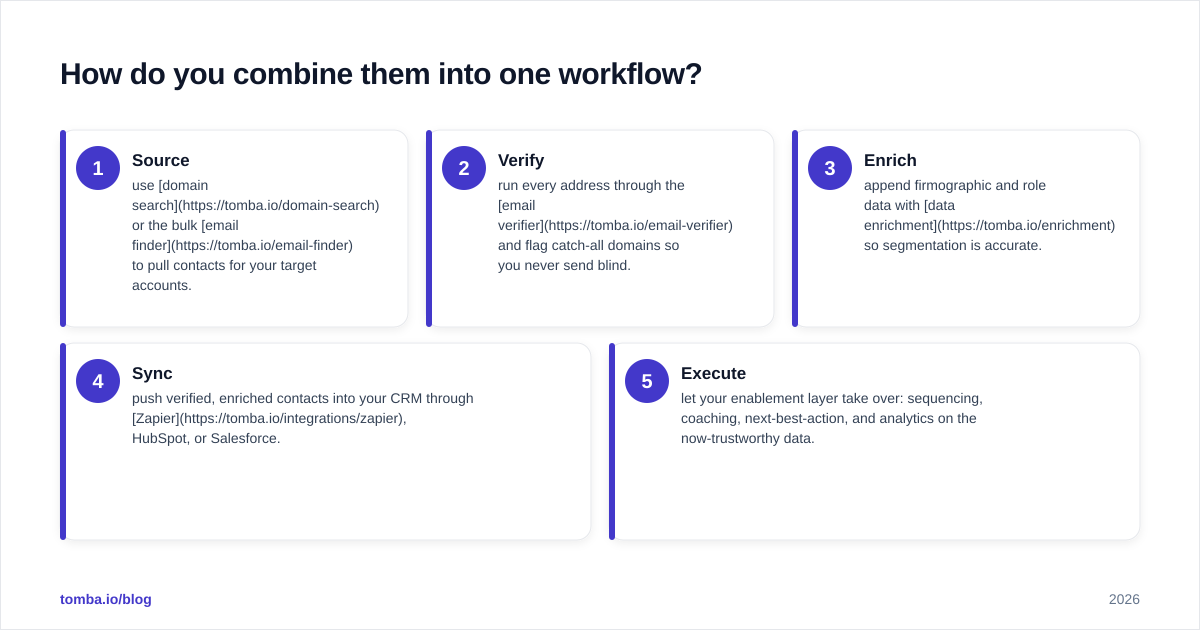
Zapier](https://tomba.io/integrations/zapier), HubSpot, or Salesforce. 5. Execute — let your enablement layer take over: sequencing, coaching, next-best-action, and analytics on the now-trustworthy data.
The order matters. Verification and enrichment happen before anything enters the sequencing engine, so your process metrics reflect selling skill — not data noise. If you'd rather start outside your CRM, the Tomba Chrome extension and Google Sheets add-on cover the manual and spreadsheet workflows.
For context on how the broader category fits together, G2's sales intelligence grid and HubSpot's guide to sales enablement are useful neutral references on where data tools and enablement tools draw the line.
Final verdict: Adaptio vs Tomba#
There's no single winner because they're not in the same race. Adaptio (and enablement tools like it) make your reps better at working the pipeline you have. Tomba makes sure that pipeline is built on real, deliverable, verified contacts in the first place.
If you can only invest in one thing this quarter, invest where the leak is biggest — and for most teams running outbound, that leak is data quality, because it silently caps the ceiling on everything downstream. Get the contacts right, protect your sender reputation, and then layer process on top.
Ready to stop guessing at email addresses? Start with the Tomba Email Finder — find and verify professional emails by name or domain, free for your first 25 searches a month, then $49/mo when you're ready to scale. Clean data is the foundation every enablement tool quietly depends on. Build it first.
// get started
Find, verify and enrich your first contacts today
Start on the free plan with 25 searches a month, then scale when your team is ready.
Free plan · No credit card required · GDPR & CCPA
// about the author