Adaptio vs Vainu (2026): B2B Data Intelligence Compared
Adaptio and Vainu both promise smarter B2B prospecting data, but they solve different problems. Here's an honest 2026 breakdown of features, pricing, coverage, and which fits your GTM stack.
Adaptio vs Vainu: Which B2B Data Platform Wins in 2026?
Picking between Adaptio and Vainu comes down to one question: do you need a signal-driven account intelligence layer, or a deep company database that powers segmentation and territory planning? They overlap on the label "B2B data," but they pull your go-to-market motion in different directions.
TL;DR — The Short Answer#
- Vainu is a mature company-data platform built for ICP segmentation, territory building, and CRM enrichment, with especially strong coverage of Nordic and European registry data.
- Adaptio leans toward real-time buying-signal detection and account prioritization — surfacing when an account is worth a rep's time, not just who they are.
- Pricing for both is quote-based and enterprise-leaning; neither publishes a transparent self-serve tier, which matters if you're a small team.
- Neither tool is a dedicated email finder. If your actual blocker is reaching the contacts these platforms surface, you'll still need a verified-email layer on top.
- Best combo: use a data-intelligence platform to prioritize accounts, then a tool like Tomba Email Finder to reach the right people at those accounts.
What Is Adaptio?#
Adaptio positions itself as an account-intelligence and prioritization layer. Instead of handing you a static list of companies, it watches for change signals — hiring spikes, tech-stack shifts, funding events, leadership moves — and scores accounts so reps work the ones most likely to convert right now.
Think of it like a weather radar for your pipeline. A traditional database tells you which cities exist; a signal engine tells you which ones are about to get a storm worth chasing. The value isn't the list, it's the timing.
That makes Adaptio most useful for teams running an account-based motion where rep capacity is the bottleneck and you need to ruthlessly rank a fixed universe of target accounts.
What Is Vainu?#
Vainu is a B2B company database and data-enrichment platform with roots in Finland and unusually deep coverage of European company-registry data. It's been a fixture in the B2B data intelligence space for years.
Its strengths are breadth and structure: millions of company records with firmographics, financials, registry filings, web-technology footprints, and custom data points you can use to build precise ICP segments. Vainu also pushes hard on CRM integration — it's designed to keep your Salesforce or HubSpot records continuously enriched and de-duplicated rather than living as a separate prospecting tab.
If Adaptio answers "which accounts should I work today," Vainu answers "what does my entire addressable market look like, and how do I slice it."
Adaptio vs Vainu: Feature Comparison#
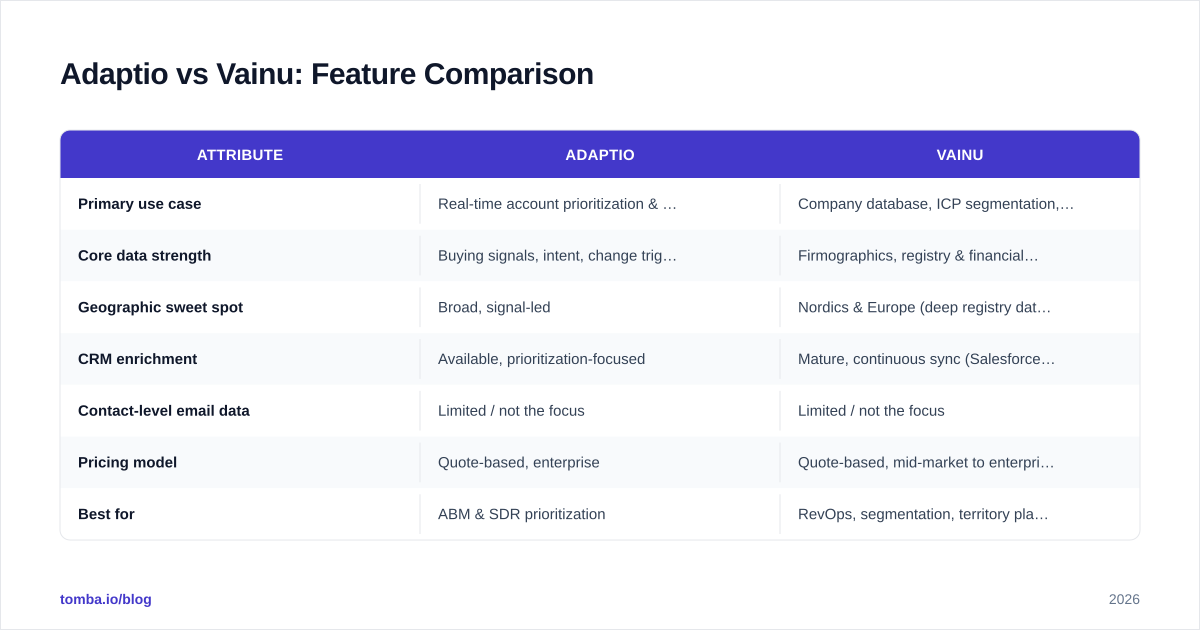
Here's the head-to-head on the attributes that actually change how a revenue team operates.
| Attribute | Adaptio | Vainu |
|---|---|---|
| Primary use case | Real-time account prioritization & signals | Company database, ICP segmentation, CRM enrichment |
| Core data strength | Buying signals, intent, change triggers | Firmographics, registry & financial data |
| Geographic sweet spot | Broad, signal-led | Nordics & Europe (deep registry data) |
| CRM enrichment | Available, prioritization-focused | Mature, continuous sync (Salesforce, HubSpot, Pipedrive) |
| Contact-level email data | Limited / not the focus | Limited / not the focus |
| Pricing model | Quote-based, enterprise | Quote-based, mid-market to enterprise |
| Best for | ABM & SDR prioritization | RevOps, segmentation, territory planning |
| Free self-serve tier | No | No |
The single most important row for most buyers is the contact-level one: both platforms are account- and company-centric, not person-and-email-centric. They'll tell you the company is hiring 40 engineers; they're far less reliable at handing you the verified email of the VP of Engineering you need to write to.

Is Adaptio Better Than Vainu?#
Conclusion first: it depends on whether your problem is prioritization or coverage.
Choose Adaptio when:
- You already have a defined target-account list and need to rank it by readiness.
- Your reps are drowning and you want signal-based focus, not more rows.
- You run a tight ABM motion where timing beats volume.
Choose Vainu when:
- You need to define and size your market, not just rank an existing list.
- European and Nordic company data accuracy is mission-critical.
- You want a durable enrichment backbone wired into your CRM and revenue operations reporting.
Neither is "better" in the abstract. A signal engine on top of a market you haven't properly segmented is a fast car with no map. A perfectly segmented database that nobody acts on in time is a map with no engine.
How Do They Compare on Pricing?#
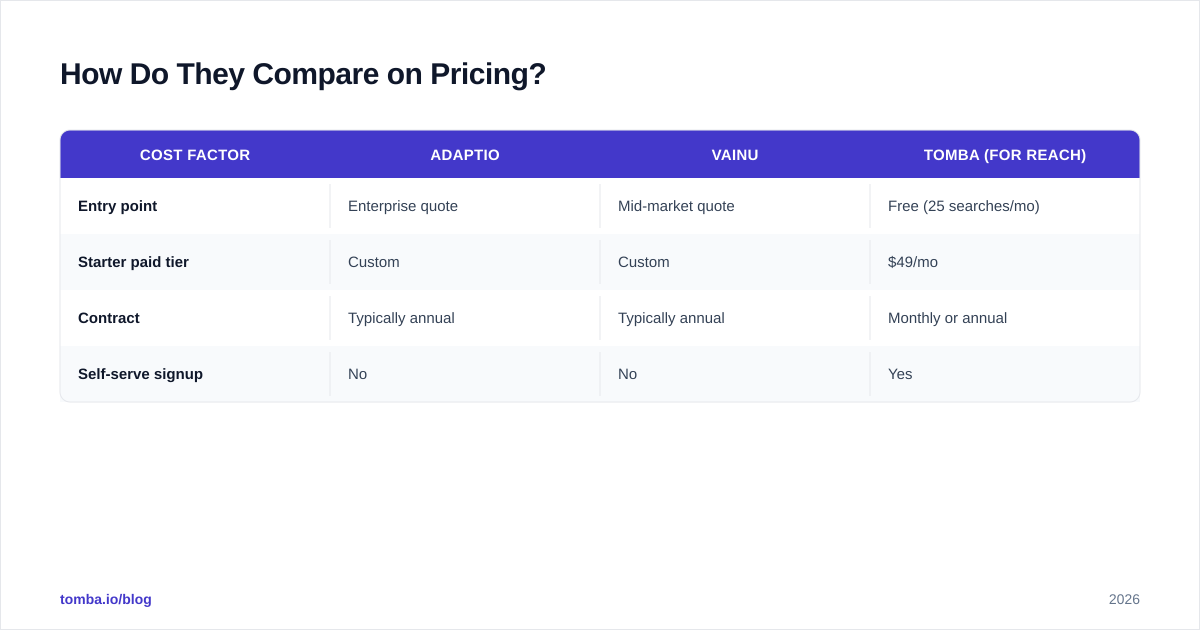
Both Adaptio and Vainu use sales-led, quote-based pricing rather than published self-serve tiers. That has two consequences:
- You can't try before you talk to sales. Expect a demo-and-quote cycle, annual contracts, and seat- or data-volume-based pricing.
- Small teams get squeezed. If you're a two-person SDR team, enterprise data-platform pricing often can't be justified by the volume you'll actually use.
This is where the comparison frequently breaks down for early-stage and SMB buyers. The data is good; the entry cost and contract commitment are not built for you. If that's your situation, a transparent, usage-based tool with a free tier — like Tomba pricing at $49/mo for Starter — solves the reach problem at a fraction of the commitment, and you can layer richer account intelligence later.
| Cost factor | Adaptio | Vainu | Tomba (for reach) |
|---|---|---|---|
| Entry point | Enterprise quote | Mid-market quote | Free (25 searches/mo) |
| Starter paid tier | Custom | Custom | $49/mo |
| Contract | Typically annual | Typically annual | Monthly or annual |
| Self-serve signup | No | No | Yes |
Where Do Both Tools Fall Short?#
Every honest comparison needs a "but." Here's where account-data platforms leave a gap.
They surface accounts, not inboxes. Knowing that Acme Corp just raised a Series B is necessary but not sufficient. You still have to identify the buying committee and get a verified, deliverable email address for each person. Account intelligence ends exactly where outreach begins.
Contact data decays fast. B2B contacts churn roughly 25–30% per year as people change jobs. A platform optimized for company-level signals won't necessarily keep individual email addresses fresh, so a percentage of any contact list you export will bounce.
Deliverability is your problem, not theirs. Even a perfect account list fails if your emails hit spam. Pairing prospecting data with strong email deliverability hygiene — verification, warmup, and authentication — is what turns a list into replies.
That's the layer Tomba is built for. Once Adaptio or Vainu tells you which accounts matter, you use a domain search to map the company's email pattern, find the specific decision-makers, and run every address through an email verifier before you ever hit send.

What Does a Complete Stack Look Like?#
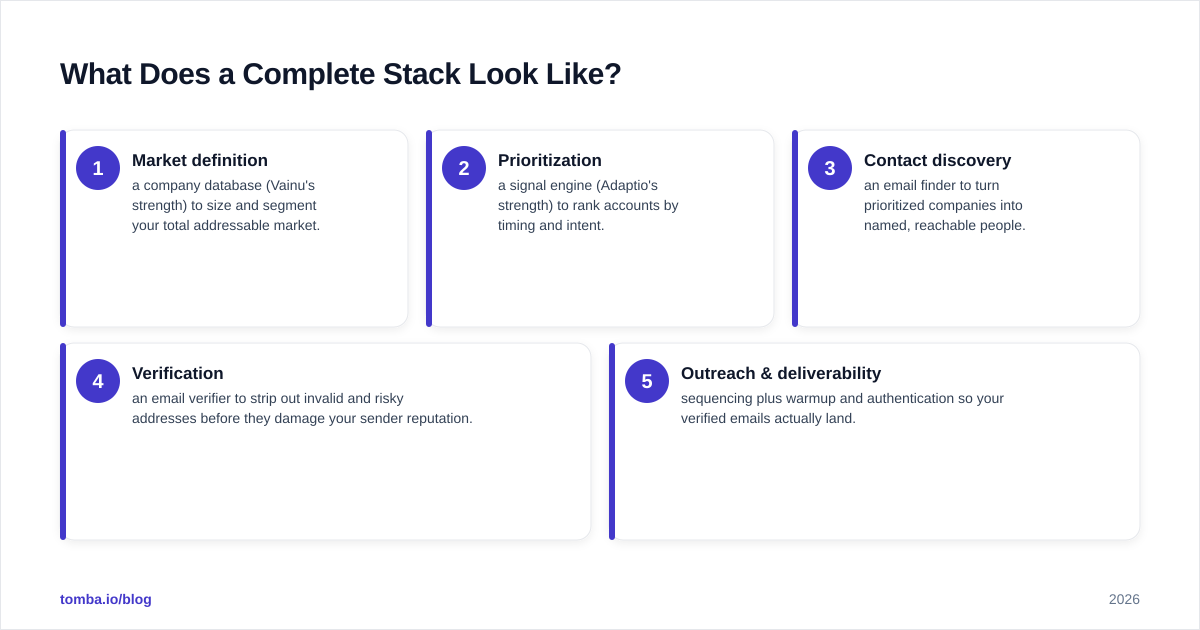
The smartest 2026 GTM teams don't pick one tool — they stack layers, each doing one job well:
- Market definition — a company database (Vainu's strength) to size and segment your total addressable market.
- Prioritization — a signal engine (Adaptio's strength) to rank accounts by timing and intent.
- Contact discovery — an email finder to turn prioritized companies into named, reachable people.
- Verification — an email verifier to strip out invalid and risky addresses before they damage your sender reputation.
- Outreach & deliverability — sequencing plus warmup and authentication so your verified emails actually land.
Layers 3 and 4 are exactly where Adaptio and Vainu hand off, and where most teams underinvest. You can run the discovery-and-verification layer through Tomba's bulk email finder for whole account lists, or wire it straight into your workflow via the Tomba API. For reps living in Salesforce or HubSpot, the same data flows through native integrations so contacts land enriched and verified without copy-paste.
If you'd rather not commit to enterprise data contracts at all, it's worth seeing how a focused finder-plus-verifier compares directly — Tomba maintains a side-by-side Vainu alternative breakdown for teams weighing that exact trade-off.
How Should You Choose Between Adaptio and Vainu?#
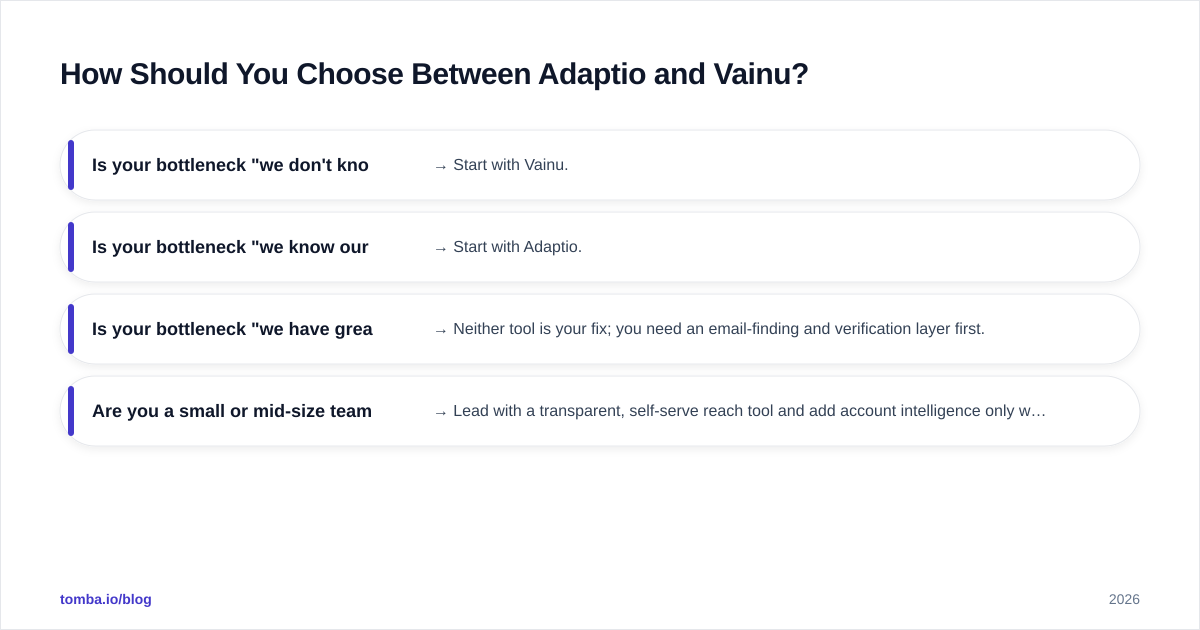
Run this quick decision filter:
- Is your bottleneck "we don't know our market"? → Start with Vainu.
- Is your bottleneck "we know our market but waste time on cold accounts"? → Start with Adaptio.
- Is your bottleneck "we have great accounts but can't reach the right people"? → Neither tool is your fix; you need an email-finding and verification layer first.
- Are you a small or mid-size team without enterprise budget? → Lead with a transparent, self-serve reach tool and add account intelligence only when volume justifies the spend.
Be honest about which of those sentences describes your Monday morning. Most teams think they have a data-coverage problem when they actually have a reach-and-deliverability problem — and that one is cheaper and faster to solve.
For deeper validation of how third-party data vendors source and refresh records, the analyst coverage on G2's data intelligence category and the buyer guides on Gartner's sales technology research are useful neutral references before you sign anything. And if you're evaluating CRM-native enrichment specifically, HubSpot's own data-quality documentation explains why continuous sync beats one-time imports.
The Bottom Line#
Adaptio and Vainu aren't really rivals so much as two ends of the same shelf. Vainu builds the map of your market; Adaptio tells you where the action is on that map. Both are strong, both are enterprise-priced, and both stop short of the one thing every outbound team ultimately needs: a verified email for a real human.
That last mile is where deals are actually made — and where the cheapest, highest-leverage tooling lives. Before you commit to a six-figure data contract, make sure you can reliably find and verify the contacts you already have access to. Start free with Tomba Email Finder — 25 searches a month, no contract, accurate professional emails by name or domain — and turn whichever account-intelligence platform you choose into actual replies.
// get started
Find, verify and enrich your first contacts today
Start on the free plan with 25 searches a month, then scale when your team is ready.
Free plan · No credit card required · GDPR & CCPA
// about the author