Adaptio vs Winmo 2026: Media Sales Intelligence Compared
Adaptio vs Winmo, broken down for ad-sales and media teams: data depth, intent signals, pricing, and which platform actually fills your pipeline in 2026.
If you sell advertising, sponsorships, or media, you have probably hit the same wall every ad-sales rep hits: you know which brands should be spending, but you do not know who controls the budget, when the next pitch window opens, or which agency holds the account. Adaptio and Winmo both promise to close that gap. They do it very differently.
This is a practical, vendor-neutral breakdown of Adaptio vs Winmo for 2026 — what each platform is, where the data comes from, how pricing shakes out, and which one fits your team. We will also be honest about where a lighter, cheaper stack beats both.
TL;DR — Adaptio vs Winmo at a glance#
- Winmo is the established advertiser-and-agency intelligence database: deep brand/agency relationships, verified contacts, spend estimates, and pitch-timing alerts. Best for teams that want a mature, media-specific Rolodex.
- Adaptio is the newer, AI-forward challenger built around real-time signals and predictive account scoring. Best for teams that prioritize timing and intent over a static contact archive.
- Data depth vs. data freshness is the core trade-off: Winmo wins on relationship mapping; Adaptio leans into automation and signal speed.
- Pricing for both is quote-based and enterprise-leaning — expect four figures annually. Neither publishes a self-serve free tier.
- The cheaper play: pair either platform (or skip both) with a focused email finder and enrichment layer to verify contacts and cut wasted seats.
What is Winmo?#
Winmo is a sales intelligence platform aimed squarely at the advertising, marketing, and media-sales world. Where a general B2B database lists "companies and people," Winmo maps the advertising ecosystem: which brands advertise, which agencies represent them, who the decision-makers are on both sides, estimated ad spend, and — its signature feature — predictive alerts about when an account is likely to review its agency or open a new budget.
Think of Winmo as a specialized scouting report for media sellers. A generic database tells you a company exists; Winmo tells you the brand just parted ways with its agency, names the CMO and the media buyer, and flags that a pitch window is opening. You can learn more on the official Winmo site.
Core capabilities:
- Brand-to-agency relationship mapping
- Verified decision-maker contacts (email + phone)
- Estimated advertising spend by brand and channel
- "Winmo Edge" predictive pitch-timing alerts
- Account assignments and territory views for sales teams
What is Adaptio?#
Adaptio is the newer entrant positioning itself as an AI-native media sales intelligence platform. Instead of leading with a static contact archive, Adaptio leans on real-time signals, predictive account scoring, and workflow automation — surfacing which accounts to work this week rather than just who exists.
The analogy: Winmo is a richly detailed encyclopedia of the ad world; Adaptio is more like a live radar that pings when an account heats up. Adaptio's pitch is speed and prioritization — fewer hours spent researching, more spent on accounts the model says are ready. Because Adaptio is younger, its relationship graph and historical depth are still maturing relative to Winmo's years of accumulated data. You can compare current user reviews on G2 and Capterra before committing.
Core capabilities:
- AI account scoring and prioritization
- Real-time buying/intent signals
- Contact and company enrichment
- Workflow automation and CRM sync
- Predictive alerts tuned for media and ad sales
Adaptio vs Winmo: side-by-side comparison#
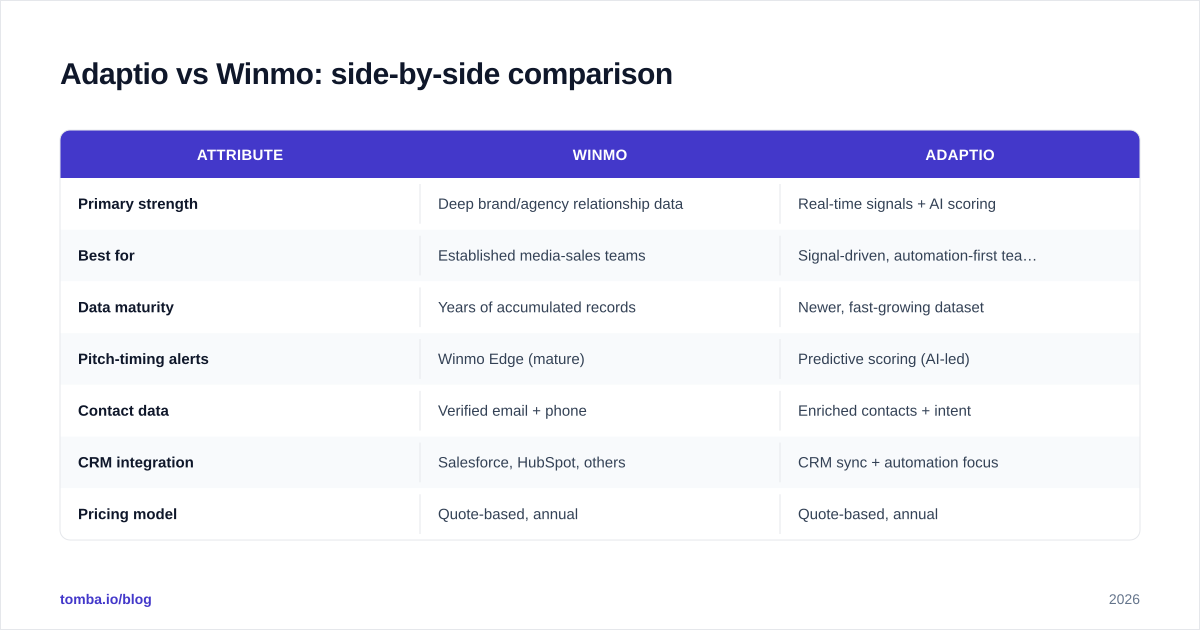
Here is the head-to-head on the attributes that actually change a buying decision.
| Attribute | Winmo | Adaptio |
|---|---|---|
| Primary strength | Deep brand/agency relationship data | Real-time signals + AI scoring |
| Best for | Established media-sales teams | Signal-driven, automation-first teams |
| Data maturity | Years of accumulated records | Newer, fast-growing dataset |
| Pitch-timing alerts | Winmo Edge (mature) | Predictive scoring (AI-led) |
| Contact data | Verified email + phone | Enriched contacts + intent |
| CRM integration | Salesforce, HubSpot, others | CRM sync + automation focus |
| Pricing model | Quote-based, annual | Quote-based, annual |
| Free tier | No | No |
| Learning curve | Moderate | Low to moderate |
The pattern is clear: Winmo trades on depth and trust; Adaptio trades on speed and automation. Neither is "wrong" — they optimize for different sales motions.
Is Adaptio better than Winmo?#
Short answer: it depends on whether your bottleneck is coverage or timing.
Choose Winmo if your reps repeatedly ask "who owns this account and who is the agency?" Winmo's relationship mapping and verified contacts mean less guesswork on the org chart, and its pitch-timing alerts are battle-tested. If you run a structured media-sales floor that lives in account assignments and territory plans, Winmo's maturity is hard to beat.
Choose Adaptio if your reps ask "which 20 accounts should I touch today?" Adaptio's scoring compresses research time and pushes prioritization to the top of the workflow. Teams that already have decent contact coverage but waste hours deciding where to spend effort tend to get more out of an AI-first tool.
A useful frame: Winmo answers who and when with editorial-grade data; Adaptio answers what's hot now with model-driven signals. Many high-performing teams genuinely want both — which is exactly why total cost matters.
How much do Adaptio and Winmo cost in 2026?#
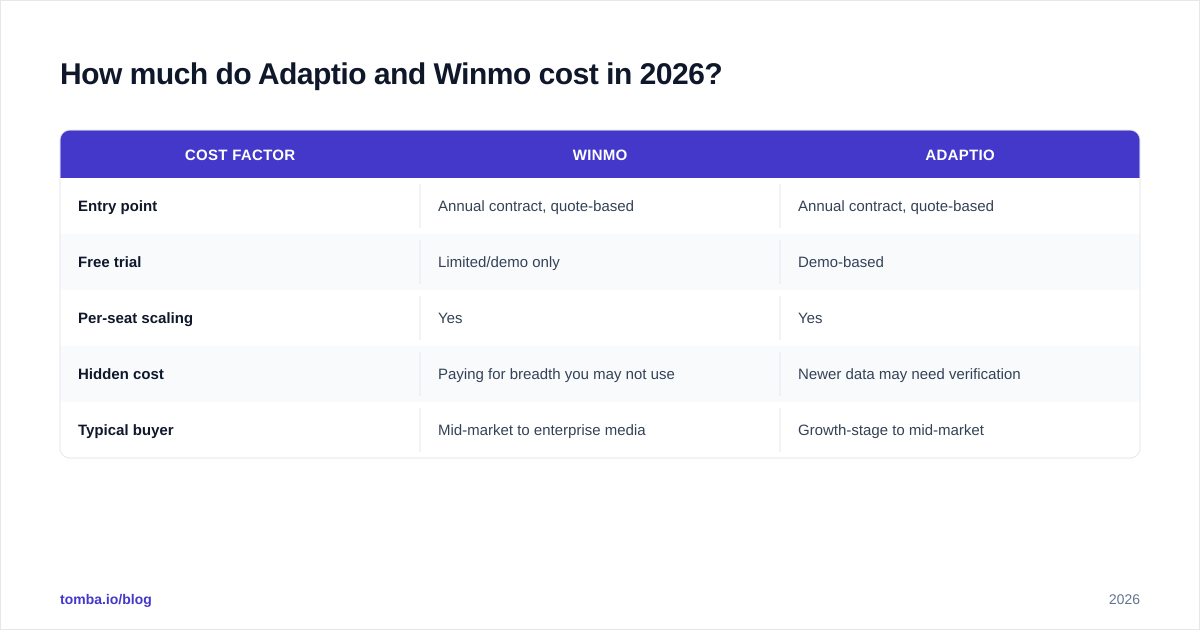
Both platforms are quote-based and skew enterprise. Neither publishes transparent self-serve pricing or a free tier, so your real cost depends on seats, data scope, and contract length. Expect annual commitments in the four-to-five-figure range per team, with Winmo's longer track record often commanding a premium for its data depth.
| Cost factor | Winmo | Adaptio |
|---|---|---|
| Entry point | Annual contract, quote-based | Annual contract, quote-based |
| Free trial | Limited/demo only | Demo-based |
| Per-seat scaling | Yes | Yes |
| Hidden cost | Paying for breadth you may not use | Newer data may need verification |
| Typical buyer | Mid-market to enterprise media | Growth-stage to mid-market |
Here is the part most comparison posts skip: a large share of what you pay either vendor is contact data you can source and verify far more cheaply. If your main need is reaching the CMO, the brand manager, or the agency media buyer, you do not necessarily need a full media-intelligence suite for every rep — you need accurate, verified contact details and a way to enrich the accounts you already target.
Where a lighter stack beats both#
Before you sign a five-figure contract, separate the two jobs these platforms bundle:
- Account intelligence — who is advertising, which agency, what's the spend, when's the pitch window. This is where Adaptio and Winmo earn their keep.
- Contact acquisition and verification — getting a valid, deliverable email and phone number for the specific decision-maker. This is a commodity you can buy precisely and cheaply.
For job #2, a dedicated tool is faster and dramatically less expensive per contact. With a focused email finder you can pull the decision-maker's professional email by name and company, then run it through an email verifier so you are not burning sends on bounces. Need the brand's whole marketing org? A domain search returns every reachable contact on the company domain in one query. And when you have a list of target brands from your intelligence platform, data enrichment fills the gaps — titles, socials, phone — so your CRM is complete before the rep ever dials.
This is the combo many lean teams run: keep one intelligence seat for the strategist who needs spend data and pitch alerts, then equip the whole sales floor with cheap, accurate contact tooling instead of full-price suite seats for everyone.
Which should you choose? A decision framework#
Run your situation through these questions:
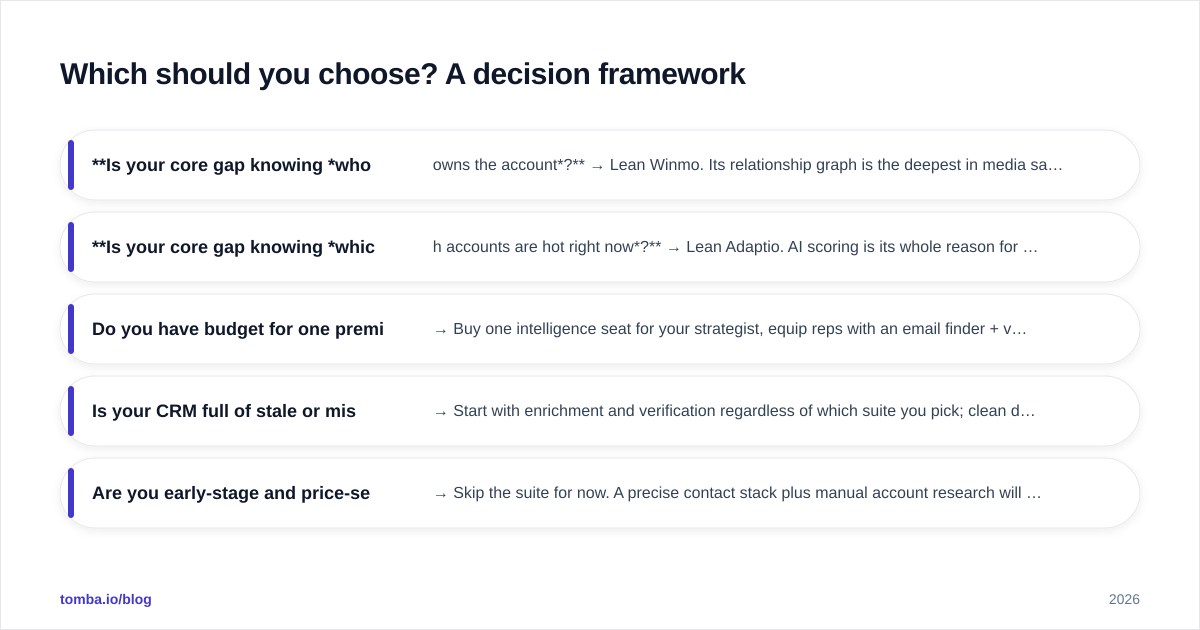
- Is your core gap knowing who owns the account? → Lean Winmo. Its relationship graph is the deepest in media sales.
- Is your core gap knowing which accounts are hot right now? → Lean Adaptio. AI scoring is its whole reason for existing.
- Do you have budget for one premium seat, not ten? → Buy one intelligence seat for your strategist, equip reps with an email finder + verifier stack.
- Is your CRM full of stale or missing contacts? → Start with enrichment and verification regardless of which suite you pick; clean data multiplies the value of either platform.
- Are you early-stage and price-sensitive? → Skip the suite for now. A precise contact stack plus manual account research will carry you until volume justifies a full platform.
Common mistakes when buying media sales intelligence#
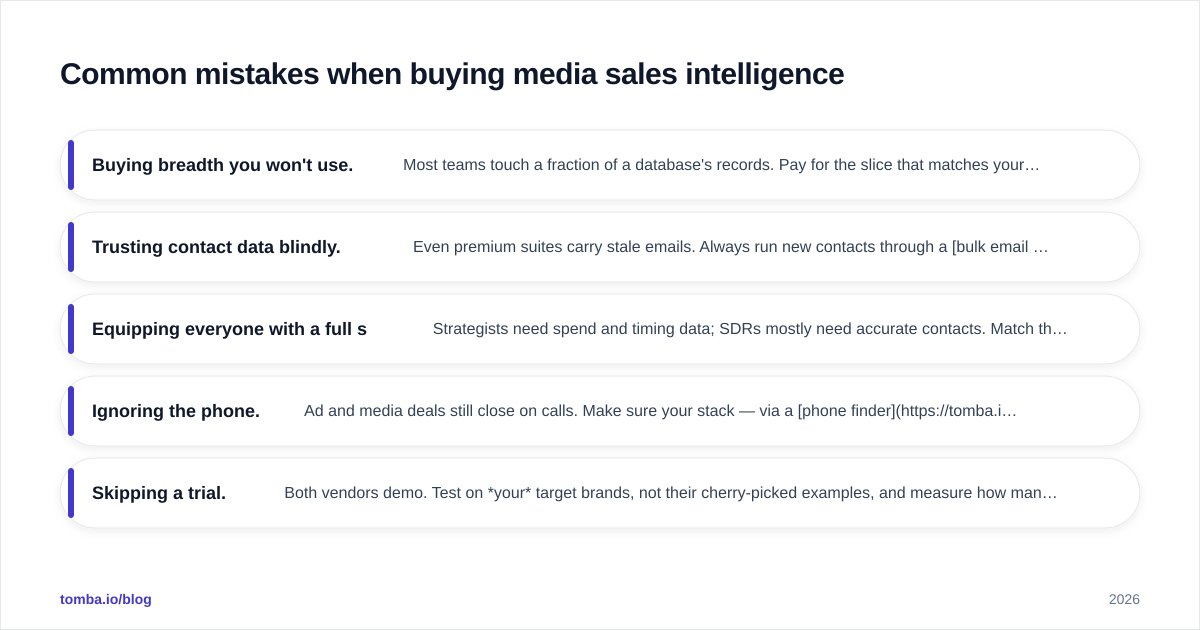
- Buying breadth you won't use. Most teams touch a fraction of a database's records. Pay for the slice that matches your territory, not the whole encyclopedia.
- Trusting contact data blindly. Even premium suites carry stale emails. Always run new contacts through a bulk email finder and verification pass before a campaign.
- Equipping everyone with a full seat. Strategists need spend and timing data; SDRs mostly need accurate contacts. Match the tool to the role.
- Ignoring the phone. Ad and media deals still close on calls. Make sure your stack — via a phone finder or your suite — actually surfaces direct dials, not just switchboards.
- Skipping a trial. Both vendors demo. Test on your target brands, not their cherry-picked examples, and measure how many contacts you actually had to re-verify.
The bottom line on Adaptio vs Winmo#
Winmo is the safer pick when your sales motion runs on relationship depth and proven pitch-timing data. Adaptio is the sharper pick when your edge is acting on signals faster than competitors. Both are real options for serious media-sales teams — and both are priced like premium suites, because they are.
But do not confuse "I need account intelligence" with "I need to pay suite prices for every contact my reps email." Those are separate purchases. The smartest 2026 stacks pair a single intelligence platform with cheap, accurate contact tooling — and that is where the real ROI hides.
Ready to stop overpaying for contact data? Try the Tomba Email Finder to pull verified, deliverable emails for the exact decision-makers your intelligence platform surfaces — by name, company, or whole domain. Start free with 25 searches a month, then scale on Tomba pricing that starts at $49/mo, a fraction of a suite seat. Let Adaptio or Winmo tell you who and when; let Tomba make sure the message actually lands.
// get started
Find, verify and enrich your first contacts today
Start on the free plan with 25 searches a month, then scale when your team is ready.
Free plan · No credit card required · GDPR & CCPA
// about the author