9 Best Adversus Alternatives for Outbound Calling in 2026
Adversus is a capable outbound dialer, but it is not the right fit for every team. Compare the 8 best Adversus alternatives on dial modes, pricing, and the data that actually feeds your calls.
You came here because Adversus is either too much or too little for what your team is doing right now. Maybe the predictive dialer is overkill for a five-rep SDR pod, maybe the reporting feels thin, or maybe you simply want to see what else is out there before you re-sign. This guide compares eight credible Adversus alternatives so you can match a dialer to your actual workflow instead of the other way around.
TL;DR#
- Adversus is a strong mid-market outbound dialer (power, predictive, and preview modes plus automation workflows), but teams outgrow it on integrations, AI features, or per-seat cost.
- Best overall alternatives: Aircall and CloudTalk for cloud calling, Kixie and JustCall for CRM-native dialing, PhoneBurner for power dialing, and Orum or Nooks for AI parallel dialing.
- The dialer is only half the equation. A predictive dialer calling bad numbers just burns through your list faster. Connect rate lives and dies on data quality.
- Use the framework below to pick by dial mode, CRM fit, and budget — then feed it with verified mobile numbers.
What is Adversus and who is it for?#
Adversus is a Danish cloud-based outbound calling platform built for teams that dial at volume — telemarketing, appointment setting, debt collection, and high-activity SDR motions. Its core is a flexible dialer that runs in power, predictive, and preview modes, wrapped in lead management, call recording, automation triggers, and a workflow builder. You can see the full feature set on the Adversus website.
It sits in a useful middle ground: more structured than a basic VoIP softphone, less heavyweight (and less expensive) than enterprise contact-center suites like Five9 or Genesys. That is exactly why teams shop for Adversus alternatives — they hit one of three walls:
- Integration gaps — your CRM or sales engagement stack is not natively supported.
- Missing AI — no parallel dialing, no AI transcription/coaching that newer tools ship by default.
- Cost and rigidity — per-seat pricing that does not scale down for a small team or up cleanly for an enterprise.
Why look for an Adversus alternative?#
Be honest about which wall you hit, because it changes the shortlist.
- You want CRM-native dialing. If reps live inside HubSpot, Pipedrive, or Salesforce all day, a click-to-call dialer embedded in the CRM (Kixie, JustCall) beats a separate dashboard.
- You want connect rate, not just dial volume. Parallel dialers (Orum, Nooks) dial several numbers at once and only route a live human to a rep, which can multiply conversations per hour.
- You want a simpler cloud phone. If outbound is one of many jobs, a full cloud telephony product (Aircall, CloudTalk, Dialpad) may serve support and sales together.
- You want to control spend. Some teams just need fewer seats at a lower entry price with a usable free trial.
)
One thing every category above shares: none of them fix a bad list. We will come back to that, because it is the variable most teams ignore.
What are the best Adversus alternatives in 2026?#
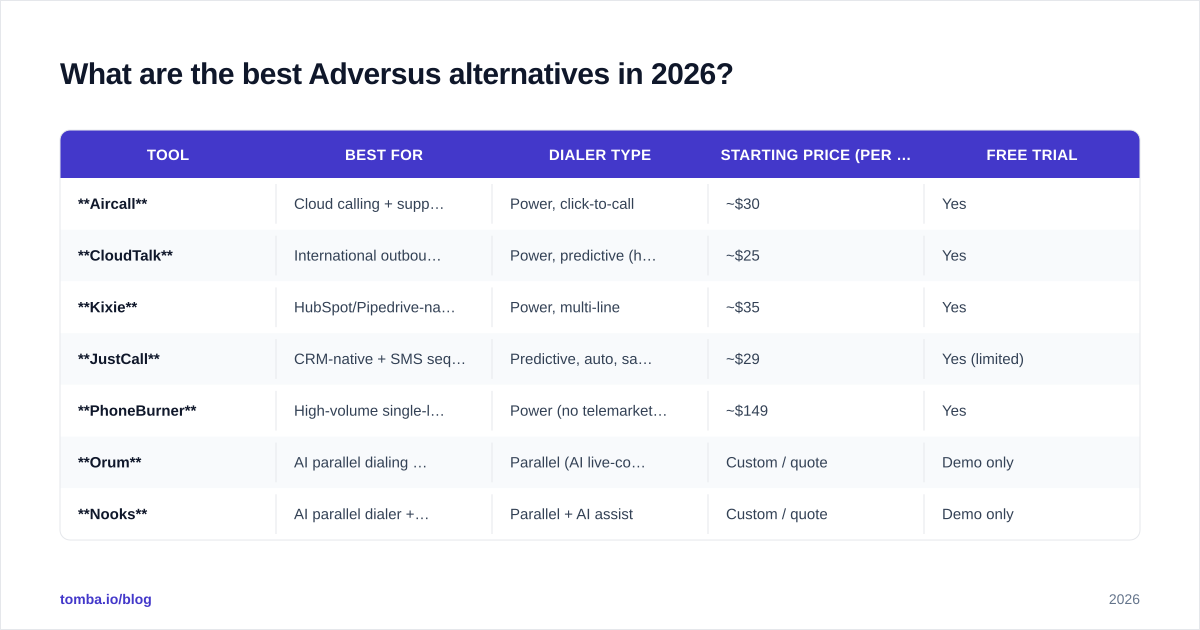
Here is the shortlist, grouped by what they are actually good at. Pricing reflects publicly listed entry tiers at the time of writing and is billed per user per month unless noted — always confirm current rates on each vendor's site, since dialer pricing changes often.
| Tool | Best for | Dialer type | Starting price (per user/mo) | Free trial |
|---|---|---|---|---|
| Aircall | Cloud calling + support/sales blend | Power, click-to-call | ~$30 | Yes |
| CloudTalk | International outbound, smart routing | Power, predictive (higher tiers) | ~$25 | Yes |
| Kixie | HubSpot/Pipedrive-native SDR teams | Power, multi-line | ~$35 | Yes |
| JustCall | CRM-native + SMS sequences | Predictive, auto, sales dialer | ~$29 | Yes (limited) |
| PhoneBurner | High-volume single-line power dialing | Power (no telemarketer delay) | ~$149 | Yes |
| Orum | AI parallel dialing for SDRs | Parallel (AI live-connect) | Custom / quote | Demo only |
| Nooks | AI parallel dialer + coaching | Parallel + AI assist | Custom / quote | Demo only |
| Dialpad | AI-native unified comms | Power, click-to-call | ~$27 | Yes |
Aircall#
The default "grown-up cloud phone." Aircall is easy to roll out, has a deep integration directory, and balances inbound support and outbound sales. It is not the fastest pure dialer, but it is the safest choice for a team that wants reliability and a clean admin experience. Browse verified reviews on G2 before committing.
CloudTalk#
Strong for international outbound thanks to local number coverage and smart call routing. Predictive dialing shows up on higher tiers, so price it carefully if that mode is the reason you are leaving Adversus.
Kixie and JustCall#
Both are built for reps who never want to leave the CRM. Kixie's multi-line PowerDialer and tight HubSpot/Pipedrive sync make it a favorite for SDR pods, while JustCall layers SMS sequences and a sales dialer on top of CRM-native calling. If your motion is calls plus texts inside one record, these two are the closest spiritual replacements for Adversus with better integrations.
PhoneBurner#
A power dialer purist. No awkward connect delay, solid built-in CRM, and a workflow tuned for one rep blasting through a single-line list. Higher entry price, but teams that measure success in dials-per-hour tend to love it.
Orum and Nooks#
The AI parallel-dialer generation. They dial multiple numbers simultaneously, filter out voicemails and dead numbers with AI, and drop a rep into live conversations only. This can dramatically raise conversations per hour — but it amplifies whatever list you feed it. Garbage data at 5x speed is still garbage.
How do these alternatives compare on the things that matter?#
Dial mode and CRM fit are the two axes most teams should decide on first. Read the table above as a starting filter, then weigh these trade-offs:
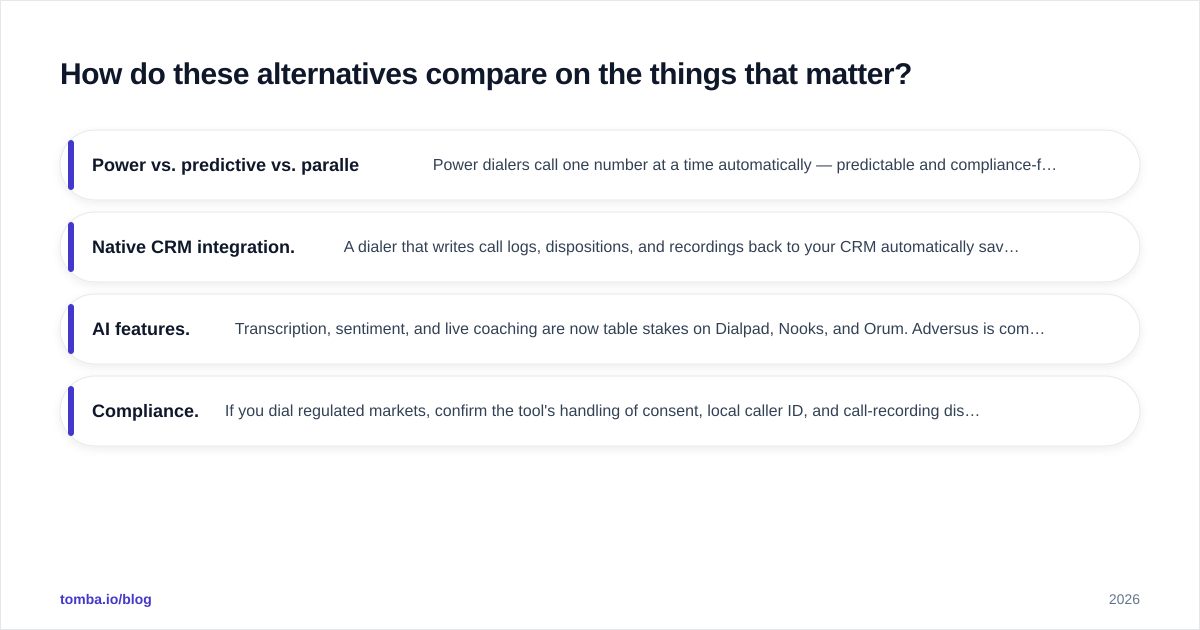
- Power vs. predictive vs. parallel. Power dialers call one number at a time automatically — predictable and compliance-friendly. Predictive dials ahead of rep availability for higher throughput but risks abandoned calls. Parallel (Orum, Nooks) maximizes live connects but needs clean, high-volume lists to be worth the price.
- Native CRM integration. A dialer that writes call logs, dispositions, and recordings back to your CRM automatically saves reps 15–20 minutes a day. Check that the integration is native, not a brittle
Zapier hop.
- AI features. Transcription, sentiment, and live coaching are now table stakes on Dialpad, Nooks, and Orum. Adversus is comparatively light here.
- Compliance. If you dial regulated markets, confirm the tool's handling of consent, local caller ID, and call-recording disclosure.
For a deeper look at how connect metrics flow into pipeline, our primer on response rate explains why raw dial volume is a vanity metric without conversation quality behind it.
Is a dialer enough, or is data the real bottleneck?#
Here is the uncomfortable truth most dialer comparisons skip: the fastest dialer in the world cannot connect to a wrong number. If 30% of your list is stale, disconnected, or wrong-contact, you are paying premium per-seat rates to fail faster.
)
Think of your dialer like a sports car and your contact list like fuel. A predictive or parallel dialer is a high-performance engine — pour in contaminated fuel and you will stall on the on-ramp no matter how much you spent on the car. Industry data consistently shows mobile direct dials connect at multiples of switchboard or generic office numbers, so the type and freshness of the number matters as much as the dialer.
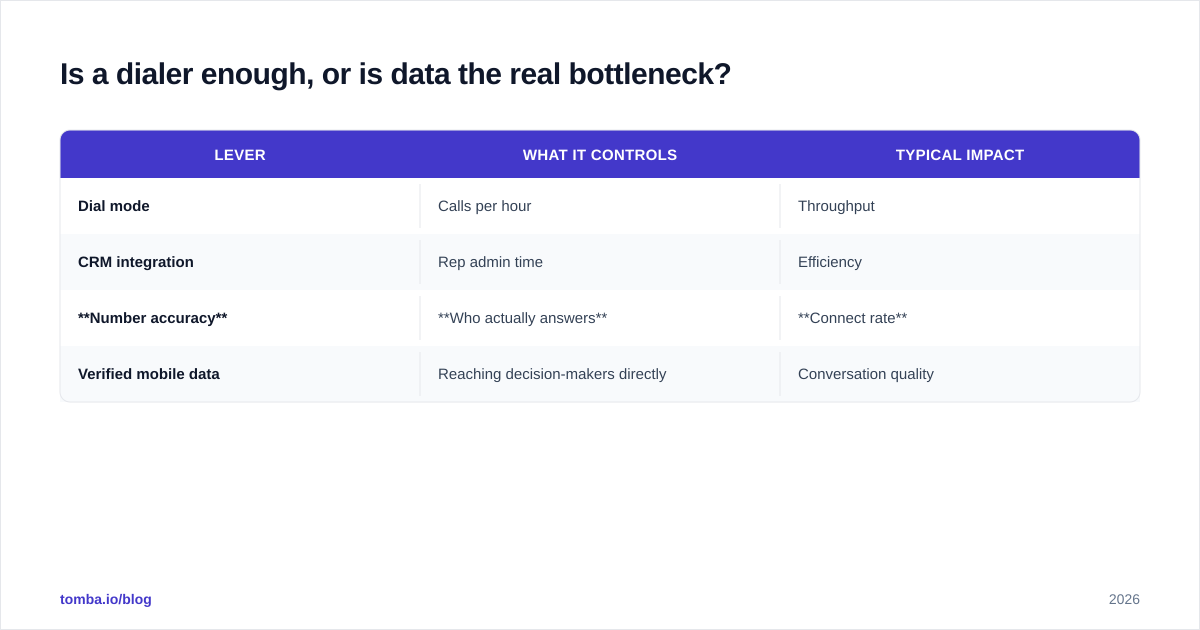
That is why your tool evaluation should include the data layer:
| Lever | What it controls | Typical impact |
|---|---|---|
| Dial mode | Calls per hour | Throughput |
| CRM integration | Rep admin time | Efficiency |
| Number accuracy | Who actually answers | Connect rate |
| Verified mobile data | Reaching decision-makers directly | Conversation quality |
You can pair any dialer on this list with a clean data source. Tomba's phone finder surfaces B2B phone numbers tied to verified professional contacts, and the broader B2B database lets you build and enrich target lists before a single number ever hits your dialer. Feeding a power dialer verified numbers is the difference between a 6% and a 16% connect rate.
How should you choose the right Adversus alternative?#
Work through this in order — it stops you from buying features you will never switch on.
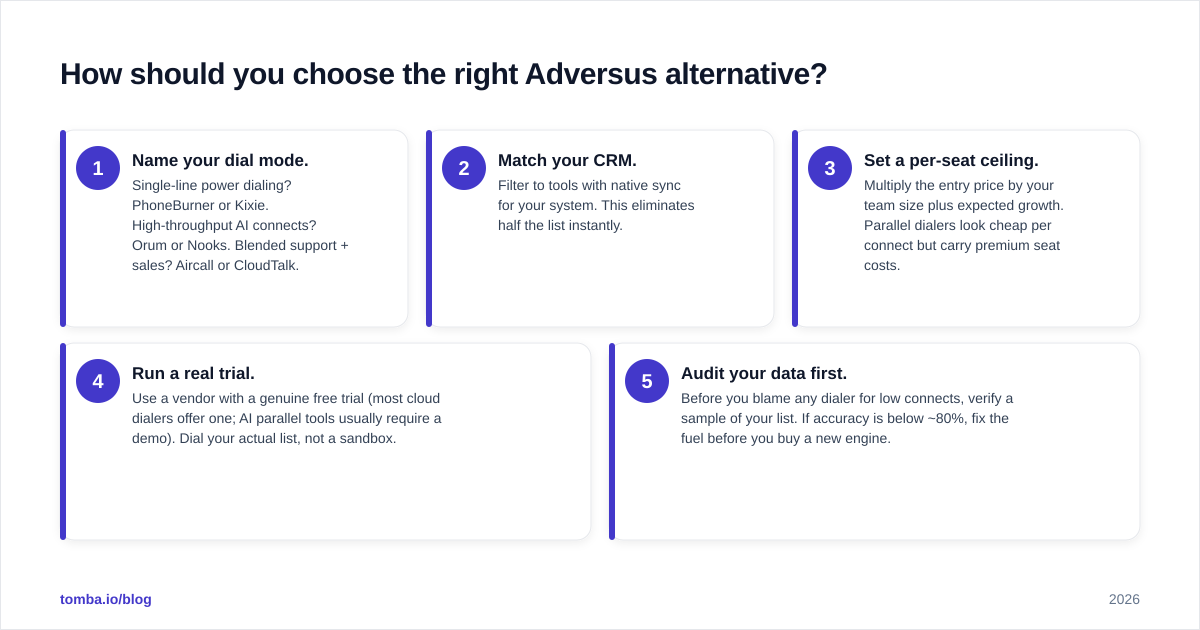
- Name your dial mode. Single-line power dialing? PhoneBurner or Kixie. High-throughput AI connects? Orum or Nooks. Blended support + sales? Aircall or CloudTalk.
- Match your CRM. Filter to tools with native sync for your system. This eliminates half the list instantly.
- Set a per-seat ceiling. Multiply the entry price by your team size plus expected growth. Parallel dialers look cheap per connect but carry premium seat costs.
- Run a real trial. Use a vendor with a genuine free trial (most cloud dialers offer one; AI parallel tools usually require a demo). Dial your actual list, not a sandbox.
- Audit your data first. Before you blame any dialer for low connects, verify a sample of your list. If accuracy is below ~80%, fix the fuel before you buy a new engine.
If you are also rethinking the rest of your outbound stack, our guides on the email finder and data enrichment workflows pair naturally with a calling motion — most teams run multi-touch sequences across phone and email, not one channel in isolation. You can compare entry costs across these tools against Tomba pricing when you scope the data side.
Frequently asked questions#
Is there a free Adversus alternative? Most cloud dialers (Aircall, CloudTalk, Dialpad, Kixie) offer free trials rather than permanent free tiers. For the data side, you can start verifying contacts on a free tier and scale up as your list grows.
What is the best Adversus alternative for small teams? For a small SDR pod inside HubSpot or Pipedrive, Kixie or JustCall give you CRM-native dialing without enterprise overhead. Aircall is the safest general-purpose pick.
What is the best alternative for high-volume calling? PhoneBurner for single-line power dialing, or Orum/Nooks if you want AI parallel dialing and have the list volume and budget to justify it.
Will switching dialers improve my connect rate? Partly. A better dial mode helps throughput, but connect rate is driven mostly by number accuracy. Switching dialers without fixing data quality usually disappoints. Verify your numbers first. Check independent reviews on Capterra to validate any shortlist.
The bottom line#
Adversus alternatives fall into clear buckets: CRM-native dialers (Kixie, JustCall), cloud phone systems (Aircall, CloudTalk, Dialpad), power dialers (PhoneBurner), and AI parallel dialers (Orum, Nooks). Pick by dial mode and CRM fit, trial it on your real list, and respect your per-seat ceiling.
But do not stop at the dialer. The single highest-leverage upgrade for most outbound teams is not a faster engine — it is cleaner fuel. Before you migrate, run your list through the Tomba Email Finder and phone finder to confirm you are dialing real, current, decision-maker numbers. Pair any dialer on this list with verified Tomba data and you will get more conversations per hour than a dialer upgrade alone could ever deliver. Start free and feed your new dialer the kind of list it deserves.
Ready to find emails that actually work?
Join 150,000+ professionals who stopped guessing and started sending. Free credits on signup — no credit card required.
Get the Tomba newsletter
Practical outbound tactics and product updates — once every two weeks.
About the author