AdvizorPro vs Clodura.ai (2026): Which B2B Data Tool Wins?
AdvizorPro targets financial-advisor data; Clodura.ai is a full-funnel sales intelligence engine. Here's an honest 2026 breakdown of pricing, data depth, and which one fits your motion.
Choosing a B2B data platform usually comes down to a single question: do you need depth in one vertical, or breadth across the whole funnel? AdvizorPro vs Clodura.ai is exactly that trade-off in miniature. One is a specialist built around the financial-advisor and wealth-management universe. The other is a generalist sales-intelligence engine that bundles contact data, intent signals, and outbound sequencing.
This guide compares both on data coverage, accuracy, pricing, integrations, and the use cases where each one earns its seat in your stack.
TL;DR — AdvizorPro vs Clodura.ai at a glance#
- AdvizorPro is a niche data provider for the financial-services world (RIAs, broker-dealers, insurance, and wealth advisors). If your ICP is advisors, its depth is hard to beat.
- Clodura.ai is a broad, full-funnel sales-intelligence platform: contact and company database, buyer-intent signals, org charts, and built-in email sequencing.
- Pick AdvizorPro when every dollar of pipeline comes from financial advisors and you need firm-level AUM, custodian, and licensing detail.
- Pick Clodura.ai when you sell across industries and want prospecting, enrichment, and outreach in one tool.
- Neither is a pure email-finder. If verified email accuracy is your bottleneck, pair either with a dedicated email finder and email verifier.
What is AdvizorPro?#
AdvizorPro is a vertical B2B data provider focused on the financial-services industry. Instead of trying to map every company on earth, it goes deep on a defined universe: registered investment advisors (RIAs), broker-dealers, insurance agents, retirement plan advisors, and the people who work inside those firms.
That focus shows up in the fields it exposes. You can filter by assets under management (AUM), custodian relationships, regulatory licenses (Series 7, 65, 66), CRD numbers, and firm affiliations — attributes a generalist database simply doesn't carry. For a wealthtech vendor, an asset manager, or a recruiter staffing advisory firms, that specificity is the entire value proposition.
The trade-off is obvious: if your buyers sit outside financial services, most of AdvizorPro's schema is dead weight. You're paying for advisor-grade depth you'll never query.
What is Clodura.ai?#
Clodura.ai is a full-funnel sales-intelligence platform. It pairs a large contact-and-company database (it advertises hundreds of millions of contacts) with buyer-intent data, technographics, organizational charts, and a built-in email-sequencing tool. The pitch is "prospect to outreach in one login" — find accounts, pull verified contacts, layer on intent, then run cadences without exporting to a separate sender.
Clodura leans on AI to surface "sales triggers" — hiring signals, funding events, technology adoption — so reps can time outreach around something relevant. It positions itself against tools like ZoomInfo, Apollo, and Lusha, competing on price and the all-in-one bundle rather than on any single vertical's depth.
Because it's a generalist, Clodura's strength is reach. Its weakness is the same one every broad database has: coverage and accuracy vary by region, seniority, and industry, and niche attributes (like advisor licensing) aren't there.
AdvizorPro vs Clodura.ai: how do they compare?#
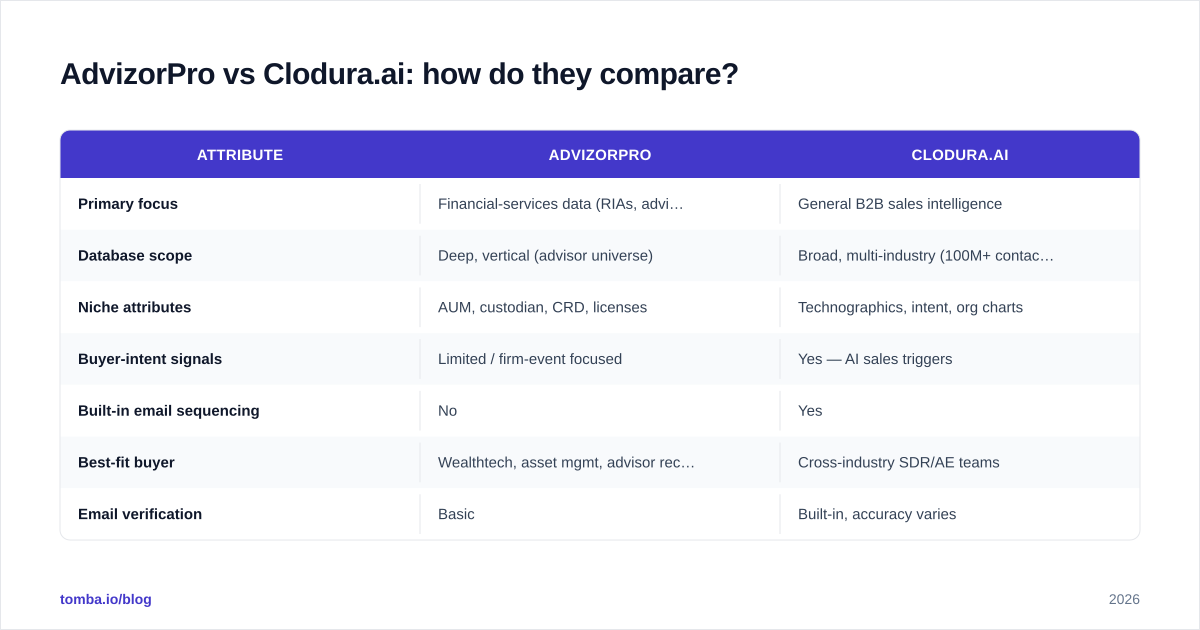
Here's the side-by-side on the attributes that actually drive a buying decision.
| Attribute | AdvizorPro | Clodura.ai |
|---|---|---|
| Primary focus | Financial-services data (RIAs, advisors, insurance) | General B2B sales intelligence |
| Database scope | Deep, vertical (advisor universe) | Broad, multi-industry (100M+ contacts) |
| Niche attributes | AUM, custodian, CRD, licenses | Technographics, intent, org charts |
| Buyer-intent signals | Limited / firm-event focused | Yes — AI sales triggers |
| Built-in email sequencing | No | Yes |
| Best-fit buyer | Wealthtech, asset mgmt, advisor recruiters | Cross-industry SDR/AE teams |
| Email verification | Basic | Built-in, accuracy varies |
| Free tier | No public free tier | Limited free plan |
The pattern is consistent: AdvizorPro wins on depth within one vertical, Clodura.ai wins on breadth plus workflow. Neither is strictly "better" — they're built for different motions.
Which has better data accuracy?#
Accuracy depends on what you're measuring. AdvizorPro's advantage is that a narrow, well-maintained dataset is easier to keep clean. When you only track financial advisors and pull from regulatory filings (Form ADV, FINRA BrokerCheck, SEC records), the source data is structured and refreshes on a known cadence. Firm-level facts like AUM and custodian tend to be reliable because they're disclosed.
Clodura.ai faces the classic generalist problem: maintaining freshness across hundreds of millions of records in every industry and geography. Broad databases inevitably carry more decay — people change jobs, titles drift, and email patterns shift. Clodura mitigates this with built-in verification, but independent review-site feedback on any large database (check current ratings on G2) shows accuracy is uneven by segment.
The honest takeaway: trust the firmographics, re-verify the emails. No database — vertical or general — should be your final word on whether an address is deliverable. Run contacts through a dedicated email verification step before any send, and use data enrichment to fill the gaps either platform leaves behind.

How do AdvizorPro and Clodura.ai price?#
AdvizorPro uses custom, seat-and-module pricing aimed at financial-services teams; you'll talk to sales and pay a premium for vertical depth. There's no public self-serve free tier — it's positioned as a specialist tool with specialist pricing.
Clodura.ai is more transparent and self-serve, with a limited free plan and paid tiers that scale by credits, seats, and features (sequencing, intent, integrations). For teams that want to start small and expand, that on-ramp is friendlier.
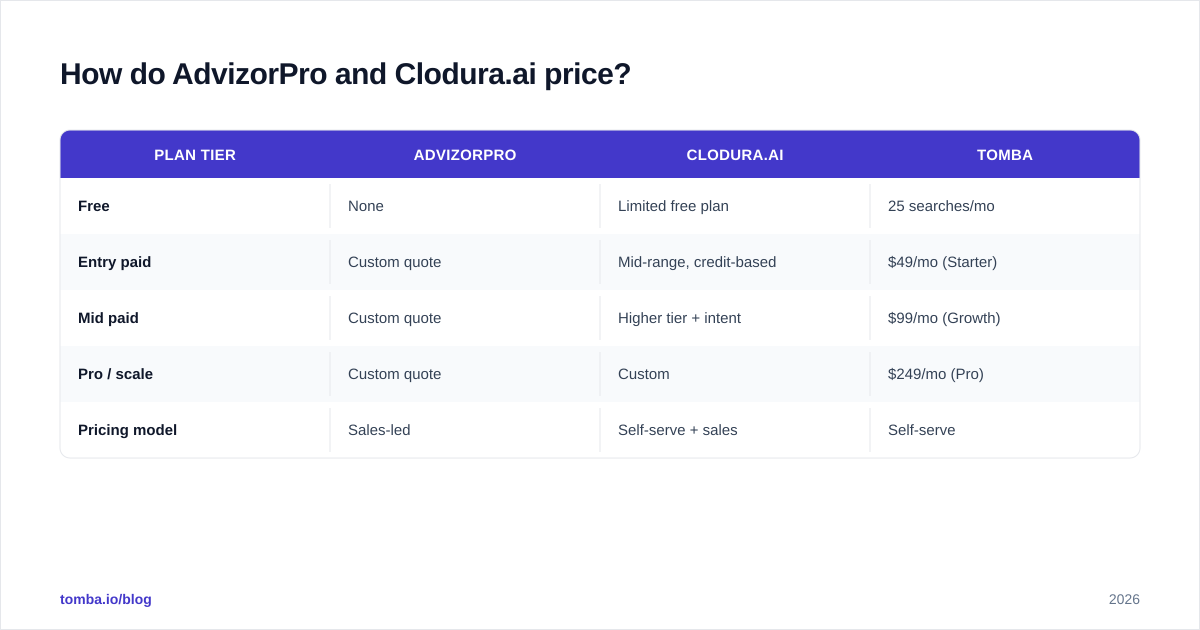
For context, here's how both sit relative to a focused data-and-verification tool like Tomba, which many teams bolt on for the "is this email real?" job:
| Plan tier | AdvizorPro | Clodura.ai | Tomba |
|---|---|---|---|
| Free | None | Limited free plan | 25 searches/mo |
| Entry paid | Custom quote | Mid-range, credit-based | $49/mo (Starter) |
| Mid paid | Custom quote | Higher tier + intent | $99/mo (Growth) |
| Pro / scale | Custom quote | Custom | $249/mo (Pro) |
| Pricing model | Sales-led | Self-serve + sales | Self-serve |
If budget transparency matters early on, Clodura's published plans and Tomba's flat pricing tiers are easier to model than AdvizorPro's custom quotes. If advisor depth is non-negotiable, AdvizorPro's premium is the cost of admission.
Which integrates better with your stack?#
Clodura.ai is built to live inside an outbound workflow. It connects to mainstream CRMs (Salesforce, HubSpot, Pipedrive), supports its own sequencing, and offers a Chrome extension and API. Because it's a full-funnel tool, the integration story is about keeping reps inside one surface from prospecting to cadence.
AdvizorPro integrates with CRMs and supports exports, but it's a data source first — the expectation is that you pull advisor data into your existing system of record and run outreach elsewhere. That's fine if your sequencing already lives in another tool; it's a gap if you wanted everything in one place.
Whichever you choose, the connective tissue matters. If you run enrichment or verification programmatically, a clean email finder API lets you validate and append contacts inside the same pipeline rather than juggling CSV exports between systems.
When should you choose AdvizorPro?#
Choose AdvizorPro when financial advisors are your market, not a segment of it:
- You sell wealthtech, portfolio software, or compliance tools to RIAs and broker-dealers.
- You're an asset manager prospecting advisors by AUM, custodian, or product fit.
- You recruit for advisory firms and need licensing and CRD detail.
- You need regulatory-grade firmographics no generalist carries.
In those cases, the vertical depth pays for itself. You're not paying for 100 million irrelevant contacts — you're paying for the 300,000 that matter, described in the language your sales motion actually uses.
When should you choose Clodura.ai?#
Choose Clodura.ai when you sell across industries and want one tool to do most of the job:
- Your SDRs prospect into multiple verticals and need broad coverage.
- You want intent signals and sales triggers to time outreach.
- You'd rather sequence inside the same tool than wire up a separate sender.
- You want a self-serve on-ramp and transparent pricing to start.
Clodura's all-in-one bundle is genuinely convenient for a small-to-mid outbound team that doesn't want to assemble a five-tool stack. Just go in clear-eyed about generalist accuracy and budget a verification step before you hit send.
Do you even need to choose? The hybrid stack#
For many teams the smartest answer to "AdvizorPro vs Clodura.ai" is neither alone. Vertical specialists and generalist platforms solve different halves of the problem, and a thin verification-and-enrichment layer on top fixes the weakness both share.
A practical 2026 stack looks like this:
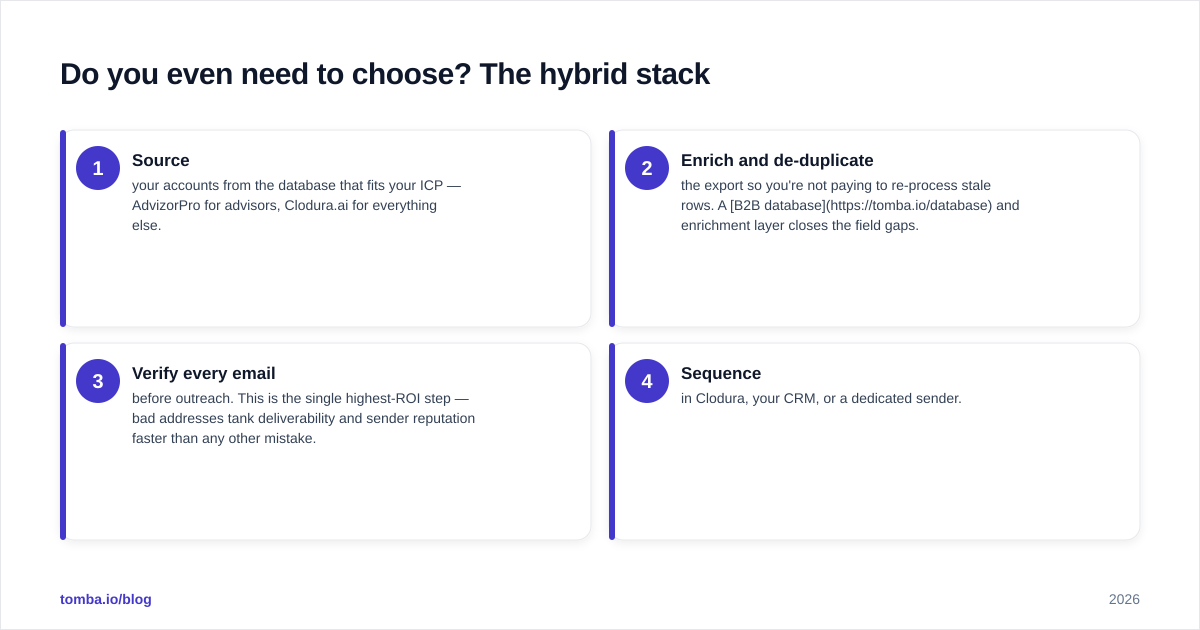
- Source your accounts from the database that fits your ICP — AdvizorPro for advisors, Clodura.ai for everything else.
- Enrich and de-duplicate the export so you're not paying to re-process stale rows. A B2B database and enrichment layer closes the field gaps.
- Verify every email before outreach. This is the single highest-ROI step — bad addresses tank deliverability and sender reputation faster than any other mistake.
- Sequence in Clodura, your CRM, or a dedicated sender.
This is where a focused tool like Tomba slots in. You're not replacing your intelligence platform; you're making sure the contacts it hands you are real before they cost you a bounce. Independent buyers comparing data vendors on G2 consistently flag verification as the step that separates a clean list from a blacklisted domain.
How accurate is each platform's contact data, really?#
Be skeptical of any headline accuracy claim — vendors measure it differently. AdvizorPro benefits from regulated, disclosed source data, so its firm facts age slowly. Clodura.ai's edge is recency on fast-moving signals (hiring, funding) but its long-tail contact records decay like every large database.
Two rules hold regardless of which you pick:
- Firmographics from a specialist > firmographics from a generalist in that specialist's vertical.
- Email deliverability is a separate problem from data sourcing. Treat it as its own pipeline step with its own tool.
If you want to sanity-check a vendor's numbers, run a sample export through an independent verifier and measure the real bounce rate yourself. That single test tells you more than any marketing page. Compare what you find against the vendor's official claims — AdvizorPro publishes its coverage at advizorpro.com and Clodura at clodura.ai.
Final verdict: AdvizorPro vs Clodura.ai#
There's no universal winner — there's a winner for your motion:
- AdvizorPro is the right call if financial advisors are your entire world. Its depth, licensing detail, and regulatory-grade firmographics are worth the premium and the sales-led pricing.
- Clodura.ai is the right call for cross-industry teams that want breadth, intent signals, and built-in sequencing on a transparent, self-serve plan.
- Both share the same blind spot — email accuracy and deliverability — and both get materially better when you add a dedicated verification layer.
Match the tool to your ICP, not to the longest feature list. A specialist used inside its lane beats a generalist every time; a generalist beats a specialist the moment your ICP gets wider.
Get accurate contacts before you spend a credit#
Whatever intelligence platform you land on, the contacts are only as good as their deliverability. Tomba's email finder and email verifier plug into the gap AdvizorPro and Clodura.ai both leave open — turning raw database rows into verified, send-ready addresses. Start free with 25 searches a month, and scale on transparent pricing from $49/mo. Stop paying to email addresses that bounce — verify first, then send.
// get started
Find, verify and enrich your first contacts today
Start on the free plan with 25 searches a month, then scale when your team is ready.
Free plan · No credit card required · GDPR & CCPA
// about the author