Affistash vs Dealsignal 2026: B2B Data Platform Showdown
Affistash vs Dealsignal compared head-to-head: data coverage, accuracy, pricing, and verification. See which B2B data platform fits your pipeline in 2026.
TL;DR
- Affistash leans toward affiliate and partner-led prospecting — it shines when you need to discover companies and outreach contacts inside niches and referral networks quickly.
- Dealsignal is a research-grade B2B data platform built around on-demand verification and deep firmographic/technographic enrichment for enterprise teams.
- On raw data freshness, Dealsignal's verify-on-request model usually wins; on speed-to-list and price, Affistash is the lighter, faster option.
- Neither tool is a pure email finder, so pair whichever you pick with a dedicated email verifier before you send.
- If your real bottleneck is finding and confirming work emails at scale, a focused tool like the Tomba Email Finder often does that one job cheaper and more accurately than either platform.
What are Affistash and Dealsignal?#
Both Affistash and Dealsignal sell the same promise — turn a vague target market into a working list of companies and contacts — but they come at it from opposite ends.
Think of it like buying produce. Affistash is the busy farmers' market: fast, broad, you grab a lot quickly and trust your own eye for quality. Dealsignal is the specialty grocer that weighs and inspects each item on the spot — slower, pricier, but you know exactly what you're getting.
Affistash positions itself around partner and affiliate-led discovery. It's designed for teams who build pipeline through niche communities, referral networks, and adjacent-market prospecting. The pitch is breadth and velocity: point it at a segment and get a usable list fast.
Dealsignal is a B2B data platform built around on-demand verification. Instead of serving you a static database that decays the moment it's written, Dealsignal re-verifies records when you request them, aiming for high accuracy on emails, direct dials, and firmographics. Their own marketing centers on 97%+ accuracy claims and human-plus-machine verification — you can read their positioning directly on the Dealsignal site.
The distinction matters because it changes who each tool is for. One optimizes for "give me a big list now." The other optimizes for "give me a list I can trust to hit quota."
How do Affistash and Dealsignal compare on features?#
Here's the head-to-head on the attributes that actually move pipeline. Treat the pricing as directional — both vendors quote custom enterprise tiers and change packaging frequently, so confirm before you buy.
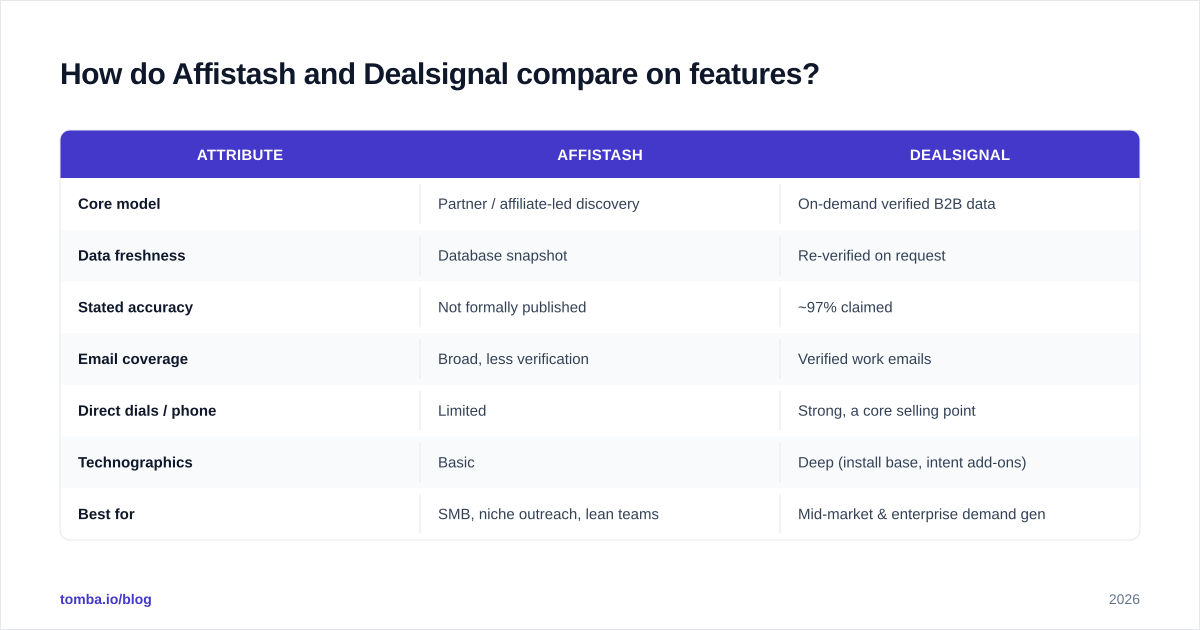
| Attribute | Affistash | Dealsignal |
|---|---|---|
| Core model | Partner / affiliate-led discovery | On-demand verified B2B data |
| Data freshness | Database snapshot | Re-verified on request |
| Stated accuracy | Not formally published | ~97% claimed |
| Email coverage | Broad, less verification | Verified work emails |
| Direct dials / phone | Limited | Strong, a core selling point |
| Technographics | Basic | Deep (install base, intent add-ons) |
| Best for | SMB, niche outreach, lean teams | Mid-market & enterprise demand gen |
| Typical entry price | Lower, lightweight tiers | Higher, credit + platform fees |
| Learning curve | Shallow | Moderate |
| CRM enrichment | Available | Robust, a primary use case |
The pattern is consistent: Affistash trades depth for speed and cost; Dealsignal trades cost and speed for verified depth.
)
One nuance worth flagging: "coverage" and "accuracy" are not the same metric, and vendors love to blur them. A database can technically have a contact for 90% of your accounts while half those emails bounce. Affistash tends to win on coverage breadth; Dealsignal tends to win on the share of records that are actually correct on the day you use them. For a deeper primer on what drives that gap, see Tomba's notes on data accuracy and sources.
Which tool has better data accuracy?#
Dealsignal wins the accuracy contest in most real-world tests — but the gap costs you, and you still have to verify.
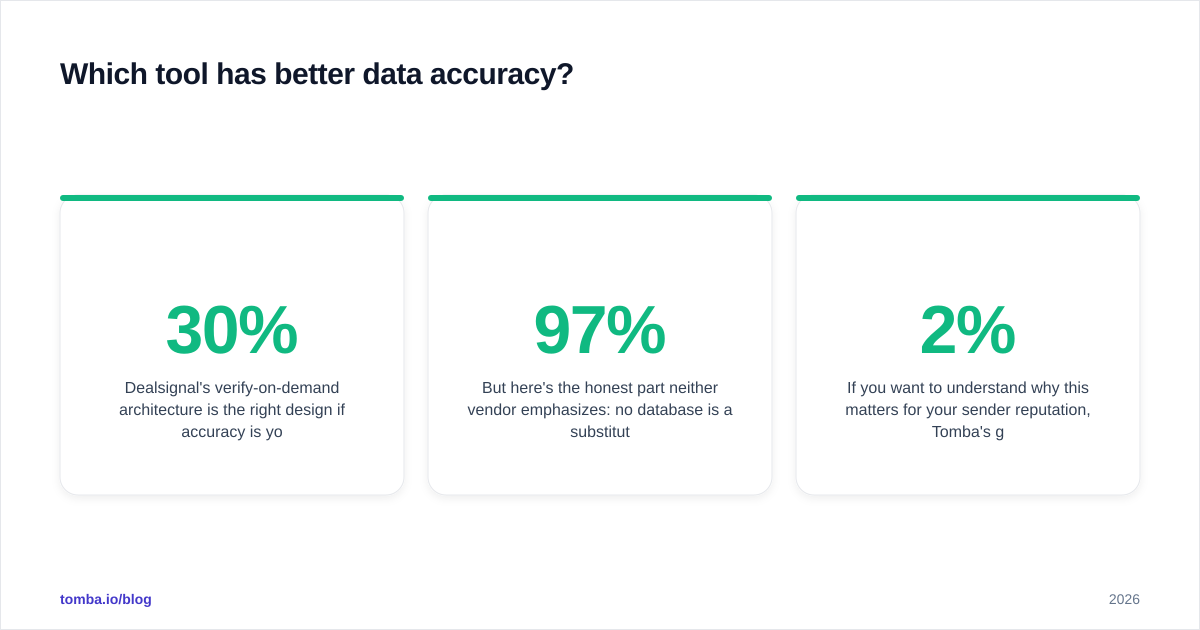
Dealsignal's verify-on-demand architecture is the right design if accuracy is your top priority. Because records get re-checked when you pull them, you're less exposed to the silent decay that plagues static databases — roughly 22–30% of B2B contact data goes stale every year as people change jobs, per long-running estimates cited across the industry (G2 and others track this; see vendor benchmarks on G2).
Affistash's model is more like a snapshot. It can be perfectly accurate the day a record is added and quietly wrong six months later. For high-velocity SMB outreach where you're burning through lists fast anyway, that's often an acceptable trade. For a six-month enterprise ABM motion against a fixed account list, it's a liability.
But here's the honest part neither vendor emphasizes: no database is a substitute for verification at send time. Even a 97% accuracy claim means three in every hundred sends are at risk — and a list that sat in your CRM for two months has drifted further. This is why disciplined teams run a verification pass right before launch, regardless of source. A dedicated email verification step catches catch-all traps, role accounts, and freshly-bounced addresses that any provider's "verified" stamp missed.
If you want to understand why this matters for your sender reputation, Tomba's glossary entry on email deliverability lays out how bounce rates above ~2% start dragging your inbox placement down across every campaign — not just the one with the bad list.
How do Affistash and Dealsignal price out?#
Neither company publishes fully transparent self-serve pricing the way a product-led tool does, so budget expectations matter.
Affistash sits at the lighter end. Its packaging favors smaller teams and lean prospecting budgets, which is consistent with its "fast list, low friction" positioning. You'll generally pay less to get started, and the value scales with how much niche/partner discovery you actually do.
Dealsignal is an enterprise-grade spend. Expect a platform fee plus credit-based consumption for verified records, with direct dials and intent data pushing the bill higher. The accuracy is real, but so is the invoice — this is a tool you justify with a defined ABM or demand-gen program, not casual prospecting.
The strategic question isn't "which is cheaper." It's "what does a bounced email or a wrong phone number cost my team?" If a single enterprise deal funds a year of Dealsignal, the premium is trivial. If you're running 50 SMB touches a week and iterating fast, Affistash's economics make more sense — and you can backfill accuracy cheaply with a standalone verifier.
For reference, a focused email-finding tool like Tomba pricing starts with a free tier (25 searches/mo) and a $49/mo Starter plan — an order of magnitude below an enterprise data-platform contract. That's the arbitrage many teams miss: you don't always need a full platform to solve the one job you actually have.
)
Which one should you choose?#
Pick Affistash if you're an SMB or lean growth team, you prospect through niches and partner networks, you value speed-to-list over guaranteed freshness, and you're comfortable adding your own verification step. It's the pragmatic, budget-aware choice.
Pick Dealsignal if you run mid-market or enterprise demand gen, accuracy and direct dials are mission-critical, you need deep technographics and intent signals, and you have the budget to fund a research-grade platform. It's the choice when a wrong record costs real money.
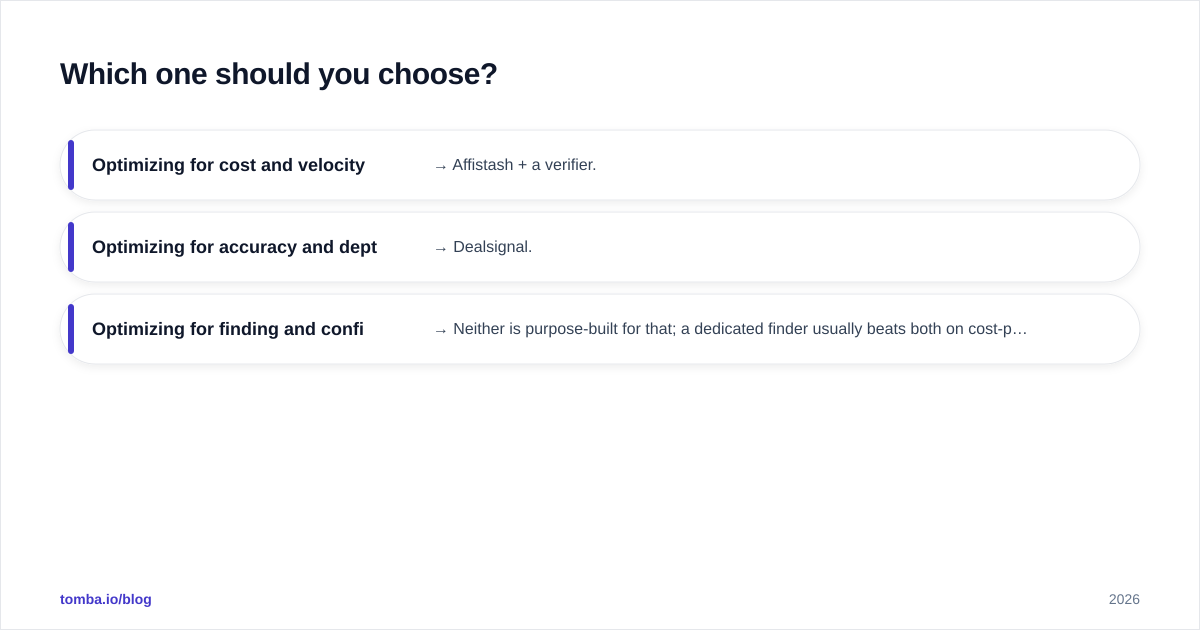
Here's a simple decision rule:
- Optimizing for cost and velocity? → Affistash + a verifier.
- Optimizing for accuracy and depth on named accounts? → Dealsignal.
- Optimizing for finding and confirming work emails specifically? → Neither is purpose-built for that; a dedicated finder usually beats both on cost-per-valid-email.
That third bullet is the one teams overlook. Both Affistash and Dealsignal are platforms — they bundle discovery, firmographics, enrichment, intent, and more. If your actual unmet need is narrow ("I have a list of 2,000 target people and I need their verified work emails"), you're paying for a lot of surface area you won't use.
What about a focused alternative?#
If the core job is finding and verifying business emails, a specialized tool is often faster, cheaper, and more accurate than a broad data platform — because it does one thing.
That's the lane Tomba sits in. Instead of selling you a static database to query, the Tomba Email Finder finds professional emails by name, company, or domain and confirms them, so you can:
- Run a domain search to pull every public contact pattern for a target company.
- Verify emails — including the catch-all domains that quietly inflate everyone's bounce rate — before they ever hit your sequencer.
- Enrich and dedupe lists in bulk, or wire it into your stack through the Tomba API.
It's not a replacement for Dealsignal's intent data or Affistash's partner discovery. It's the precision layer that makes whatever list you build actually deliver. Plenty of teams run a discovery platform for finding accounts and a finder/verifier for confirming contacts — the two solve different halves of the problem.
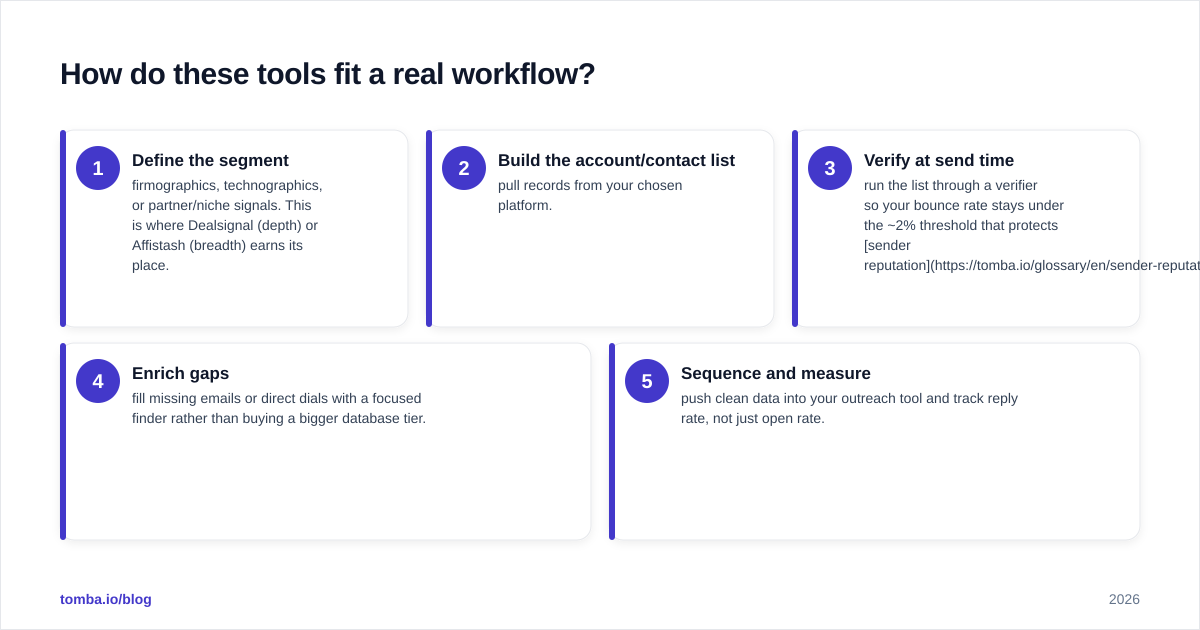
How do these tools fit a real workflow?#
A practical stack usually looks like a relay race, not a single tool:
- Define the segment — firmographics, technographics, or partner/niche signals. This is where Dealsignal (depth) or Affistash (breadth) earns its place.
- Build the account/contact list — pull records from your chosen platform.
- Verify at send time — run the list through a verifier so your bounce rate stays under the ~2% threshold that protects sender reputation.
- Enrich gaps — fill missing emails or direct dials with a focused finder rather than buying a bigger database tier.
- Sequence and measure — push clean data into your outreach tool and track reply rate, not just open rate.
The mistake is treating any single vendor as the whole pipeline. Affistash and Dealsignal are strong at steps 1–2 for different audiences. Steps 3–4 are where a purpose-built finder/verifier consistently outperforms a general platform on cost-per-valid-contact — which is exactly why the "platform vs. focused tool" debate usually ends in "use both, deliberately."
The bottom line#
Affistash and Dealsignal aren't really competing for the same buyer. Affistash is the lightweight, niche-and-partner discovery option for cost-conscious SMB teams. Dealsignal is the verified, research-grade platform for enterprise demand gen that can absorb the price. Choose based on whether your constraint is budget and speed or accuracy and depth — they sit on opposite ends of that line.
But whichever side you land on, don't skip the verification layer. A platform's accuracy claim is a starting point, not a guarantee, and contact data decays the moment it's stored. The cheapest insurance against a wrecked sender reputation is confirming each address right before you send.
If your real bottleneck is getting accurate, verified work emails into your sequencer — not buying another broad data subscription — start with the Tomba Email Finder. Run the free tier (25 searches/month), test the accuracy against your own known-good contacts, and see how far a focused tool gets you before you commit to a full platform contract. It's the fastest way to find out whether you needed Affistash, Dealsignal, or just a better finder all along.
// get started
Find, verify and enrich your first contacts today
Start on the free plan with 25 searches a month, then scale when your team is ready.
Free plan · No credit card required · GDPR & CCPA
// about the author