Affistash vs Generect 2026: Which B2B Lead Tool Wins?
Affistash hunts affiliate and partner programs; Generect builds B2B lead lists. This 2026 breakdown shows which one fits your pipeline — and where a dedicated email finder beats both.
TL;DR
- Affistash and Generect solve different problems. Affistash is built for affiliate and partnership discovery; Generect is built for B2B lead-list generation and contact data. Picking between them starts with knowing which job you're actually hiring for.
- Affistash wins if your growth channel is affiliates, partners, and program scouting. Generect wins if you need company and people data to feed outbound sequences.
- Neither tool is a best-in-class email finder or verifier — both treat contact data as a feature, not a core product, so accuracy and bounce rates vary.
- Pricing models differ sharply: Affistash leans toward affiliate-intelligence subscriptions, Generect toward seat- and credit-based lead access.
- If your real bottleneck is getting accurate, verified email addresses into your CRM, a dedicated finder like Tomba Email Finder closes the gap either tool leaves open.
When two tools land on the same shortlist, it's usually because someone typed "lead generation software" into a search bar and the algorithm did the rest. Affistash and Generect both appear under that umbrella, but they're aimed at different motions. This breakdown walks through what each one does, where they overlap, and how to decide — without the marketing gloss.
What is Affistash?#
Affistash is an affiliate-marketing intelligence tool. Its core job is helping you discover affiliate programs, partners, and the publishers already promoting competitors in your niche. Think of it less like a Rolodex and more like a radar: you point it at a market and it surfaces who's running affiliate offers, what networks they use, and which sites are sending them traffic.
That makes Affistash a fit for performance marketers, partnership teams, and agencies whose growth model depends on recruiting affiliates rather than cold-emailing prospects one by one. If your channel mix is "find people who will promote us for a cut," Affistash speaks your language.
What it is not is a general-purpose B2B prospecting database. The contact data it surfaces is incidental to the partnership angle. You can find program owners, but you're not pulling 10,000 verified CFO emails for a cold campaign.
What is Generect?#
Generect is a B2B lead generation platform. Its core job is building targeted lists of companies and decision-makers, then handing you contact details — emails, sometimes phone numbers — to load into your outbound stack. You filter by industry, headcount, geography, and role, then export.
This puts Generect in the same conversation as the broad field of prospecting databases. It's built for SDRs, founders running their own outbound, and demand-gen teams that need volume. The promise is straightforward: define your ideal customer profile, and Generect returns a list you can email.
The catch — and it's the same catch every database tool carries — is that "we have the email" and "the email is deliverable today" are two different claims. Lead databases age. Contacts change jobs. A list pulled in January can carry a meaningful bounce rate by March if nothing re-verifies it.
Affistash vs Generect: how do they compare?#
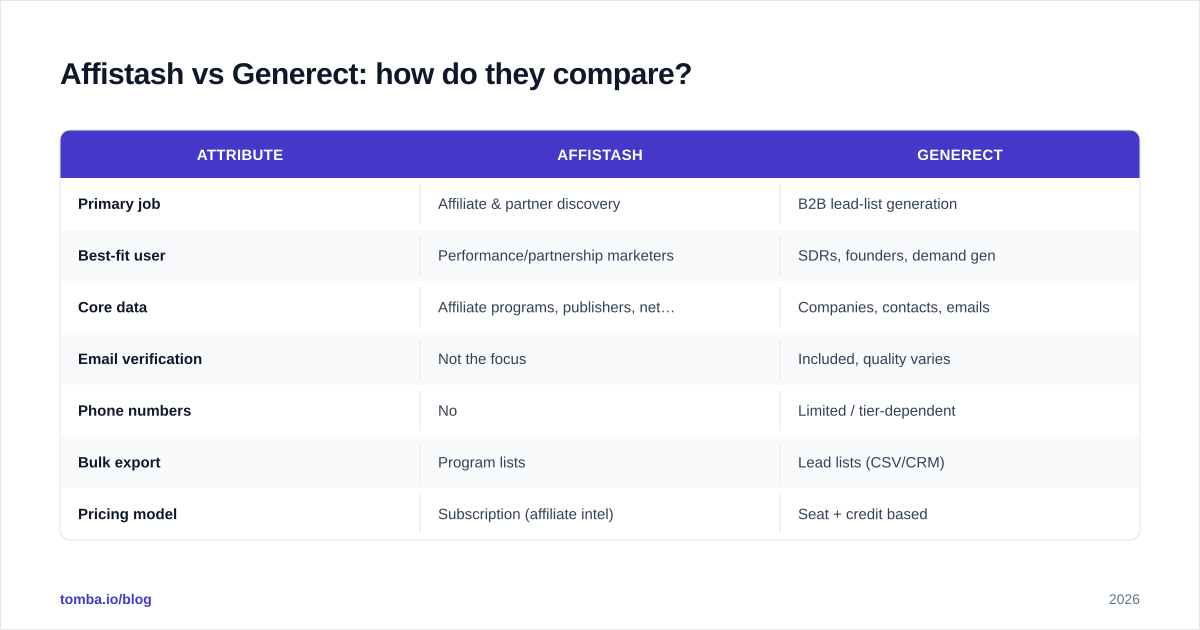
Here's the honest side-by-side. Note that several cells are marked "varies" or "not the focus" — that's not a dodge, it's the actual shape of these products. Always confirm current numbers on each vendor's own pricing page before you buy, since both iterate frequently.
| Attribute | Affistash | Generect |
|---|---|---|
| Primary job | Affiliate & partner discovery | B2B lead-list generation |
| Best-fit user | Performance/partnership marketers | SDRs, founders, demand gen |
| Core data | Affiliate programs, publishers, networks | Companies, contacts, emails |
| Email verification | Not the focus | Included, quality varies |
| Phone numbers | No | Limited / tier-dependent |
| Bulk export | Program lists | Lead lists (CSV/CRM) |
| Pricing model | Subscription (affiliate intel) | Seat + credit based |
| Free tier | Trial / limited | Limited trial |
| API access | Limited | Yes, tier-dependent |
| Where it falls short | Not a prospecting DB | Data freshness, verification |
The pattern is clear: these tools rarely compete head-to-head. They compete for budget and attention, not for the same task. If you're choosing between them, you've probably mis-scoped at least one of your requirements.

Which one should you choose?#
Conclusion first: match the tool to your acquisition channel, not to a generic "we need leads" goal.
Choose Affistash if:
- Affiliates and partners are a real revenue channel, not a someday idea.
- You need competitive intelligence on who's promoting whom.
- You're an agency or marketer who recruits publishers at scale.
Choose Generect if:
- Your motion is outbound email and you need ICP-filtered lists.
- You want company + contact data exported into a sequencer or CRM.
- Volume matters more than partnership depth.
Choose neither — or add a third tool — if your actual pain is that the emails you already have are bouncing, going to spam, or sitting unverified in a spreadsheet. That's a contact-data quality problem, and neither Affistash nor Generect is engineered to solve it as a primary function. This is where a focused email verifier and finder earn their place in the stack.
How accurate is the contact data in each?#
This is the question that decides whether a campaign works, and it's the one both tools handle as a side feature.
Affistash isn't trying to be a contact-accuracy product, so judging it on bounce rates misses the point — you use it to find programs, then often reach out through the network or a listed contact. Generect does compete on contact data, which means it should be held to the standard every database faces: how fresh is the record, and is the email verified at the moment you pull it?
Here's the mechanism that trips teams up. Two emails can look identical on paper:
jane.doe@company.com(verified, active mailbox)jane.doe@company.com(Jane left six months ago; mailbox bounces)
Your spreadsheet can't tell them apart. Only a verification step that pings the mail server in real time can. Most all-in-one lead tools verify on a schedule, not on demand — so the data is only as good as the last refresh. For a deeper look at how providers source and refresh records, see Tomba's data sources breakdown.
Industry reviews back this up: on platforms like G2, the most common complaint across lead-database tools isn't missing contacts — it's stale or unverifiable ones. The fix is the same regardless of which database you start with: run a verification pass before you send.
What do Affistash and Generect cost?#
Pricing is where the two diverge most, because they're selling different value.
Affistash prices around affiliate intelligence — you're paying for market visibility and program discovery, so the value scales with how central affiliates are to your growth. Generect prices around access: seats and credits that map to how many leads you pull. Both publish current numbers on their own sites — confirm at affistash.com and generect.com rather than trusting a third-party table, since SaaS pricing shifts quarterly.
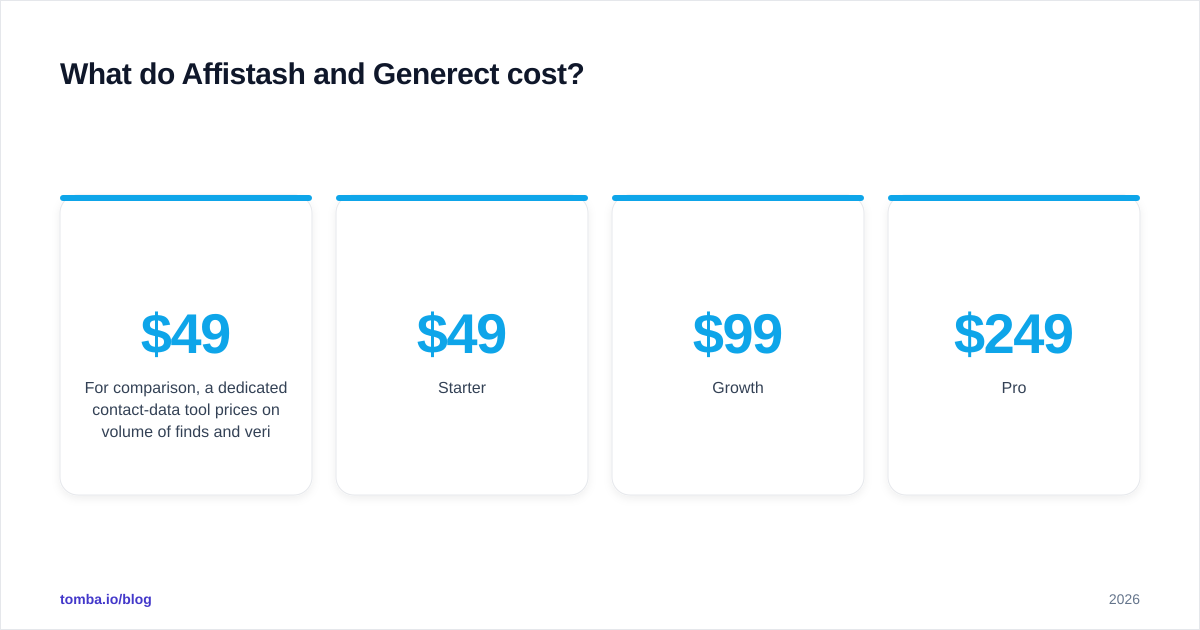
For comparison, a dedicated contact-data tool prices on volume of finds and verifications. Tomba pricing, for example, runs a free tier at 25 searches/month, Starter at $49/mo, Growth at $99/mo, and Pro at $249/mo — so you can layer accurate email finding onto either Affistash or Generect without committing to another full platform.
| Plan | Tomba (contact data) |
|---|---|
| Free | 25 searches/mo |
| Starter | $49/mo |
| Growth | $99/mo |
| Pro | $249/mo |
| Enterprise | Custom |
The takeaway isn't "Tomba is cheaper than X." It's that contact accuracy is a separable line item — and treating it as one often costs less than over-buying a platform for a feature it does part-time.
Where does an email finder fit alongside these tools?#
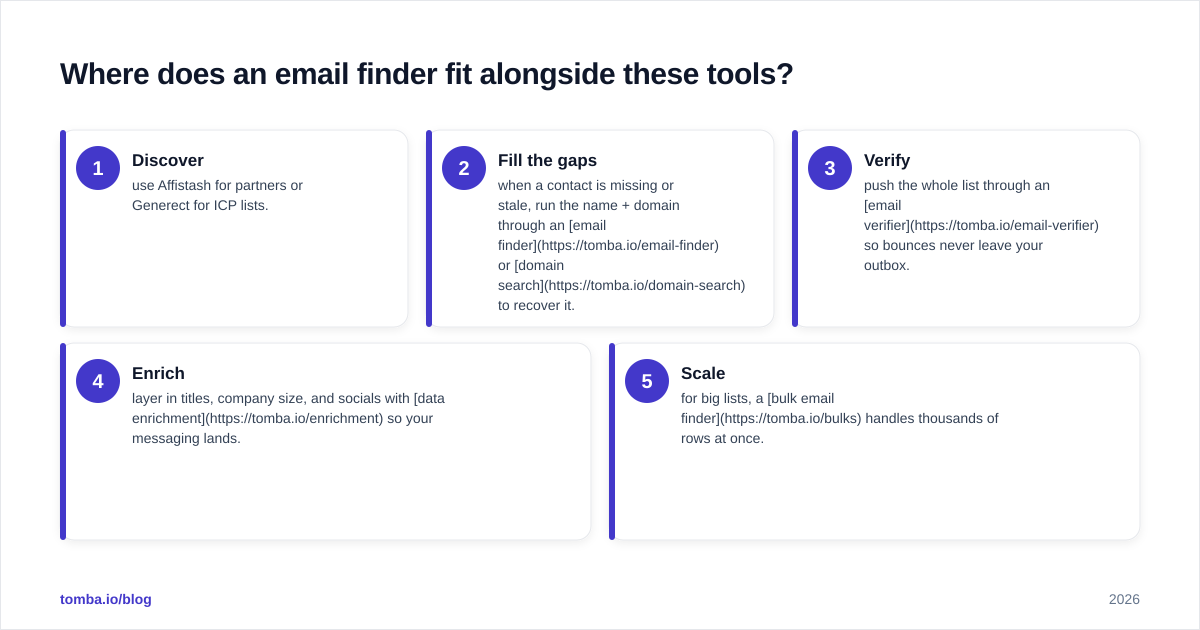
Think of Affistash and Generect as the top of the funnel — they tell you who to talk to and which markets to chase. An email finder is the part that makes the conversation actually start: it turns a name and a company domain into a deliverable address, and confirms that address is live before you send.
A practical workflow looks like this:
- Discover — use Affistash for partners or Generect for ICP lists.
- Fill the gaps — when a contact is missing or stale, run the name + domain through an email finder or domain search to recover it.
- Verify — push the whole list through an email verifier so bounces never leave your outbox.
- Enrich — layer in titles, company size, and socials with data enrichment so your messaging lands.
- Scale — for big lists, a bulk email finder handles thousands of rows at once.
This is why "Affistash vs Generect" is often the wrong framing. The better question is which discovery tool fits your channel — then which data layer keeps that channel from leaking. Outbound email leadership at firms like HubSpot consistently flags list hygiene as the single biggest lever on deliverability; the discovery tool matters far less than what you do with the list afterward.
What about deliverability risk?#
Both tools can put bad addresses in your hands without meaning to — that's the nature of any data product. The risk lands on your sending domain. A campaign sent to an unverified Generect list can spike your bounce rate, and once mailbox providers see that, your sender reputation drops and even your good emails start hitting spam.
Protect the asset:
- Never send to a list you haven't verified in the last 30 days.
- Watch for catch-all domains — they accept everything and tell you nothing. A catch-all verifier separates real mailboxes from black holes.
- Keep bounce rates under 2%; above that, pause and re-clean.
These habits matter more than which discovery tool you picked. You can win the Affistash-vs-Generect debate and still torch your domain if step three is missing.
The bottom line#
Affistash and Generect aren't really rivals — they're specialists. Affistash is the right call when affiliates and partnerships drive your growth. Generect is the right call when you need ICP-filtered B2B lead lists for outbound. The mistake is expecting either one to also be your accuracy layer.
That layer is where deals are won or lost. A discovery tool gets you a name; a finder-and-verifier gets you a reply. Whichever platform tops your shortlist, plug the data gap deliberately rather than hoping the built-in feature is enough.
Ready to stop guessing whether your emails are deliverable? Run your Affistash partners or Generect lead lists through Tomba Email Finder to recover missing addresses and verify every one before you send. Start free with 25 searches a month — no card required — and see how much of your current list is actually reachable. Your sender reputation will thank you.
// get started
Find, verify and enrich your first contacts today
Start on the free plan with 25 searches a month, then scale when your team is ready.
Free plan · No credit card required · GDPR & CCPA
// about the author