Affistash vs LeadEngineAI 2026: Which Lead Tool Wins?
A neutral, side-by-side breakdown of Affistash vs LeadEngineAI in 2026 — features, pricing, data quality, and which lead-gen workflow each one actually fits.
TL;DR
- Affistash leans toward affiliate and partner discovery — surfacing programs, publishers, and partnership signals you can recruit or pitch.
- LeadEngineAI leans toward AI-scored outbound lead generation — building target lists, predicting intent, and prioritizing accounts.
- Neither tool is a full replacement for the other: they sit at different points in the funnel, and many teams run one for partnerships and one for direct outbound.
- Both are only as good as the contact data underneath them. Whatever you pick, you'll need a reliable email finder and verification layer to actually reach the leads.
- Use the framework below to decide based on motion (partner-led vs. direct outbound), data needs, and budget — not on marketing claims.
What are Affistash and LeadEngineAI?#
Short answer: they solve adjacent problems that people lump together as "lead generation," but they don't compete head-to-head as cleanly as the "vs" framing suggests.
Affistash is positioned around affiliate and partnership intelligence. Think of it like a scout for a sports team — instead of finding customers directly, it finds the people who already have your customers' attention (affiliates, publishers, niche sites, partner programs). You use it to discover programs to join, recruit affiliates into your own program, or map who's promoting competitors.
LeadEngineAI is positioned around AI-driven direct lead generation. The analogy here is a metal detector tuned to a specific signal — it sweeps a large pool of companies and people, scores them for fit and intent, and hands you a prioritized list to go after with outbound. The "AI" piece is mostly about scoring and enrichment rather than discovery alone.
So the honest framing: Affistash optimizes a partner-led motion, LeadEngineAI optimizes a direct outbound motion. If you confuse the two, you'll buy the wrong tool and blame it for not doing a job it was never built for.
How do Affistash and LeadEngineAI compare on features?#
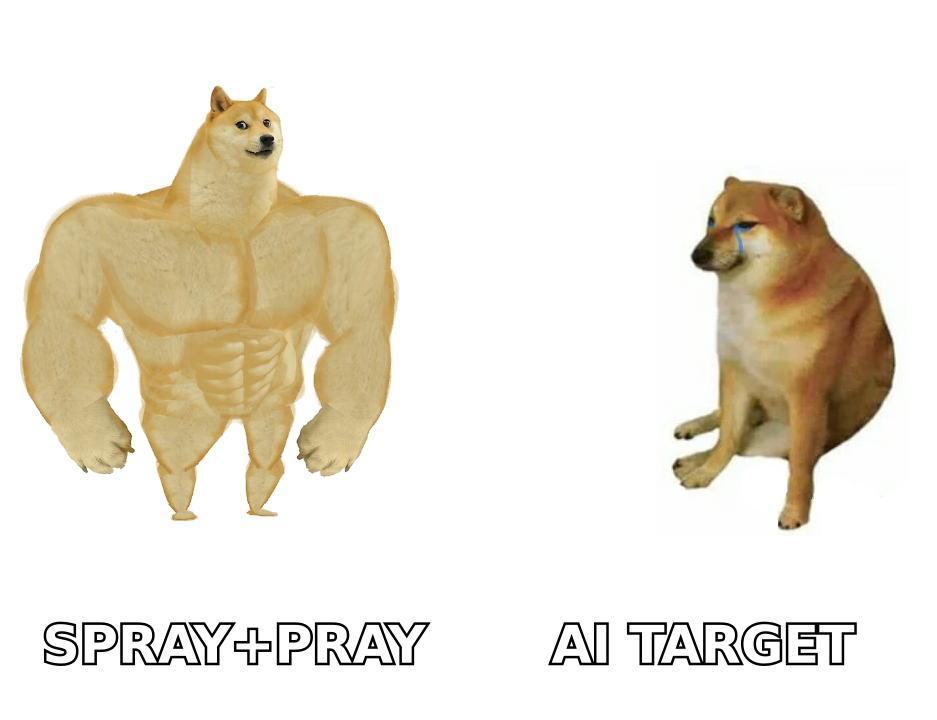
Here's a side-by-side on the dimensions that actually change your day-to-day. Pricing tiers below are illustrative of how these categories are typically packaged — confirm current numbers on each vendor's own pricing page before you buy, since lead-gen pricing changes often.
| Dimension | Affistash | LeadEngineAI |
|---|---|---|
| Primary job | Affiliate / partner discovery | AI-scored outbound leads |
| Core output | Programs, publishers, partner signals | Target accounts + contacts, ranked |
| Data angle | Partnership & promotion footprint | Firmographic + intent scoring |
| Best for | Affiliate managers, partnerships, SEO/PR | SDRs, demand gen, founder-led sales |
| AI usage | Discovery + matching | Scoring, prioritization, enrichment |
| Contact data | Limited — pair with an email finder | Built-in but verify before sending |
| Typical entry price | ~$49–$99/mo range | ~$60–$120/mo range |
| Free trial / tier | Usually limited trial | Usually limited trial |
| Where it stops | You still need verified emails | You still need deliverability hygiene |
Two things stand out. First, both tools hand off to the same next step: you have to confirm the contact is reachable. Discovery and scoring don't matter if the email bounces. Second, the "AI" label on LeadEngineAI is doing a lot of work in its marketing — treat scored intent as a prioritization aid, not gospel, and always sanity-check the top of the list manually.
Which one has better data quality?#
Conclusion first: data quality depends less on the brand and more on how fresh the underlying source is and whether you verify before outreach. Both categories suffer the same decay problem — B2B contact data goes stale at roughly 2–3% per month as people change jobs, so a list that was 95% accurate in January is materially worse by summer.
Affistash's "data" is really relationship signals — who links to whom, who promotes what, which programs are active. That kind of data ages differently; a partnership footprint is stickier than a personal email address, but program terms and contacts still drift.
LeadEngineAI's data is contact-and-account level, which is exactly the data that decays fastest. AI scoring can't fix a wrong email — if anything, a confident score on a dead contact wastes more of your reps' time than no score at all.
The practical move with either tool is the same: treat their export as a starting list, then run it through an email verifier to drop bounces before they hit your sending domain. One hard bounce spike can drag your sender reputation down for weeks, and no amount of AI scoring buys that back.
When should you choose Affistash?#
Choose Affistash when your growth motion runs through other people's audiences. Concretely:
- You're building or scaling an affiliate program and need to recruit publishers who already rank for your category.
- You're in partnerships or BD and want to map who promotes competitors so you can pitch the same partners.
- You're an SEO or PR team hunting for sites and creators to collaborate with, not individual buyers to cold-email.
In these cases, the value is discovery of programs and promoters, and Affistash's footprint-mapping is the point. Where it leaves you hanging is the contact layer — knowing a site promotes your competitor doesn't give you the right person's inbox. That's where you bolt on a domain search to pull the actual people behind a partner domain, then reach out.
If most of your pipeline is direct — you sell to end buyers, not through intermediaries — Affistash will feel like a tool searching for a use case in your stack.
When should you choose LeadEngineAI?#
Choose LeadEngineAI when you run direct outbound and want help prioritizing a large universe of accounts. It fits when:
- You're an SDR team drowning in TAM and need a ranked list rather than an alphabetical dump.
- You're doing demand gen and want intent-style signals layered onto firmographics.
- You're a founder selling early and need a fast, opinionated "go after these 50 first" list.
The trap with AI-scored lead tools is over-trusting the ranking. Scores are correlations, not commitments. The discipline that makes them work: pull the top slice, manually review 10–15 accounts to gut-check the model against your ICP, and only then scale. And as always, the scored contact still needs a verified email and a clean sending setup before you send anything.
Affistash vs LeadEngineAI: which is better for ROI?#
There's no universal winner — there's a winner for your motion. Use this decision framework:
- Identify your dominant motion. Partner-led and audience-leverage → Affistash. Direct outbound to named accounts → LeadEngineAI.
- Count the handoffs. Both tools stop short of "verified, reachable contact." Budget for an email-finding and verification layer in either path — it's not optional.
- Price against pipeline, not seats. A $99/mo tool that produces 5 bad lists is more expensive than a $249 tool that produces one good one. Judge by qualified meetings, not feature count.
- Pilot with a single segment. Run one tool against one narrow ICP for 30 days. Measure reply rate and meeting rate, not vanity list size.
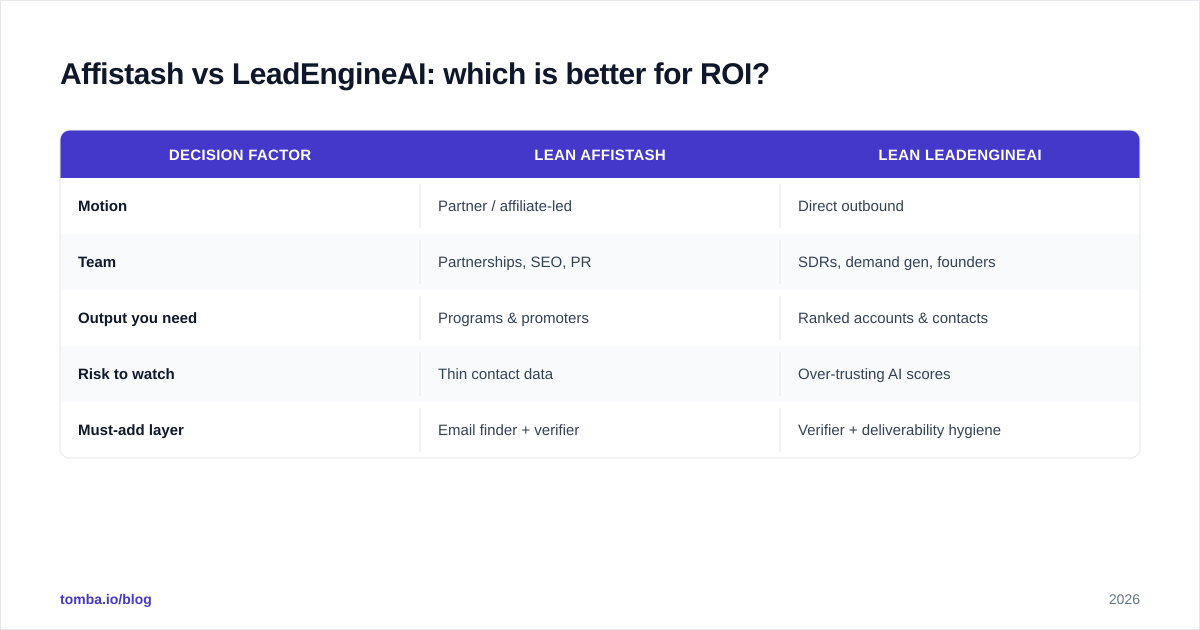
| Decision factor | Lean Affistash | Lean LeadEngineAI |
|---|---|---|
| Motion | Partner / affiliate-led | Direct outbound |
| Team | Partnerships, SEO, PR | SDRs, demand gen, founders |
| Output you need | Programs & promoters | Ranked accounts & contacts |
| Risk to watch | Thin contact data | Over-trusting AI scores |
| Must-add layer | Email finder + verifier | Verifier + deliverability hygiene |
If you're cross-shopping these two and a half-dozen others, it's worth reading independent reviews on G2 or Capterra and weighting recent reviews heavily — lead-gen tools change fast, and a glowing 2024 review may describe a product that no longer exists.
What do both tools miss — and how do you fill the gap?#
Both Affistash and LeadEngineAI share the same blind spot: the last mile from "I found a lead" to "I can actually reach this person." Discovery and scoring are the front of the funnel; deliverability and accurate contact data are what determine whether any of it converts.
That gap is where a dedicated email-intelligence layer earns its keep:
- Find the right person. When a tool gives you a company or a domain but not the decision-maker, find email addresses by name and domain instead of guessing the format.
- Verify before you send. Run every list through verification so hard bounces never touch your domain. HubSpot's own deliverability guidance is blunt about this: list hygiene is the single biggest lever on inbox placement (see HubSpot's email deliverability resources).
- Enrich the thin rows. Where a record is missing a title, phone, or social profile, data enrichment fills it so your reps aren't researching one lead at a time.
- Work at list scale. For larger imports, a bulk email finder processes thousands of rows at once rather than one lookup per record.
None of this competes with Affistash's partner discovery or LeadEngineAI's scoring — it completes them. The cleanest stack is "discovery tool of choice + reliable contact and verification layer," not one mega-tool that claims to do everything and does the contact part poorly.
How do you actually run a pilot between them?#
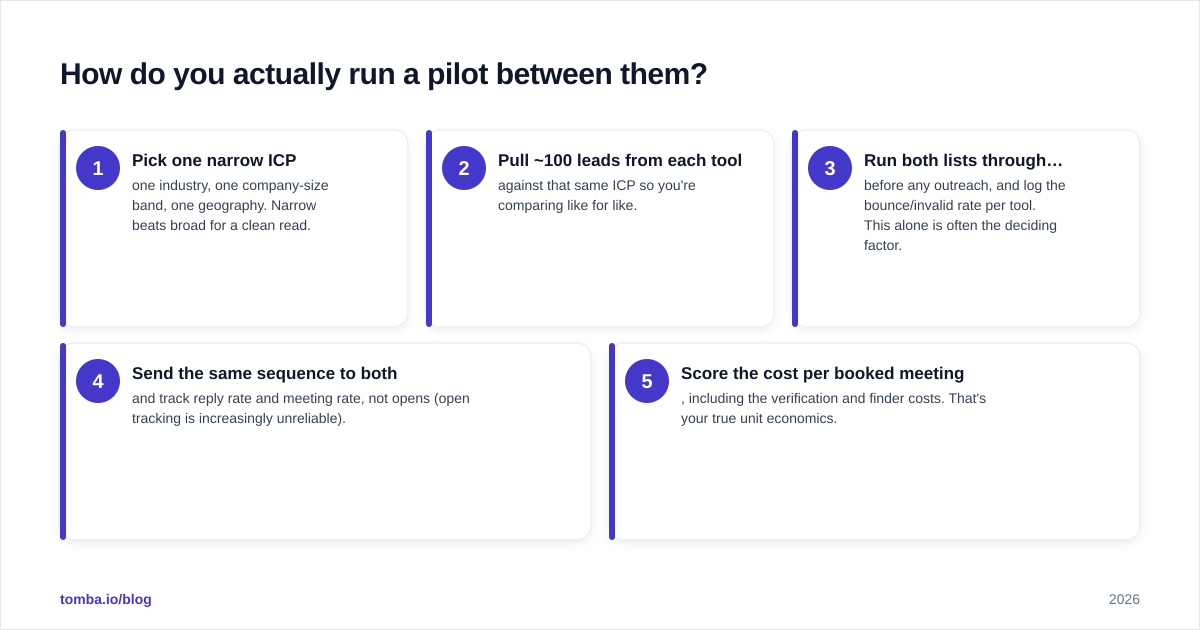
Keep it simple and time-boxed so you get a real signal in 30 days:
- Pick one narrow ICP — one industry, one company-size band, one geography. Narrow beats broad for a clean read.
- Pull ~100 leads from each tool against that same ICP so you're comparing like for like.
- Run both lists through verification before any outreach, and log the bounce/invalid rate per tool. This alone is often the deciding factor.
- Send the same sequence to both and track reply rate and meeting rate, not opens (open tracking is increasingly unreliable).
- Score the cost per booked meeting, including the verification and finder costs. That's your true unit economics.
The team that wins isn't the one with the fanciest AI label — it's the one that pairs the right discovery tool with disciplined data hygiene and measures honestly.
The bottom line#
Affistash and LeadEngineAI aren't really rivals; they're specialists for two different motions. Affistash is the better pick for partner-led and affiliate growth. LeadEngineAI is the better pick for AI-prioritized direct outbound. Match the tool to your motion, pilot it against one ICP, and judge it by booked meetings.
Whichever you choose, the deciding factor on results won't be the discovery engine — it'll be whether the contacts you reach are real and reachable. That's the layer Tomba is built for. Use the Tomba Email Finder to turn the companies and domains either tool surfaces into verified, ready-to-contact decision-makers — then verify in bulk before you send so your outreach lands in the inbox instead of the bounce log. Start on the free tier (25 searches/month), and check Tomba pricing when you're ready to scale: Starter is $49/mo, Growth $99/mo, and Pro $249/mo.
// get started
Find, verify and enrich your first contacts today
Start on the free plan with 25 searches a month, then scale when your team is ready.
Free plan · No credit card required · GDPR & CCPA
// about the author