Affistash vs Onemorelead: Which B2B Lead Tool Wins in 2026?
Affistash and OneMoreLead both promise ready-to-use B2B contacts, but they solve very different problems. Here's an honest breakdown of pricing, data quality, and which one fits your pipeline in 2026.
Affistash vs OneMoreLead is a confusing match-up. Both tools claim to hand you B2B contacts. But they were built for different jobs. Pick the wrong one and you waste money two ways. You either pay for affiliate-recruitment features you never touch. Or you blast a stale list and burn your sender reputation. This breakdown cuts through the marketing copy.
TL;DR#
- Affistash is built for affiliate and partnership discovery. It finds publishers, affiliates, and partner sites to recruit. It is not for general cold-outbound prospecting.
- OneMoreLead is a B2B contact database. You filter a pre-built list of companies and people, then export emails for outreach.
- They are not true head-to-head rivals. If you run an affiliate program, Affistash wins by default. If you need cold-email-ready B2B contacts, OneMoreLead is the closer fit.
- Both share one weakness: data freshness and email accuracy. A static database decays ~22–30% per year. Recruited-partner contact info goes stale just as fast.
- For most outbound teams, a real-time verification layer matters more than which database you start from. A dedicated email verifier does that job.
What is Affistash?#
Affistash is an affiliate-marketing discovery platform. Its core promise is simple. Tell it your niche or a competitor's domain. It then surfaces affiliates, publishers, and partner sites you could recruit. Think of it less as a phone book and more as a scout. It tells you who is already promoting products like yours, so you can pitch them a partnership.
That framing matters. Affistash optimizes for partner discovery, not for building a 10,000-row cold-email list. The contact data it returns (emails, social handles) helps you start a partnership conversation. It is not meant to fuel a high-volume sequence.
Typical users: affiliate managers, growth marketers running referral programs, and SaaS teams standing up a partner channel. If that's not you, most of Affistash's feature surface is dead weight.
What is OneMoreLead?#
OneMoreLead is a B2B lead database and list-building tool. You log in and apply filters, such as industry, title, company size, location, or technology. It then returns matching contacts you can export. It markets itself on the size of its database — hundreds of millions of records — and on verified business emails.
The mental model here is a giant filterable spreadsheet. You're not discovering relationships. You're slicing a pre-existing dataset down to a target segment. Then you pull the contacts out for your CRM or bulk email finder workflow.
Typical users: SDR teams, demand-gen marketers, and founders doing early cold outbound who want volume fast.
Affistash vs Onemorelead: how do they actually differ?#
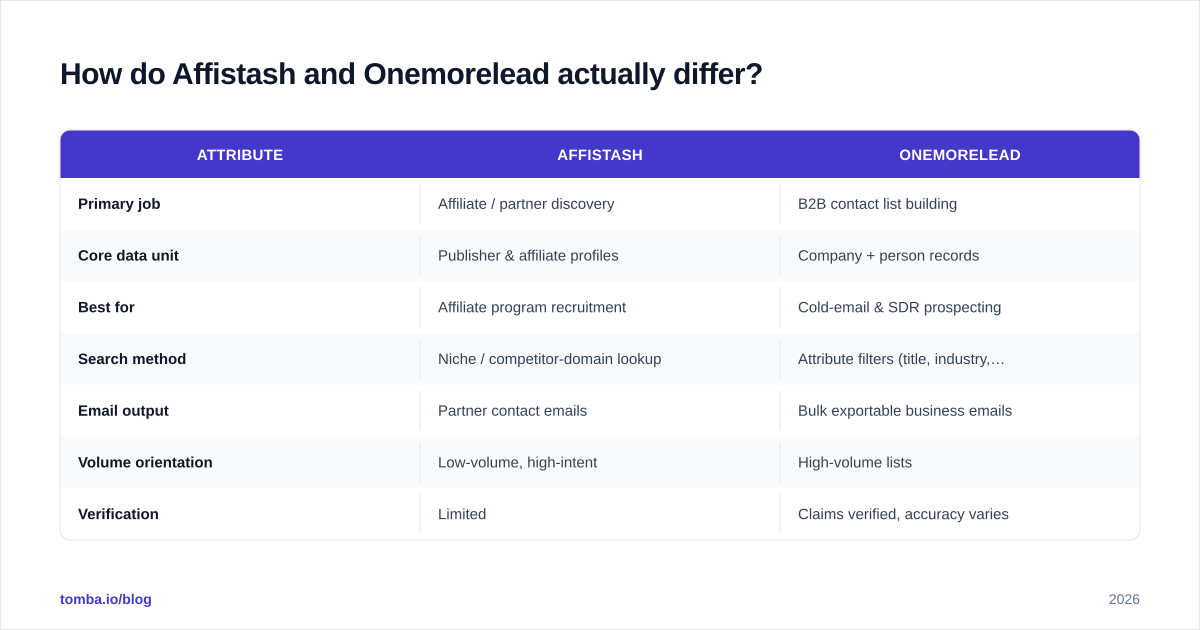
The honest answer: they overlap less than their landing pages suggest. One is a discovery engine for partnerships. The other is a contact warehouse for outbound. Here's the side-by-side.
| Attribute | Affistash | OneMoreLead |
|---|---|---|
| Primary job | Affiliate / partner discovery | B2B contact list building |
| Core data unit | Publisher & affiliate profiles | Company + person records |
| Best for | Affiliate program recruitment | Cold-email & SDR prospecting |
| Search method | Niche / competitor-domain lookup | Attribute filters (title, industry, size) |
| Email output | Partner contact emails | Bulk exportable business emails |
| Volume orientation | Low-volume, high-intent | High-volume lists |
| Verification | Limited | Claims verified, accuracy varies |
| Native CRM sync | Limited | Export-based |
| Ideal team | Affiliate / partnerships | SDR / demand gen |
The takeaway is about the question you're asking. Is it "who should I recruit as an affiliate?" Then you want Affistash. Is it "give me 2,000 CMOs at 50–200 person SaaS companies"? Then you want OneMoreLead — or a purpose-built email finder.
)
Which has better data accuracy?#
Neither tool escapes the core problem of static B2B data: it rots. People change jobs every 2–3 years. Companies rebrand domains. Catch-all servers hide invalid mailboxes. Industry benchmarks from review sites like G2 and Capterra show the same thing. Database-first tools lose accuracy the moment a record is written.
OneMoreLead leans on database size as a selling point. But a bigger database is not a more accurate one. It just means more rows to decay. Affistash's contact data is narrower and more intent-driven, since these are active publishers. Still, partnership emails are often role-based or personal addresses. They bounce when someone leaves.
The practical fix is the same, whichever tool you start with: verify every address at send time, not at export time. A list verified three months ago is already 5–8% wrong. So run exports through a real-time email verification step before they hit your sequencer. It's the single highest-leverage habit in cold outbound. That's why we treat verification as separate from sourcing.
)
How do they compare on pricing?#
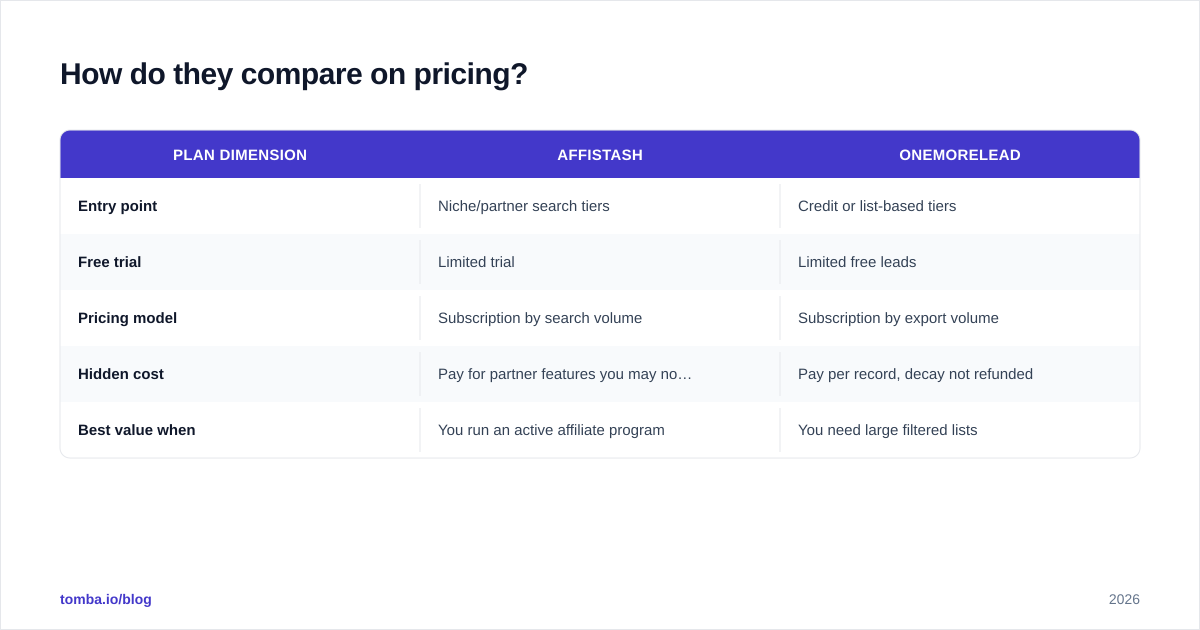
Both vendors gate exact numbers behind sign-up or sales calls, and tiers shift. So treat the shape below as directional, not a quote. Always confirm on the vendor's own site. For Affistash that's affistash.com, and OneMoreLead publishes plans on its homepage.
| Plan dimension | Affistash | OneMoreLead |
|---|---|---|
| Entry point | Niche/partner search tiers | Credit or list-based tiers |
| Free trial | Limited trial | Limited free leads |
| Pricing model | Subscription by search volume | Subscription by export volume |
| Hidden cost | Pay for partner features you may not use | Pay per record, decay not refunded |
| Best value when | You run an active affiliate program | You need large filtered lists |
The cost trap with both is the same. You pay for access to records. But you don't pay less when a chunk of those records bounce. That's the difference between buying data and buying deliverable data. For comparison, transparent per-search pricing — like the published Tomba pricing tiers — lets you model cost-per-valid-contact instead of cost-per-row.
Which should you choose?#
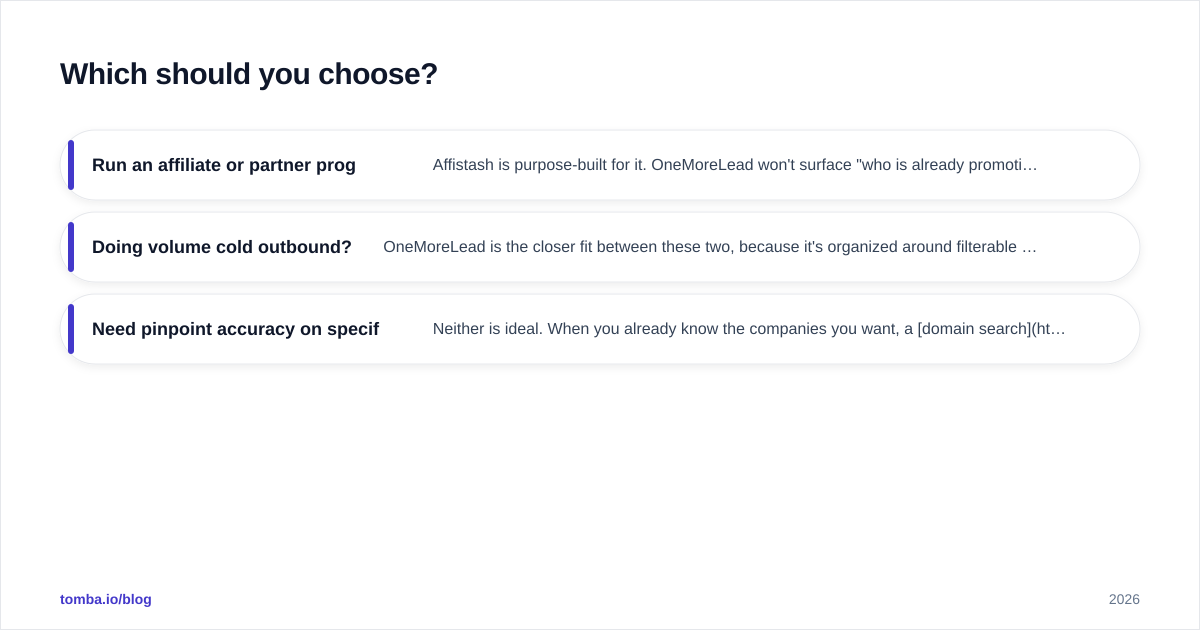
The Affistash vs OneMoreLead choice comes down to the job, not the brand:
- Run an affiliate or partner program? Affistash is purpose-built for it. OneMoreLead won't surface "who is already promoting competitors," which is the whole point of partner recruitment.
- Doing volume cold outbound? OneMoreLead is the closer fit of these two. It's organized around filterable B2B segments and bulk export.
- Need pinpoint accuracy on specific targets? Neither is ideal. When you already know the companies you want, a domain search and on-demand email finder beat browsing a static database. You fetch exactly the contact you need and verify it on the spot.
A simple rule helps here. Discovery tools find the relationship. Database tools find the row. Finders confirm the address. Most teams need at least two of those three. And the address-confirmation layer is non-negotiable if you care about email deliverability.
What about a more accurate alternative?#
Here's the uncomfortable truth that neither comparison page will tell you. For pure cold-email prospecting, a list database is rarely the most accurate starting point. Databases optimize for coverage (how many rows) at the expense of freshness (are those rows still true today).
A finder-plus-verifier workflow inverts that. Instead of downloading 5,000 maybe-valid rows and hoping, you:
- Identify target companies (from your ICP, a SERP, or a partner-discovery tool like Affistash).
- Run a domain search to pull current contacts per company.
- Verify each address in real time before it enters your sequencer.
- Enrich the survivors with firmographics via a data enrichment pass.
This produces a smaller list with a much higher hit rate. That is what actually protects your sender reputation and your reply rate. You can read the underlying methodology on Tomba's data sources page. You can also validate the approach against independent reviews on Capterra.
The point isn't that Affistash or OneMoreLead are bad. It's that "buy a list" is the wrong first instinct for a 2026 outbound motion. Sourcing and verification are two jobs. Bolting them together inside one static database is where deliverability quietly dies.
Frequently asked questions#
Is Affistash a competitor to OneMoreLead? Only loosely. Affistash discovers affiliates and partners. OneMoreLead builds filtered B2B contact lists. They overlap on "here are some emails," but the intent behind each tool is different.
Which one is better for cold email? Between the two, OneMoreLead is the closer fit, because it's built around exportable B2B segments. But for cold email specifically, a finder-plus-verifier stack usually delivers a higher valid-email rate than any static list.
Do I still need to verify emails if the tool says they're verified? Yes. "Verified" usually means verified at the time the record was created, which could be months ago. Re-verify at send time. It's the cheapest insurance against bounces and blacklisting.
Can I use both tools together? Sure. Use Affistash to find partners. Use OneMoreLead (or a finder) to source contacts. Then use a dedicated verifier to clean everything before outreach. Just don't pay two vendors for overlapping coverage you won't use.
The bottom line#
The Affistash vs OneMoreLead debate isn't really a fight over the same buyer. One recruits partners. The other rents you a contact list. Match the tool to the job and you'll waste less money. But whichever you pick, the accuracy of your outreach lives or dies on a step neither tool fully owns: real-time verification of every address before you press send.
Is your real goal finding and confirming professional emails you can actually reach? Then start with the Tomba Email Finder. It pulls current contacts by name, company, or domain. It also pairs natively with verification, so the list you build is the list that lands. Try it on your top 25 target accounts — the free tier covers 25 searches a month. Then compare the valid-email rate against any list you've exported. The gap is usually the whole argument.
// get started
Find, verify and enrich your first contacts today
Start on the free plan with 25 searches a month, then scale when your team is ready.
Free plan · No credit card required · GDPR & CCPA
// about the author