Affistash vs SalesIntel 2026: Which B2B Data Tool Wins?
Affistash and SalesIntel both promise accurate B2B contact data, but they solve different problems. Here's a no-spin breakdown of pricing, accuracy, coverage, and fit for 2026.
TL;DR
- Affistash is a lightweight prospecting and lead-discovery tool aimed at small teams, agencies, and solo founders who want emails fast without an enterprise contract.
- SalesIntel is a heavier B2B data platform built around human-verified contacts, intent data, and technographics for mid-market and enterprise revenue teams.
- The real split is price and depth: Affistash wins on affordability and speed; SalesIntel wins on data depth, compliance, and account-level intelligence — at a much higher cost.
- Neither is the cheapest accurate option for pure email discovery. If your core need is finding and verifying work emails at scale, a dedicated email finder like Tomba usually beats both on cost-per-valid-contact.
- Pick by job-to-be-done, not brand: lean Affistash for fast, budget outbound; lean SalesIntel for ABM and committee-level selling.
What are Affistash and SalesIntel?#
Affistash and SalesIntel sit in the same broad category — B2B contact data — but they were built for different buyers.
Affistash markets itself as a fast, affordable lead-generation and prospecting tool. You search by criteria, it returns business contacts and emails, and you export. The pitch is speed and low friction: no annual lock-in, no sales call to see a price. It appeals to agencies, recruiters, and small outbound teams who need volume without a data-team budget.
SalesIntel (salesintel.io) is a B2B data and intelligence platform. Its differentiator is human-verified data — contacts re-verified on a rolling cycle — plus buyer intent signals, technographics, and firmographics. It's sold to RevOps, demand gen, and enterprise sales teams running account-based motions where data depth and compliance matter more than a low monthly fee.
Think of it like transport. Affistash is a reliable compact car: cheap, quick, gets you there. SalesIntel is a fully loaded SUV with a driver who double-checks the route — more capable, far more expensive, overkill for a quick trip across town.
How do Affistash and SalesIntel compare on price?#
Price is where these two diverge hardest, and it's the first filter for most buyers.
Affistash uses transparent, self-serve, credit-style pricing aimed at individuals and small teams. You can start cheap and scale credits as you grow.
SalesIntel uses quote-based enterprise pricing. Plans are annual, negotiated, and typically land in the four-to-five-figure range per year depending on seats, credits, and which data modules (intent, technographics) you bolt on. That's normal for verified enterprise data — but it prices out smaller teams entirely.
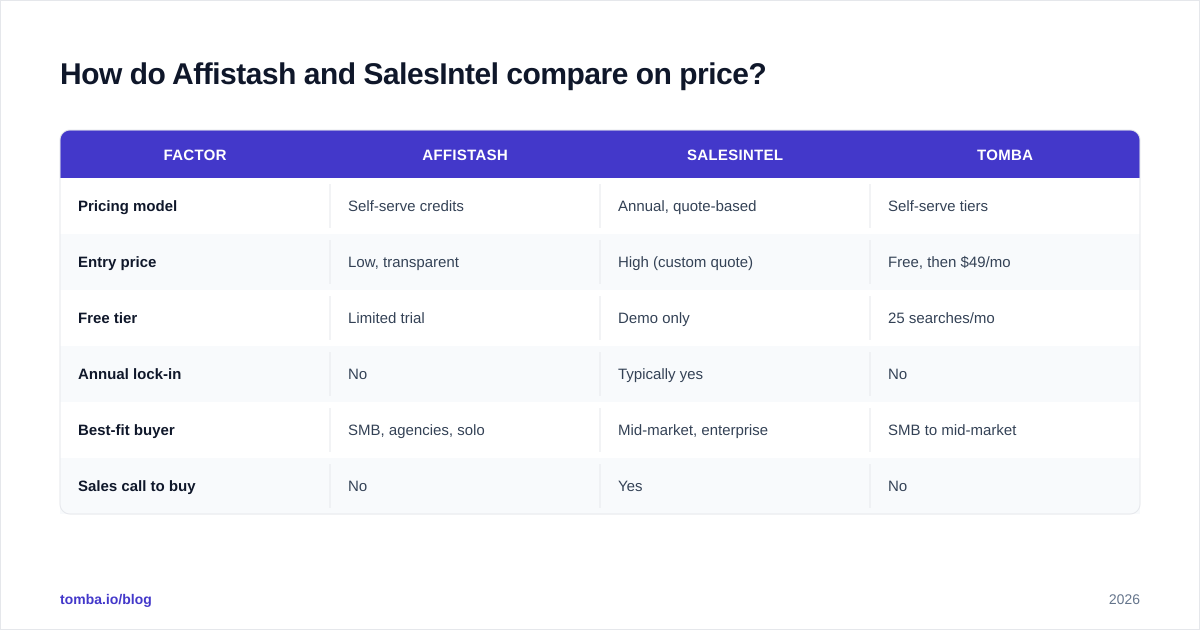
For reference, here's how a dedicated email-finding tool like Tomba is structured, since many readers comparing these two are really trying to control cost-per-contact. You can see the full Tomba pricing breakdown, but the short version: a Free tier with 25 searches/mo, Starter at $49/mo, Growth at $99/mo, and Pro at $249/mo.
| Factor | Affistash | SalesIntel | Tomba |
|---|---|---|---|
| Pricing model | Self-serve credits | Annual, quote-based | Self-serve tiers |
| Entry price | Low, transparent | High (custom quote) | Free, then $49/mo |
| Free tier | Limited trial | Demo only | 25 searches/mo |
| Annual lock-in | No | Typically yes | No |
| Best-fit buyer | SMB, agencies, solo | Mid-market, enterprise | SMB to mid-market |
| Sales call to buy | No | Yes | No |
The pattern is clear: Affistash and Tomba are buy-it-today tools; SalesIntel is a procurement process.
Which has more accurate B2B data?#
Accuracy is the whole point of paying for data, so this deserves scrutiny.
SalesIntel's core selling point is human verification. A research team re-checks contacts on a cycle, which reduces the bounce-and-decay problem that plagues purely scraped databases. For roles with high turnover or for direct-dial phone numbers, that hands-on layer is genuinely valuable — it's hard to replicate with automation alone.
Affistash relies more on automated discovery and aggregation. That keeps the price down and the search fast, but automated data ages faster between refreshes, so you should expect more variance in deliverability and verify before you send.
The honest takeaway: no contact database is "always accurate." Email validity decays roughly 2–3% per month as people change jobs, so verification at send-time matters more than any vendor's headline accuracy claim. Whatever tool you choose, run results through an email verifier before a campaign. That single step protects your sender reputation more than chasing a marginally higher database accuracy stat.

If your buying committee is large and your deals are high-value, SalesIntel's verification justifies its cost. If you're sending higher-volume, lower-touch outbound, paying enterprise prices for verification you'd re-run anyway is wasted budget — a leaner bulk email finder plus verification covers it.
What features set them apart?#
Beyond raw contacts, the platforms differ in scope.
Affistash keeps the surface area small on purpose: search, find emails, export. That focus is a feature — fewer tabs, faster time-to-list, less onboarding. What you give up is the intelligence layer: intent data, account scoring, and deep firmographic filtering are limited or absent.
SalesIntel is a platform, not a utility. You get:
- Buyer intent data — signals on which accounts are researching your category now.
- Technographics — what software a target company already runs.
- Firmographic depth — granular filtering by revenue, headcount, industry, and growth signals.
- CRM enrichment — keep records current inside Salesforce or HubSpot.
That breadth is why SalesIntel works for account-based marketing, where you orchestrate plays across a whole buying committee. It's also why it's heavier to adopt: more power means more configuration and more seats to justify.
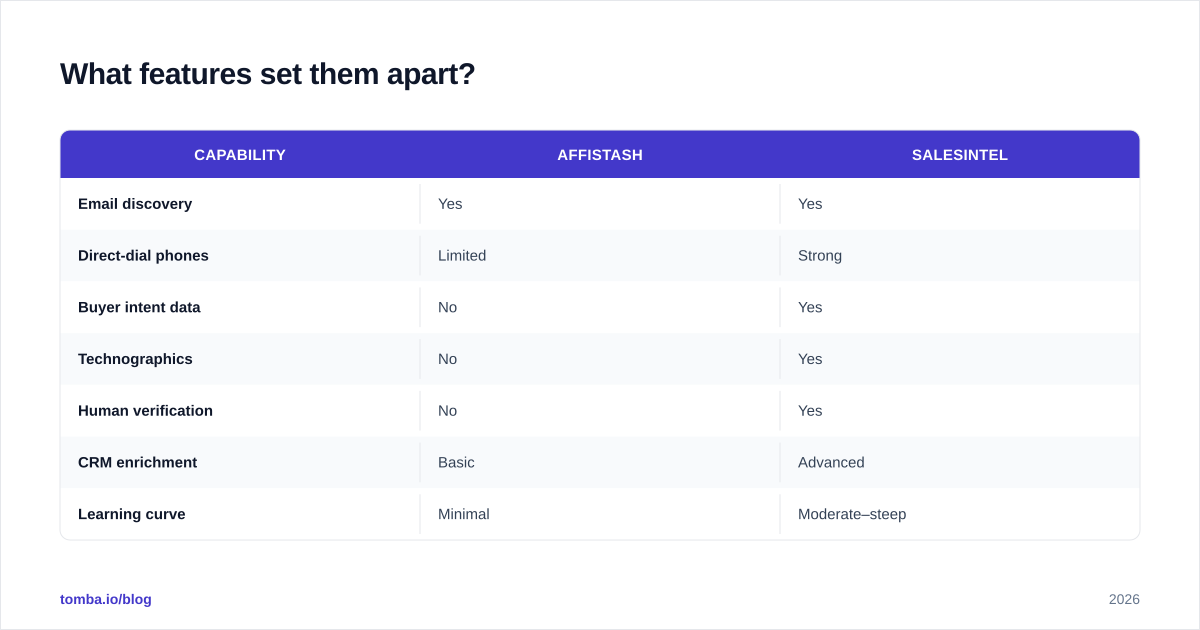
| Capability | Affistash | SalesIntel |
|---|---|---|
| Email discovery | Yes | Yes |
| Direct-dial phones | Limited | Strong |
| Buyer intent data | No | Yes |
| Technographics | No | Yes |
| Human verification | No | Yes |
| CRM enrichment | Basic | Advanced |
| Learning curve | Minimal | Moderate–steep |
A useful gut check: count the features you'll actually use in the next quarter. Teams routinely pay enterprise prices for intent and technographic modules they never operationalize. If that's you, the cheaper tool isn't a downgrade — it's a refund.
How do they handle compliance and data sourcing?#
For regulated industries and EU outreach, sourcing and compliance aren't optional.
SalesIntel leans into compliance as a differentiator, with documented sourcing and processes designed around GDPR/CCPA expectations — important when legal reviews your data vendor. Enterprises often pick SalesIntel partly for this paper trail.
Affistash provides standard data-handling terms appropriate to its SMB audience, but it doesn't position itself as a compliance-first enterprise vendor. For most SMB outbound that's fine; for a Fortune 500 procurement review it may not clear the bar.
Whichever you choose, understand where the contacts come from. Transparency about data sources is a fair thing to demand from any provider — if a vendor won't explain how data is gathered and refreshed, treat that as a red flag regardless of price.
Affistash vs SalesIntel: which should you choose?#
Conclusion first: choose by motion and budget, not by which brand sounds more premium.
Choose Affistash if you:
- Run a small team, agency, or solo outbound and need contacts today.
- Want transparent, self-serve pricing with no annual contract.
- Value speed and simplicity over an intelligence layer.
- Will verify emails yourself before sending anyway.
Choose SalesIntel if you:
- Run ABM or committee-based selling into mid-market/enterprise.
- Need human-verified contacts and direct dials for high-value deals.
- Rely on intent and technographic signals to prioritize accounts.
- Have a procurement process and budget for annual enterprise data.
There's a third path many teams miss. If your actual job-to-be-done is find and verify work emails efficiently, a specialized email finder often beats both general platforms on cost-per-valid-contact. You can layer data enrichment and a domain search on top when you need firmographics, without paying for an enterprise suite you only half-use. Many teams run a lean finder for volume and reserve a premium verified source only for their top-tier target accounts — a hybrid that controls spend without sacrificing quality where it counts.
What do reviews and the market say?#
Independent review sites are the sanity check on any vendor's own claims. SalesIntel generally earns strong marks for data quality and support on platforms like G2, with the common critique being price and contract rigidity. Affistash, as a younger SMB-focused tool, shows up with praise for affordability and ease, and the expected caveats around depth versus the enterprise incumbents. Cross-check current ratings on Capterra too, since feature sets and pricing shift quarter to quarter — and weight recent reviews over old ones, because data products change fast.
Two reading tips for any review pile: filter to reviewers whose company size matches yours, and ignore both five-star and one-star outliers. The three-star reviews usually contain the most honest tradeoffs.

Frequently asked questions#
Is Affistash cheaper than SalesIntel? Yes, substantially. Affistash uses low, transparent self-serve pricing, while SalesIntel is quote-based annual enterprise pricing that typically runs into four or five figures per year.
Does SalesIntel have a free trial? SalesIntel is demo-led rather than free-self-serve; you generally book a call to access the platform. Affistash offers a lower-friction entry point you can start without sales contact.
Which is more accurate? SalesIntel's human verification gives it an edge on direct dials and high-turnover roles. Affistash's automated approach is faster and cheaper but benefits from re-verification. Verify emails at send-time either way.
Can I use them together? Yes. A common stack is a low-cost finder for volume plus a premium verified source for top-tier target accounts. Connect either to your CRM through standard integrations.
What's the best alternative to both? If your priority is cost-efficient email discovery and verification rather than a full intelligence suite, a dedicated email finder is usually the better-value pick.
The bottom line#
Affistash and SalesIntel aren't really competitors so much as tools for different buyers. Affistash is the fast, affordable choice for SMBs and agencies that want emails now. SalesIntel is the deep, verified, intent-rich platform for enterprise ABM teams with the budget to match. Match the tool to your motion and you'll stop overpaying for depth you don't use — or underpowering a deal cycle that needs it.
If the job underneath your search is simply "find accurate work emails without an enterprise bill," start with the Tomba Email Finder. Find professional email addresses by domain, name, or company, verify them in the same workflow, and scale with self-serve pricing — a free tier to test, then $49/mo when you're ready. It's the leanest way to get the part of Affistash and SalesIntel most teams actually need, without paying for the parts they don't.
// get started
Find, verify and enrich your first contacts today
Start on the free plan with 25 searches a month, then scale when your team is ready.
Free plan · No credit card required · GDPR & CCPA
// about the author