Affistash vs Smarte 2026: Which B2B Data Tool Wins?
Affistash vs Smarte compared on coverage, accuracy, pricing, and workflow fit for 2026. See which B2B contact-data tool actually earns a slot in your prospecting stack.
TL;DR
- Affistash leans toward fast, self-serve email discovery for founders, affiliates, and lean outbound teams who want emails without a sales call.
- Smarte (SMARTe) is a heavier sales-intelligence platform built for mid-market and enterprise RevOps teams that need phone numbers, intent signals, and CRM enrichment at scale.
- Neither is strictly "better" — they solve different problems at different price points and different levels of buying friction.
- If raw email accuracy and pay-as-you-grow pricing matter most, a focused email finder like Tomba often beats both on cost-per-verified-contact.
- Read the comparison table below before you commit budget — the wrong choice locks you into a tool your workflow will outgrow in a quarter.
What are Affistash and Smarte?#
Affistash and Smarte both sell the same promise — turn a name, domain, or company into reach-able contact data — but they come at it from opposite ends of the market.
Affistash positions itself as a lightweight B2B email-finding and lead-generation tool. The pitch is speed and simplicity: search a domain or a person, get an email, export, and start sending. It appeals to solo operators, affiliate marketers, agencies, and small sales teams who want results in minutes and don't want a procurement cycle.
Smarte (branded SMARTe) is a sales-intelligence and go-to-market data platform. It targets RevOps, demand-gen, and enterprise SDR teams that need more than an email — think direct-dial phone numbers, firmographics, technographics, buying-intent signals, and native CRM enrichment. It competes more with the Apollo and ZoomInfo tier than with a single-purpose email lookup.
Think of it like transport. Affistash is a scooter — you're moving in 30 seconds and it's cheap to park. Smarte is a delivery van — slower to start, more expensive, but it carries a full load of data across a long route. The right choice depends on the trip, not the brand.
How do Affistash and Smarte compare at a glance?#
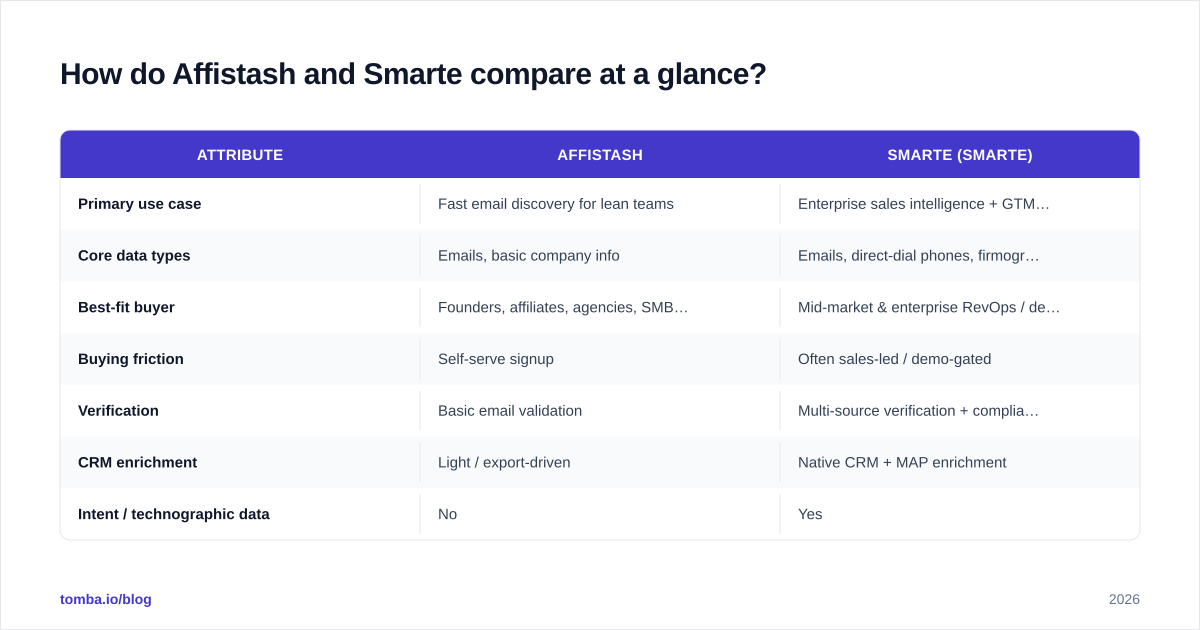
Here's the head-to-head on the attributes that actually change your day-to-day workflow and your budget.
| Attribute | Affistash | Smarte (SMARTe) |
|---|---|---|
| Primary use case | Fast email discovery for lean teams | Enterprise sales intelligence + GTM data |
| Core data types | Emails, basic company info | Emails, direct-dial phones, firmographics, intent |
| Best-fit buyer | Founders, affiliates, agencies, SMB SDRs | Mid-market & enterprise RevOps / demand-gen |
| Buying friction | Self-serve signup | Often sales-led / demo-gated |
| Verification | Basic email validation | Multi-source verification + compliance focus |
| CRM enrichment | Light / export-driven | Native CRM + MAP enrichment |
| Intent / technographic data | No | Yes |
| Pricing transparency | More transparent, smaller tiers | Frequently quote-based |
| Learning curve | Low | Moderate to high |
The pattern is clear: Affistash optimizes for time-to-first-email, Smarte optimizes for depth and scale. If you're choosing between them, you're really choosing between those two priorities.
Which tool has better data accuracy?#
Accuracy is the only metric that survives contact with a real campaign — everything else is marketing.
Smarte invests heavily in multi-source verification and compliance (GDPR/CCPA posture is part of its enterprise pitch), which tends to produce strong accuracy on phone data and a lower bounce rate on enterprise contacts. That depth is part of why it costs more. Affistash, being lighter, gives you fast email results but typically thinner verification, so you'll want to run an independent check before you send at volume.
Whichever you pick, the non-negotiable step is verification. A "found" email is a hypothesis until an email verifier confirms the mailbox exists and accepts mail. Skipping that step is how sender reputation gets torched. Bounce rates above 2-3% start dragging inbox placement for your entire domain — see email deliverability for why that compounds fast.

A practical accuracy workflow that works regardless of vendor:
- Pull candidate contacts from your primary tool (Affistash or Smarte).
- Run every address through a dedicated verifier before import.
- Quarantine catch-all domains with a catch-all verifier rather than mailing them blind.
- Re-verify any list older than 90 days — B2B data decays roughly 2-3% per month as people change jobs.
Independent reviews on G2 are the fastest sanity check on real-world accuracy claims; vendor benchmarks always flatter the vendor.
How does pricing compare for Affistash vs Smarte?#
Pricing is where the two diverge most sharply — and where total cost of ownership matters more than sticker price.
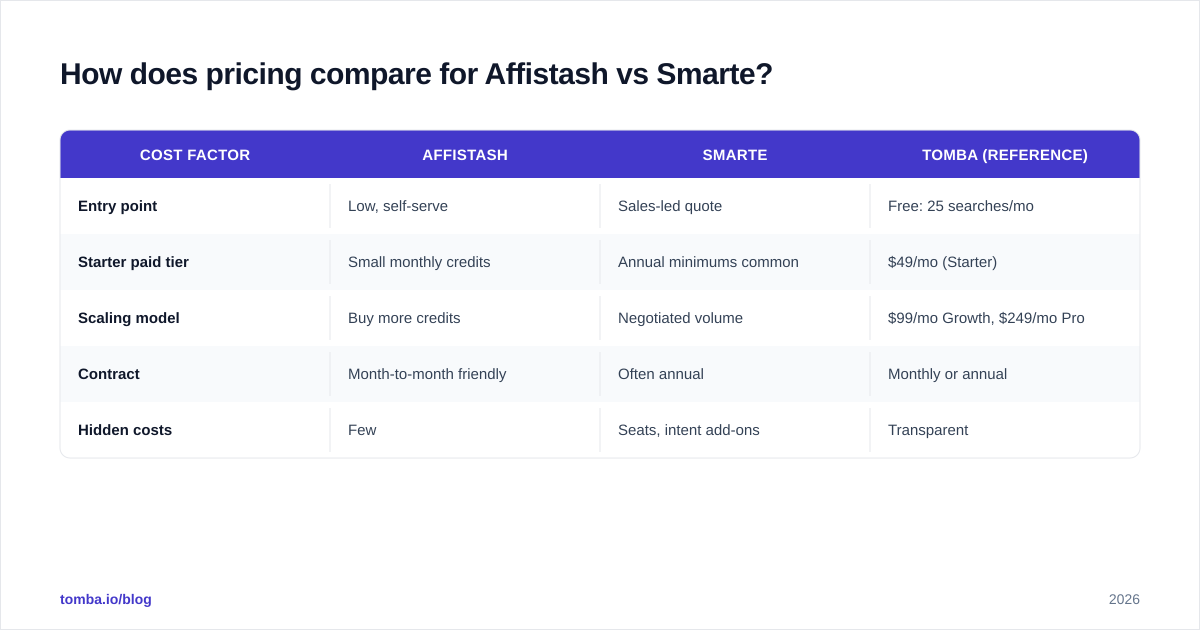
Affistash uses smaller, more transparent self-serve tiers, which makes it easy to start cheap and scale credits as you go. Smarte is frequently quote-based, bundling data volume, seats, intent topics, and integrations into an annual contract. That model rewards large teams with predictable, high-volume needs and punishes small teams that just want a few thousand verified emails.
| Cost factor | Affistash | Smarte | Tomba (reference) |
|---|---|---|---|
| Entry point | Low, self-serve | Sales-led quote | Free: 25 searches/mo |
| Starter paid tier | Small monthly credits | Annual minimums common | $49/mo (Starter) |
| Scaling model | Buy more credits | Negotiated volume | $99/mo Growth, $249/mo Pro |
| Contract | Month-to-month friendly | Often annual | Monthly or annual |
| Hidden costs | Few | Seats, intent add-ons | Transparent |
For teams that want predictable, published numbers, it's worth comparing both against transparent Tomba pricing: a free tier of 25 searches, Starter at $49/mo, Growth at $99/mo, and Pro at $249/mo, with no demo required to see a price. If your monthly contact volume is in the low thousands, a quote-based enterprise contract is almost always the wrong shape.

Which integrates better with your sales stack?#
A data tool that doesn't reach your CRM is just a spreadsheet generator.
Smarte's advantage here is native enrichment into CRMs and marketing-automation platforms — it's built to push enriched records into Salesforce or HubSpot and keep them fresh. That's a real differentiator for RevOps teams running enrichment as an always-on background process rather than a manual export.
Affistash leans more on export-and-import or lighter integrations, which is fine for campaign-by-campaign work but adds friction if you want continuous enrichment. If your team lives inside the CRM, weigh how much manual handling each tool forces on you.
For reference, mature data platforms expose enrichment three ways — UI, bulk upload, and API. A data enrichment layer plus an email finder API lets you wire discovery directly into your own pipeline, which is the model most scaling teams eventually move toward. Check vendor integration directories like the HubSpot ecosystem to confirm a native connector actually exists before you assume it does.
Who should choose Affistash?#
Choose Affistash if speed and low commitment beat depth for you.
- You're a founder or small team doing outbound yourself and you need emails today, not after a procurement cycle.
- You're an affiliate or agency running many small campaigns where cost-per-lead and quick exports matter more than intent data.
- Your volume is modest — a few hundred to a few thousand contacts a month — and an enterprise contract would be overkill.
- You value transparent, self-serve pricing and want to avoid demo-gated sales motions.
The trade-off: you'll do your own verification and you won't get phone numbers or intent signals. For many lean teams, that's a perfectly good trade.
Who should choose Smarte?#
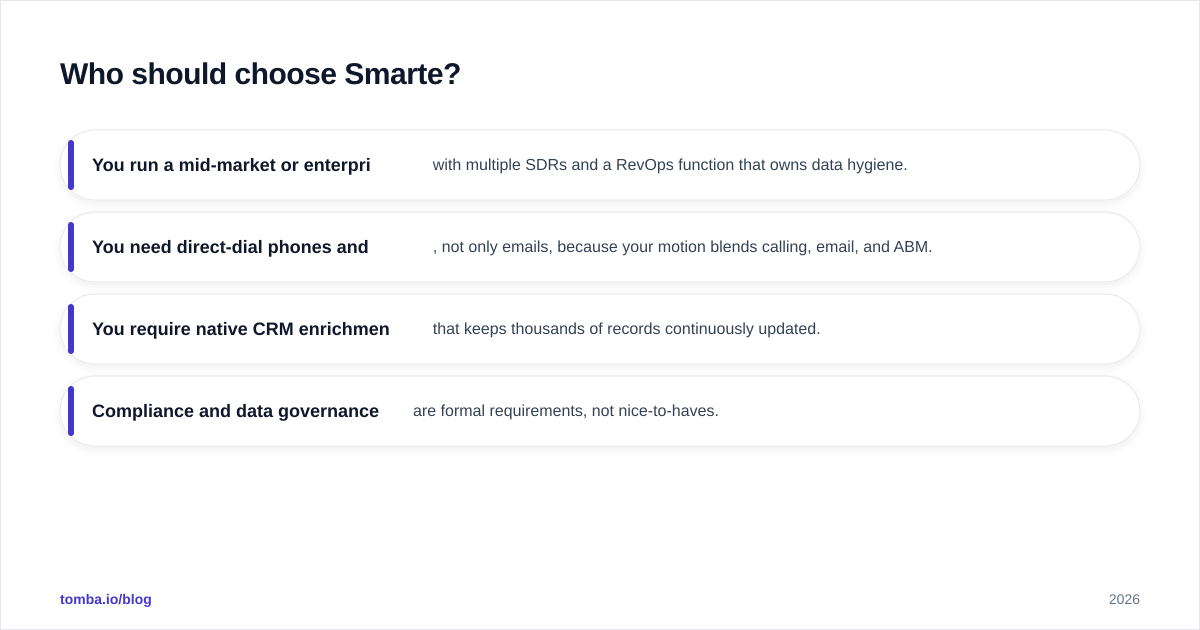
Choose Smarte if you need a full GTM data layer, not just emails.
- You run a mid-market or enterprise sales org with multiple SDRs and a RevOps function that owns data hygiene.
- You need direct-dial phones and intent data, not only emails, because your motion blends calling, email, and ABM.
- You require native CRM enrichment that keeps thousands of records continuously updated.
- Compliance and data governance are formal requirements, not nice-to-haves.
The trade-off: higher cost, a sales-led buying process, annual commitment, and a steeper learning curve. For a large, structured team, that overhead pays for itself. For a three-person startup, it's friction you don't need.
Is there a better-fit alternative to both?#
Often, yes — because most teams over-buy.
Here's the uncomfortable truth: a large share of "I need a sales-intelligence platform" buyers actually just need accurate, verified emails at a fair price, plus the occasional phone number and the ability to enrich in bulk. They pay enterprise prices for features that sit idle.
If that's you, a focused stack beats an all-in-one suite:
- Use a high-accuracy email finder for discovery by name, domain, or company.
- Run domain search to pull every public address at a target account in one pass.
- Verify everything with a dedicated email verifier before it touches your sequencer.
- Add a phone finder only for the segments where calling actually converts.
- Push it all through a bulk email finder when you're working lists instead of single lookups.
This à la carte approach is how you get Smarte-grade outcomes on Affistash-grade budgets — you pay for accuracy and coverage, not for a dashboard full of features you'll never open. Transparency on where the data comes from matters here too; you should always be able to see the source behind a contact.
How should you actually decide?#
Run a 50-contact bake-off before you sign anything.
- Pick one real target segment — a list of 50 accounts you'd genuinely prospect.
- Run the same list through each tool (Affistash, Smarte, and at least one focused alternative).
- Verify every result independently with the same verifier so the test is fair.
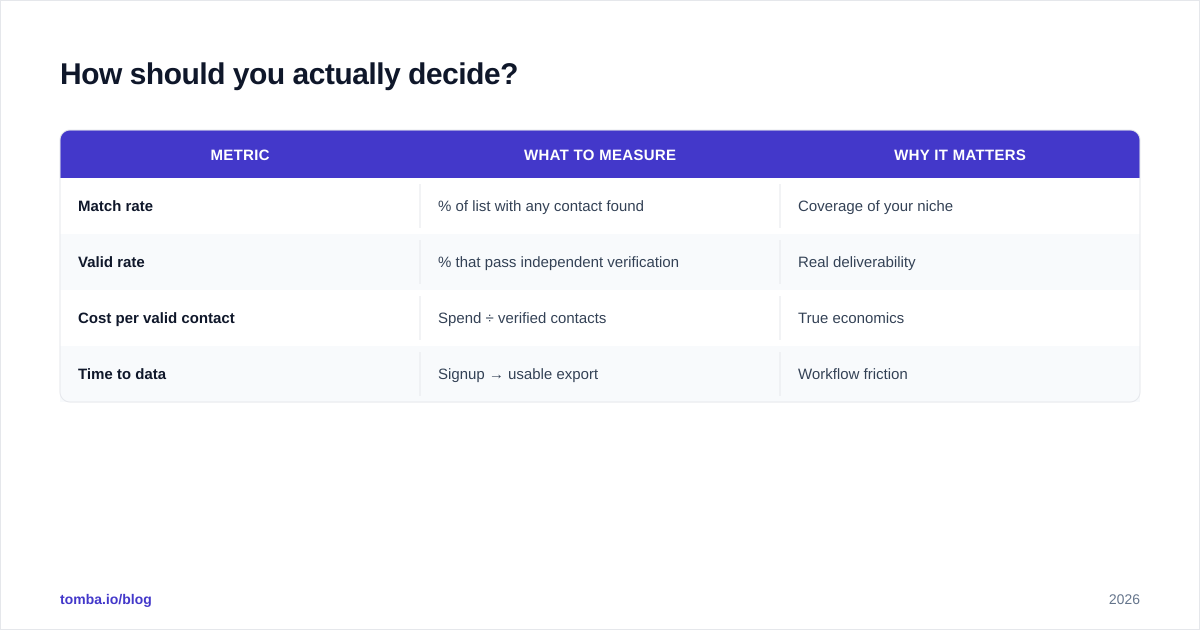
- Score each tool on three numbers: match rate (how many contacts found), valid rate (how many survived verification), and cost-per-valid-contact.
- Multiply by your real monthly volume to get true annual cost — not the sticker tier.
The winner is rarely the tool with the most features. It's the one with the lowest cost-per-verified-contact at your actual volume. That single metric cuts through every sales deck.
A short scoring rubric:
| Metric | What to measure | Why it matters |
|---|---|---|
| Match rate | % of list with any contact found | Coverage of your niche |
| Valid rate | % that pass independent verification | Real deliverability |
| Cost per valid contact | Spend ÷ verified contacts | True economics |
| Time to data | Signup → usable export | Workflow friction |
The bottom line#
Affistash wins on speed, simplicity, and low-commitment pricing for lean teams. Smarte wins on depth, phone data, intent signals, and enterprise-grade CRM enrichment for large, structured orgs. The "vs" framing hides the real answer: they're built for different buyers, and plenty of teams need neither at full price.
Before you commit to either platform's billing model, test your real target list against a transparent, accuracy-first option. Start free with the Tomba Email Finder — 25 searches a month at no cost, verified results, published pricing from $49/mo, and an API when you're ready to scale. Find the emails, verify them, and let cost-per-valid-contact pick the winner for you.
// get started
Find, verify and enrich your first contacts today
Start on the free plan with 25 searches a month, then scale when your team is ready.
Free plan · No credit card required · GDPR & CCPA
// about the author