7 Best AgentGPT Alternatives for Autonomous AI Agents (2026)
AgentGPT is great for a demo, shaky for production. Here are 7 AgentGPT alternatives compared on autonomy, cost, and the one thing every agent needs: clean data.

AgentGPT made autonomous AI agents feel real. You type a goal into a browser tab, watch the agent spawn its own subtasks, and feel like you just hired an intern who never sleeps. Then you try to ship something with it, and the cracks show: shallow tool access, runaway loops, thin output, and no clean way to feed it the data your business actually runs on.
If you have hit that wall, you are looking for AgentGPT alternatives that survive contact with production. This guide compares seven of them on the dimensions that matter — autonomy model, tool ecosystem, cost, and how well each one handles the unglamorous foundation of every useful agent: accurate, structured data.
TL;DR#
- AgentGPT is a great demo, a weak production tool. It shines for quick goal-to-plan experiments but lacks the tool depth, control, and data hooks real workflows need.
- Best overall alternative: CrewAI for multi-agent orchestration, LangGraphLangChain for engineering control, and SuperAGI for a self-hosted GUI.
- For non-developers, Microsoft Copilot Studio and Relay.app deliver autonomous behavior without writing Python.
- Every agent is only as good as its inputs. A reasoning loop fed stale contact data produces confident garbage — pair any agent with a clean data enrichment and verification layer.
- No tool is "set and forget." Budget for guardrails, evals, and a human checkpoint before you let an agent touch revenue.
What is AgentGPT and why look for alternatives?#
AgentGPT is a browser-based autonomous agent platform. You give it a name and an objective, and it uses a large language model to break that objective into tasks, execute them in sequence, and refine its plan as it goes. It popularized the "AutoGPT in your browser" experience — no install, no terminal, just a goal box.
That accessibility is also its ceiling. Think of AgentGPT like a rental scooter: perfect for a ten-minute joyride, frustrating the moment you need to haul cargo across town. The common reasons teams shop for AgentGPT alternatives:
- Limited tool use. Native integrations are thin. Agents that cannot reliably call your CRM, search live data, or write to a database stay stuck in toy territory.
- Loop and cost control. Autonomous agents love to spin. Without hard budgets and step caps, a single objective can burn tokens with little to show.
- Shallow output. Goal decomposition looks impressive, but the final deliverable is often a generic summary rather than a finished artifact.
- No data backbone. An agent prospecting for leads is worthless if the emails and company records it works with are wrong.
That last point is the quiet killer, and we will come back to it.
How should you evaluate an AgentGPT alternative?#
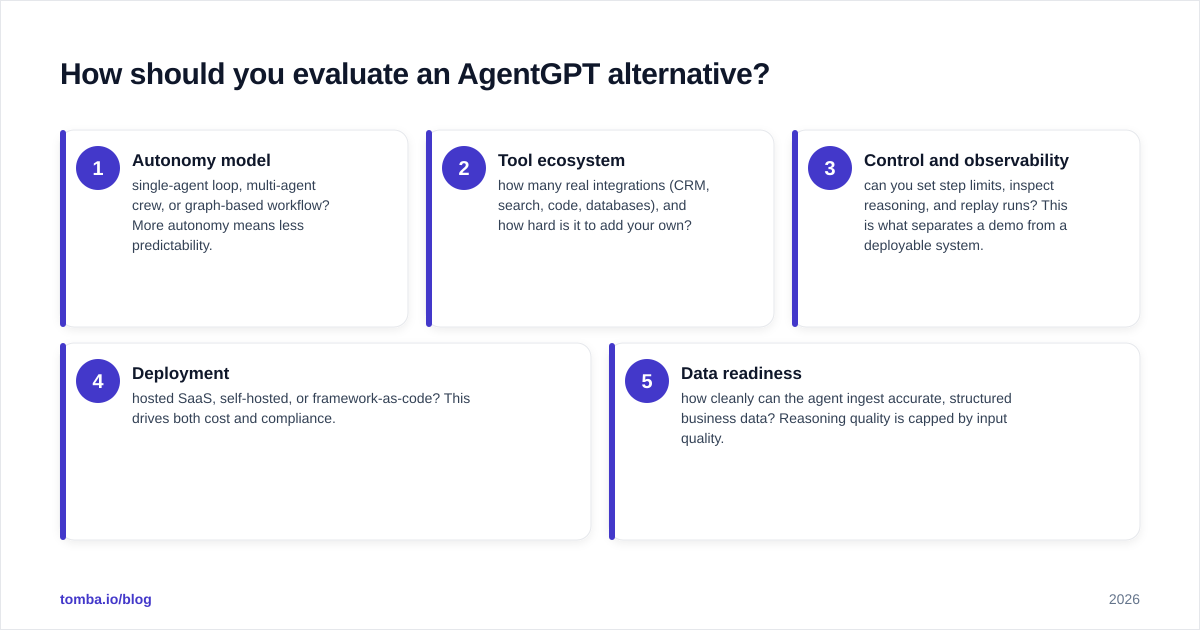
Before comparing logos, fix your criteria. Score every candidate on five axes:
- Autonomy model — single-agent loop, multi-agent crew, or graph-based workflow? More autonomy means less predictability.
- Tool ecosystem — how many real integrations (CRM, search, code, databases), and how hard is it to add your own?
- Control and observability — can you set step limits, inspect reasoning, and replay runs? This is what separates a demo from a deployable system.
- Deployment — hosted SaaS, self-hosted, or framework-as-code? This drives both cost and compliance.
- Data readiness — how cleanly can the agent ingest accurate, structured business data? Reasoning quality is capped by input quality.
Hold every option below against those five before you commit.
What are the best AgentGPT alternatives in 2026?#
Here is the honest landscape. None of these is strictly "better" than AgentGPT in every dimension — each trades simplicity for power in a different way.
1. AutoGPT#
The project that started the autonomous-agent wave. AutoGPT is open source, runs locally or self-hosted, and now offers a low-code "blocks" builder. It is more configurable than AgentGPT and has a far larger contributor community, but it carries the same tendency to loop and the same need for careful prompt and budget discipline. Best for tinkerers who want full control and do not mind babysitting runs.
2. CrewAI#
CrewAI reframes the problem: instead of one agent chasing a goal, you define a crew of role-based agents (researcher, writer, reviewer) that delegate to each other. This multi-agent pattern produces noticeably better output on complex tasks because responsibility is split and checked. It is a Python framework, so it needs developer time, but it has become the default choice for teams building production agent workflows. See the CrewAI project for the current feature set.
3. LangChain / LangGraph#
If AgentGPT is a scooter, LangGraph is a car kit — maximum control, some assembly required. LangGraph models agents as explicit state graphs, giving you deterministic control over branching, retries, and human-in-the-loop checkpoints. It is the most engineering-heavy option here and overkill for simple goals, but unmatched when you need reliability, observability, and custom tools. Pair it with LangSmith for evals and tracing.
4. SuperAGI#
SuperAGI is the closest "drop-in" upgrade from AgentGPT for people who want a GUI without writing a framework from scratch. It is open source and self-hostable, with a dashboard, concurrent agents, a tool marketplace, and built-in performance telemetry. Good middle ground between AgentGPT's simplicity and CrewAI's power.
5. Microsoft Copilot Studio#
For enterprises already in the Microsoft ecosystem, Copilot Studio lets non-developers build autonomous agents wired into Microsoft 365, Dynamics, and thousands of connectors. It trades open flexibility for governance, security, and a no-code canvas. Strong fit when IT compliance matters more than bleeding-edge autonomy.
6. Relay.app#
Relay.app sits at the workflow-automation end of the spectrum — think Zapier with AI agents embedded in the steps. You get human-in-the-loop approvals, real app integrations, and reliable execution without managing infrastructure. Best for operations and go-to-market teams who want autonomous steps inside dependable workflows rather than a fully self-directing agent.
7. Agno (formerly Phidata)#
Agno is a lightweight Python framework for building agents with memory, knowledge, and tools, with a clean developer experience and built-in monitoring. It is faster to stand up than LangGraph and more structured than raw AutoGPT — a solid pick for developers who want production patterns without heavy ceremony.
How do the AgentGPT alternatives compare?#
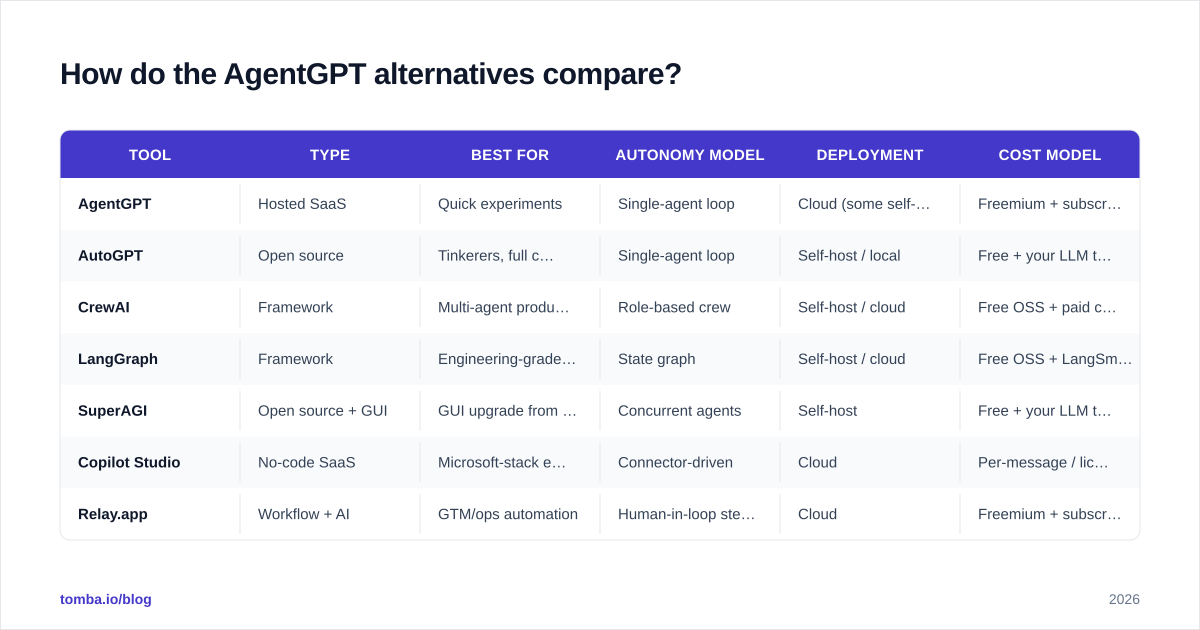
| Tool | Type | Best for | Autonomy model | Deployment | Cost model |
|---|---|---|---|---|---|
| AgentGPT | Hosted SaaS | Quick experiments | Single-agent loop | Cloud (some self-host) | Freemium + subscription |
| AutoGPT | Open source | Tinkerers, full control | Single-agent loop | Self-host / local | Free + your LLM tokens |
| CrewAI | Framework | Multi-agent production workflows | Role-based crew | Self-host / cloud | Free OSS + paid cloud |
| LangGraph | Framework | Engineering-grade reliability | State graph | Self-host / cloud | Free OSS + LangSmith |
| SuperAGI | Open source + GUI | GUI upgrade from AgentGPT | Concurrent agents | Self-host | Free + your LLM tokens |
| Copilot Studio | No-code SaaS | Microsoft-stack enterprises | Connector-driven | Cloud | Per-message / license |
| Relay.app | Workflow + AI | GTM/ops automation | Human-in-loop steps | Cloud | Freemium + subscription |
The pattern is clear: you are trading ease-of-use for control and depth as you move down the list. Pick the lowest-autonomy tool that still solves your problem — predictability is worth more than raw agency in almost every business workflow.
Which AgentGPT alternative is right for you?#
Match the tool to your team, not the hype:
- You want to experiment fast, no code: stay near AgentGPT or move to SuperAGI for more control with a GUI.
- You are a developer building something real: CrewAI for multi-agent tasks, LangGraph when reliability and observability are non-negotiable, Agno for a lighter footprint.
- You are an enterprise on Microsoft: Copilot Studio, full stop — governance wins.
- You are in sales or operations: Relay.app gives you autonomous steps inside workflows you can actually trust with customer data.
For a deeper look at where autonomous agents fit alongside other tooling, our roundup of AI sales technology trends pairs well with this comparison.
Why does data quality decide whether your agent succeeds?#
Here is the part most "best AgentGPT alternatives" lists skip: the framework is rarely the bottleneck. The data is.
An autonomous agent is a reasoning engine. Point it at a goal like "find 50 qualified prospects at Series B SaaS companies and draft personalized outreach," and it will dutifully decompose the task, search, and generate emails. But if the contact records it pulls are stale, the email addresses bounce, and the company data is six months out of date, the agent produces 50 confident, useless messages. Garbage in, autonomous garbage out — just faster.
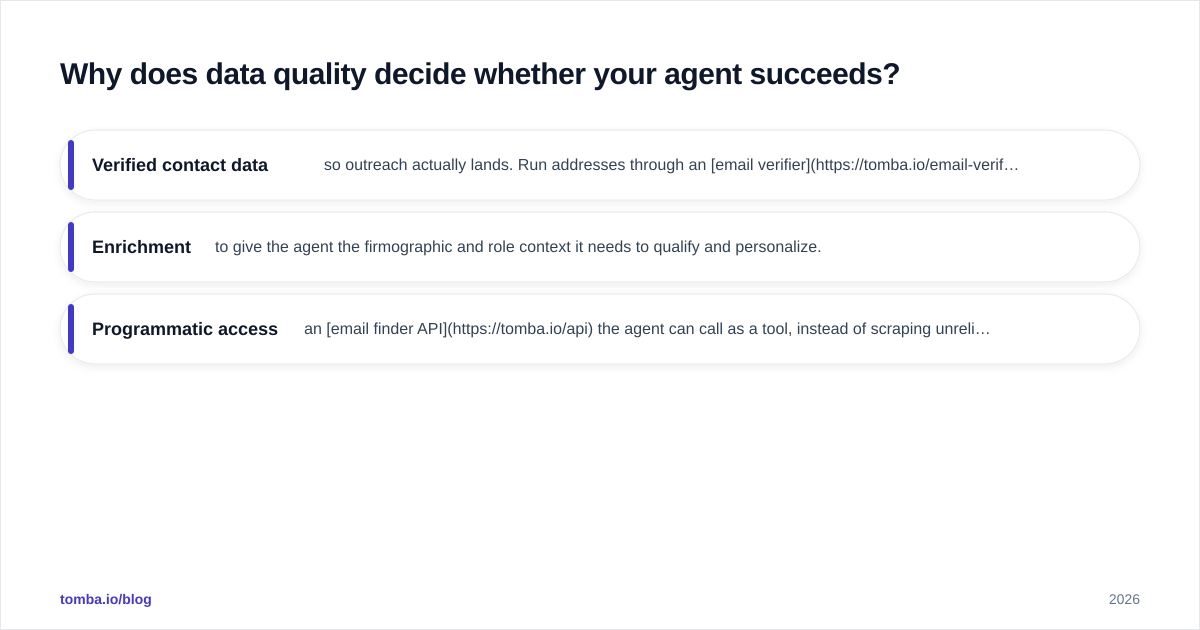
This is why your data layer matters more than your agent layer. Whatever framework you pick, it needs a reliable source of accurate, verified, structured business data to act on. That means:
- Verified contact data so outreach actually lands. Run addresses through an email verifier before an agent ever sends.
- Enrichment to give the agent the firmographic and role context it needs to qualify and personalize.
- Programmatic access — an email finder API the agent can call as a tool, instead of scraping unreliable sources mid-run.
When you wire a real data source into CrewAI, LangGraph, or AutoGPT as a callable tool, the agent stops hallucinating contacts and starts working from ground truth. That single change does more for output quality than swapping models.

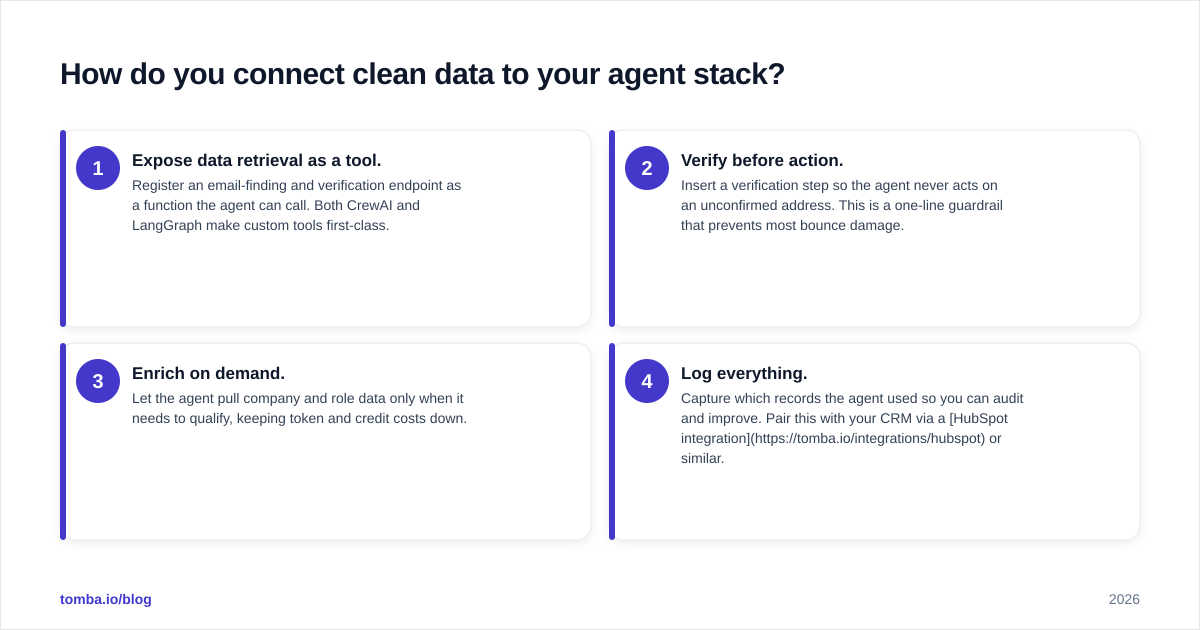
How do you connect clean data to your agent stack?#
The integration pattern is straightforward regardless of framework:
- Expose data retrieval as a tool. Register an email-finding and verification endpoint as a function the agent can call. Both CrewAI and LangGraph make custom tools first-class.
- Verify before action. Insert a verification step so the agent never acts on an unconfirmed address. This is a one-line guardrail that prevents most bounce damage.
- Enrich on demand. Let the agent pull company and role data only when it needs to qualify, keeping token and credit costs down.
- Log everything. Capture which records the agent used so you can audit and improve. Pair this with your CRM via a HubSpot integration or similar.
You can prototype this in an afternoon: stand up your agent framework of choice, register a data tool, and gate every outbound action behind verification. For grounding on the broader category, vendor-neutral directories like G2's AI agents category and Gartner's market guides are useful sanity checks before you commit budget.
Common mistakes when replacing AgentGPT#
- Choosing maximum autonomy by default. A fully self-directing agent is harder to debug and trust. Start constrained and loosen only when you have evals proving it is safe.
- Skipping the data layer. Covered above, and worth repeating: a brilliant agent on bad data is a liability.
- No budget caps. Always set token, step, and time limits. Autonomous loops are the fastest way to a surprise invoice.
- No human checkpoint. Before an agent touches revenue, email, or money, keep a human in the loop. Relay.app and LangGraph both make this a built-in primitive.
- Ignoring observability. If you cannot replay and inspect a run, you cannot improve it. Favor tools with tracing.
Frequently asked questions#
Is there a free AgentGPT alternative? Yes — AutoGPT, CrewAI, SuperAGI, and Agno are all open source and free to run; you pay only for the underlying LLM tokens. Hosted options like Relay.app and AgentGPT itself offer free tiers with usage limits.
What is the best AgentGPT alternative for non-developers? Microsoft Copilot Studio for enterprise no-code, or Relay.app for go-to-market and operations teams who want autonomous steps without writing code.
Do I need a data provider to use these tools? Not technically — but for any task involving real contacts, companies, or outreach, a verified data source is what separates a useful agent from a fast hallucination machine.
The takeaway#
AgentGPT is a fantastic on-ramp to autonomous agents and a poor place to stay. Move to CrewAI or LangGraph when you need production reliability, SuperAGI for a GUI upgrade, or Copilot Studio and Relay.app if you would rather not write code. But whichever framework you choose, remember the unglamorous truth: your agent's output is capped by the quality of the data you feed it.
Before you let an autonomous agent prospect, enrich, or reach out on your behalf, give it ground truth to work from. Tomba's Email Finder and verification tools plug into any agent stack as a callable tool — accurate professional emails, real-time verification, and a clean Tomba API your agents can hit directly. Start on the free tier with 25 searches a month, scale to the Starter plan at $49/mo when your agents go to work, and check the full Tomba pricing for higher-volume tiers. Build the smart agent — then feed it data it can trust.
// get started
Find, verify and enrich your first contacts today
Start on the free plan with 25 searches a month, then scale when your team is ready.
Free plan · No credit card required · GDPR & CCPA
// about the author