AgentGPT Pricing, Reviews, Pros and Cons (2026 Guide)
A neutral breakdown of AgentGPT pricing, real user reviews, and the honest pros and cons before you trust an autonomous AI agent with your sales workflow in 2026.
AgentGPT pricing reviews pros and cons — here's the neutral breakdown before you trust an autonomous AI agent with B2B sales work in 2026.
TL;DR
- AgentGPT (by Reworkd) is a browser-based autonomous AI agent. It chains GPT calls to pursue a goal you type in plain English — no code required.
- Pricing runs from a free demo tier to a paid Pro plan, commonly cited around $40/month. Always confirm the current number on the official site, because Reworkd has changed it more than once.
- Reviews are split. People love the zero-setup demo and the "watch it think" factor. Others complain about loops, shallow output, and runs that burn credits without finishing.
- For B2B sales, AgentGPT is a research and brainstorming aid — not a reliable source of verified contact data.
- This guide covers AgentGPT pricing reviews pros and cons so you can decide where it fits before wiring it into real outbound.
What is AgentGPT?#
AgentGPT is a web app that lets you spin up an "autonomous" AI agent. You give it a name and a goal. For example, you type "research the top 10 CRM vendors and summarize their pricing." The agent then breaks that goal into tasks and runs them one by one. It feeds each result back into itself to decide the next step. Think of it like hiring an eager intern who never sleeps. You hand over a one-line brief. It keeps spawning its own to-do list until the job looks done — or until it runs out of budget.
It was built by Reworkd and rode the same 2023 wave as AutoGPT and BabyAGI. But it has one big difference: it runs in your browser with no install. That accessibility is the whole pitch. It's also why AgentGPT pricing reviews pros and cons get searched so often. People try the free demo, get curious, and want to know whether the paid tier is worth it.
Under the hood it's an orchestration layer over large language models, primarily OpenAI's GPT family. The agent doesn't "know" things. It reasons in loops, calls the model repeatedly, and stitches the outputs together.
How does AgentGPT pricing work in 2026?#
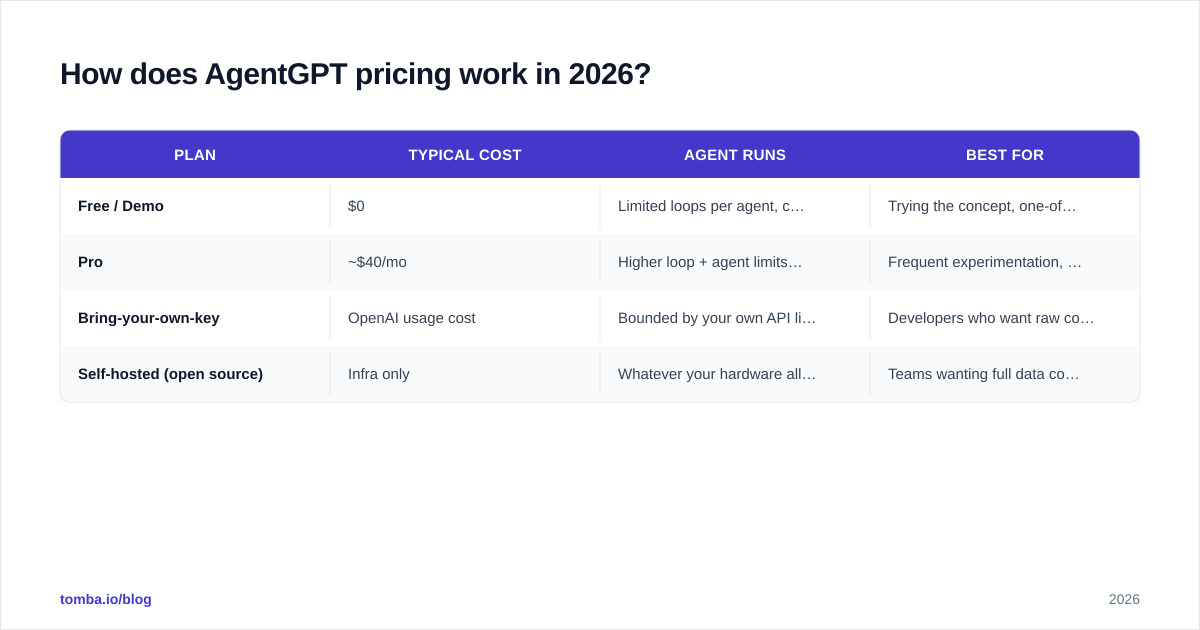
AgentGPT uses a freemium model. The free tier lets you run a limited number of agents and loops, so you can see the mechanic in action. The paid Pro plan raises the ceilings — more concurrent agents, longer runs, and faster models.
Pricing has shifted since launch. Treat the figures below as a reference snapshot, not a contract. The commonly cited Pro price has hovered around $40/month. There's also an option to plug in your own OpenAI API key. Then you pay model costs directly instead of through AgentGPT's bundled credits.
| Plan | Typical cost | Agent runs | Best for |
|---|---|---|---|
| Free / Demo | $0 | Limited loops per agent, capped per day | Trying the concept, one-off questions |
| Pro | ~$40/mo | Higher loop + agent limits, priority access | Frequent experimentation, longer tasks |
| Bring-your-own-key | OpenAI usage cost | Bounded by your own API limits | Developers who want raw control over spend |
| Self-hosted (open source) | Infra only | Whatever your hardware allows | Teams wanting full data control |
Two things matter more than the sticker price. First, the real cost of an autonomous agent is token consumption. A single ambitious goal can trigger dozens of model calls, so "cheap" tools get expensive when an agent loops. Second, AgentGPT is open source. A self-hosted deployment can drop the subscription entirely and leave you paying only for infrastructure and model usage. If you're comparing recurring software costs, do the same exercise you'd do with Tomba pricing. Map the plan to how often you'll actually use it, not to the headline number.
What do AgentGPT reviews actually say?#
Reviews cluster into two camps. Both are right, depending on what you expected.
The enthusiasts love that it removes the setup tax. Tools like AutoGPT historically needed a terminal, a Python environment, and an API key just to say hello. AgentGPT lets a non-technical marketer watch an agent decompose a goal in real time. On review platforms like G2 and in community threads, the recurring praise is simple: "it's the easiest way to understand what an AI agent even is."
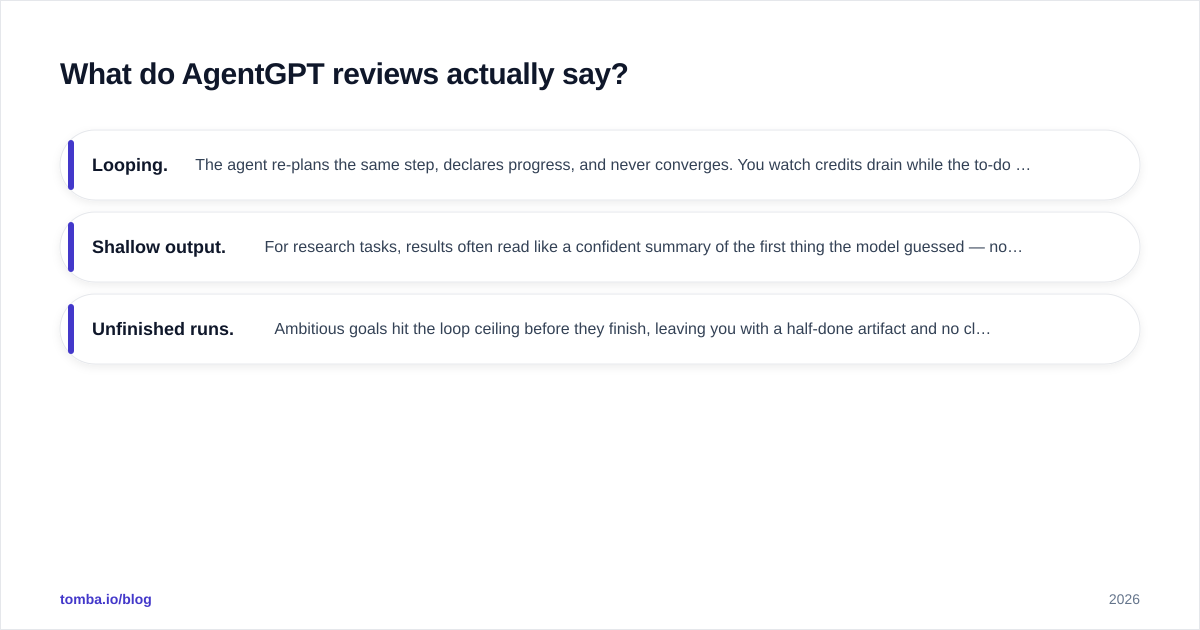
The skeptics report three repeat problems:
- Looping. The agent re-plans the same step, declares progress, and never converges. You watch credits drain while the to-do list grows instead of shrinks.
- Shallow output. For research tasks, results often read like a confident summary of the model's first guess — not verified fact. Autonomous agents inherit every hallucination risk of the underlying model. There's no human in the loop to catch it.
- Unfinished runs. Ambitious goals hit the loop ceiling before they finish. You're left with a half-done artifact and no clean way to resume.
The fair synthesis is this. AgentGPT is a brilliant demonstration of autonomous agents and a genuinely useful brainstorming tool. But it is not a dependable production system for tasks that demand accuracy. As one common refrain in reviews puts it: it's a toy that occasionally does real work, not a worker that occasionally plays.
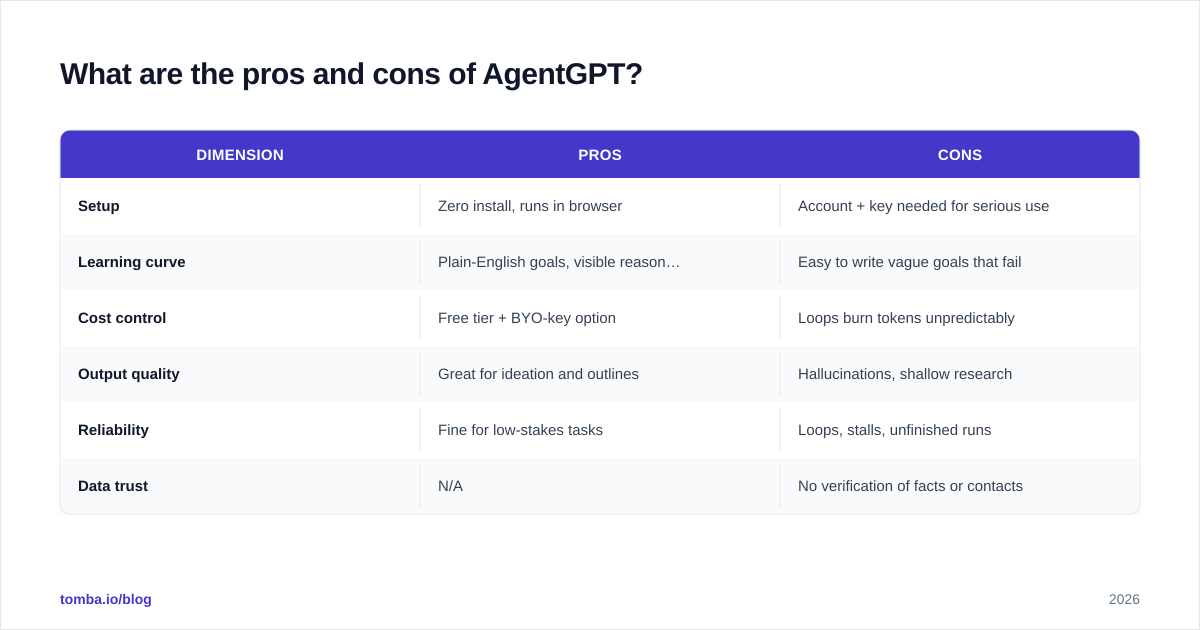
What are the pros and cons of AgentGPT?#
Here's the honest ledger. No tool earns a place in your stack on vibes.
| Dimension | Pros | Cons |
|---|---|---|
| Setup | Zero install, runs in browser | Account + key needed for serious use |
| Learning curve | Plain-English goals, visible reasoning | Easy to write vague goals that fail |
| Cost control | Free tier + BYO-key option | Loops burn tokens unpredictably |
| Output quality | Great for ideation and outlines | Hallucinations, shallow research |
| Reliability | Fine for low-stakes tasks | Loops, stalls, unfinished runs |
| Data trust | N/A | No verification of facts or contacts |
The pros, expanded#
The single biggest win is accessibility. AgentGPT made autonomous agents legible to people who would never touch a command line. The second win is speed of ideation. For first drafts, brainstorming, and "what should I even consider here" questions, it's a fast thinking partner. The third is transparency. You can literally read the agent's task list as it forms. That's a better mental model of AI reasoning than a black-box chat reply.
The cons, expanded#
The biggest risk is trusting the output. An autonomous agent that confidently invents a statistic is more dangerous than a chatbot that does the same. The agent's structure makes it look like rigorous work. For anything that touches revenue — prospect lists, contact details, pricing claims — you need verification that AgentGPT simply doesn't provide. This is the exact gap where a dedicated data enrichment source matters. An agent can draft your outreach angle. It can't tell you whether the email address it suggested is real.

Is AgentGPT good for B2B sales and prospecting?#
Short answer: as an assistant, yes; as a data source, no.
Where AgentGPT genuinely helps a sales team:
- Account research scaffolding — "summarize this company's recent news and likely pain points" gives you a starting brief to refine.
- Messaging drafts — outline a cold sequence, then rewrite it in your own voice. For the writing itself, a purpose-built tool like Tomba's cold email AI is more focused than a general agent.
- Brainstorming target segments — useful for widening your thinking before you commit to a list.
Where it falls down, and why it matters:
A sales motion lives or dies on deliverability and data accuracy. Say your prospect list is full of guessed addresses. Your bounce rate spikes, your sender reputation tanks, and even your good emails land in spam. AgentGPT has no way to validate that a contact exists, that the email is deliverable, or that the company data is current. It generates plausible text. And plausible is the enemy of accurate in outbound.
This is the practical division of labor. Let an autonomous agent help you think. Let a verification-grade pipeline handle the facts. You find and confirm real contacts with a dedicated email finder. You verify them before sending. Only then do you layer AI on top for personalization. Reverse the order — let the agent invent contacts — and you're automating your own bounce rate.
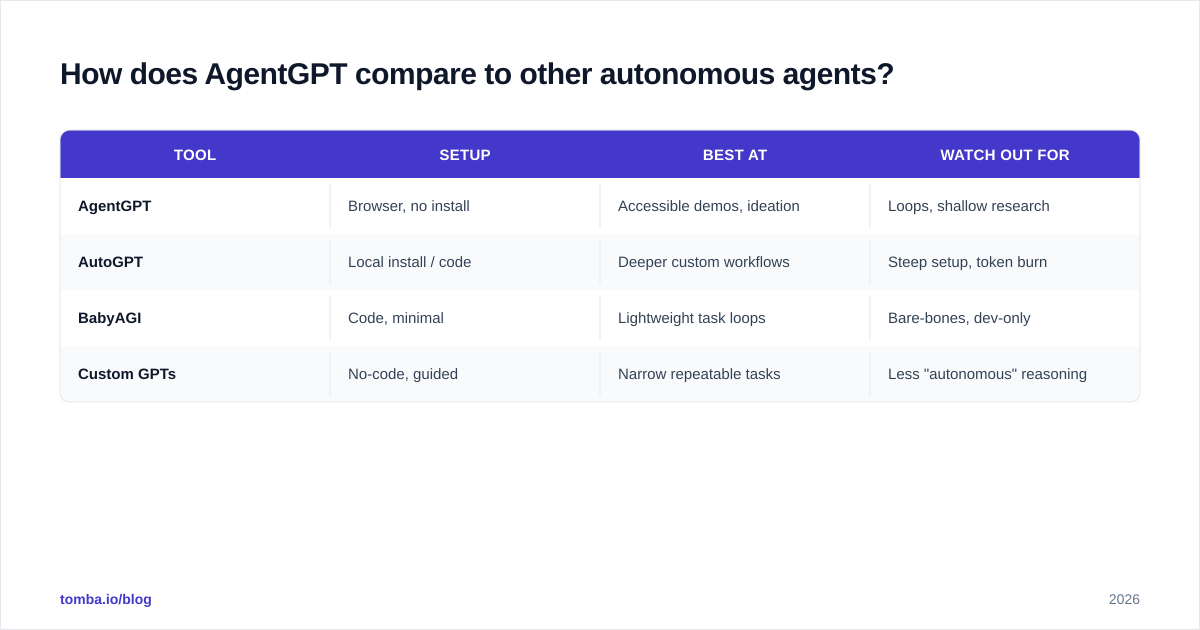
How does AgentGPT compare to other autonomous agents?#
AgentGPT isn't alone. The autonomous-agent category includes several tools with different trade-offs. Knowing where AgentGPT sits keeps your expectations honest.
| Tool | Setup | Best at | Watch out for |
|---|---|---|---|
| AgentGPT | Browser, no install | Accessible demos, ideation | Loops, shallow research |
| AutoGPT | Local install / code | Deeper custom workflows | Steep setup, token burn |
| BabyAGI | Code, minimal | Lightweight task loops | Bare-bones, dev-only |
| Custom GPTs | No-code, guided | Narrow repeatable tasks | Less "autonomous" reasoning |
The pattern across all of them is the same. Autonomous agents are excellent at generating direction and unreliable at guaranteeing correctness. Want a fuller primer on the underlying tech? The Wikipedia entry on autonomous agents is a neutral starting point. Most vendor docs, including Reworkd's own, are upfront that these tools are experimental.
The takeaway for a buyer is clear. Pick AgentGPT if you value zero-setup accessibility and you're using it for thinking work. Pick a code-first tool if you need custom integrations and can manage the complexity. In every case, keep a separate, trusted system of record for the data that actually drives revenue.
Who should use AgentGPT — and who shouldn't?#
Use it if you are:
- A marketer or founder who wants to understand AI agents without code.
- Someone doing low-stakes ideation, outlining, or first-draft research.
- A developer prototyping agent workflows before building something custom.
Skip it (or pair it with verification) if you are:
- Running outbound at scale where bad data costs you deliverability.
- Making decisions that depend on factual accuracy you can't double-check.
- Expecting a hands-off system that finishes complex jobs without supervision.
The honest framing is that AgentGPT is a capable co-pilot and a poor autopilot. Used as the former, it earns its place. Used as the latter, it will quietly produce confident, wrong work. And in B2B sales, confident-and-wrong is the most expensive failure mode there is.
The bottom line on AgentGPT pricing reviews pros and cons#
AgentGPT is one of the most approachable ways to experience autonomous AI agents. That's exactly what it should be used for: learning, ideating, and drafting. Its pricing is reasonable for experimentation. Its reviews are fairly positive for what it is. Its biggest con — unverified, sometimes-hallucinated output — is manageable, as long as you never treat its results as ground truth.
For sales teams, the rule is simple. Let AI help you write and think, but build your pipeline on data you can verify. That's where Tomba fits. Use the Tomba Email Finder to source real, deliverable professional emails by name, company, or domain. Then verify them before you ever hit send. Pair an agent's creativity with verified contact data, and you get the best of both worlds: fast ideas and accurate execution. Start on the free tier (25 searches a month). Scale up only when the results prove themselves — the same evidence-first approach you should apply to every tool in your stack, AgentGPT included.
Ready to find emails that actually work?
Join 150,000+ professionals who stopped guessing and started sending. Free credits on signup — no credit card required.
Get the Tomba newsletter
Practical outbound tactics and product updates — once every two weeks.
About the author