Agile CRM vs SugarCRM (2026): Which CRM Wins for B2B Sales?
Agile CRM vs SugarCRM compared head-to-head for 2026 — pricing, automation, reporting, and real-world fit. Find out which CRM actually matches your B2B sales team before you sign a contract.
Choosing a CRM is one of those decisions that quietly shapes your sales team for years. Pick wrong and you inherit a tool people avoid, a pipeline nobody trusts, and a renewal invoice you resent. Agile CRM and SugarCRM both promise to fix the chaos, but they aim at very different buyers. This breakdown shows you which one fits your team in 2026 — and where each one quietly costs you.
TL;DR — Agile CRM vs SugarCRM at a glance#
- Agile CRM is the budget-friendly, all-in-one pick for small teams that want CRM, marketing automation, and a help desk in one cheap bundle. Great value, lighter at scale.
- SugarCRM is the configurable, enterprise-grade platform with deep customization, strong reporting, and AI-assisted forecasting — but it asks for a bigger budget and an admin who knows what they're doing.
- Price gap is real: Agile CRM starts free and stays under $50/user, while SugarCRM's serious tiers run $40–$135/user/month with annual commitments.
- Pick Agile CRM if you're a startup or SMB under ~25 reps. Pick SugarCRM if you need complex workflows, on-premise options, or granular permissions across departments.
- Either CRM is only as good as the contact data inside it — clean, verified emails and enriched records are what actually move deals.
What is Agile CRM?#
Agile CRM is an all-in-one customer relationship platform built for small and mid-sized businesses that don't want to stitch together five separate tools. In one subscription you get contact management, sales pipeline tracking, marketing automation, email campaigns, landing pages, telephony, and a basic help desk.
Think of it like a Swiss Army knife. It won't out-cut a chef's knife on any single task, but when you're working out of a small kitchen and need one thing that does everything, it's hard to beat on price. Agile CRM leans hard into that positioning: a free tier for up to 10 users and paid plans that stay aggressively cheap.
The trade-off is depth. As your data volume and team size grow, you start bumping into ceilings — reporting that feels thin, automations that can't quite express the logic you want, and an interface that shows its age.
What is SugarCRM?#
SugarCRM is a configurable, enterprise-oriented CRM that's been around since 2004 and has evolved into a serious platform for mid-market and larger sales organizations. Its modern products — Sugar Sell, Sugar Serve, and Sugar Market — cover sales, service, and marketing respectively, with an emphasis on automation, AI-driven predictions, and deep customization.
If Agile CRM is a Swiss Army knife, SugarCRM is a fully equipped workshop. More power, more precision, more configurability — and a steeper learning curve to match. SugarCRM also offers something most cloud CRMs no longer do: a genuine on-premise / private-cloud deployment option, which matters for regulated industries and teams with strict data-residency requirements.
You can read more about how a CRM fits into the broader stack in our B2B glossary, but the short version is that SugarCRM targets teams that have outgrown lightweight tools and need real workflow engineering.
Agile CRM vs SugarCRM: the core comparison table#
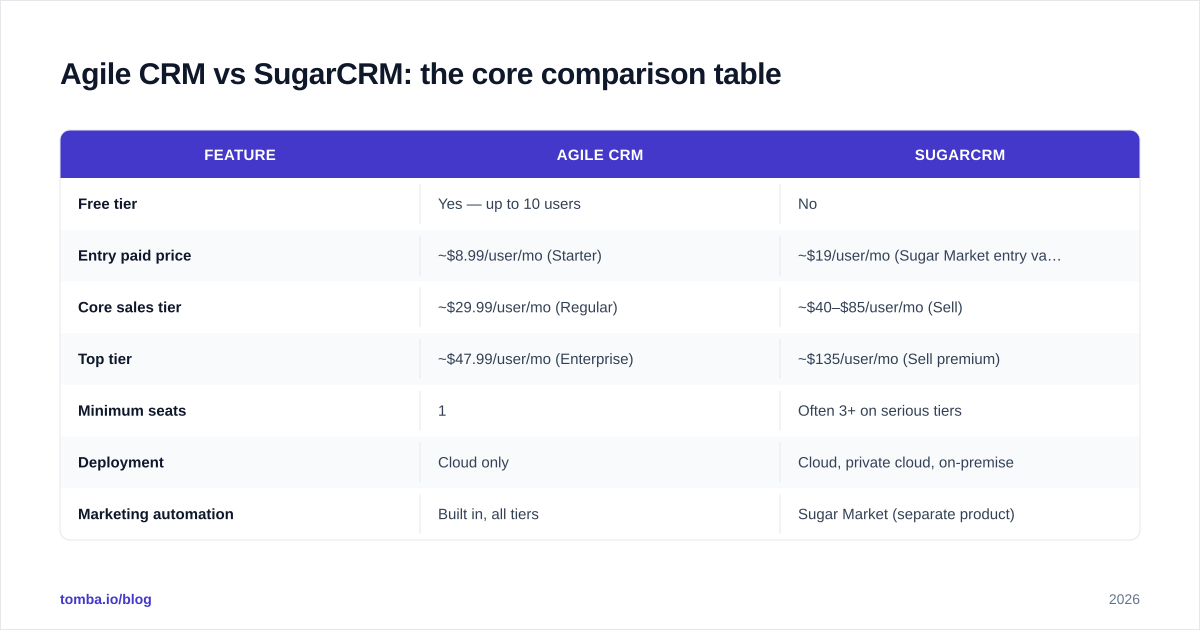
Here's the head-to-head on the attributes that actually drive the buying decision. Prices reflect publicly listed plans as of 2026 and are billed per user, per month.
| Feature | Agile CRM | SugarCRM |
|---|---|---|
| Free tier | Yes — up to 10 users | No |
| Entry paid price | ~$8.99/user/mo (Starter) | ~$19/user/mo (Sugar Market entry varies) |
| Core sales tier | ~$29.99/user/mo (Regular) | ~$40–$85/user/mo (Sell) |
| Top tier | ~$47.99/user/mo (Enterprise) | ~$135/user/mo (Sell premium) |
| Minimum seats | 1 | Often 3+ on serious tiers |
| Deployment | Cloud only | Cloud, private cloud, on-premise |
| Marketing automation | Built in, all tiers | Sugar Market (separate product) |
| Reporting & dashboards | Basic to moderate | Advanced, customizable |
| AI forecasting | Limited | Yes (SugarPredict) |
| Customization depth | Moderate | Deep (Sugar Studio, modules) |
| Best fit | Startups, SMBs, solo teams | Mid-market to enterprise |
| Learning curve | Low | Moderate to high |
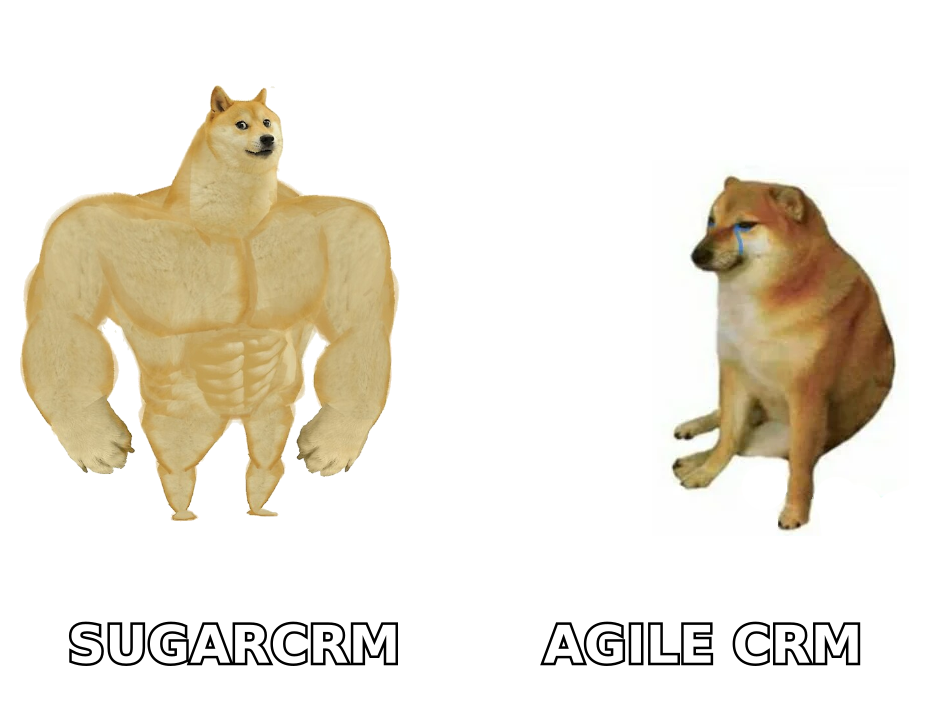
The pattern is clear: Agile CRM wins on price and simplicity, SugarCRM wins on power and configurability. Almost every other difference flows from that split.
Is Agile CRM better than SugarCRM for small teams?#
For most small teams, yes — at least at the start. If you have fewer than 25 reps and you're price-sensitive, Agile CRM's value is hard to argue with. You get a functioning sales pipeline, email marketing, and basic automation without a procurement process or an annual commitment. The free tier alone covers a scrappy founding sales team.
SugarCRM's strengths — granular permissions, complex routing, custom modules, advanced forecasting — are often overkill for a 5- or 10-person team. Paying enterprise prices for features you won't configure is the most common CRM regret we hear about.
That said, "better for small teams now" isn't the same as "better forever." If you expect to triple headcount and your processes are getting complicated, starting on a platform you'll outgrow in 18 months has its own cost. Migration is painful, and reps hate switching tools twice.
A useful decision framework is to map your needs against complexity and growth trajectory rather than just price:
Where does SugarCRM pull ahead?#
SugarCRM earns its higher price in a few specific places, and if any of these describe you, the gap is decisive:
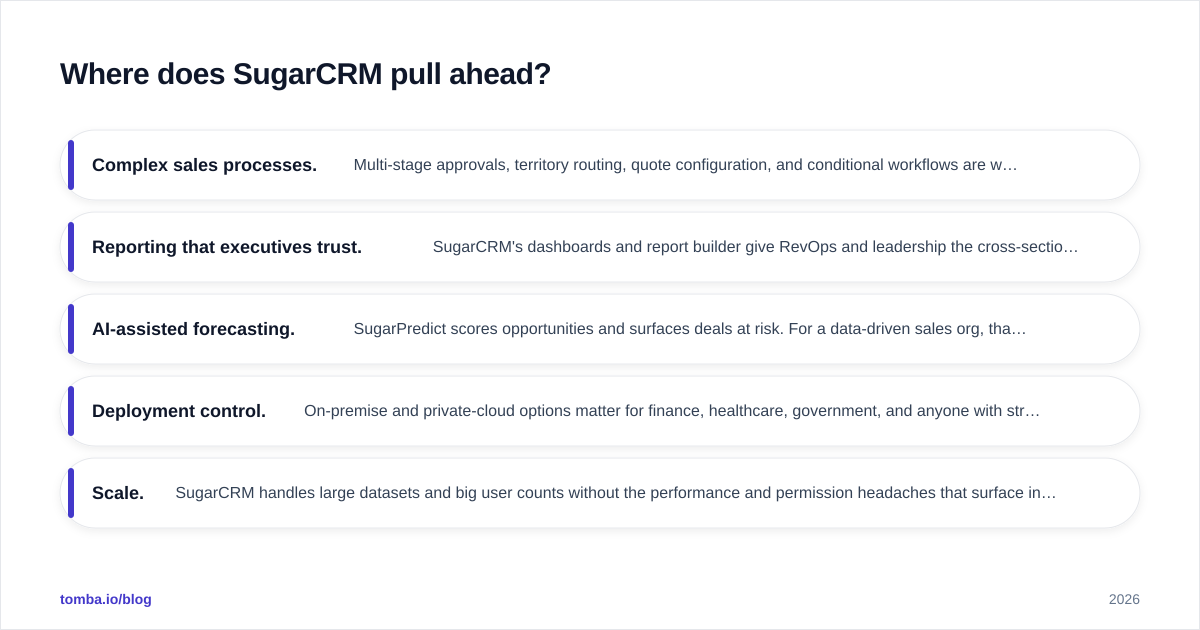
- Complex sales processes. Multi-stage approvals, territory routing, quote configuration, and conditional workflows are where Sugar Studio shines. Agile CRM's automation can't match that expressiveness.
- Reporting that executives trust. SugarCRM's dashboards and report builder give RevOps and leadership the cross-sectional views they need. Agile CRM reporting is serviceable but shallow by comparison.
- AI-assisted forecasting. SugarPredict scores opportunities and surfaces deals at risk. For a data-driven sales org, that's a real lever on win rate.
- Deployment control. On-premise and private-cloud options matter for finance, healthcare, government, and anyone with strict compliance needs. Agile CRM doesn't offer this.
- Scale. SugarCRM handles large datasets and big user counts without the performance and permission headaches that surface in lighter tools.
If you want to compare features against verified user reviews rather than vendor marketing, both products have detailed listings on G2 worth reading before you commit.
Where does Agile CRM pull ahead?#
Agile CRM isn't just the cheap option — it genuinely wins on a few dimensions:
- All-in-one bundling. CRM + marketing + help desk in one subscription means fewer integrations to maintain and one vendor relationship instead of three.
- Time to value. A new user can set up a pipeline and start logging deals the same afternoon. SugarCRM implementations often involve a partner and weeks of configuration.
- Predictable, low cost. No surprise seat minimums, no enterprise sales motion, no annual lock-in to get a usable plan.
- Solo and micro-team friendliness. The free tier and $1-per-day-ish entry plan fit founders and consultants who'd never justify SugarCRM's pricing.
For a team whose process is "find leads, email them, track replies, close," Agile CRM removes friction that SugarCRM would add.
How do pricing and total cost of ownership compare?#
Sticker price is only half the story. Total cost of ownership includes implementation, admin time, training, and integrations.
Agile CRM TCO stays low and flat. Most teams self-implement, training is minimal, and the bundled features cut integration spend. The hidden cost shows up later — if you outgrow it, the migration to a heavier platform is the real expense.
SugarCRM TCO front-loads the cost. Expect implementation effort (often via a partner), a dedicated admin or RevOps owner, and longer onboarding. The payoff is a platform that scales with you, so you don't pay the switching tax down the road.
A rough rule of thumb: under 25 users and a simple process, Agile CRM's lower TCO usually wins. Above that, or with real process complexity, SugarCRM's higher upfront cost amortizes into a better long-term deal. Check current published numbers directly — SugarCRM pricing and Agile CRM pricing both change periodically.
What about data quality — the part both CRMs ignore?#
Here's the uncomfortable truth: neither Agile CRM nor SugarCRM fixes your biggest sales problem, which is bad contact data. A CRM is a container. Fill it with stale, unverified, or incomplete records and you get a very expensive list of bounced emails and dead phone numbers.
This is where your CRM choice intersects with your prospecting stack. Whatever platform you land on, you need a reliable way to:
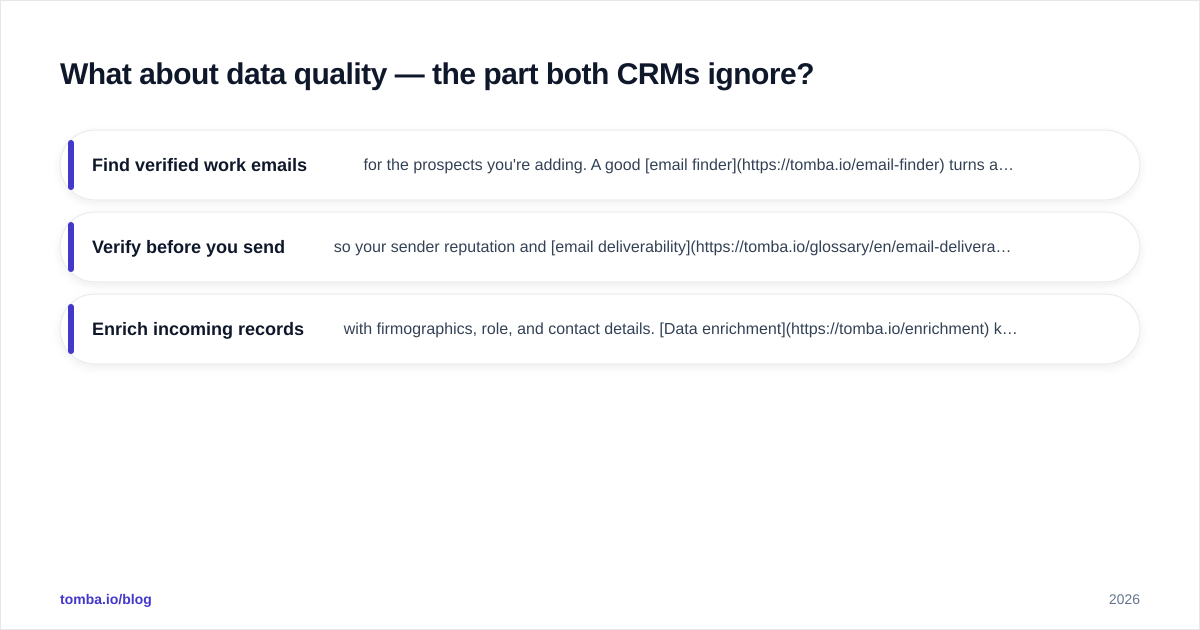
- Find verified work emails for the prospects you're adding. A good email finder turns a name and company into a deliverable address.
- Verify before you send so your sender reputation and email deliverability don't take a hit from hard bounces.
- Enrich incoming records with firmographics, role, and contact details. Data enrichment keeps CRM fields complete so reps aren't researching manually.
Both CRMs integrate with common stacks — and if you run HubSpot-style marketing alongside, tools like the HubSpot integration keep contact data flowing. But the cleaning and finding happens upstream, before data ever lands in Agile CRM or SugarCRM.
Which CRM should you choose in 2026?#
Decide based on three questions, in order:
- How complex is your sales process? Simple, linear pipeline → Agile CRM. Multi-stage, approval-heavy, territory-based → SugarCRM.
- How fast are you scaling? Stable small team → Agile CRM. Aggressive headcount growth or enterprise motion → SugarCRM.
- What's your deployment requirement? Cloud is fine → either. Need on-premise or private cloud for compliance → SugarCRM by default.
If you answered "simple, small, cloud" across the board, Agile CRM gives you 90% of what you need at a fraction of the cost. If even one answer points to complexity, scale, or control, SugarCRM's premium is justified — and trying to force Agile CRM into that role will frustrate your team within a year.
There's no universally "better" CRM here. There's the one that matches your process today and won't trap you tomorrow. Be honest about which describes you, and the choice gets easy.
Start with the data, not just the CRM#
Whichever platform you choose, it lives or dies on the quality of the contacts inside it. Before you import a single lead, make sure those records are real, reachable, and complete. Tomba's Email Finder finds and verifies professional email addresses by name, company, or domain — so the pipeline you build in Agile CRM or SugarCRM is full of prospects you can actually reach, not bounces waiting to happen. Try it free, plug it into your CRM, and let your reps sell instead of hunting for emails.
// get started
Find, verify and enrich your first contacts today
Start on the free plan with 25 searches a month, then scale when your team is ready.
Free plan · No credit card required · GDPR & CCPA
// about the author