Agile Education Marketing vs Clodura.ai: 2026 Data Showdown
One sells curated K-12 and higher-ed contact lists; the other is an AI sales-intelligence engine. Here's which B2B data source actually fits your pipeline in 2026 — and where each one breaks down.
Choosing between Agile Education Marketing and Clodura.ai is really a choice between two different philosophies of B2B data: buy a vertical-specific list, or run a live sales-intelligence engine that builds lists on demand. They are not the same product, and picking the wrong one wastes both budget and your sender reputation.
This guide breaks down what each tool actually does, where the data comes from, how fresh it stays, what you pay, and which sales motion each one fits. No vendor cheerleading — just the trade-offs you'd find out the hard way after three months of bounced sends.
TL;DR#
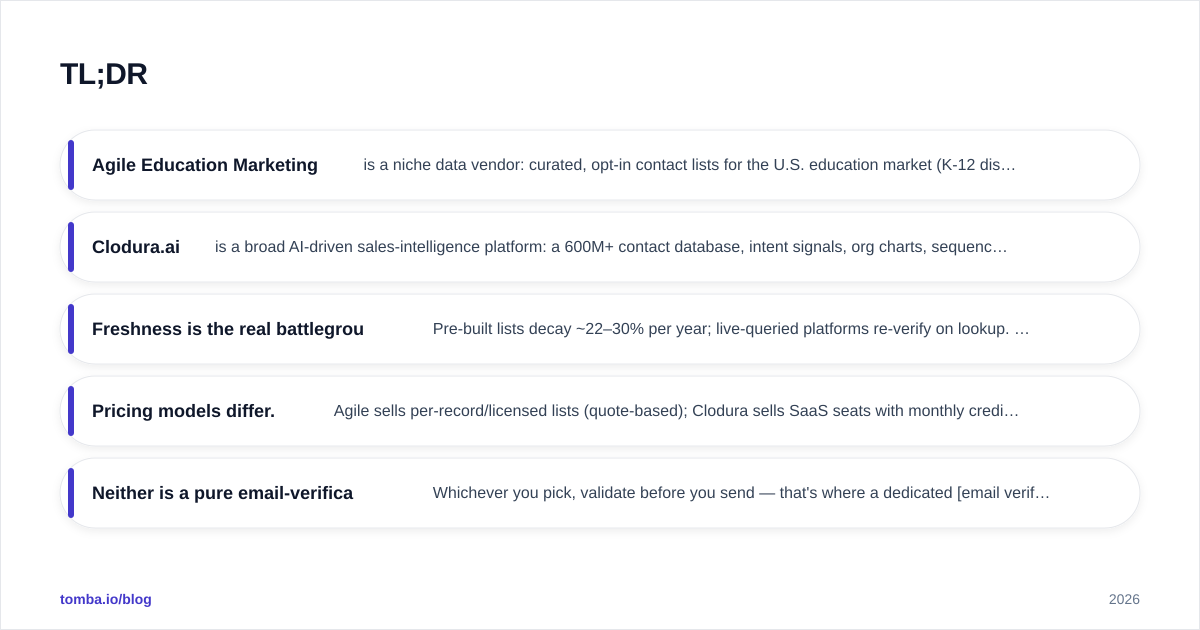
- Agile Education Marketing is a niche data vendor: curated, opt-in contact lists for the U.S. education market (K-12 districts, higher ed, administrators, faculty). Best when education is your entire ICP.
- Clodura.ai is a broad AI-driven sales-intelligence platform: a 600M+ contact database, intent signals, org charts, sequences, and a built-in email finder/verifier across all industries.
- Freshness is the real battleground. Pre-built lists decay ~22–30% per year; live-queried platforms re-verify on lookup. Education contacts churn fast every summer.
- Pricing models differ. Agile sells per-record/licensed lists (quote-based); Clodura sells SaaS seats with monthly credit limits.
- Neither is a pure email-verification layer. Whichever you pick, validate before you send — that's where a dedicated email verifier earns its keep.
What is Agile Education Marketing?#
Agile Education Marketing is a specialized B2B data and marketing-services provider focused exclusively on the education sector. If you sell curriculum software, classroom hardware, ed-tech, or professional-development services, this is a company built around your buyer.
Their core asset is a permission-based database of education professionals — district superintendents, principals, IT directors, procurement leads, department heads, and teachers — segmented by grade level, subject, district size, geography, and role. You typically license a targeted list (or a multichannel campaign) rather than self-serve a SaaS dashboard. They also run email deployment, direct mail, and lead-gen services on top of the data, which matters if you want a done-for-you motion instead of tooling.
The strength is depth in one vertical. Education data is messy — district boundaries change, staff rotate every academic year, and many addresses are role-based (principal@district.org). A vendor that lives in this niche tends to model those quirks better than a generalist. You can read more about how they position the data on the official Agile Education Marketing site.
The weakness is also the niche: if your ICP drifts beyond education — say you start selling to municipal government or healthcare — the data doesn't follow you.
What is Clodura.ai?#
Clodura.ai is an all-in-one sales-intelligence and prospecting platform. Instead of selling you a list, it gives you a searchable engine: 600M+ B2B contacts, 18M+ companies, org charts, technographics, buyer-intent signals, and built-in email finding and verification — plus lightweight sales-engagement sequencing so you can prospect and send from one place.
The model is self-serve SaaS. You filter by industry, title, company size, technology used, or intent topic, then pull verified contacts into a campaign. Because lookups happen against a live index, records get re-checked at query time rather than sitting in a CSV you bought last quarter. You can see their full feature set on the official Clodura.ai homepage and read user reviews on G2.
The strength is breadth and self-service speed. Any industry, any region, on demand, with intent data layered on top. The weakness is depth in any single vertical: a generalist 600M-record index will rarely match a specialist's accuracy on, say, the exact procurement contact for a 1,200-student rural school district.
Agile Education Marketing vs Clodura.ai: how do they compare?#
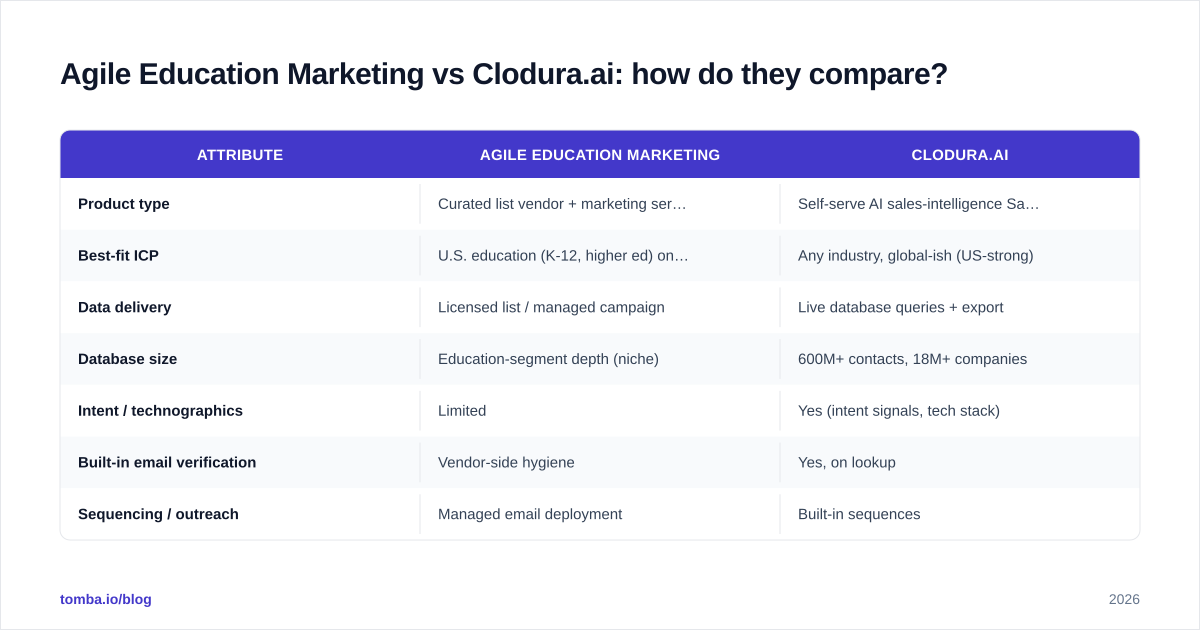
Here's the side-by-side on the attributes that actually change your results.
| Attribute | Agile Education Marketing | Clodura.ai |
|---|---|---|
| Product type | Curated list vendor + marketing services | Self-serve AI sales-intelligence SaaS |
| Best-fit ICP | U.S. education (K-12, higher ed) only | Any industry, global-ish (US-strong) |
| Data delivery | Licensed list / managed campaign | Live database queries + export |
| Database size | Education-segment depth (niche) | 600M+ contacts, 18M+ companies |
| Intent / technographics | Limited | Yes (intent signals, tech stack) |
| Built-in email verification | Vendor-side hygiene | Yes, on lookup |
| Sequencing / outreach | Managed email deployment | Built-in sequences |
| Pricing model | Quote-based, per-record/license | SaaS seats + monthly credits |
| Free tier | No (sales contact) | Free plan available |
| Data freshness risk | Higher (pre-built lists decay) | Lower (re-verified on query) |
The pattern: Agile wins on vertical precision and done-for-you service; Clodura wins on breadth, self-serve speed, and freshness mechanics.
Which one has fresher, more accurate data?#
Freshness is where this decision is usually won or lost — and it's the one buyers underweight.
B2B contact data decays roughly 22–30% per year as people change jobs, companies restructure, and emails get deprecated. In education the decay is seasonal and brutal: a large share of staff turnover lands every summer between academic years. A list licensed in May can be materially wrong by September.
That structural reality favors the live-query model. When a platform like Clodura re-verifies a record at the moment you pull it, you sidestep most shelf-life decay. A pre-built list from any vendor — Agile included — is only as fresh as its last refresh cycle, so you must ask pointed questions: When was this segment last validated? What's your bounce guarantee? Do you re-run hygiene before delivery?
That said, "live" doesn't mean "perfect." Generalist databases carry catch-all domains and role addresses that pass a basic syntax check but still bounce. Education is full of these (info@, office@, shared inboxes). This is exactly why a verification step belongs in your workflow regardless of source — run pulled lists through a catch-all verifier before they touch a sending domain. For more on why source data ages, see how providers document their data sources and accuracy.
How does pricing compare?#
The pricing models aren't directly comparable, which trips up a lot of buyers.
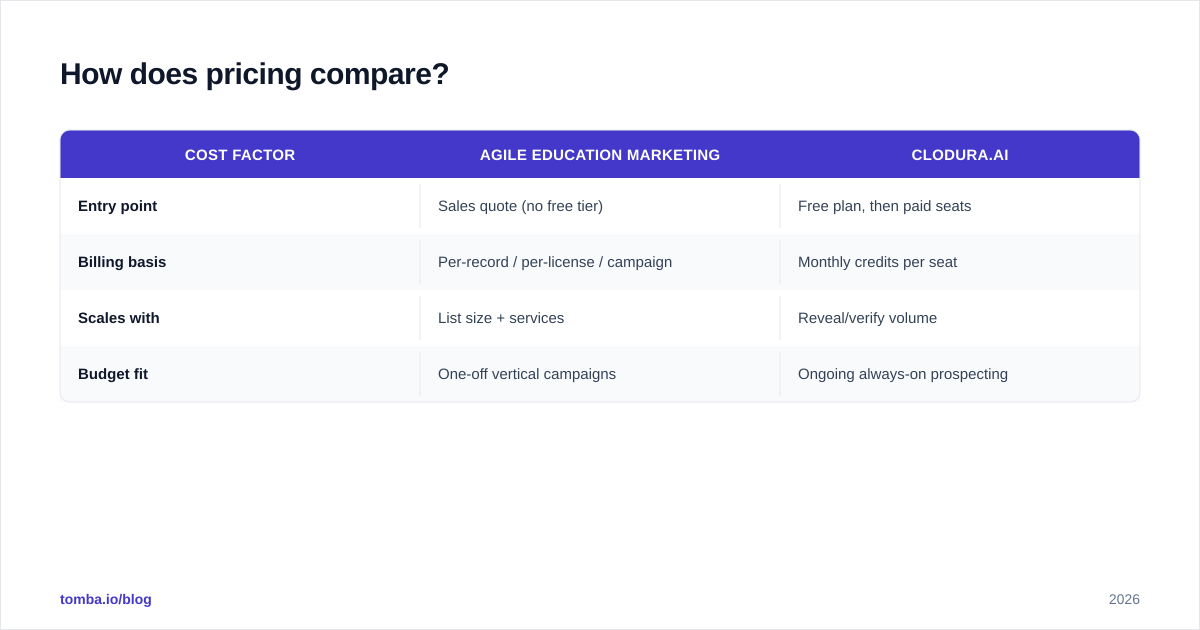
Agile Education Marketing is quote-based. You're licensing a defined list or commissioning a campaign, so cost scales with record count, segmentation depth, and whether you add deployment services. There's no public self-serve tier — you talk to sales, and you typically pay per use or per license rather than for ongoing database access.
Clodura.ai is SaaS. It offers a free plan plus paid tiers with monthly credit allotments for contact reveals and verifications, billed per seat. Predictable, self-serve, and you keep access to the whole index — but credits cap how much you can pull each month, and overages add up if you prospect heavily.
| Cost factor | Agile Education Marketing | Clodura.ai |
|---|---|---|
| Entry point | Sales quote (no free tier) | Free plan, then paid seats |
| Billing basis | Per-record / per-license / campaign | Monthly credits per seat |
| Scales with | List size + services | Reveal/verify volume |
| Budget fit | One-off vertical campaigns | Ongoing always-on prospecting |
Rule of thumb: if education is a campaign you run a few times a year, a licensed list can be cheaper per touch. If prospecting is an always-on engine, SaaS credits amortize better.
Which should you choose for your sales motion?#
Match the tool to your ICP and how you run outbound — not to whichever has the bigger logo.
Choose Agile Education Marketing if:
- Education is 100% of your ICP and you need district/role-level precision.
- You want managed deployment, not another dashboard to staff.
- You run periodic campaigns rather than continuous prospecting.
Choose Clodura.ai if:
- You sell across multiple industries or expect your ICP to expand.
- You want self-serve speed, intent signals, and built-in sequencing.
- You'd rather re-query fresh data than license and babysit a static list.
Choose neither (or a third option) if your real need is just accurate emails on a prospect list you already have. In that case a focused email-finding and verification stack beats both — you don't need a 600M index or an education license, you need correct addresses. Tools like the Tomba email finder and domain search cover that lane directly, and tend to be cheaper than either platform for the find-and-verify job.
What about deliverability after you get the data?#
Sourcing is half the battle; landing in the inbox is the other half — and the data source quietly drives both.
Bought lists carry deliverability risk because you didn't earn those addresses. Even opt-in education lists include role accounts and aging mailboxes that inflate bounce rates and ding your sender reputation. Live-query platforms reduce stale records but still surface catch-all domains that look valid and aren't.
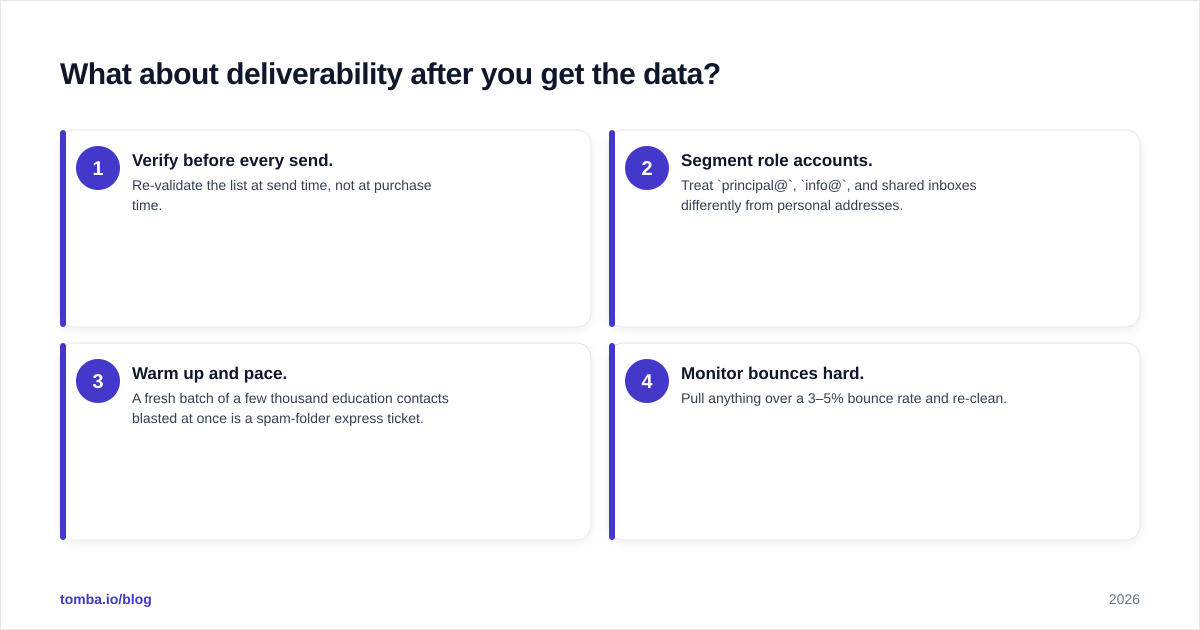
Regardless of which you pick, protect your domain:
- Verify before every send. Re-validate the list at send time, not at purchase time.
- Segment role accounts. Treat
principal@,info@, and shared inboxes differently from personal addresses. - Warm up and pace. A fresh batch of a few thousand education contacts blasted at once is a spam-folder express ticket.
- Monitor bounces hard. Pull anything over a 3–5% bounce rate and re-clean.
A quick pre-send pass with an email verifier catches most of the damage before it hits your reputation. This step is non-negotiable for bought data — it's the cheapest insurance in your stack.
Frequently asked questions#
Is Clodura.ai a direct competitor to Agile Education Marketing? Only partially. Clodura competes on the data layer, but Agile's vertical depth and managed-services model serve a different buyer. A general platform rarely matches a specialist on niche accuracy; a specialist rarely matches a generalist on breadth.
Can I use both? Yes, and some teams do — Agile for deep education campaigns, Clodura (or a finder/verifier stack) for everything else. Just don't double-pay for overlapping coverage.
Do either guarantee deliverability? No vendor honestly can. They can report verification rates, but inbox placement depends on your domain reputation, warmup, content, and pacing — factors you control after the data hands off.
What's the cheapest path if I only need verified emails? Skip both and use a dedicated find-and-verify tool. You'll pay for exactly the addresses you need instead of a license or a full SaaS seat.
The bottom line#
Agile Education Marketing and Clodura.ai solve adjacent but different problems. If education is your whole world and you want curated, serviced data, Agile's vertical depth is hard to beat. If you prospect across industries and want self-serve, re-verified data with intent signals, Clodura's live engine fits better. The deciding factor is almost always how niche your ICP is and how often you prospect.
But if you strip the question down to "I just need correct, deliverable email addresses for the prospects I already know," neither heavyweight is the efficient answer. Start with the Tomba Email Finder to pull verified, professional emails by name, company, or domain — then layer verification before you send. It's the leanest way to fill a pipeline without licensing a list you'll only half-use or paying for an index you'll barely touch. Check the Tomba pricing tiers — there's a free plan to test accuracy on your own ICP before you commit a dollar.
// get started
Find, verify and enrich your first contacts today
Start on the free plan with 25 searches a month, then scale when your team is ready.
Free plan · No credit card required · GDPR & CCPA
// about the author