Agile Education Marketing vs Tomba: 2026 Data Comparison
Agile Education Marketing sells curated education contact lists; Tomba finds and verifies emails on demand. Here's how they compare on data, pricing, accuracy, and compliance in 2026.
If you sell into schools, districts, or higher-ed institutions, you have probably hit the same fork in the road: buy a pre-built education contact list from a specialist like Agile Education Marketing, or build your own verified contacts on demand with a tool like Tomba. They solve the same surface problem — getting decision-maker emails — but they are very different products underneath.
This guide breaks down agile education marketing vs tomba on the dimensions that actually change your pipeline: data freshness, accuracy, pricing model, compliance, and the kind of campaigns each one is built for.
TL;DR — Which one should you pick?#
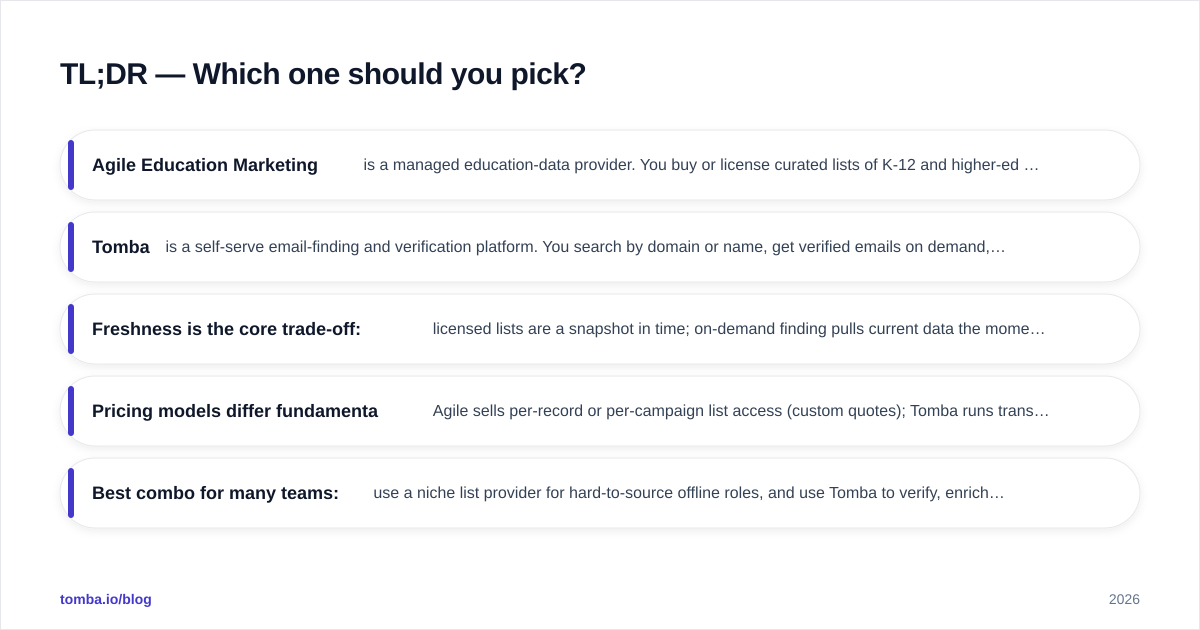
- Agile Education Marketing is a managed education-data provider. You buy or license curated lists of K-12 and higher-ed contacts (teachers, principals, administrators, IT directors) segmented by role, subject, district size, and geography.
- Tomba is a self-serve email-finding and verification platform. You search by domain or name, get verified emails on demand, and pay per usage rather than per list.
- Freshness is the core trade-off: licensed lists are a snapshot in time; on-demand finding pulls current data the moment you need it.
- Pricing models differ fundamentally: Agile sells per-record or per-campaign list access (custom quotes); Tomba runs transparent monthly tiers starting at $49/mo.
- Best combo for many teams: use a niche list provider for hard-to-source offline roles, and use Tomba to verify, enrich, and refresh that list so you are not emailing dead inboxes.
What is Agile Education Marketing?#
Agile Education Marketing is a long-running, education-focused data and marketing-services company. Its whole catalog is built around the education vertical: it maintains contact databases of educators and administrators across U.S. public schools, private schools, districts, colleges, and universities.
The pitch is depth of segmentation. Because the data is curated specifically for education, you can slice it by attributes generalist databases rarely carry — grade level taught, subject area, Title I status, enrollment size, technology budget, or job function within a district. For a vendor selling, say, a STEM curriculum product, that segmentation is the value: you reach 6th-grade science teachers, not "anyone at the school."
Lists are typically licensed or purchased for a defined campaign, often delivered as a file or activated through email/direct-mail/digital channels the agency runs for you. You can read independent reviews of education data vendors on G2 and Capterra to see how buyers rate freshness and deliverability.
What is Tomba?#
Tomba is a B2B email finder and verification platform. Instead of selling you a static list, it gives you tools to generate verified contact data yourself, in real time, for whatever target you define.
The core workflow: give Tomba a company domain or a person's name plus company, and it returns the most likely professional email along with a confidence score and verification status. A domain search returns every public email pattern it can find for an organization — useful when you want every administrator at a district domain rather than one named person. Around that sit an email verifier, catch-all detection, phone finder, and data enrichment.
Tomba is vertical-agnostic. It does not "know" education the way a specialist list does, but it works on any .edu or district domain you point it at, and the data is generated fresh on each lookup rather than pulled from a file built months ago.
How do they compare side by side?#
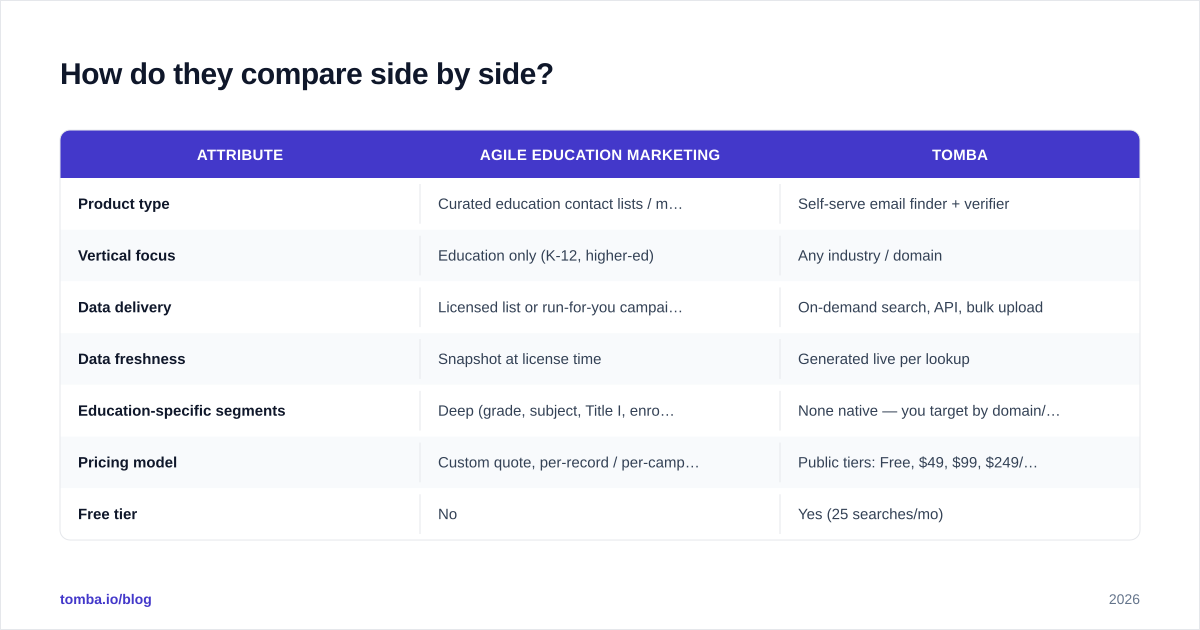
Here is the head-to-head on the attributes that decide most buying decisions.
| Attribute | Agile Education Marketing | Tomba |
|---|---|---|
| Product type | Curated education contact lists / managed campaigns | Self-serve email finder + verifier |
| Vertical focus | Education only (K-12, higher-ed) | Any industry / domain |
| Data delivery | Licensed list or run-for-you campaign | On-demand search, API, bulk upload |
| Data freshness | Snapshot at license time | Generated live per lookup |
| Education-specific segments | Deep (grade, subject, Title I, enrollment) | None native — you target by domain/role |
| Pricing model | Custom quote, per-record / per-campaign | Public tiers: Free, $49, $99, $249/mo |
| Free tier | No | Yes (25 searches/mo) |
| Verification included | Varies by package | Built-in on every result |
| Self-serve API | Limited | Full email finder API |
| Best for | Bulk education outreach with rich segmentation | Targeted, fresh, verified outreach at any scale |
Is licensed list data better than on-demand finding?#
It depends on what you value more: segmentation depth or freshness.
Think of it like groceries. A licensed education list is a stocked pantry — everything is there in bulk, organized by category, ready the moment you walk in. But some of it has been on the shelf a while. On-demand finding is ordering fresh — you get exactly what you need at the moment you need it, but you assemble the basket yourself.
Licensed lists win when:
- You need attributes that only exist in a curated education database (subject taught, district funding tier, enrollment band).
- You are running broad, high-volume campaigns where coverage matters more than per-contact precision.
- You want a vendor to run the campaign end-to-end and do not want to build the data muscle in-house.
On-demand finding wins when:
- Freshness matters — teacher and administrator turnover in education is high, and a six-month-old list decays fast.
- You target specific institutions (you already know the districts or colleges you want).
- You want every email verified before send to protect email deliverability and sender reputation.
- You need transparent, predictable pricing instead of a custom quote.
The decay problem is the one people underestimate. Education staff churn every academic year. A list that was 95% accurate in August can drop meaningfully by spring. On-demand verification re-checks the address at send time, which is why many teams keep a verification layer even when they buy lists elsewhere.
How does pricing compare?#
This is where the two models diverge most.
Agile Education Marketing uses custom, quote-based pricing typical of managed data providers. Cost scales with record count, segmentation complexity, license duration (one-time vs multi-use), and whether you add managed campaign services. There is no public free tier, and you generally commit to a list or campaign minimum.
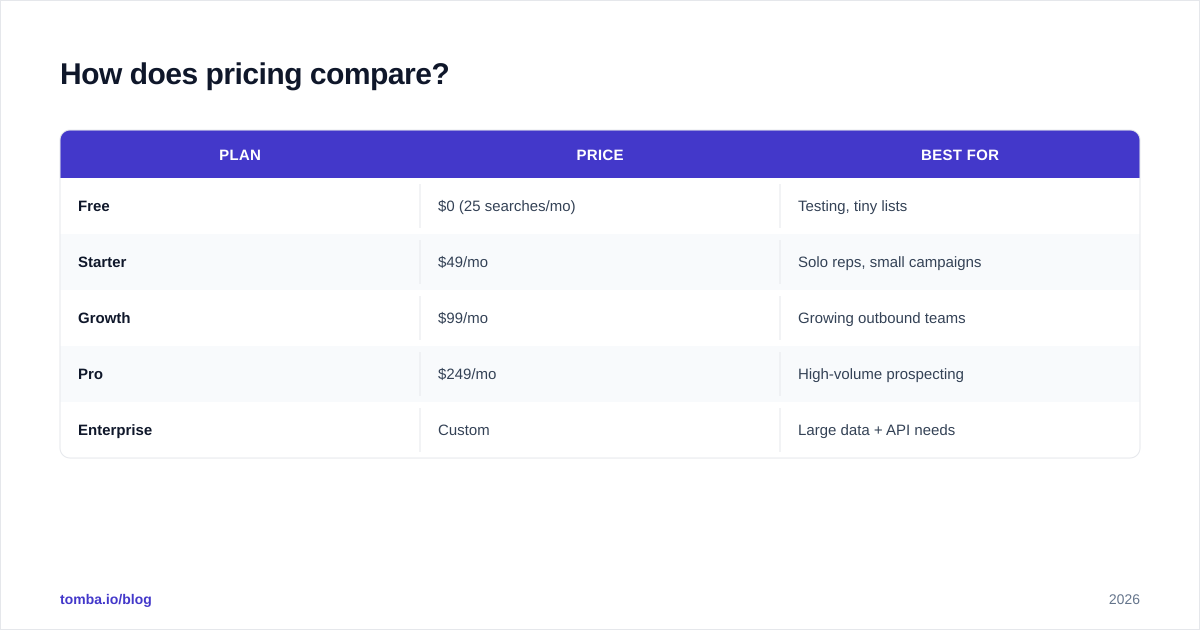
Tomba uses transparent, self-serve tiers (see full Tomba pricing):
| Plan | Price | Best for |
|---|---|---|
| Free | $0 (25 searches/mo) | Testing, tiny lists |
| Starter | $49/mo | Solo reps, small campaigns |
| Growth | $99/mo | Growing outbound teams |
| Pro | $249/mo | High-volume prospecting |
| Enterprise | Custom | Large data + API needs |
The mental model: with Agile you pay for access to a curated dataset; with Tomba you pay for the act of finding and verifying contacts you define. If you run a handful of large education blasts a year, a licensed list may amortize well. If you run continuous, targeted outbound and care about freshness, usage-based pricing is usually cheaper per usable contact.
What about compliance and data quality?#
Selling into education carries real compliance weight, and the two approaches handle it differently.
Specialist education vendors typically market that their data is sourced and maintained for education outreach, and reputable ones document opt-out handling and suppression. Still, any purchased list shifts responsibility to you to honor CAN-SPAM, district policies, and — where student data is involved — frameworks like FERPA. Always confirm how a list was sourced and how recently it was scrubbed.
With Tomba, you are finding professional, role-based contact data (the administrator's work email at their institution), and every result ships with a verification status so you can suppress invalid or risky addresses before sending. Pairing finding with verification is the single biggest lever on deliverability: clean lists bounce less, which protects your sender reputation and keeps you out of spam folders.
Whichever path you choose, the non-negotiable is verification at send time. Bought or built, an unverified education list will burn your domain.
Can you use both together?#
Yes — and for many education-focused teams this is the strongest setup.
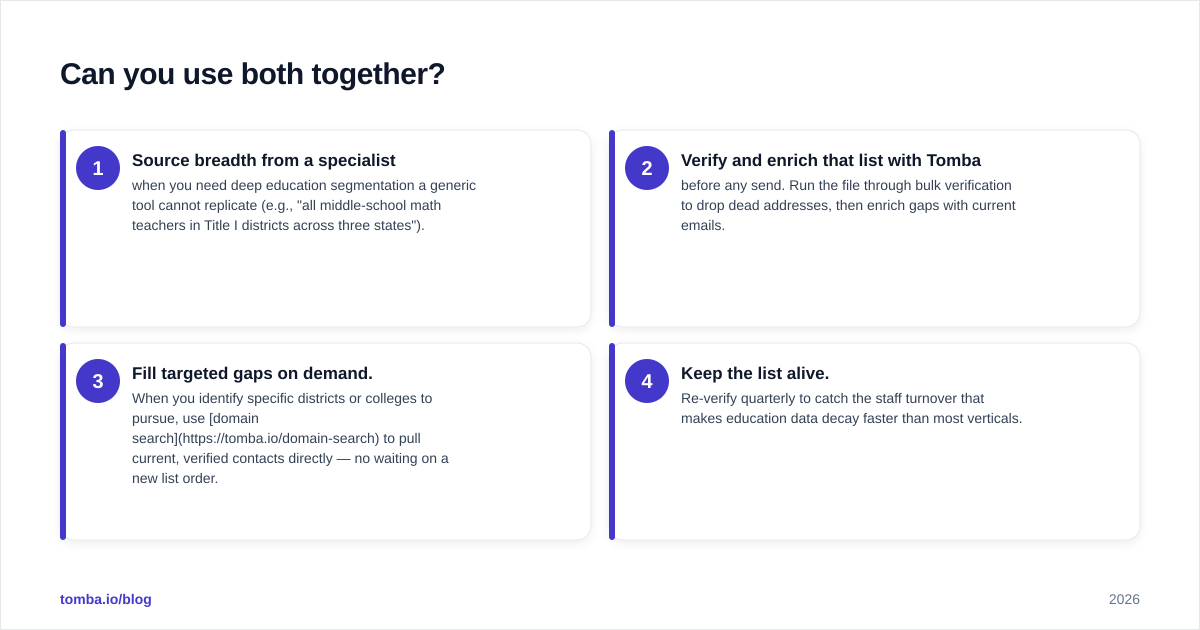
A practical hybrid workflow:
- Source breadth from a specialist when you need deep education segmentation a generic tool cannot replicate (e.g., "all middle-school math teachers in Title I districts across three states").
- Verify and enrich that list with Tomba before any send. Run the file through bulk verification to drop dead addresses, then enrich gaps with current emails.
- Fill targeted gaps on demand. When you identify specific districts or colleges to pursue, use domain search to pull current, verified contacts directly — no waiting on a new list order.
- Keep the list alive. Re-verify quarterly to catch the staff turnover that makes education data decay faster than most verticals.
This way you get the segmentation depth of a curated provider and the freshness and verification of an on-demand tool, without betting your deliverability on a single static file.
Which should you choose?#
- Choose Agile Education Marketing if your campaigns depend on rich, education-specific segmentation you cannot build yourself, you run large managed blasts, and you are comfortable with custom quote pricing.
- Choose Tomba if you value fresh, verified data, you target known institutions, you want transparent usage-based pricing, and you need an API or bulk workflow your team controls.
- Choose both if you want curated reach and live verification — license the hard-to-source segments, then let Tomba keep them clean and current.
The honest summary: these are not really the same product. One sells you a vertical dataset; the other gives you a fresh-data engine. The right answer depends on whether your bottleneck is segmentation you can't build or freshness and verification you can't trust in a static list.
Get started with verified contact data#
If freshness, transparent pricing, and built-in verification are what you are after, start with the Tomba Email Finder. Point it at any district, school, or university domain and pull current, verified decision-maker emails on demand — no quote, no minimum, and a free tier of 25 searches a month so you can test it against a sample of your existing education list before committing. If your data is decaying faster than you can clean it, that is the fastest way to find out exactly how much.
// get started
Find, verify and enrich your first contacts today
Start on the free plan with 25 searches a month, then scale when your team is ready.
Free plan · No credit card required · GDPR & CCPA
// about the author