AI BDR Tools in 2026: Top Platforms, Pricing & How to Pick
AI BDR tools promise autonomous pipeline, but most teams overpay for hype. Here's how the 2026 platforms actually compare — and where they break.
TL;DR
- AI BDR tools automate the top of the sales funnel — list building, research, personalization, and multi-channel sequencing — so a human rep can focus on conversations that close.
- The category splits into two camps: autonomous "AI BDR agents" (Artisan, 11x, AiSDR) that run the whole motion, and AI-assisted stacks (Clay, Apollo, Outreach) where you keep the wheel.
- Data quality, not the AI layer, is the real differentiator. A clever agent emailing bad contacts just burns your domain reputation faster.
- Expect $500–$5,000+/month for full autonomous platforms; assisted stacks start far lower and scale on usage.
- Pair any AI BDR tool with an accurate email source. Garbage contacts kill deliverability no matter how good the copy is.
What are AI BDR tools?#
AI BDR tools are software platforms that automate the work a Business Development Representative normally does by hand: finding accounts, identifying the right contacts, researching them, writing personalized outreach, and following up across email, LinkedIn, and sometimes phone.
Think of a traditional BDR as a line cook prepping every plate from scratch — chopping, seasoning, plating, one at a time. An AI BDR tool is the prep kitchen that does the chopping and seasoning in bulk, so your human rep only plates the dish and sends it out. The AI handles volume and repetition; the human handles judgment and relationships.
The phrase covers a wide spectrum. On one end you have fully autonomous AI BDR agents marketed as a "digital employee" — you give it an ICP, connect a mailbox, and it builds lists, drafts messages, and books meetings into your calendar. On the other end you have AI features bolted onto existing sales engagement platforms — smart sequencing, AI copy suggestions, intent scoring — where a person still drives.
Both reduce manual grunt work. They differ enormously in how much control, oversight, and budget they demand.
How do AI BDR tools actually work?#
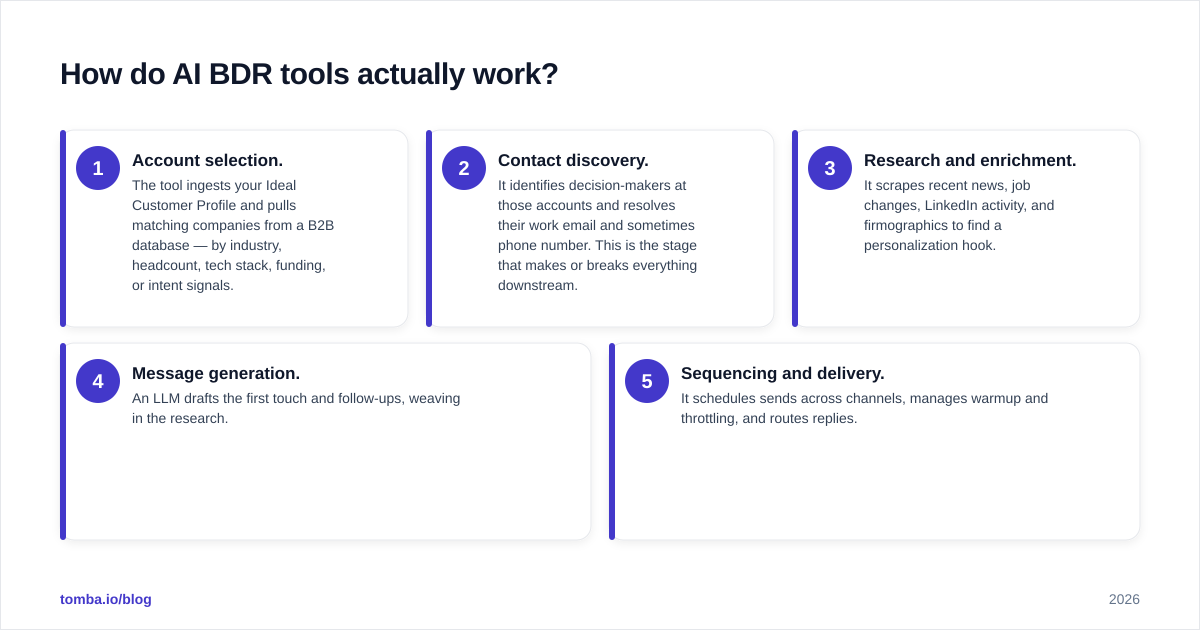
Every AI BDR platform, autonomous or assisted, runs the same five-stage pipeline under the hood. Understanding the stages tells you where each tool is strong and where it quietly cuts corners.
- Account selection. The tool ingests your Ideal Customer Profile and pulls matching companies from a B2B database — by industry, headcount, tech stack, funding, or intent signals.
- Contact discovery. It identifies decision-makers at those accounts and resolves their work email and sometimes phone number. This is the stage that makes or breaks everything downstream.
- Research and enrichment. It scrapes recent news, job changes, LinkedIn activity, and firmographics to find a personalization hook.
- Message generation. An LLM drafts the first touch and follow-ups, weaving in the research.
- Sequencing and delivery. It schedules sends across channels, manages warmup and throttling, and routes replies.
The marketing focuses almost entirely on stages 4 and 5 — the AI writing and the autonomy. But the leverage is in stages 2 and 3. A beautifully written email sent to info@ or a guessed address that bounces does worse than nothing: it trains spam filters to distrust your domain. That is why serious teams treat the email finder and verifier as the foundation, not an afterthought. Tomba's email finder and email verifier exist precisely to keep stage 2 clean before any AI copy goes out.
Is an AI BDR better than a human BDR?#
Short answer: not yet, and not as a replacement — but as a force multiplier, the math is compelling.
A human BDR is better at reading nuance, handling objections, building rapport, and knowing when a "no" is really a "not now." No 2026 AI matches that. Where AI wins decisively is volume, consistency, and cost per touch. An autonomous agent can research and personalize 1,000 prospects overnight without fatigue, never forgets a follow-up, and never has a bad Monday.
The teams getting real ROI don't fire their reps and buy an "AI employee." They use AI BDR tools to handle the repetitive 80% — list building, first drafts, follow-up scheduling — and free their humans for the 20% that actually requires a human: live conversations, discovery calls, and relationship-building.
There's also a deliverability ceiling that hype tends to ignore. You cannot blast 10,000 AI-written emails a week from one domain and expect inbox placement. Volume without email deliverability discipline lands you in spam fast. The best results come from tighter, better-targeted lists — which loops back to data quality, not raw send volume.
What are the best AI BDR tools in 2026?#
The market clusters into three tiers. Pick the tier that matches how much control you want to keep and how much you can spend.
Autonomous AI BDR agents — Artisan (Ava), 11x (Alice), AiSDR. These run the full motion and aim to replace headcount. Highest price, lowest oversight, biggest risk if your data or ICP is off.
AI-augmented engagement platforms — Outreach, Salesloft, Apollo. Mature sequencing and analytics with AI features layered on. You keep control; the AI assists.
Data-and-enrichment-first stacks — Clay, plus dedicated finders and verifiers. You compose the workflow yourself, which gives maximum accuracy control and the lowest data cost.
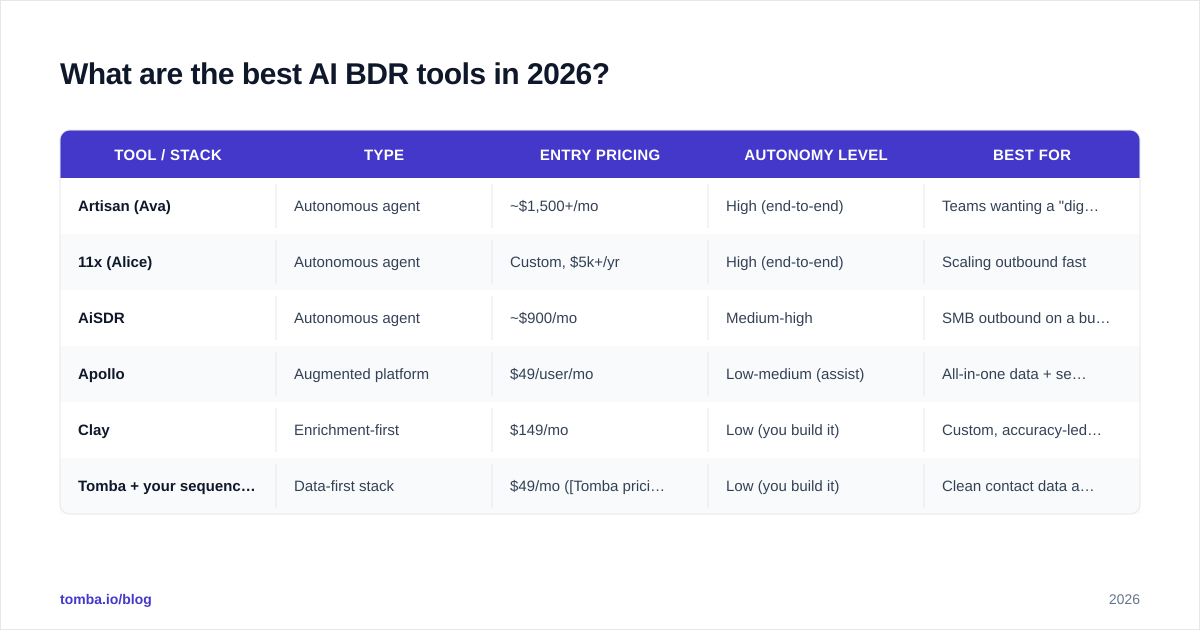
Here's how representative options compare on the attributes that actually matter:
| Tool / Stack | Type | Entry pricing | Autonomy level | Best for |
|---|---|---|---|---|
| Artisan (Ava) | Autonomous agent | ~$1,500+/mo | High (end-to-end) | Teams wanting a "digital BDR" |
| 11x (Alice) | Autonomous agent | Custom, $5k+/yr | High (end-to-end) | Scaling outbound fast |
| AiSDR | Autonomous agent | ~$900/mo | Medium-high | SMB outbound on a budget |
| Apollo | Augmented platform | $49/user/mo | Low-medium (assist) | All-in-one data + sequencing |
| Clay | Enrichment-first | $149/mo | Low (you build it) | Custom, accuracy-led workflows |
| Tomba + your sequencer | Data-first stack | $49/mo (Tomba pricing) | Low (you build it) | Clean contact data at low cost |
Note the pricing gap. A full autonomous agent can cost 10–30x a data-first stack. That premium buys convenience and orchestration — not better contact data. If your outbound is underperforming, the fix is usually upstream of the AI.
How do you choose the right AI BDR tool?#
Match the tool to three things: your data confidence, your team size, and your tolerance for autonomous sends going out under your domain.
Start with data quality, not features. Ask every vendor where their contact data comes from and what their verified bounce rate is. If they're vague, assume the worst. You can always layer a dedicated verifier on top — running lists through an email verifier before send is the single cheapest way to protect deliverability. Tomba documents its data sources openly, which is the kind of transparency you want before trusting any list.
Then weigh autonomy against risk. Fully autonomous agents are seductive because they promise "set it and forget it." But every email goes out with your company's name on it. One badly-personalized AI message at scale can damage a brand. If you're not ready to audit what the agent sends, start assisted and graduate to autonomous.
Then size it to your team. A two-person startup doesn't need an $18k/year autonomous platform; a data-first stack plus a cheap sequencer gets you 80% of the value. A 30-rep org with a RevOps function can justify the orchestration layer.
Use this checklist before signing anything:
- Can you see and approve messages before they send (at least during onboarding)?
- What's the documented email accuracy / bounce rate, and is it independently verifiable?
- Does it support data enrichment so contacts arrive complete, not half-blank?
- Does pricing scale on credits, seats, or sends — and which one matches your motion?
- Can you export your data and leave, or are you locked in?
What does an AI BDR tool cost in 2026?#
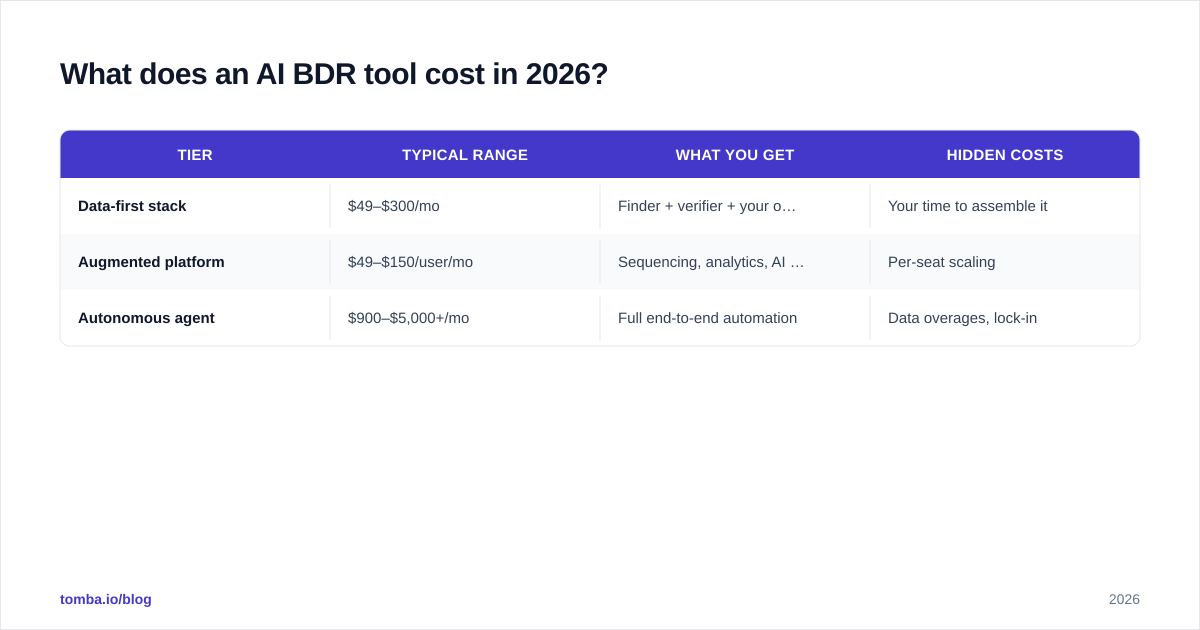
Pricing falls into three bands, and the band you need depends entirely on how much of the pipeline you want the software to own.
| Tier | Typical range | What you get | Hidden costs |
|---|---|---|---|
| Data-first stack | $49–$300/mo | Finder + verifier + your own sequencer | Your time to assemble it |
| Augmented platform | $49–$150/user/mo | Sequencing, analytics, AI assist | Per-seat scaling |
| Autonomous agent | $900–$5,000+/mo | Full end-to-end automation | Data overages, lock-in |
The headline subscription is rarely the full bill. Autonomous platforms often charge separately for enrichment credits, extra mailboxes, and overages — costs that balloon as you scale sends. A data-first approach inverts this: you pay a flat, predictable rate for accurate contacts and bring your own delivery layer.
For most teams under 20 reps, the value-for-money winner is a hybrid: a precise data source feeding an affordable sequencer, with AI used for first drafts rather than full autonomy. You get most of the efficiency at a fraction of the cost, and you keep your hand on the deliverability lever. Tomba sits in this layer — at $49/mo for the Starter plan it covers the contact-data foundation, and you can scale to the Growth ($99/mo) or Pro ($249/mo) tiers as volume grows. Compare the full Tomba plans before committing to a four-figure autonomous platform you may not need yet.
What are the risks of AI BDR tools?#
Three failure modes sink most AI BDR deployments, and all three are avoidable.
Deliverability collapse. This is the big one. Autonomous agents make it trivially easy to send too much, too fast, from unwarmed domains, to unverified contacts. The result is a poisoned sender reputation that takes months to repair. Protect yourself: verify every address, warm your domains, and watch your sender reputation like a hawk. Industry guidance from sources like HubSpot and reviews on G2 consistently rank deliverability hygiene above clever copy.
Generic personalization at scale. "Hi {FirstName}, I saw {Company} is growing" is not personalization — and prospects spot AI boilerplate instantly. If the research stage is shallow, the AI just automates spam. The fix is richer enrichment data feeding the model, so the hook is genuinely specific.
Over-automation and brand risk. When you hand the whole motion to an agent and stop reading what it sends, mistakes compound silently. A wrong merge field or a tone-deaf message goes out 5,000 times before anyone notices. Keep a human in the approval loop, especially early.
The common thread: every one of these risks traces back to either bad data or unchecked volume. Solve those two and AI BDR tools become a genuine advantage rather than a liability. For an honest market overview of vendor categories, Gartner tracks the sales engagement and revenue intelligence space if you want analyst framing before you buy.
Frequently asked questions#
Can AI BDR tools replace human reps entirely? No. In 2026 they automate the repetitive top-of-funnel work — research, drafting, follow-ups — but live conversations, discovery, and closing still need humans. Treat them as multipliers, not replacements.
Do AI BDR tools hurt email deliverability? They can, if used carelessly. The risk comes from high-volume sending to unverified contacts. Verify your lists, warm your domains, and the risk drops sharply.
What's the cheapest way to get started? A data-first stack: an accurate email finder plus a low-cost sequencer, with AI used for first drafts. You get most of the benefit for under $100/month.
How important is contact data accuracy? It's the foundation. Every downstream stage — personalization, sending, reply handling — depends on reaching a real person at a verified address. Bad data makes even the best AI worthless.
The bottom line#
AI BDR tools are real leverage when you respect the order of operations: clean data first, smart automation second, and a human in the loop for judgment. The teams that struggle are the ones who buy the most autonomous, most expensive platform and feed it bad contacts — automating their way to a ruined sender reputation faster than any human ever could.
Start from the foundation. Before you commit to a four-figure autonomous agent, make sure your contact data is accurate, verified, and complete. The Tomba Email Finder gives you that foundation — find and verify professional emails by domain, name, or company, then feed clean lists into whatever AI BDR layer you choose. Try it free with 25 searches a month, and build your outbound on data you can trust instead of credits you'll burn.
// get started
Find, verify and enrich your first contacts today
Start on the free plan with 25 searches a month, then scale when your team is ready.
Free plan · No credit card required · GDPR & CCPA
// about the author