AI Cold Calling in 2026: How It Works, Tools & ROI
AI cold calling promises more dials, instant follow-up, and lower cost per conversation. Here's how it actually works in 2026, what it costs, and where humans still win.
TL;DR
- AI cold calling covers two different things: AI-assisted dialing (a human talks, software handles dialing, transcription, and coaching) and fully autonomous voice agents (AI talks to the prospect). They have very different ROI and risk profiles.
- AI-assisted dialing is mature and low-risk in 2026 — power dialers, real-time transcription, and post-call scoring routinely lift connect-to-conversation rates.
- Autonomous AI voice agents work for qualification, appointment confirmation, and reactivation, but still underperform humans on net-new discovery and objection handling.
- Compliance (TCPA, state two-party consent, AI-disclosure rules) is the part most teams underestimate. Get it wrong and the tooling savings vanish.
- The bottleneck is rarely the dialer — it's the list. Bad numbers and unverified contacts waste AI minutes just like they waste human ones.
What is AI cold calling?#
AI cold calling is the use of machine learning and speech technology to plan, place, transcribe, or conduct outbound sales calls. Think of it like cruise control on a car: some systems just hold the speed while you steer (AI-assisted dialing), while others attempt to drive the whole route themselves (autonomous voice agents). Both are "AI," but you'd trust them with very different journeys.
In practice the term spans a spectrum:
- AI-assisted dialing — a human rep still does the talking. AI handles parallel dialing, voicemail drop, local-presence number selection, live transcription, sentiment cues, and automatic CRM logging.
- AI call coaching — post-call analysis scores talk-to-listen ratio, filler words, objection handling, and next-step commitments.
- Autonomous voice agents — a synthetic voice conducts the conversation end to end, books meetings, and hands off only on edge cases.
Most teams that say "we're doing AI cold calling" in 2026 mean the first two. The third is growing fast but is still where the hype outruns the results.

How does AI cold calling actually work?#
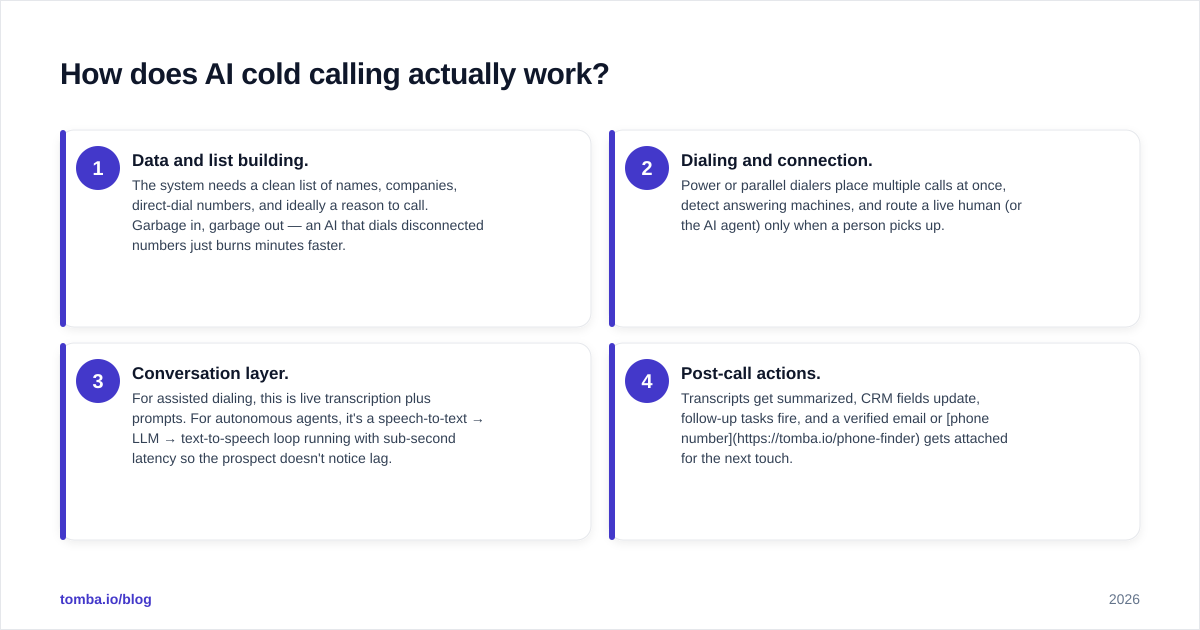
The pipeline behind any AI calling system has four stages, and the quality of each compounds:
- Data and list building. The system needs a clean list of names, companies, direct-dial numbers, and ideally a reason to call. Garbage in, garbage out — an AI that dials disconnected numbers just burns minutes faster.
- Dialing and connection. Power or parallel dialers place multiple calls at once, detect answering machines, and route a live human (or the AI agent) only when a person picks up.
- Conversation layer. For assisted dialing, this is live transcription plus prompts. For autonomous agents, it's a speech-to-text → LLM → text-to-speech loop running with sub-second latency so the prospect doesn't notice lag.
- Post-call actions. Transcripts get summarized, CRM fields update, follow-up tasks fire, and a verified email or phone number gets attached for the next touch.
The conversation layer gets the headlines, but stages one and four decide whether the program scales. A voice agent that books a meeting but logs it to the wrong record, or calls a number that was ported to a personal cell, creates more cleanup than it saves.
)
Is AI cold calling better than human SDRs?#
Short answer: not yet for net-new discovery, but often yes for the repetitive, high-volume slices of the funnel.
Humans still win where the conversation is genuinely consultative — uncovering an unstated pain, reading hesitation, improvising a relevant story. AI wins on consistency and volume: it never gets call reluctance at 4 p.m., never skips the disclosure line, and logs every word.
The smart framing isn't "replace SDRs." It's "which minutes of an SDR's day are worth a human?" Dialing, leaving voicemails, confirming appointments, and reactivating cold leads are low-judgment minutes. Discovery and handling a skeptical VP are high-judgment minutes. Route accordingly.
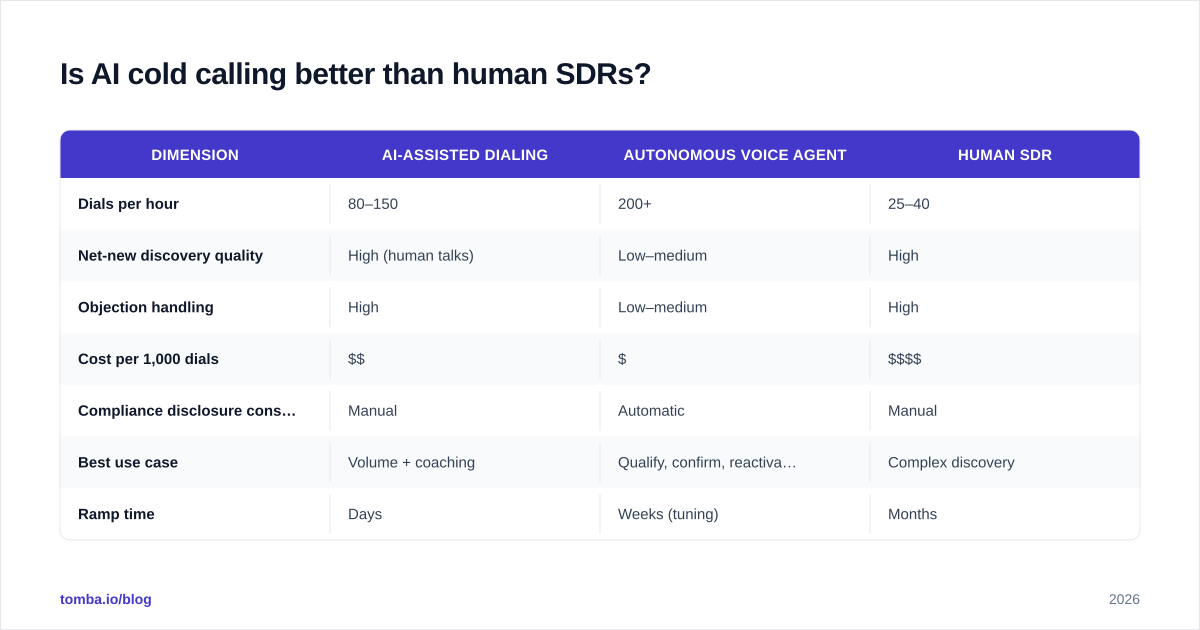
| Dimension | AI-assisted dialing | Autonomous voice agent | Human SDR |
|---|---|---|---|
| Dials per hour | 80–150 | 200+ | 25–40 |
| Net-new discovery quality | High (human talks) | Low–medium | High |
| Objection handling | High | Low–medium | High |
| Cost per 1,000 dials | $$ | $ | $$$$ |
| Compliance disclosure consistency | Manual | Automatic | Manual |
| Best use case | Volume + coaching | Qualify, confirm, reactivate | Complex discovery |
| Ramp time | Days | Weeks (tuning) | Months |
Use this as a routing map, not a scoreboard. A hybrid stack — AI for the first 10 seconds and the busywork, humans for the conversation that matters — beats either extreme in nearly every test we've seen reported.
What does AI cold calling cost in 2026?#
Costs fall into three buckets, and vendors blur them on purpose, so price them separately:
- Platform/seat fees — the dialer or agent software, usually per user or per concurrent line.
- Usage — telephony minutes, transcription, and (for autonomous agents) LLM and TTS inference. This scales with volume and is where surprise bills live.
- Data — the contacts and verified numbers feeding the machine. This is frequently the largest line item and the most ignored.
A useful rule: model your cost per connected conversation, not per dial or per seat. A cheap dialer that connects on bad numbers is more expensive than a pricier one fed clean data, because every wrong number still costs minutes and reputation.
That data cost is where a focused enrichment tool earns its keep. Before any AI touches a list, verify the contacts with an email verifier and confirm direct dials with a phone validator so your AI minutes go to real, reachable humans. You can review Tomba pricing to see how verification credits map to list volume.
)
What are the best AI cold calling tools?#
The market splits into the same spectrum described above. Here's how the main categories compare on what matters when you're buying.
| Tool category | Example players | Strength | Watch out for |
|---|---|---|---|
| Parallel/power dialers | Orum, Nooks, PowerDialer | Massive live-connect volume | Telephony spend, number reputation |
| Conversation intelligence | Gong, Chorus | Coaching, deal insight | Not a dialer; needs a source of calls |
| Autonomous voice agents | Bland, Synthflow, Air | 24/7 qualification at scale | Stilted on objections, disclosure risk |
| Data + enrichment | Tomba, |
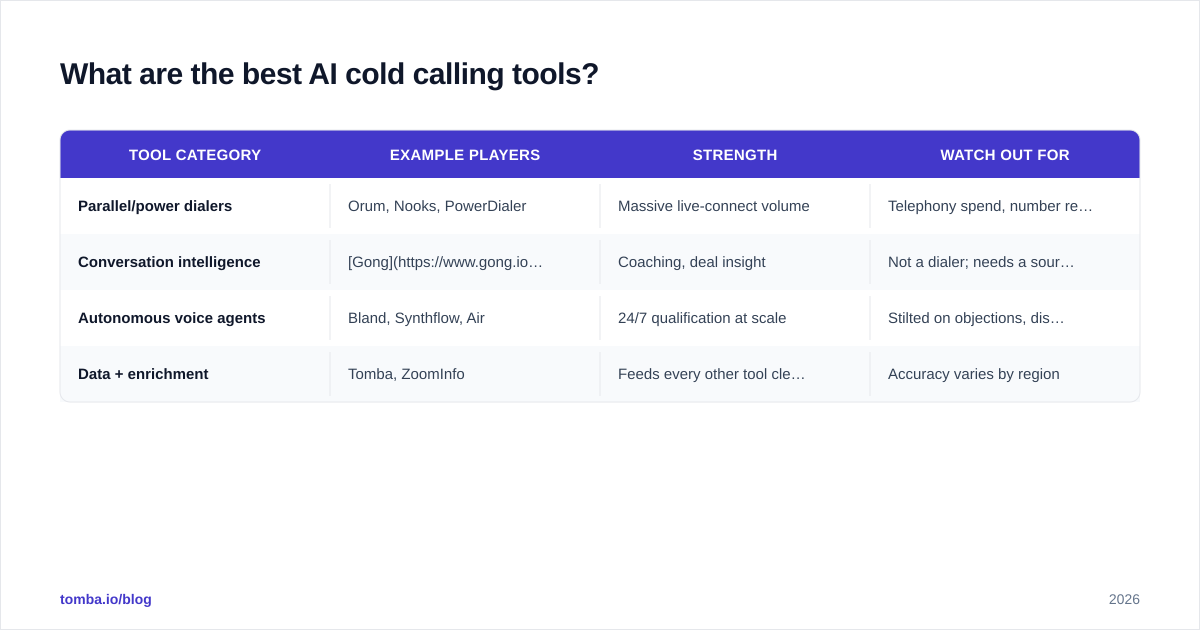
ZoomInfo | Feeds every other tool clean contacts | Accuracy varies by region |
Two buying notes. First, conversation-intelligence platforms like the ones reviewed on G2's sales engagement category are not dialers — pair them with one. Second, every tool in this table is downstream of your data. A voice agent reading from a list of catch-all addresses and dead numbers will fail no matter how good its voice sounds.
If you're evaluating broader sales-engagement suites, our breakdown of Outreach alternatives and Salesloft alternatives covers where AI calling features fit into each platform.
How do you stay compliant with AI cold calling?#
This is the section that ends programs, so treat it as a gate, not a footnote. Rules vary by jurisdiction and change often — what follows is general guidance, not legal advice, and you should confirm with counsel.
- TCPA and autodialers (US). Automated dialing to mobile numbers without prior express consent carries real per-call penalties. Many parallel dialers route through a human to stay on the right side; autonomous agents calling cell phones are far riskier.
- Two-party consent states. Recording calls (which AI transcription does by default) requires all-party consent in states like California and Florida. Bake a disclosure into your opener.
- AI disclosure. A growing number of US states and the EU require you to tell people they're speaking with an AI. Build it into the script — don't bolt it on.
- Do-not-call lists. Scrub against the national DNC registry and internal suppression lists before every campaign.
Consult the FTC's guidance on the Telemarketing Sales Rule for the current US baseline. The practical takeaway: compliance is a list-and-script problem far more than a technology problem, which is another reason clean, well-sourced data matters.
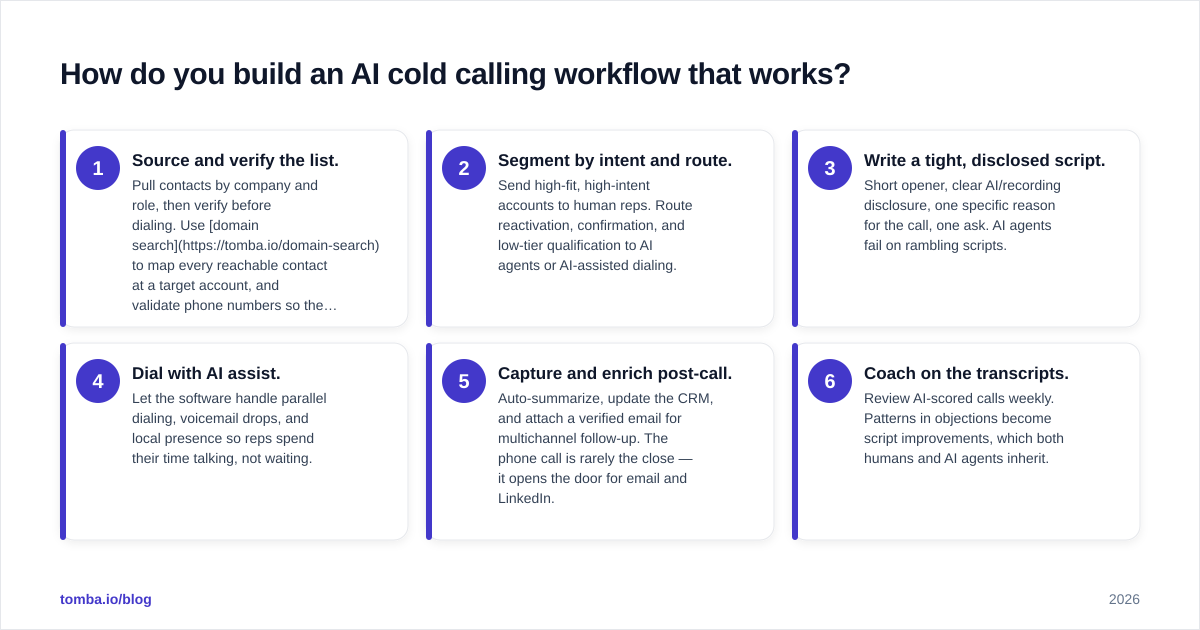
How do you build an AI cold calling workflow that works?#
A workflow that actually moves pipeline looks less like "buy an AI and point it at a list" and more like a relay race where each leg hands off cleanly.

- Source and verify the list. Pull contacts by company and role, then verify before dialing. Use domain search to map every reachable contact at a target account, and validate phone numbers so the dialer isn't chasing ghosts.
- Segment by intent and route. Send high-fit, high-intent accounts to human reps. Route reactivation, confirmation, and low-tier qualification to AI agents or AI-assisted dialing.
- Write a tight, disclosed script. Short opener, clear AI/recording disclosure, one specific reason for the call, one ask. AI agents fail on rambling scripts.
- Dial with AI assist. Let the software handle parallel dialing, voicemail drops, and local presence so reps spend their time talking, not waiting.
- Capture and enrich post-call. Auto-summarize, update the CRM, and attach a verified email for multichannel follow-up. The phone call is rarely the close — it opens the door for email and LinkedIn.
- Coach on the transcripts. Review AI-scored calls weekly. Patterns in objections become script improvements, which both humans and AI agents inherit.
The thread running through all six steps: the AI is only as good as the data and the script you feed it. Teams that treat AI calling as a data discipline first and a voice technology second are the ones reporting real lift.
Where does AI cold calling go wrong most often?#
Three failure modes account for most disappointing results:
- Dialing dirty data. The single biggest waste. If 30% of your numbers are wrong, you've lost 30% of your AI minutes and dinged your number reputation. Verify first, always.
- Over-automating discovery. Pointing an autonomous agent at complex, consultative sales and expecting it to handle a skeptical buyer. Keep humans on high-judgment conversations.
- Treating compliance as optional. Skipping disclosures or DNC scrubbing to move faster. The fines and reputational damage dwarf any efficiency gain.
Avoid those three and AI cold calling becomes what it should be: a force multiplier on your existing motion, not a replacement for thinking.
The bottom line#
AI cold calling in 2026 is real, useful, and overhyped all at once. The assisted-dialing and coaching layers deliver dependable ROI today; autonomous voice agents shine in narrow, repetitive slices and struggle everywhere else. The winning move is hybrid — let AI handle volume and busywork, keep humans on the conversations that need judgment, and obsess over compliance and data quality underneath both.
And data quality is where every AI calling program lives or dies. Before your dialer or voice agent places a single call, make sure it's reaching real people: use the Tomba Email Finder to build accurate, role-targeted contact lists, then verify the numbers and addresses so every AI minute lands on a reachable human. Start free with 25 searches a month, scale up on the $49/mo Starter plan when your outbound proves out, and stop paying — in minutes and reputation — for calls to numbers that were never going to answer.
Get the Tomba newsletter
Practical outbound tactics and product updates — once every two weeks.
About the author