AI Data Quality in 2026: Clean and Enrich Your B2B Data
Dirty CRM data quietly burns budget and tanks deliverability. Here's how AI data quality tools clean, dedupe, verify, and enrich B2B records in 2026 — and how to measure it.
TL;DR
- AI data quality is the use of machine learning to detect, fix, dedupe, verify, and enrich B2B records at a scale humans can't match manually.
- The cost of bad data is concrete: bounced emails, wasted rep hours, broken routing, and skewed forecasts. Gartner has long pegged poor data quality at roughly $12.9M per year for the average organization.
- Six dimensions matter — accuracy, completeness, consistency, timeliness, validity, and uniqueness. AI helps most on accuracy, completeness, and uniqueness.
- Verification and enrichment are the two highest-ROI moves: stop emailing dead inboxes, and fill the gaps that block segmentation.
- Tooling ranges from point verifiers to full enrichment platforms. Match the tool to your biggest leak before you buy.
What is AI data quality?#
AI data quality is the practice of using machine learning and automation to keep your customer and prospect data accurate, complete, and current — without an army of analysts cleaning spreadsheets by hand.
Think of your CRM like a fish tank. Every new lead, form fill, and imported list adds water. Without a filter, the tank slowly turns murky: duplicate contacts, dead email addresses, job titles from three roles ago, companies that were acquired last year. AI data quality is the filtration system — it runs continuously, catches the gunk, and keeps the water clear enough that your sales and marketing teams can actually see what they're working with.
The "AI" part isn't marketing fluff. Rule-based cleaning ("if state field is blank, flag it") only catches what you already anticipated. Machine learning models infer things rules miss: that "IBM Corp," "I.B.M.," and "International Business Machines" are the same account, that a Gmail address attached to a CFO title is probably a personal fallback, or that a record hasn't been touched in 400 days and is statistically likely to be stale.
Why does data quality matter for B2B teams?#
Bad data doesn't announce itself. It leaks quietly out of every process that touches a contact record.
Here's where it bites:
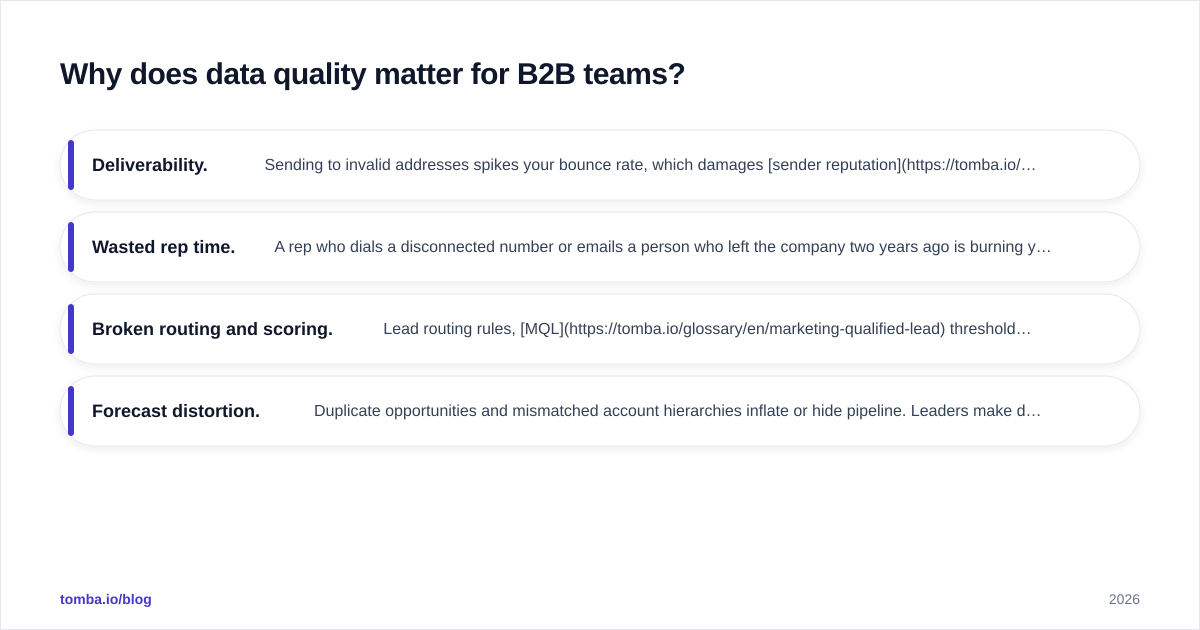
- Deliverability. Sending to invalid addresses spikes your bounce rate, which damages sender reputation and drags down inbox placement for the good addresses too.
- Wasted rep time. A rep who dials a disconnected number or emails a person who left the company two years ago is burning your most expensive resource.
- Broken routing and scoring. Lead routing rules, MQL thresholds, and territory assignment all assume the underlying fields are correct. Garbage in, mis-routed lead out.
- Forecast distortion. Duplicate opportunities and mismatched account hierarchies inflate or hide pipeline. Leaders make decisions on numbers that aren't real.
Gartner's widely cited research estimates poor data quality costs organizations an average of $12.9 million annually. You don't need to hit that figure to feel it — even a 15% stale rate on a 50,000-contact database means 7,500 records actively wasting someone's effort.
What are the six dimensions of data quality?#
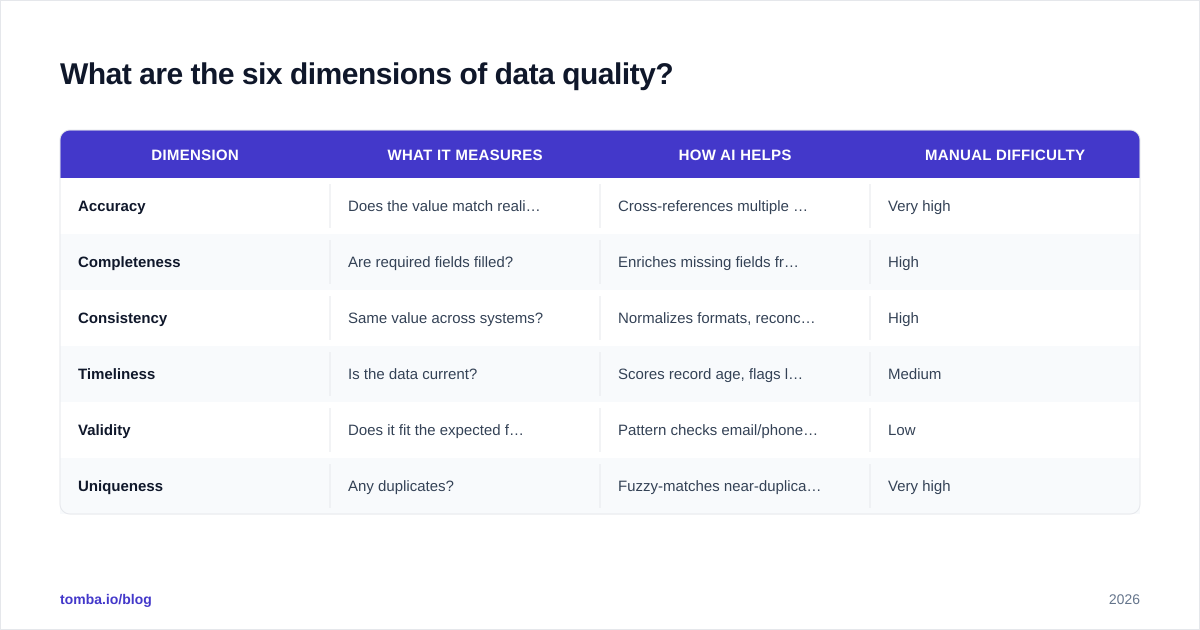
Before you can improve data quality, you need to know what "quality" means. The industry generally measures six dimensions. AI moves the needle on some more than others.
| Dimension | What it measures | How AI helps | Manual difficulty |
|---|---|---|---|
| Accuracy | Does the value match reality? | Cross-references multiple sources, flags conflicts | Very high |
| Completeness | Are required fields filled? | Enriches missing fields from external data | High |
| Consistency | Same value across systems? | Normalizes formats, reconciles records | High |
| Timeliness | Is the data current? | Scores record age, flags likely-stale rows | Medium |
| Validity | Does it fit the expected format? | Pattern checks email/phone syntax | Low |
| Uniqueness | Any duplicates? | Fuzzy-matches near-duplicates rules miss | Very high |
The pattern is clear: the dimensions humans struggle with most — accuracy, completeness, and uniqueness — are exactly where machine learning earns its keep. Validity (does this string look like an email?) you can handle with a regex. Deciding whether two slightly different records are the same company is where you want a model.
How does AI improve data quality in practice?#
AI data quality runs as a pipeline. Each stage hands off to the next, and the best platforms run them continuously rather than as a one-time scrub.
1. Profiling. The system scans your database and reports the damage: what percentage of emails are invalid, how many duplicate accounts exist, which fields are mostly empty. You can't fix what you haven't measured.
2. Cleaning and standardization. Formats get normalized — phone numbers to E.164, country names to ISO codes, job titles mapped to a controlled vocabulary. This is where "VP of Sales," "V.P. Sales," and "Vice President, Sales" become one thing.
3. Deduplication. Fuzzy matching collapses near-duplicates. This is harder than it sounds: "Mike Johnson" at "Acme" and "Michael Johnson" at "Acme Inc" are probably one person, but a naive exact-match dedupe will never catch it.
4. Verification. Every email and phone gets validated against live signals. A good email verifier checks syntax, domain, MX records, and SMTP response — and flags catch-all domains separately so you know the difference between "confirmed valid" and "can't be confirmed." For tricky domains, a dedicated catch-all verifier reduces the guesswork.
5. Enrichment. Gaps get filled from external sources — missing job titles, company size, industry, direct dials, LinkedIn profiles. This is what turns a bare email-and-name row into a record you can actually segment and personalize against. Platforms like Tomba expose this through data enrichment and bulk workflows.
6. Monitoring. Quality decays. A contact verified today is statistically less reliable in six months. Continuous monitoring re-scores records and re-triggers verification before the rot spreads.

How do you choose an AI data quality tool?#
Match the tool to your biggest leak. Don't buy a full enrichment suite if your only real problem is bounce rate — and don't buy a standalone verifier if your records are missing half their fields.
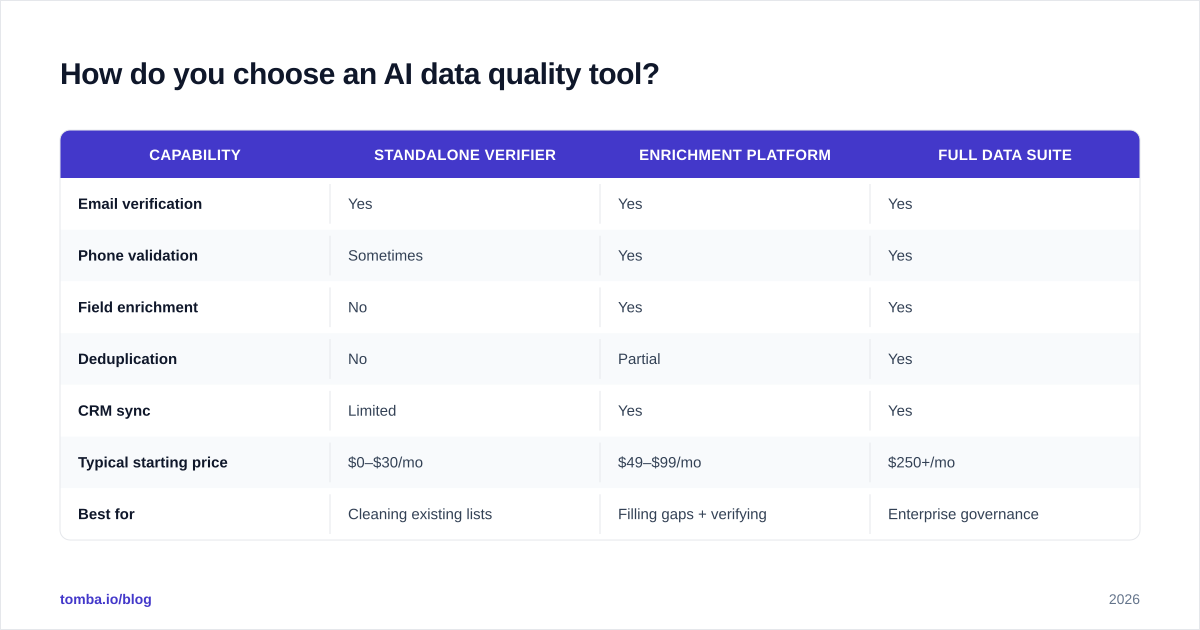
Here's how the main categories stack up:
| Capability | Standalone verifier | Enrichment platform | Full data suite |
|---|---|---|---|
| Email verification | Yes | Yes | Yes |
| Phone validation | Sometimes | Yes | Yes |
| Field enrichment | No | Yes | Yes |
| Deduplication | No | Partial | Yes |
| CRM sync | Limited | Yes | Yes |
| Typical starting price | $0–$30/mo | $49–$99/mo | $250+/mo |
| Best for | Cleaning existing lists | Filling gaps + verifying | Enterprise governance |
A few buying questions that cut through the noise:
- What's your actual failure mode? Profile your data first. If 20% of emails bounce, start with verification. If reps complain they "don't know who to call," start with enrichment.
- Where does the data come from? Ask the vendor about data sources and how often they're refreshed. A cheap database that hasn't been updated since 2024 is a liability, not an asset.
- Does it fit your stack? A great tool you have to export CSVs into and out of manually will get abandoned. Check for native integrations with your CRM and outreach tools, or an email finder API if you're building your own pipeline.
- Can it work in bulk? One-off lookups are fine for a rep. Cleaning a 100,000-row database needs a bulk workflow that won't time out.
For an independent read on vendors, cross-check user reviews on G2 and Capterra rather than trusting vendor-supplied case studies alone. And if you're standardizing how your team defines these terms internally, a shared B2B glossary prevents the "what counts as a duplicate?" argument from happening twice.
What metrics prove your data quality is improving?#
You can't manage what you don't measure. Track these before and after any cleaning effort:
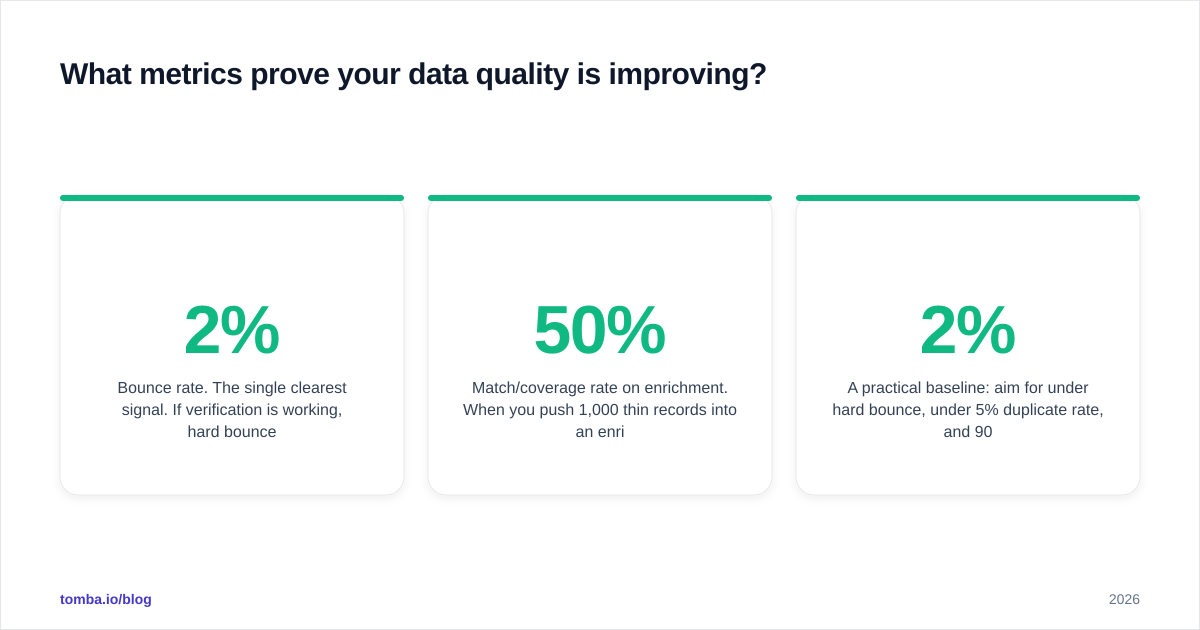
- Bounce rate. The single clearest signal. If verification is working, hard bounces should drop below 2%.
- Duplicate rate. Percentage of records that are near-duplicates of another. Run it monthly; it always creeps back up.
- Field completeness. What percentage of records have the fields your segmentation actually depends on (title, company size, industry)?
- Match/coverage rate on enrichment. When you push 1,000 thin records into an enrichment tool, how many come back enriched? Below ~50% and you're paying for misses.
- Record freshness. Median age since last verification. If it's climbing, your monitoring isn't keeping up.
A practical baseline: aim for under 2% hard bounce, under 5% duplicate rate, and 90%+ completeness on your core segmentation fields. Hit those and most downstream problems — deliverability, routing, forecasting — quietly resolve themselves.
This connects directly to revenue operations: clean data is the substrate every RevOps process runs on. A dashboard built on dirty data tells confident lies. Industry analysts at Forrester have made the same point repeatedly — data quality isn't a back-office chore, it's a revenue lever.
How often should you clean B2B data?#
Continuously for verification, quarterly for deep cleaning. Here's the honest cadence:
- At point of entry — verify every email and phone the moment it's captured, before it ever lands in the CRM. Cheapest possible place to catch a bad record.
- Continuously — automated monitoring re-scores and re-verifies in the background.
- Quarterly — a full profiling + dedupe + enrichment pass to catch what slipped through and to refill fields that have gone stale.
- Before any major campaign — never blast a list you haven't verified in the last 30 days. The deliverability hit isn't worth the saved hour.
B2B data decays at roughly 2–3% per month as people change jobs, companies merge, and domains lapse. That's about 30% of your database going stale every year with zero new errors introduced. Continuous quality work isn't optional maintenance — it's the cost of keeping the asset alive.
Where Tomba fits#
If your biggest leak is bad or missing contact data, start at the source. The Tomba Email Finder finds professional email addresses by domain, name, or company and verifies them before they reach your CRM — so you're enriching from clean inputs instead of cleaning up after the fact. Pair it with the verifier and enrichment tools to close the loop, and check current Tomba pricing (free tier with 25 searches/month, Starter at $49/mo) to match a plan to your volume. Clean data in, fewer bounces out — that's the whole game.
// get started
Find, verify and enrich your first contacts today
Start on the free plan with 25 searches a month, then scale when your team is ready.
Free plan · No credit card required · GDPR & CCPA
// about the author