AI Email Automation in 2026: The B2B Sales Playbook
AI email automation is no longer a buzzword — it's how lean B2B teams send personalized outreach at scale. Here's how it works, what tools to use, and the workflow to deploy this quarter.
TL;DR
- AI email automation uses machine learning to research prospects, write personalized copy, and trigger sends based on behavior — not just blast the same template on a timer.
- The real unlock isn't the AI writer; it's the data layer feeding it. Bad contact data means automated emails that bounce or land in spam at scale.
- A working stack has four parts: a clean data source, an AI personalization layer, a sending/sequencing engine, and a feedback loop that scores replies.
- Expect to pay $30–$250/mo per seat depending on whether you buy point tools or an all-in-one platform.
- Start narrow: automate one segment, measure reply rate against a manual control group, then expand.
What is AI email automation?#
AI email automation is the practice of using machine learning to handle the parts of email outreach that used to eat a rep's day — researching the prospect, drafting a relevant message, deciding when to send, and reacting to what the recipient does next.
Think of it like the difference between a vending machine and a barista. Old-school automation is the vending machine: it dispenses the same canned drink to everyone who presses the button, on a fixed schedule. AI email automation is the barista who remembers your order, notices you look tired, and suggests an extra shot — context-aware, adaptive, and far more likely to earn a return visit.
Technically, that means three layers working together: a model that ingests prospect data and generates copy, a rules-and-triggers engine that decides who gets what and when, and an analytics loop that feeds outcomes (opens, replies, meetings) back into targeting. The output is outreach that feels one-to-one while running one-to-many.
Why is everyone moving to AI email automation in 2026?#
The short answer: inbox competition got brutal and headcount didn't grow to match. Buyers get more cold email than ever, generic templates get ignored, and reps are expected to run more accounts with the same hours in the day.
AI email automation closes that gap in three concrete ways:
- Research at machine speed. Instead of a rep spending six minutes per prospect reading a LinkedIn profile and a funding announcement, an AI layer pulls firmographic and behavioral signals in seconds and drafts an opener around them.
- Personalization that survives scale. The classic trade-off was reach or relevance. AI lets you keep relevance while multiplying reach, because the variable parts of each email are generated per-contact.
- Timing based on behavior, not guesswork. Modern systems trigger follow-ups when a prospect opens twice, visits pricing, or replies with intent language — instead of a blind "Day 3" cadence.
According to HubSpot's State of Sales research, reps who lean on AI for prospecting and outreach report meaningfully more time spent actually selling. The macro trend is clear in analyst coverage too — Gartner's sales technology guidance treats AI-assisted engagement as a default expectation, not a differentiator.
How does AI email automation actually work?#
A production-grade system is a pipeline, not a single tool. Each stage hands clean output to the next. Get one stage wrong and the whole flow degrades — usually loudly, in your bounce rate.
Stage 1 — Data. You need accurate, deliverable contact records: verified email, role, company, and enrichment signals. This is the foundation everything else stands on. If you automate sends against stale or guessed addresses, AI just helps you fail faster. Tools like the Tomba Email Finder plus an email verifier pass exists precisely to keep this stage clean before a single message goes out.
Stage 2 — Personalization. The AI layer takes each enriched record and generates the variable parts of the email: the opener, the relevance hook, sometimes the CTA. The best implementations constrain the model with your value props and proof points so it personalizes the frame without hallucinating facts.
Stage 3 — Sending and sequencing. A sequencing engine decides send windows, throttles volume to protect sender reputation, and branches the follow-up path based on recipient behavior.
Stage 4 — Feedback loop. Replies, meetings, and unsubscribes get scored and fed back into targeting and copy. Over time the system learns which segments and angles convert.
What can you automate — and what should stay human?#
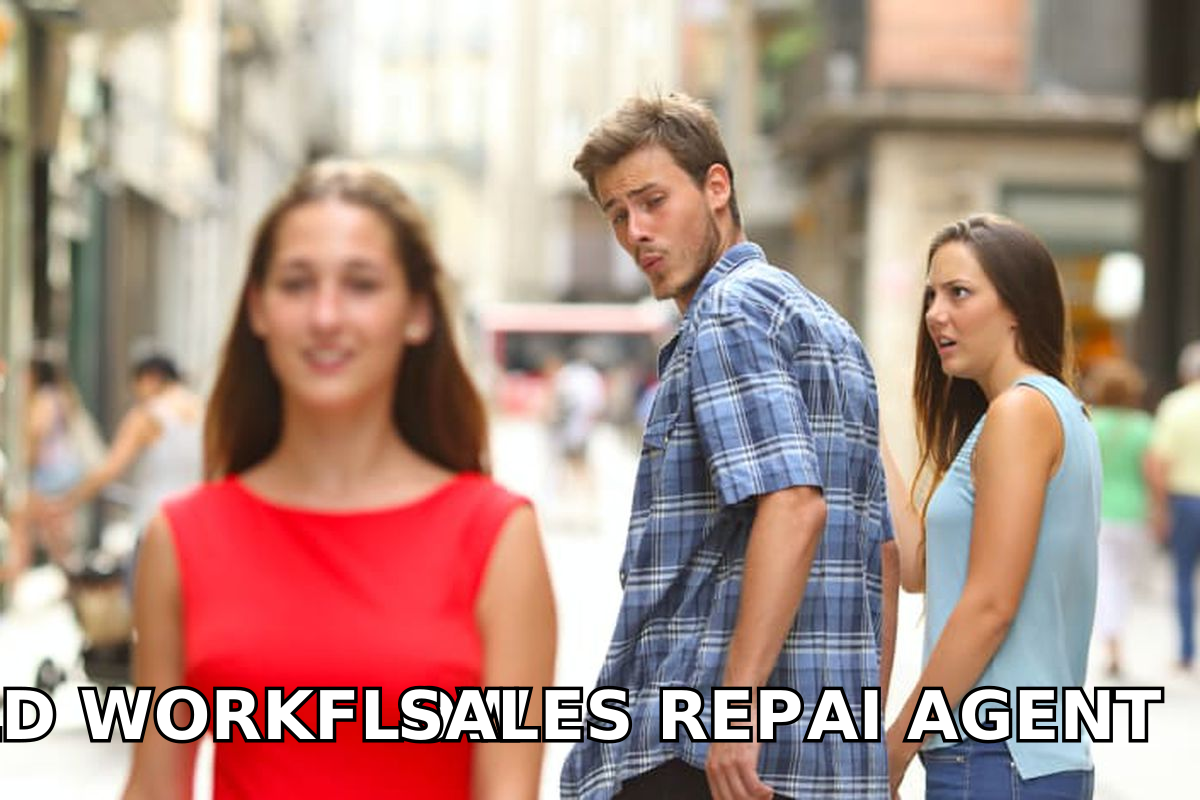
Not every part of outreach should be handed to a model. Use this split as a starting rule of thumb.
| Task | Automate with AI? | Why |
|---|---|---|
| Prospect research & enrichment | Yes | Fast, repeatable, low judgment risk |
| First-touch opener personalization | Yes, with guardrails | Big time saver; constrain to verified facts |
| Follow-up timing & branching | Yes | Behavior triggers beat fixed cadences |
| Reply classification (intent/OOO) | Yes | Routes hot replies to humans instantly |
| Negotiation & pricing replies | No | High stakes, needs human nuance |
| Sensitive accounts / executives | Partial | AI drafts, human edits and sends |
| List building from guessed emails | No | Guessing wrecks deliverability — verify first |
The pattern: automate the high-volume, low-judgment work, and keep humans on the high-stakes, high-nuance moments. The mistake teams make is automating the send before they've automated the data quality — that's how you end up with a beautifully sequenced campaign hitting dead inboxes.
Which AI email automation tools should you compare?#
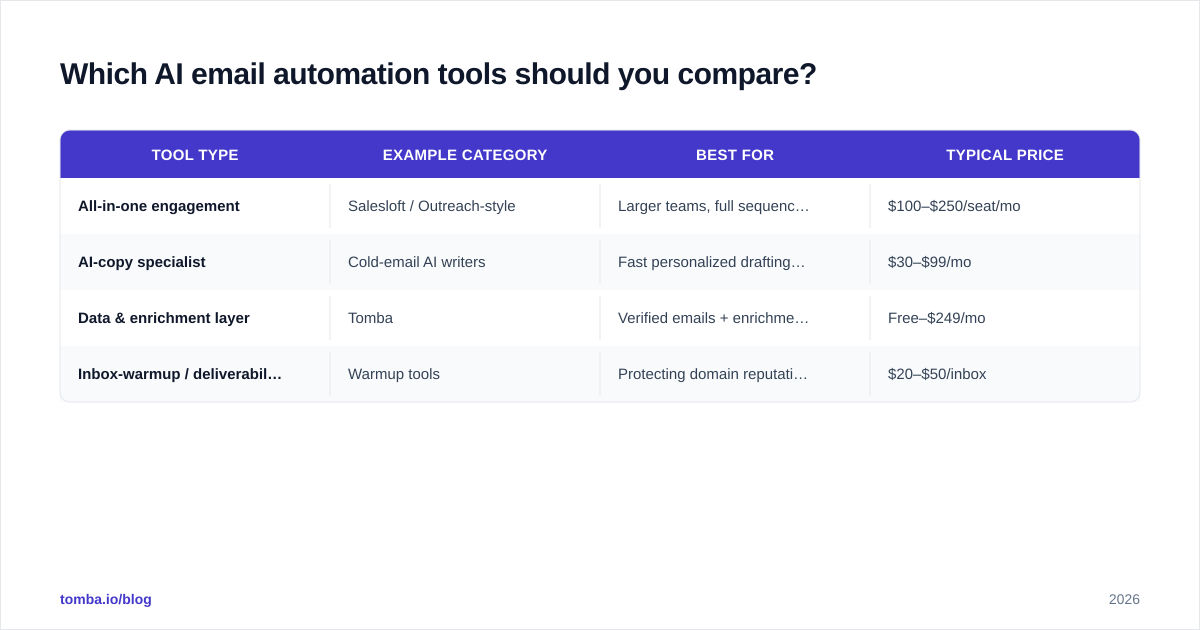
The market splits into three buckets: all-in-one sales engagement platforms, AI-copy specialists, and the data layer that feeds both. Most real stacks combine one from each rather than betting on a single vendor.
| Tool type | Example category | Best for | Typical price |
|---|---|---|---|
| All-in-one engagement | Salesloft / Outreach-style | Larger teams, full sequencing + CRM sync | $100–$250/seat/mo |
| AI-copy specialist | Cold-email AI writers | Fast personalized drafting at volume | $30–$99/mo |
| Data & enrichment layer | Tomba | Verified emails + enrichment feeding the flow | Free–$249/mo |
| Inbox-warmup / deliverability | Warmup tools | Protecting domain reputation at scale | $20–$50/inbox |
A few honest notes on picking:
- All-in-one platforms are powerful but heavy; if you're a five-person team you'll pay for modules you never touch. Compare options on G2's sales engagement category before committing to a seat-based contract.
- AI-copy tools are only as good as the data and proof points you feed them. A free cold email AI writer gets you 80% of the way for first drafts.
- The data layer is the part teams underinvest in. You can run AI personalization through any sender, but if the underlying emails aren't verified, your reply rate is capped no matter how clever the copy. Tomba's data enrichment and Tomba API exist to slot into whichever engagement tool you already use.
For reference on where engagement tooling sits in the broader stack, Salesforce's sales automation overview is a useful neutral primer.
How much does AI email automation cost?#
Budget by stack layer, not by a single headline price. A realistic small-team setup looks like this:
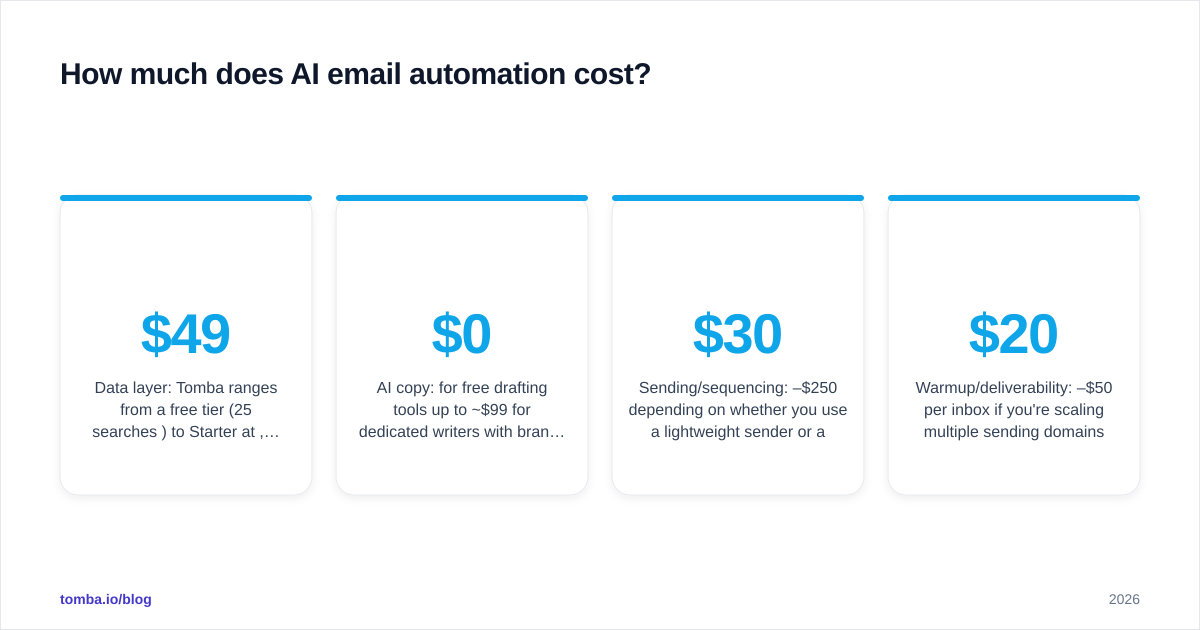
- Data layer: Tomba ranges from a free tier (25 searches/mo) to Starter at $49/mo, Growth at $99/mo, and Pro at $249/mo. See current Tomba pricing for credit allotments per plan.
- AI copy: $0 for free drafting tools up to ~$99/mo for dedicated writers with brand training.
- Sending/sequencing: $30–$250 per seat depending on whether you use a lightweight sender or a full engagement platform.
- Warmup/deliverability: $20–$50 per inbox if you're scaling multiple sending domains.
A lean two-person outbound team can run a credible AI email automation stack for under $150/month total. An enterprise SDR org with 20 reps on an all-in-one platform plus enrichment will land in the thousands. The cost curve is driven by seats and send volume, not by the AI itself — the intelligence is cheap; the deliverable data and the human seats are where the money goes.
What kills AI-automated email campaigns?#
Three failure modes account for most blown campaigns. Watch for all three before you scale send volume.
1. Garbage data in, spam folder out. This is the number-one killer. AI doesn't fix a bad list; it amplifies it. A high bounce rate from invalid addresses tanks your email deliverability and can blacklist your domain. Always run addresses through verification — and handle catch-all domains carefully, since they pass syntax checks but may still reject mail.
2. Personalization that's obviously fake. "I loved your recent post" when there was no recent post reads worse than no personalization at all. Constrain your AI to verified facts only. If the model has to invent the hook, it'll invent it badly.
3. Volume ramped too fast. A brand-new domain blasting 500 AI-personalized emails on day one looks exactly like a spammer to inbox providers. Warm up, throttle, and let the feedback loop earn you more volume over weeks.
The teams that win treat deliverability as a discipline, not an afterthought. The AI is the engine; clean data and reputation are the fuel and the road.
How do you roll out AI email automation without breaking things?#
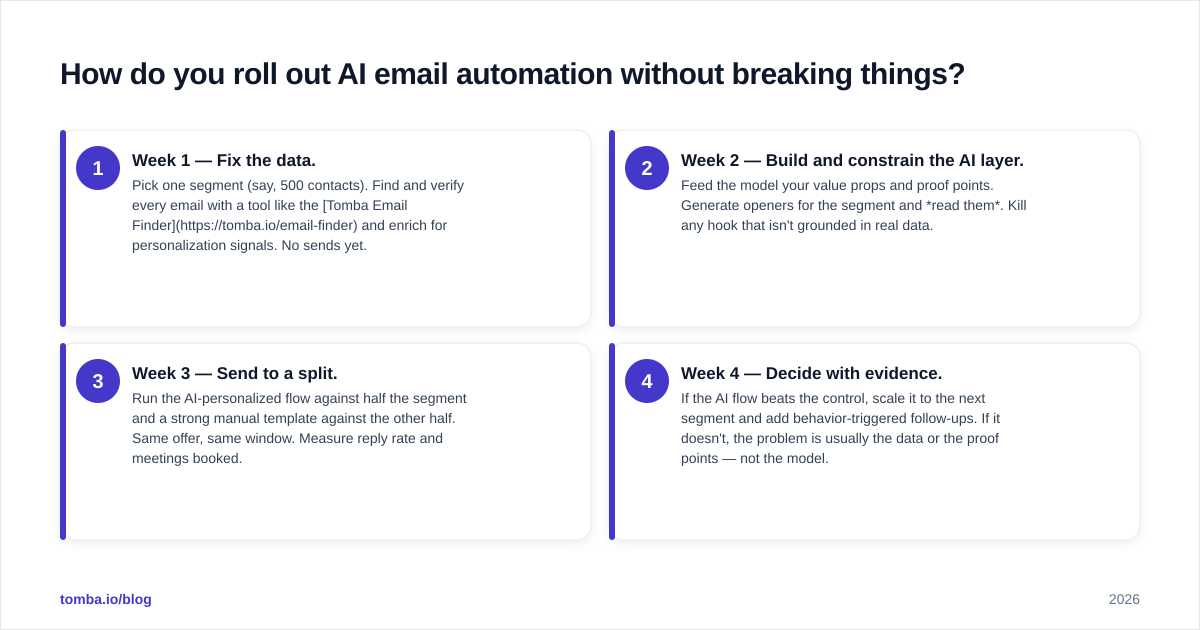
Start with a controlled pilot, prove lift, then expand. Here's a four-week rollout that keeps risk contained:
- Week 1 — Fix the data. Pick one segment (say, 500 contacts). Find and verify every email with a tool like the Tomba Email Finder and enrich for personalization signals. No sends yet.
- Week 2 — Build and constrain the AI layer. Feed the model your value props and proof points. Generate openers for the segment and read them. Kill any hook that isn't grounded in real data.
- Week 3 — Send to a split. Run the AI-personalized flow against half the segment and a strong manual template against the other half. Same offer, same window. Measure reply rate and meetings booked.
- Week 4 — Decide with evidence. If the AI flow beats the control, scale it to the next segment and add behavior-triggered follow-ups. If it doesn't, the problem is usually the data or the proof points — not the model.
This A/B discipline is the single biggest predictor of whether AI email automation works for a team. It turns "AI is hype / AI is magic" debates into a number you can act on.
The bottom line#
AI email automation in 2026 is table stakes for any B2B team that wants to scale outreach without scaling headcount — but it lives or dies on the data underneath it. The smartest investment isn't a fancier AI writer; it's a verified, enriched contact foundation that makes every automated send count.
That foundation is exactly what Tomba is built for. Start free with 25 searches a month, find and verify the emails behind your target accounts with the Tomba Email Finder, and pipe clean, deliverable data straight into whatever AI sequencing tool you already run. Automate the busywork — but automate it on data you can trust.
// get started
Find, verify and enrich your first contacts today
Start on the free plan with 25 searches a month, then scale when your team is ready.
Free plan · No credit card required · GDPR & CCPA
// about the author