AI Email Checker in 2026: How It Works and the Best Tools
An AI email checker scores deliverability before you hit send. Here's how the tech works, what to look for, and how the top tools compare in 2026.
TL;DR
- An AI email checker validates whether an address is real, deliverable, and safe to send to — combining classic SMTP checks with machine-learning signals that catch what syntax rules miss.
- The payoff is concrete: lower bounce rates, protected sender reputation, and cleaner lists that keep you out of spam folders.
- Accuracy varies widely between tools, especially on catch-all domains and role-based addresses — this is where AI scoring earns its keep.
- Expect to pay per verification credit; free tiers exist but cap monthly volume. Tomba starts free (25 searches/mo) with paid plans from $49/mo.
- The best workflow pairs a checker with a finder so you verify addresses at the moment you collect them, not weeks later.
What is an AI email checker?#
An AI email checker is a tool that predicts whether an email address will actually deliver — before you send anything to it. Think of it like a bouncer at a club checking IDs: a basic checker glances at the format and waves people through, while an AI-powered one cross-references a watchlist, spots fake IDs, and flags the people who'll cause trouble inside.
Technically, a traditional verifier runs a fixed checklist: is the syntax valid, does the domain have MX records, does the mailbox respond to an SMTP handshake. That works until it doesn't — catch-all servers accept every address, greylisting hides real mailboxes, and disposable domains spin up faster than blocklists update. An AI layer adds probabilistic scoring on top: it weighs hundreds of signals (domain age, historical bounce patterns, mailbox provider behavior, role-account likelihood) and returns a confidence score instead of a brittle yes/no.
The result is fewer false "valid" verdicts on addresses that quietly bounce, and fewer false "invalid" verdicts that make you discard good leads. For anyone running cold outreach or newsletters, that difference protects your sender reputation — the single metric mailbox providers use to decide whether you reach the inbox.
Why does email verification still matter in 2026?#
Because bounces are expensive in ways that compound. Every hard bounce tells Gmail, Outlook, and Yahoo that you're emailing addresses you shouldn't have. Cross a threshold — usually around 2-3% — and providers start routing your mail to spam, even for the recipients who do exist.
Here's the chain reaction a dirty list sets off:
- High bounce rate → mailbox providers flag your sending domain
- Flagged domain → lower inbox placement for every future send
- Lower placement → fewer replies → reps blame the copy, not the data
- Teams "fix" copy that was never broken, while the real problem keeps growing
A good email verifier breaks that chain at step one. And in 2026, the volume of AI-generated and scraped lead lists has made verification more necessary, not less — more data is flowing into CRMs, and a larger share of it is stale or fabricated. Google's own Postmaster Tools documentation makes the expectation explicit: keep your spam complaint and bounce signals low or lose the inbox.

How does an AI email checker actually work?#
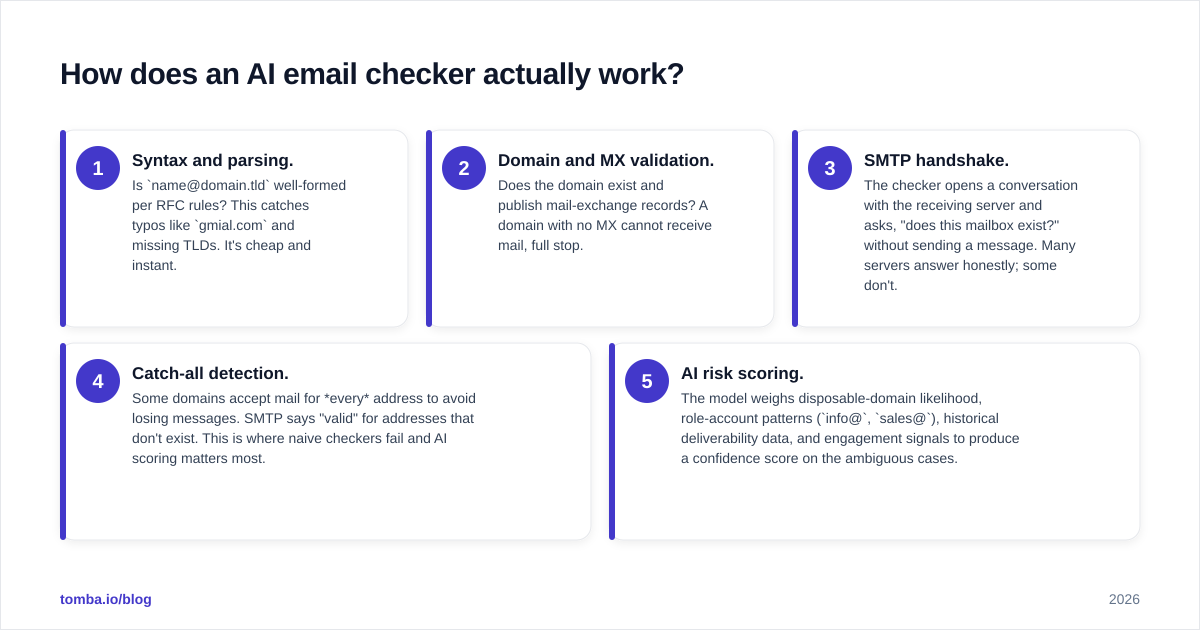
It runs a pipeline, and each stage filters out a different failure mode. Understanding the stages helps you read the score a tool hands back instead of trusting it blindly.
- Syntax and parsing. Is
name@domain.tldwell-formed per RFC rules? This catches typos likegmial.comand missing TLDs. It's cheap and instant. - Domain and MX validation. Does the domain exist and publish mail-exchange records? A domain with no MX cannot receive mail, full stop.
- SMTP handshake. The checker opens a conversation with the receiving server and asks, "does this mailbox exist?" without sending a message. Many servers answer honestly; some don't.
- Catch-all detection. Some domains accept mail for every address to avoid losing messages. SMTP says "valid" for addresses that don't exist. This is where naive checkers fail and AI scoring matters most.
- AI risk scoring. The model weighs disposable-domain likelihood, role-account patterns (
info@,sales@), historical deliverability data, and engagement signals to produce a confidence score on the ambiguous cases.
The SMTP protocol was never designed to be a verification tool, which is exactly why the AI layer exists — it interprets ambiguous protocol responses statistically instead of taking them at face value.
Wait — that diagram is a meme, not a flowchart:

What should you look for in an AI email checker?#
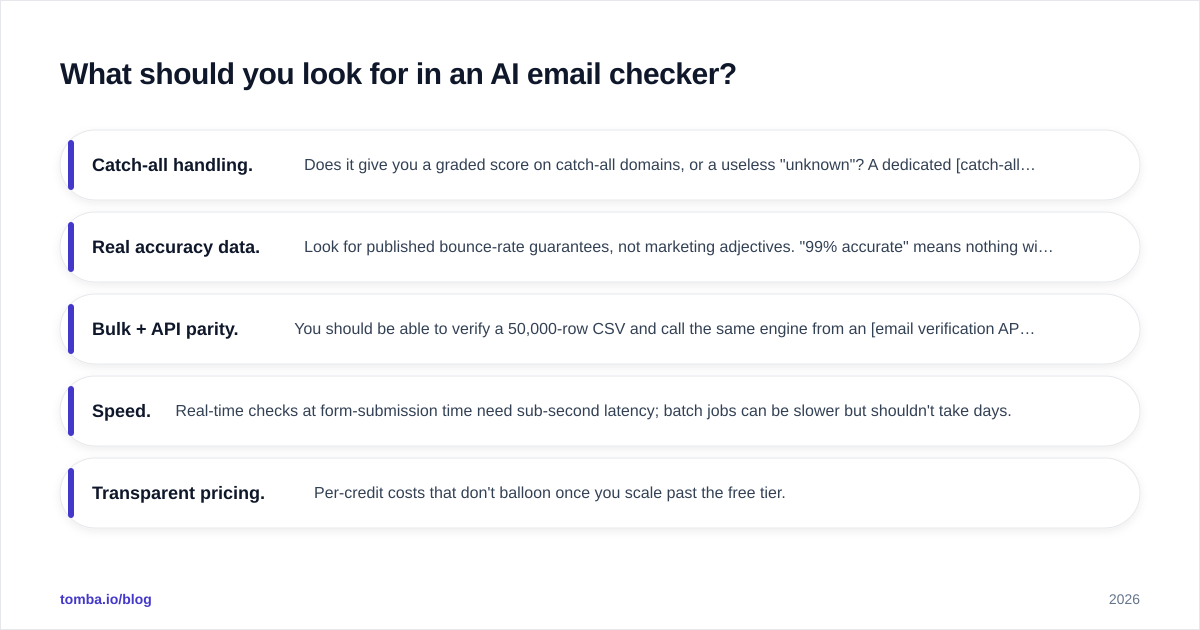
Five things separate a tool you can trust from one that just returns green checkmarks.
- Catch-all handling. Does it give you a graded score on catch-all domains, or a useless "unknown"? A dedicated catch-all verifier that scores these addresses is worth more than the rest of the feature list combined.
- Real accuracy data. Look for published bounce-rate guarantees, not marketing adjectives. "99% accurate" means nothing without a defined test set.
- Bulk + API parity. You should be able to verify a 50,000-row CSV and call the same engine from an email verification API with identical results.
- Speed. Real-time checks at form-submission time need sub-second latency; batch jobs can be slower but shouldn't take days.
- Transparent pricing. Per-credit costs that don't balloon once you scale past the free tier.
How do the top AI email checkers compare in 2026?#
The table below compares representative tools on the attributes that actually move bounce rates. Prices are entry-level paid tiers; all figures reflect publicly listed plans at time of writing — confirm current numbers on each vendor's page before buying.
| Feature | Tomba | ZeroBounce | NeverBounce | Bouncer |
|---|---|---|---|---|
| Free tier | 25 searches/mo | 100 credits | 1,000 (trial) | 100 credits |
| Entry paid price | $49/mo | $18/mo (2k) | Pay-as-you-go | $20/mo (1k) |
| Catch-all scoring | Yes | Partial | Limited | Yes |
| Bulk verification | Yes | Yes | Yes | Yes |
| API access | Yes | Yes | Yes | Yes |
| Finder + checker in one | Yes | No | No | No |
| Phone validation | Yes | Add-on | No | No |
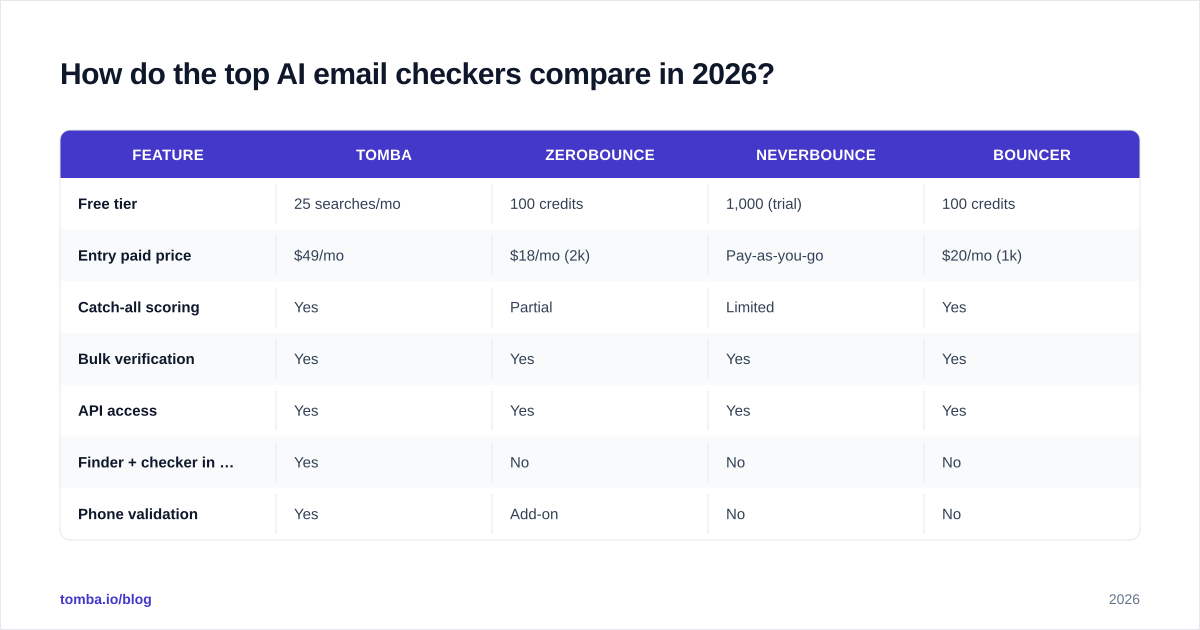
The differentiator in that last-but-one row matters more than price. Most checkers verify a list you bring them. A platform that bundles an email finder with verification lets you validate addresses at the moment of discovery — so the data never goes stale between collection and outreach. You can cross-check independent reviews on G2 before committing.

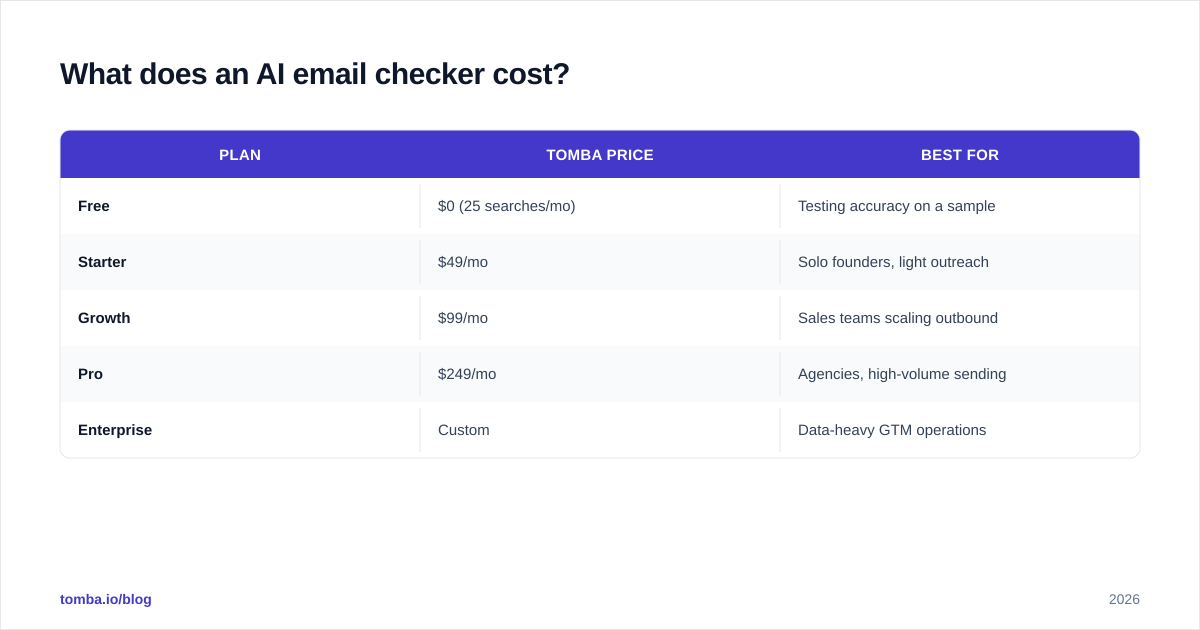
What does an AI email checker cost?#
Pricing follows two models, and you'll usually want both.
Credit-based (verification). You buy a bucket of checks; each address verified consumes one credit. This suits one-off list cleanups — import 20,000 contacts, run them, done.
Subscription (find + verify). A monthly plan bundles finding and verifying, which fits ongoing prospecting where you're constantly adding new contacts.
| Plan | Tomba price | Best for |
|---|---|---|
| Free | $0 (25 searches/mo) | Testing accuracy on a sample |
| Starter | $49/mo | Solo founders, light outreach |
| Growth | $99/mo | Sales teams scaling outbound |
| Pro | $249/mo | Agencies, high-volume sending |
| Enterprise | Custom | Data-heavy GTM operations |
Full Tomba pricing is public, so you can map credits to your monthly volume before paying. A practical rule: estimate your monthly new-contact count, double it to cover re-verification of aging records, and pick the tier that covers that number without overage fees.
How do you put an AI email checker into your workflow?#
Three integration points cover most teams, ordered by how early they catch bad data.
- At capture. Verify on form submit or at the moment you find an address. This is the highest-leverage spot — bad data never enters your CRM. If you build lists by company, run domain search and verify in the same pass.
- Before each campaign. Re-verify your sending segment 24-48 hours before launch. Email decays roughly 2-3% per month as people change jobs, so even a clean list rots.
- On a schedule. Batch-verify your full database quarterly to catch silent decay across the records you're not actively emailing.
For teams already living in a CRM, push verification into the tools you use — HubSpot's own guidance treats list hygiene as a prerequisite for deliverability, not an afterthought. A quick gut-check before any send: if you can't name your list's last verification date, treat it as unverified.
Is an AI email checker worth it versus free tools?#
For a hobby project or a one-time send to a few hundred contacts, a free email checker handles the basics — syntax, domain, and obvious junk.
The moment money depends on inbox placement, the math flips. A 5% bounce rate on a 10,000-contact campaign isn't 500 wasted emails; it's a damaged sending domain that suppresses your next ten campaigns too. Paid AI checkers earn their cost on the catch-all and ambiguous addresses that free tools either reject wholesale (losing you good leads) or wave through (bouncing later). The break-even is usually a single campaign.
The bottom line#
An AI email checker is the cheapest insurance you can buy for your sender reputation. The technology has matured past simple SMTP pings into genuine probabilistic scoring that handles the messy middle — catch-alls, role accounts, and decaying records — where bounce rates are actually born.
If you're collecting and emailing B2B contacts, don't bolt verification on as a separate step weeks later. Use the Tomba Email Finder to find and verify addresses in one motion — start on the free tier, confirm the accuracy on your own list, and scale up only when the numbers prove out. Clean data in, replies out.
// get started
Find, verify and enrich your first contacts today
Start on the free plan with 25 searches a month, then scale when your team is ready.
Free plan · No credit card required · GDPR & CCPA
// about the author