AI Email Outreach ROI in 2026: A Data-Backed Playbook
AI promises higher reply rates and lower cost per meeting—but does the math actually work? Here is how to model AI email outreach ROI in 2026 with real benchmarks.
AI can write a thousand cold emails before your coffee gets cold. The harder question is whether any of those emails make money. This post gives you a way to answer that question with numbers instead of vibes.
TL;DR#
- AI email outreach ROI is a ratio, not a feeling: pipeline (or closed revenue) generated divided by the fully loaded cost of running the program.
- The biggest ROI lever in 2026 is data quality, not copy. Bad contact data wrecks deliverability and inflates cost per meeting faster than any subject line can save it.
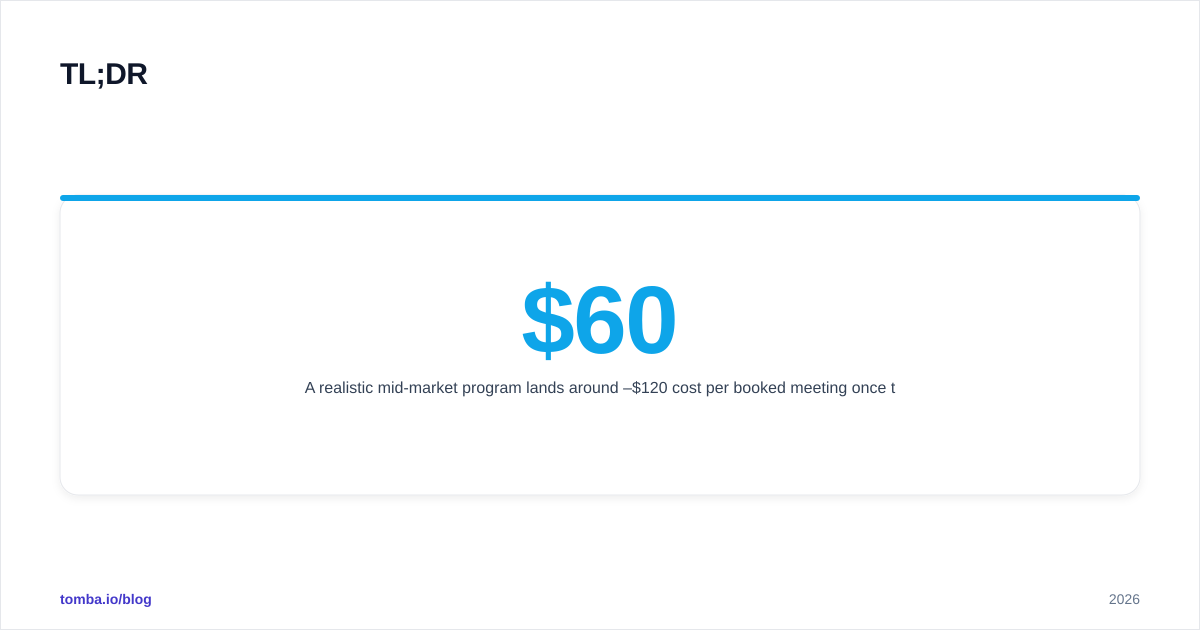
- A realistic mid-market program lands around $60–$120 cost per booked meeting once tooling, data, and SDR time are counted—AI shifts that number by cutting research and drafting hours, not by magically lifting reply rates 10x.
- Model payback on a single spreadsheet before scaling spend. If one closed deal pays back 3+ months of tooling, you have a green light.
- Track four numbers weekly: deliverability rate, reply rate, meetings booked, and cost per meeting. Everything else is noise.
What is AI email outreach ROI?#
ROI here is the return you get for every dollar spent running an AI-assisted cold email program. The formula is boring on purpose:
ROI = (Revenue or pipeline generated − total program cost) ÷ total program cost
The trap most teams fall into is counting only the obvious line item—the AI writing tool—and ignoring the rest. Your true cost stack includes data sourcing, email verification, sending infrastructure, warmup, the CRM seat, and the human hours spent reviewing AI output. Think of it like the cost of a road trip: the gas is visible, but tolls, parking, and the hours you spend driving are the part that actually decides whether the trip was worth it.
AI changes the cost side of that equation more than the revenue side. It compresses the time to research a prospect, draft a relevant first line, and personalize at volume. It does not rewrite the laws of email deliverability or make a bad offer convert.
Why does data quality decide the ROI?#
Because every downstream metric inherits the quality of your list. Send to a list that is 30% invalid and you do three expensive things at once: you burn sending reputation, you trigger spam filters, and you pay your AI tool to personalize emails that will never be read.
A clean list does the opposite. High deliverability protects your domain, which lifts inbox placement, which is the only way reply rate matters at all. This is why the ROI conversation has to start with sourcing and verification, not copywriting.
Here is the chain reaction in practice:
- Invalid emails → hard bounces → sender reputation damage → fewer future emails reach the inbox.
- Catch-all guesses → soft uncertainty → wasted sends and skewed reply-rate math.
- Verified, enriched contacts → strong placement → reply rate reflects your message, not your list hygiene.
Run every list through an email verifier before the first send. It is the cheapest insurance you can buy in the entire program. If your provider gives you a lot of ambiguous domains, a dedicated catch-all verifier keeps those from quietly tanking your numbers.
How do you build the cost-per-meeting model?#
Cost per meeting is the single most honest ROI metric for outreach, because it survives all the way to revenue. Build it from the bottom up.
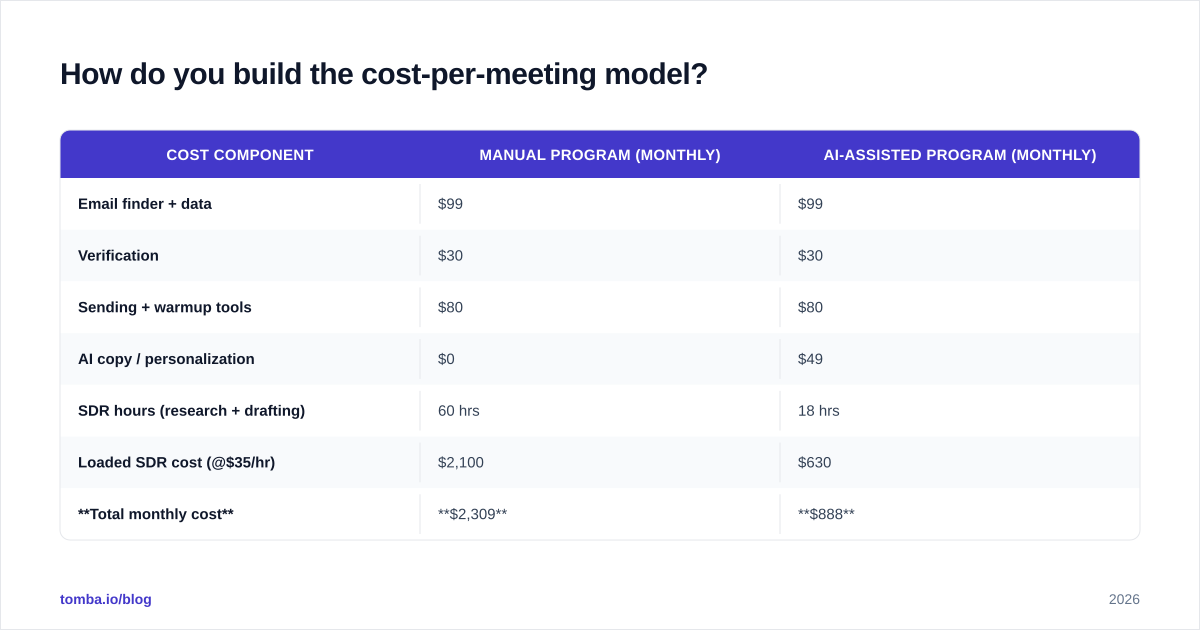
| Cost component | Manual program (monthly) | AI-assisted program (monthly) |
|---|---|---|
| Email finder + data | $99 | $99 |
| Verification | $30 | $30 |
| Sending + warmup tools | $80 | $80 |
| AI copy / personalization | $0 | $49 |
| SDR hours (research + drafting) | 60 hrs | 18 hrs |
| Loaded SDR cost (@$35/hr) | $2,100 | $630 |
| Total monthly cost | $2,309 | $888 |
| Meetings booked / mo | 18 | 22 |
| Cost per meeting | $128 | $40 |
The headline is not "AI books way more meetings." It books a few more, because relevance improves. The real win is the labor line: AI takes the 60 research-and-drafting hours down to 18 review-and-approve hours. That is where most of the ROI actually comes from in 2026.
Plug your own numbers in. If your average contract value is $6,000 and you close 20% of meetings, each meeting is worth $1,200 in expected pipeline—so a $40 cost per meeting is a 30:1 ratio before you even subtract everything else. That is the math that justifies scaling.
)
Is AI email outreach actually better than manual?#
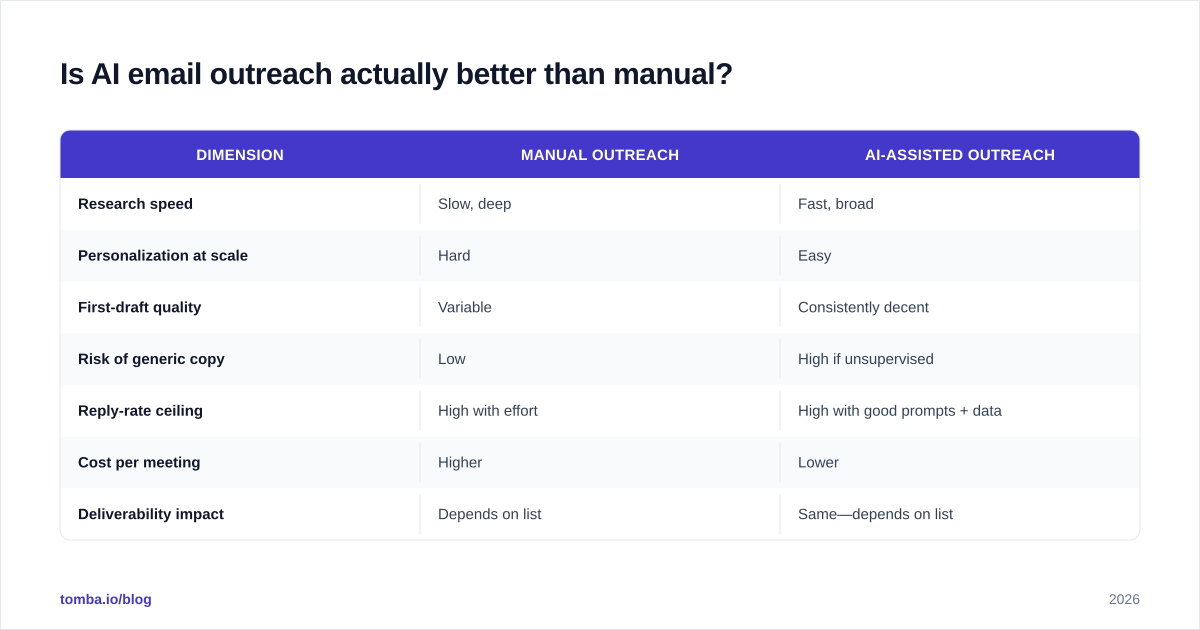
Better at the boring parts, neutral on the part that matters most. AI is excellent at scaling research and producing a competent first draft. It is not a substitute for a sharp offer or genuine account knowledge. Vendors like HubSpot and most modern sales platforms now bake AI drafting into the workflow, which means the capability is commoditized—your edge comes from the inputs you feed it.
Here is the honest comparison:
| Dimension | Manual outreach | AI-assisted outreach |
|---|---|---|
| Research speed | Slow, deep | Fast, broad |
| Personalization at scale | Hard | Easy |
| First-draft quality | Variable | Consistently decent |
| Risk of generic copy | Low | High if unsupervised |
| Reply-rate ceiling | High with effort | High with good prompts + data |
| Cost per meeting | Higher | Lower |
| Deliverability impact | Depends on list | Same—depends on list |
Notice the last row. AI does nothing for deliverability on its own. That stays a function of your data and sending hygiene. According to peer reviews aggregated on G2, the teams happiest with AI outreach tools are the ones who paired them with strong data foundations—not the ones expecting the AI to fix a weak list.
What metrics prove the ROI week to week?#
Track four numbers and ignore the rest until these are healthy.
- Deliverability rate — what share of sends actually reach an inbox. Below ~95% and nothing else matters; fix the list and warmup first.
- Reply rate — your only real signal that the message landed. Watch the response rate trend, not any single day.
- Meetings booked — the first metric that ties to money.
- Cost per meeting — the rollup that tells you if scaling is profitable.
Resist the urge to add fifteen dashboard tiles. A program that obsesses over open rate (increasingly unreliable in 2026) while ignoring cost per meeting is optimizing the wrong thing. Conclusion first: if cost per meeting is dropping while meetings rise, scale spend. If it is rising, stop and fix data or targeting before adding volume.
)
How do you scale spend without killing ROI?#
Scale the inputs that compound, throttle the ones that decay. Sending volume decays—push it too hard and deliverability collapses, dragging every other number down with it. Data quality and targeting compound—every improvement there lifts the whole funnel.
A safe scaling sequence:
- Week 1–2: Validate the model at low volume. Confirm deliverability above 95% and a cost per meeting you can live with.
- Week 3–4: Expand the verified contact pool, not the daily send rate. Use data enrichment to add firmographics and trigger events so the AI has more to personalize against.
- Month 2: Add sending domains and inboxes gradually, warming each one. Keep per-inbox volume conservative.
- Ongoing: Re-verify lists monthly. Contact data decays roughly 2–3% per month, so a list that was clean in January is measurably worse by March.
The mistake that quietly kills ROI is scaling send volume on a stale list. You pay more, reach fewer inboxes, and your cost per meeting climbs while the dashboard looks busier. Industry analysts at Gartner have long flagged data decay as the silent tax on outbound—treat re-verification as a recurring line item, not a one-time cleanup.
What does a realistic 2026 ROI scenario look like?#
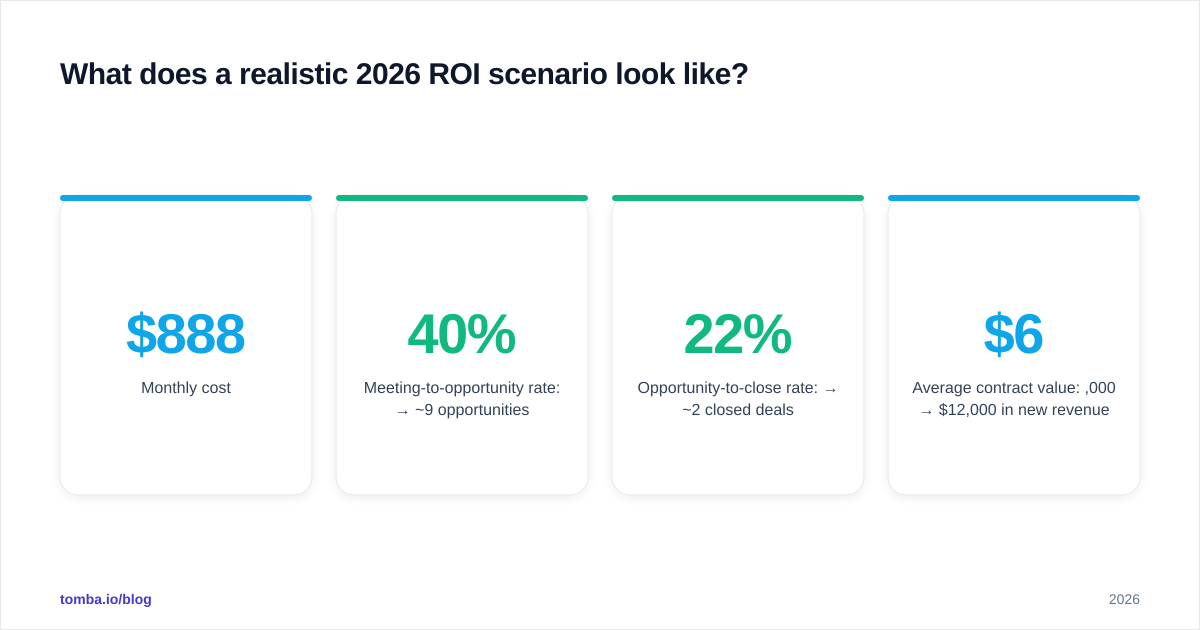
Let's make it concrete with the AI-assisted column from earlier:
- Monthly cost: $888
- Meetings booked: 22
- Meeting-to-opportunity rate: 40% → ~9 opportunities
- Opportunity-to-close rate: 22% → ~2 closed deals
- Average contract value: $6,000 → $12,000 in new revenue
That is roughly $12,000 returned on $888 spent—a 13:1 monthly return if deliverability and data hold. Drop deliverability to 80% because you skipped verification, and meetings fall to ~14, closed deals to ~1, and revenue halves while cost stays flat. Same tools, same AI, half the ROI. The variable was the list.
This is the whole argument in one example: AI email outreach ROI is gated by data, executed by AI, and proven by cost per meeting. Get the order right and the program scales. Get it backward and you scale your losses.
How do you start without overspending?#
Start narrow and instrument everything. Pick one tight segment, build a verified list, write three AI-drafted variants you personally review, and measure the four metrics for two weeks. Use a tight feedback loop before you spend on volume.
For drafting, an AI cold email writer gets you from blank page to reviewable draft in seconds—but keep a human approving every send while you calibrate. Check Tomba pricing to size the data and verification layer to your volume; the Free tier (25 searches/mo) is enough to validate the model before you commit to Starter at $49/mo or Growth at $99/mo.
The bottom line#
AI does not create ROI in cold outreach—it amplifies whatever foundation you give it. Feed it verified, enriched contact data and a clear offer, and it lowers your cost per meeting dramatically. Feed it a stale list and a vague pitch, and it just helps you fail faster and at scale.
Everything starts with reaching real people at real addresses. Tomba's Email Finder gives you accurate, verified professional emails by name, company, or domain—the clean foundation that makes every downstream AI dollar actually convert. Build the list right first, and the ROI math takes care of itself.
// get started
Find, verify and enrich your first contacts today
Start on the free plan with 25 searches a month, then scale when your team is ready.
Free plan · No credit card required · GDPR & CCPA
// about the author