AI Email Outreach Tools: 9 Best Platforms Compared (2026)
AI email outreach tools promise more replies with less manual work—but most teams pick wrong. Here's how the top platforms compare on personalization, deliverability, and price in 2026.
TL;DR
- AI email outreach tools split into three jobs: writing copy, sequencing sends, and protecting deliverability. Most "all-in-one" claims only nail one or two.
- Personalization quality now depends more on the data feeding the AI than the model writing the email. Clean contact data beats a clever prompt every time.
- Instantly and Smartlead win on send volume and inbox rotation; Lavender and Apollo win on per-email coaching and built-in data; Reply.io sits in the middle.
- Deliverability is the silent killer—AI lets you send more bad email faster. Warmup, verification, and sending limits matter more than the writing feature.
- Pair an outreach engine with a dedicated data layer. A tool that finds and verifies addresses (like Tomba) keeps your AI from personalizing emails to dead inboxes.
What are AI email outreach tools?#
AI email outreach tools are platforms that use machine learning to draft, personalize, sequence, and optimize cold and warm sales emails at scale. Instead of writing every message by hand, you feed the tool a prospect list and an offer, and it generates tailored copy, schedules follow-ups, and adjusts based on opens, clicks, and replies.
Think of it like the difference between a line cook and a kitchen full of prep stations. The old way—one rep writing 40 emails a morning—is the line cook doing everything alone. AI outreach tools are the prep stations: one handles research, one drafts copy, one watches the timing, one keeps the burners (your sending domains) from catching fire. You still run the kitchen, but the grunt work is parallelized.
Technically, these tools combine a few capabilities: large language models for copy generation, behavioral triggers for sequencing, sender-reputation management for deliverability, and increasingly, built-in or connected B2B data for personalization tokens. The category overlaps heavily with sales automation and modern AI sales technology, but the defining feature is that the AI touches the actual message content, not just the schedule.
Why does AI outreach fail more often than it succeeds?#
Because most teams optimize the writing and ignore the plumbing. AI makes it trivially easy to send 5,000 personalized-looking emails a day. It does nothing to make those 5,000 inboxes real, your domain trusted, or your offer relevant.
Here's the failure pattern I see repeatedly:
- A team buys an AI outreach tool for the copy generation.
- They upload a scraped list with 30% invalid or catch-all addresses.
- The AI writes beautiful, personalized emails to addresses that bounce.
- Bounce rate spikes, the domain reputation tanks, and even the good emails land in spam.
- The team blames the tool and churns.
The AI did its job. The data and deliverability foundation did not exist. This is why the smartest buyers treat outreach as a stack, not a single product: a data layer, a sending layer, and a writing layer. Get the data layer wrong and nothing downstream matters.

How do the top AI email outreach tools compare?#
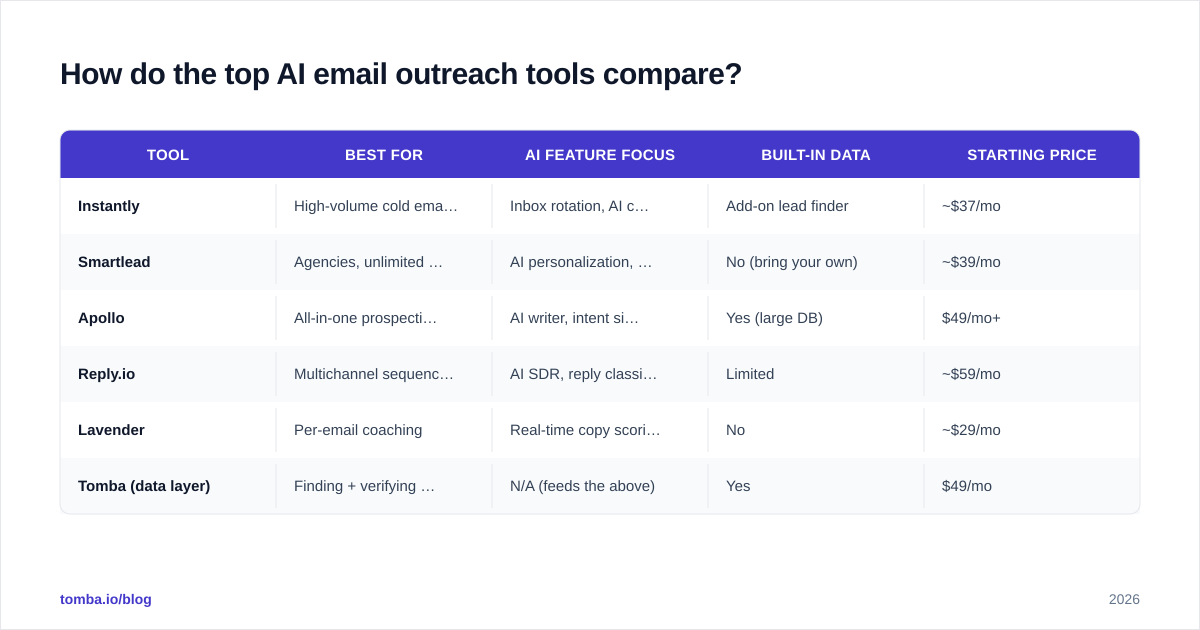
The platforms below cluster into three camps: send-volume engines (Instantly, Smartlead), data-plus-sequencing suites (Apollo, Reply.io), and copy-coaching tools (Lavender). No single tool is best at all three jobs, so match the tool to your bottleneck.
| Tool | Best for | AI feature focus | Built-in data | Starting price |
|---|---|---|---|---|
| Instantly | High-volume cold email | Inbox rotation, AI copy assist | Add-on lead finder | ~$37/mo |
| Smartlead | Agencies, unlimited inboxes | AI personalization, warmup | No (bring your own) | ~$39/mo |
| Apollo | All-in-one prospecting + send | AI writer, intent signals | Yes (large DB) | $49/mo+ |
| Reply.io | Multichannel sequences | AI SDR, reply classification | Limited | ~$59/mo |
| Lavender | Per-email coaching | Real-time copy scoring | No | ~$29/mo |
| Tomba (data layer) | Finding + verifying contacts | N/A (feeds the above) | Yes | $49/mo |
A few honest notes on this table. Prices shift constantly and most vendors gate the useful features behind higher tiers, so treat the "starting price" as a floor, not a quote. Apollo bundles data and sending, which is convenient but means you're locked into their database quality. Instantly and Smartlead are sending specialists—they assume you arrive with a clean, verified list. That assumption is exactly where most teams stumble, which is why a data enrichment and verification step belongs upstream of any of these.
If you want to pressure-test these claims yourself, G2's outreach software category and the vendors' own docs are the most current sources; this space changes faster than any blog post can track.
Does AI personalization actually improve reply rates?#
Yes, but only when it personalizes on something real. "Hi {{first_name}}, I loved your work at {{company}}" is not personalization—it's a mail merge with extra steps, and prospects spot it instantly.
Effective AI personalization pulls from genuine signal: a recent funding round, a job change, a specific piece of content the prospect published, a technology their company just adopted. The model is only as good as the data you connect to it. This is the part buyers underestimate. You can run the same AI prompt across two lists and get a 2% reply rate on a generic scraped list and a 9% reply rate on an enriched list where every token is accurate and recent.
That accuracy starts with the contact record. If your AI is personalizing around a job title the person left eight months ago, the email is worse than generic—it signals you didn't do your homework. Feeding your outreach tool data from a reliable email finder and keeping records current with an email verifier is what separates personalization that lifts response rate from personalization that just looks busy.
A practical rule: every personalization token in your sequence should map to a verified, dated data field. If you can't point to where the fact came from and when it was confirmed, cut the token. AI confidently fills gaps with plausible-sounding fiction, and a confidently wrong detail kills trust faster than no detail at all.
What about deliverability—can AI tools keep you out of spam?#
Partially. The better tools include warmup and inbox rotation, but they cannot fix a list full of bad addresses or a domain you're sending too aggressively from.
Deliverability is the discipline that decides whether your perfectly written, perfectly personalized email reaches a human. AI raises the stakes here because it removes the natural friction that used to cap your send volume. When writing 200 emails took all day, you couldn't torch your domain in an afternoon. Now you can.
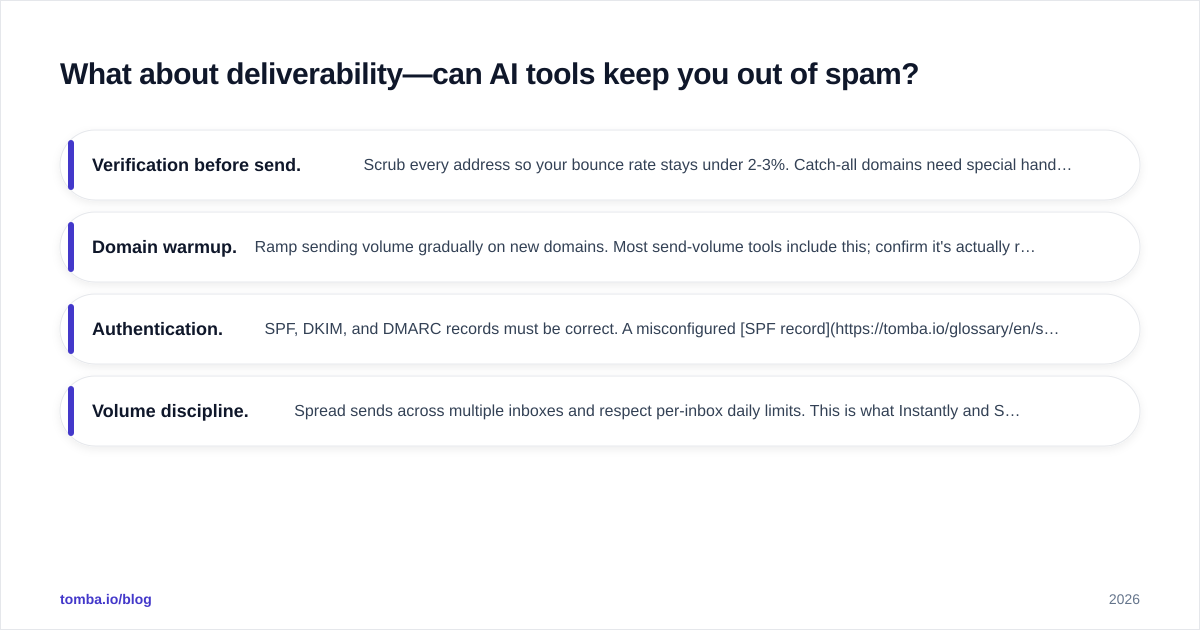
The controls that actually protect you:
- Verification before send. Scrub every address so your bounce rate stays under 2-3%. Catch-all domains need special handling—use a catch-all verifier rather than guessing.
- Domain warmup. Ramp sending volume gradually on new domains. Most send-volume tools include this; confirm it's actually running.
- Authentication. SPF, DKIM, and DMARC records must be correct. A misconfigured SPF record alone can route you to spam.
- Volume discipline. Spread sends across multiple inboxes and respect per-inbox daily limits. This is what Instantly and Smartlead automate well.
Mailbox providers also publish their own guidance—Google's sender guidelines are the canonical reference and worth reading before you scale any campaign. No AI tool overrides those rules; they just help you comply with them at scale.
The uncomfortable truth: deliverability is mostly about sender reputation and list hygiene, both of which are upstream of whatever AI writes your copy. Budget for the boring foundation before the exciting features.

How should you choose an AI email outreach tool in 2026?#
Choose based on your specific bottleneck, not the longest feature list. Run through this in order:
1. Where does your pipeline leak today? If you can't find enough good contacts, your problem is data, not sending—fix that first. If you have great lists but low reply rates, you need better copy and personalization (Lavender, Apollo's AI writer). If you have good copy but can't scale sends without landing in spam, you need a sending engine (Instantly, Smartlead).
2. Do you already own a data source? If yes, a pure sending tool is cheaper and better. If no, an all-in-one like Apollo bundles data—but you inherit their database's accuracy ceiling, which varies a lot by region and industry. Many teams get better coverage pairing a specialist sending tool with a dedicated finder via the Tomba API or a native integration.
3. What's your real volume? Agencies running many clients need unlimited-inbox pricing (Smartlead). A single team sending a few hundred emails a day will overpay for that and should pick a per-seat tool.
4. How much human review survives? "AI SDR" tools that auto-send with zero review are the fastest way to embarrass your brand. The best setups keep a human approving copy and a verification gate on the data, using AI to draft and sequence—not to operate unsupervised.
5. Total cost of the stack. Add the data layer, the sending tool, and any enrichment together. A $39/mo sending tool plus a separate finder and verifier is often cheaper and more accurate than a $99/mo bundle that does everything adequately and nothing well. Check current Tomba pricing against the bundled-data alternatives and compare cost-per-verified-contact, not cost-per-month.
What's the realistic ROI of AI outreach?#
Modest but real—if you fix the foundation. Expect AI to compress the time per email by 60-80% and lift reply rates by a few points when fed clean, enriched data. Do not expect it to turn a bad offer or a junk list into pipeline.
The teams getting strong returns treat AI as an accelerator on an already-working motion: a clear ICP, verified contacts, a relevant offer, and disciplined deliverability. AI then lets a two-person team operate like a five-person team. The teams getting burned bought AI to skip the unglamorous work of building a clean data layer and protecting their domain—and AI just helped them fail faster.
If you're benchmarking vendors, anchor on metrics that survive contact with reality: verified deliverability rate, reply rate on enriched vs. raw lists, and cost per booked meeting. Vanity metrics like "emails sent" go up the moment you turn AI on and tell you nothing.
Where does Tomba fit in your outreach stack?#
Tomba is the data layer that makes everything downstream work. Before your AI writes a word or your sending engine fires a single email, you need real, verified, current contacts—and that's exactly what Tomba does. Use the Tomba Email Finder to source professional email addresses by name, company, or domain, then verify them so your bounce rate stays low and your sender reputation stays intact. Start free with 25 searches a month, or scale on the Starter plan at $49/mo and feed clean data straight into Instantly, Smartlead, Apollo, or whatever AI engine you choose. Get the data right, and your AI outreach finally has something true to personalize. Try the email finder and build campaigns on a foundation that actually converts.
// get started
Find, verify and enrich your first contacts today
Start on the free plan with 25 searches a month, then scale when your team is ready.
Free plan · No credit card required · GDPR & CCPA
// about the author