AI Email Sequencing in 2026: The Complete Playbook
AI email sequencing replaces blast-and-pray outreach with adaptive, behavior-triggered cadences. Here's how it works, what to automate, and where humans still win in 2026.
TL;DR
- AI email sequencing is a multi-step outreach cadence where an AI layer decides timing, personalization, branching, and follow-up content based on each prospect's behavior — not a fixed drip set on day one.
- The payoff is concrete: higher reply rates, fewer wasted sends to dead inboxes, and reps who spend hours on conversations instead of scheduling.
- It only works on clean data. Sequencing into unverified or guessed addresses just automates your bounce rate and torches sender reputation.
- The best setups pair an AI sequencer (timing, copy variants, branching) with a verified contact source and human review on the highest-value accounts.
- Skip the hype: AI is excellent at scale and adaptation, mediocre at judgment. Keep humans on the accounts that matter.
What is AI email sequencing?#
AI email sequencing is outreach on autopilot with a brain attached. Think of a normal email sequence like a vending machine — you load it with messages, set the intervals, and it dispenses them in order no matter who's standing in front of it. AI sequencing is more like a good bartender: it reads the room, remembers what you ordered last time, and changes what it pours based on how you react.
Technically, an AI email sequence is a series of automated touches (emails, and often LinkedIn or call steps) where machine learning models handle one or more of the following: send-time optimization, copy personalization at the individual level, branching logic based on opens/clicks/replies, and dynamic follow-up generation. The "sequence" is the skeleton. The "AI" is the nervous system that adapts it per prospect.
This matters because classic drip campaigns treat a 5,000-person list as one person. Everyone gets email #2 exactly three days after email #1, regardless of whether they opened, replied, changed jobs, or never existed as a real inbox in the first place. AI sequencing breaks that rigidity.
How is AI sequencing different from a normal drip campaign?#
The difference comes down to who makes the decisions after you hit "start." In a traditional drip, you make every decision up front. In AI sequencing, the system keeps deciding.
)
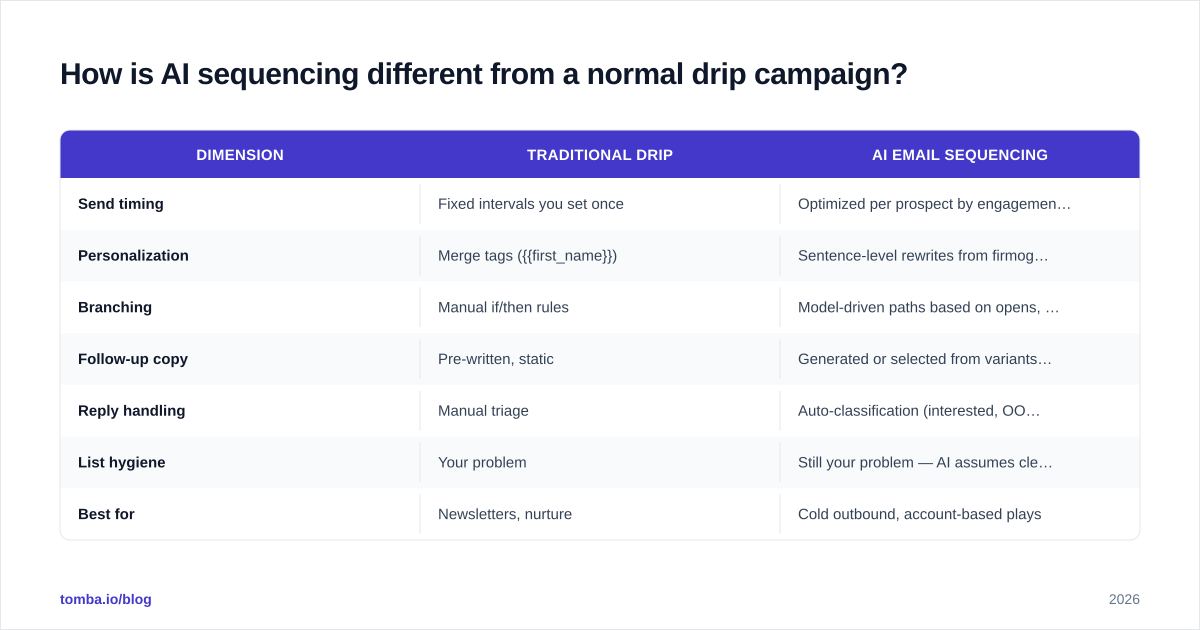
Here's the side-by-side that actually matters when you're choosing an approach:
| Dimension | Traditional drip | AI email sequencing |
|---|---|---|
| Send timing | Fixed intervals you set once | Optimized per prospect by engagement signals |
| Personalization | Merge tags ({{first_name}}) | Sentence-level rewrites from firmographic + behavioral data |
| Branching | Manual if/then rules | Model-driven paths based on opens, clicks, replies |
| Follow-up copy | Pre-written, static | Generated or selected from variants per thread |
| Reply handling | Manual triage | Auto-classification (interested, OOO, not now, unsubscribe) |
| List hygiene | Your problem | Still your problem — AI assumes clean inputs |
| Best for | Newsletters, nurture | Cold outbound, account-based plays |
Notice the second-to-last row. This is the trap. AI sequencing tools assume your contact data is real. They will happily send a beautifully personalized email to jsmith@company.com that was never a valid address, and your domain pays the deliverability bill. More on that below, because it's the single biggest reason AI sequencing campaigns underperform.
Why does AI email sequencing actually improve results?#
It improves results in three measurable places: timing, relevance, and follow-through. None of these are magic — they're just things humans do badly at scale and machines do consistently.
Timing. Reps send when it's convenient for the rep. AI sends when the prospect is most likely to be in their inbox, learned from aggregate open patterns and that contact's own history. A 9:14 a.m. Tuesday send for one person might be a 4:40 p.m. Thursday send for another. Small lifts compound across thousands of touches.
Relevance. Generic personalization ("I see you work at Acme") is transparent and ignored. AI that pulls from real firmographic and role data can open with something specific to the prospect's stack, recent funding, or job change. The bar in 2026 is high — buyers have seen a thousand AI emails, so the generated copy has to clear the "this could only have been written to me" test or it reads as spam.
Follow-through. The money in outbound is in follow-ups, and follow-ups are exactly what tired reps skip. According to widely cited sales engagement research from Salesforce, persistence across multiple touches dramatically outperforms one-and-done sends. AI never gets bored on touch four. It also kills the sequence the instant someone replies, so you never get the cringe of an automated "just bumping this up" after a prospect already said yes.
For a deeper baseline on what "good" looks like, benchmark your current numbers against industry email response rate data before and after you switch. If AI sequencing isn't moving that number, the problem is upstream — usually copy or data, not the sequencer.
What does a good AI sequence framework look like?#
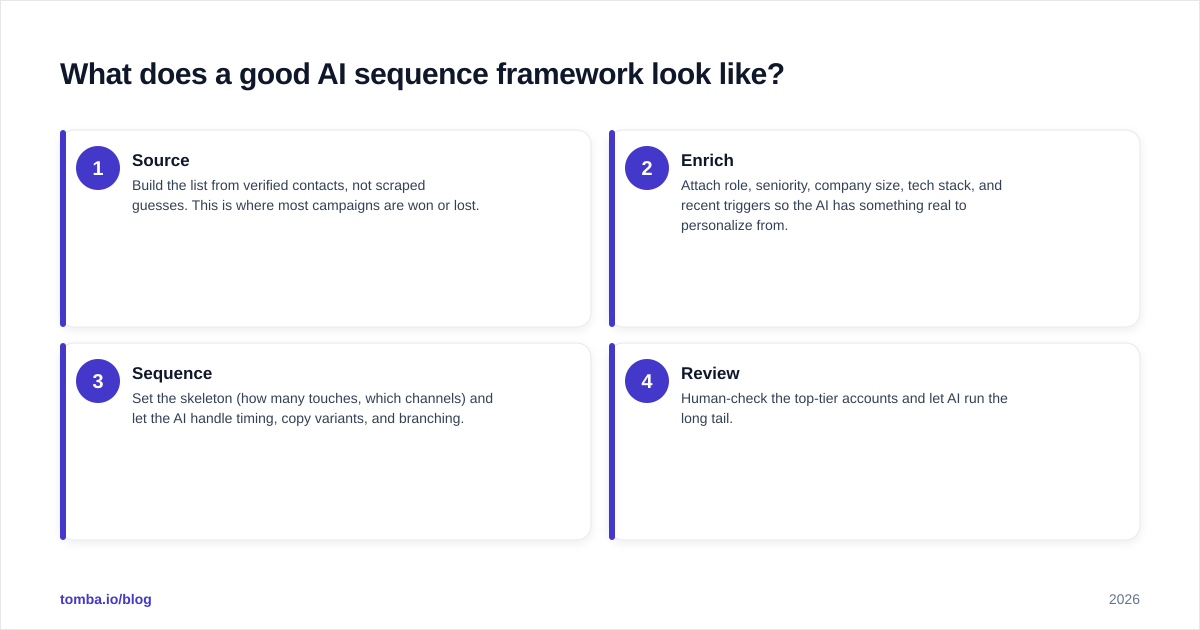
A reliable framework has four layers, and they run in order. Skip a layer and the whole thing leaks.
- Source — Build the list from verified contacts, not scraped guesses. This is where most campaigns are won or lost.
- Enrich — Attach role, seniority, company size, tech stack, and recent triggers so the AI has something real to personalize from.
- Sequence — Set the skeleton (how many touches, which channels) and let the AI handle timing, copy variants, and branching.
- Review — Human-check the top-tier accounts and let AI run the long tail.
The order is deliberate. You cannot personalize data you don't have (layer 2 needs layer 1), and you cannot sequence to addresses that bounce (layer 3 needs layer 1's verification). A surprising number of teams buy the sequencing tool first and then wonder why their open rates are 11%. They built the nervous system and forgot the skeleton.
This is the natural home for a tool like Tomba Email Finder. Before a single AI touch goes out, you want addresses that are confirmed real, sourced by domain search across the accounts you're targeting, then passed through an email verifier to strip dead and risky inboxes. Feed clean data in, and the AI layer earns its keep. Feed garbage in, and you've just automated garbage faster.
Which tools handle AI email sequencing in 2026?#
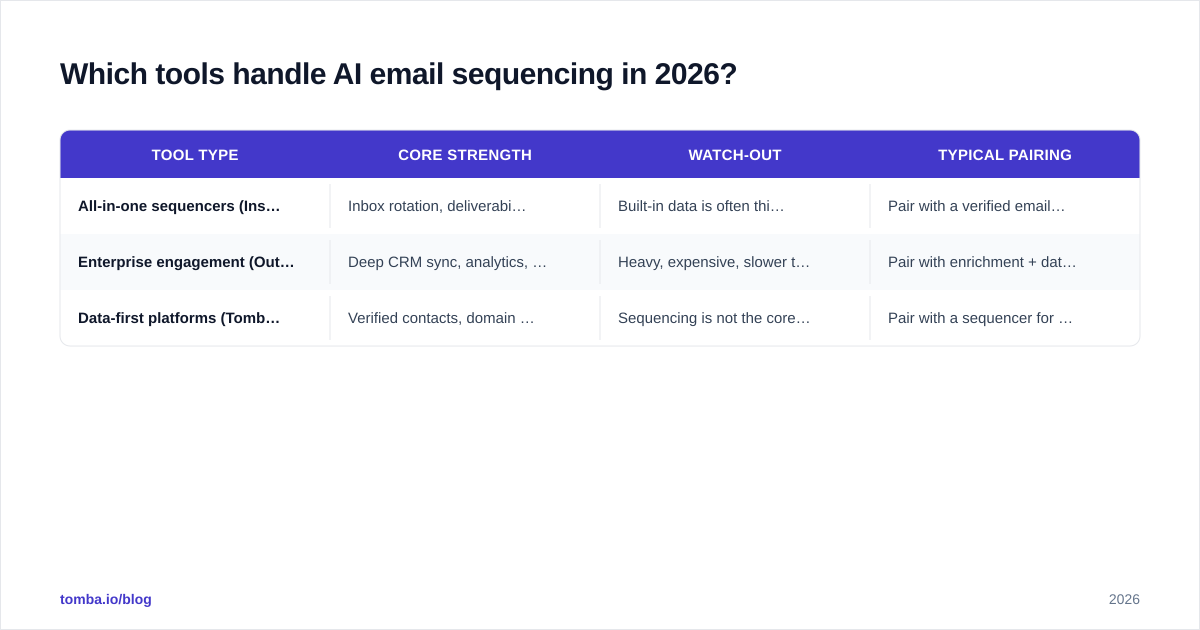
The market splits into three rough categories, and most teams end up combining them rather than betting on one. Here's how the main options compare on the axes that drive a buying decision.
| Tool type | Core strength | Watch-out | Typical pairing |
|---|---|---|---|
| All-in-one sequencers (Instantly, Smartlead) | Inbox rotation, deliverability tooling, native AI copy | Built-in data is often thin or guessed | Pair with a verified email finder |
| Enterprise engagement (Outreach, Salesloft) | Deep CRM sync, analytics, team workflows | Heavy, expensive, slower to adapt copy | Pair with enrichment + data source |
| Data-first platforms (Tomba) | Verified contacts, domain search, enrichment | Sequencing is not the core product | Pair with a sequencer for sends |
The honest read: no single vendor is best at both finding real people and running adaptive cadences. The all-in-one sequencers are strong on deliverability and AI copy but weak on data accuracy. The enterprise platforms are powerful but rigid. Data-first tools nail the contact layer but expect you to bring your own sending engine.
That's why the durable architecture is "best data source + best sequencer." If you're evaluating sequencers, read independent reviews on G2 rather than vendor landing pages — the gap between marketing claims and real deliverability shows up fast in user reviews. And if you're weighing all-in-one suites, compare them honestly against focused alternatives; our breakdown of Instantly alternatives and Outreach alternatives lays out the trade-offs without the sales gloss.
)
What can AI safely automate, and what should stay human?#
Split the work by judgment. Low-judgment, high-volume tasks are perfect for AI. High-judgment, high-stakes moments belong to people. Getting this line wrong is how teams end up with either robotic outreach or reps drowning in manual busywork.
Let AI run:
- Send-time optimization across the whole list
- First-draft personalization for the long tail of mid- and low-tier accounts
- Branching logic (if opened twice but no reply, send the case-study touch)
- Reply classification and routing
- Sequence pausing the moment someone engages or unsubscribes
- A/B testing subject lines and opener variants at scale
Keep humans on:
- The top 10-20% of accounts by deal value — write those by hand
- Anything that references a sensitive trigger (layoffs, lawsuits, executive departures)
- The final approval on AI-generated copy for a new segment before it scales
- Strategic decisions about which segments to target at all
A clean way to think about it: AI handles the volume, humans handle the value. The reps who win in 2026 aren't fighting the automation — they're aiming it. They let the system handle 2,000 mid-tier prospects and spend their freed-up hours on the 50 accounts that will actually close the quarter.
This is also where sales automation gets a bad name unfairly. Automation isn't the enemy of personal outreach; indiscriminate automation is. The fix is a tighter target, not slower sending.
How do you keep AI sequencing from wrecking deliverability?#
Protect the sending domain like it's the only asset you have, because in outbound it basically is. AI sequencing increases volume, and volume amplifies whatever you already have — good reputation or bad. Here's the non-negotiable checklist before you scale a single sequence.
Verify every address first. This is the highest-leverage step. A bounce rate above ~3% tells mailbox providers you're guessing, and they'll start routing you to spam regardless of how good your copy is. Run your whole list through an email verification pass and quarantine the catch-all and risky results. Don't sequence into them blindly.
Authenticate properly. SPF, DKIM, and DMARC must all be set up and aligned. If you can't confidently say your records pass, check them before you send — a misconfigured SPF record silently dumps mail into spam folders no matter how clever your AI copy is.
Warm up and ramp. A brand-new sending domain that suddenly fires 1,000 AI-personalized emails looks exactly like a spammer. Ramp volume gradually and keep an eye on sender reputation signals as you scale. Monitor reputation through free tools like Google Postmaster Tools if you're sending to Gmail-heavy lists.
Watch the leading indicators. Spam-complaint rate and reply rate move before deliverability fully collapses. If complaints tick up or replies crater after a sequence change, pause and diagnose — don't let the AI keep sending into a degrading reputation.
The pattern to internalize: AI sequencing doesn't fix deliverability problems, it accelerates whatever trajectory you're already on. Clean inputs and proper authentication turn that acceleration into a tailwind. Skipping them turns it into a cliff.
Is AI email sequencing worth it for small teams?#
Yes — arguably more than for big ones, because small teams have the least time to burn on manual follow-up. But the order of operations is different. A two-person team should not start by buying an enterprise engagement platform.
Start lean: get a verified list, write three or four genuinely good email variants yourself, and let an affordable sequencer handle timing and follow-ups. You don't need a model writing every word on day one. You need consistency on send timing and zero dropped follow-ups, which even basic AI sequencing delivers. Layer in heavier AI personalization once you have enough volume for it to learn from.
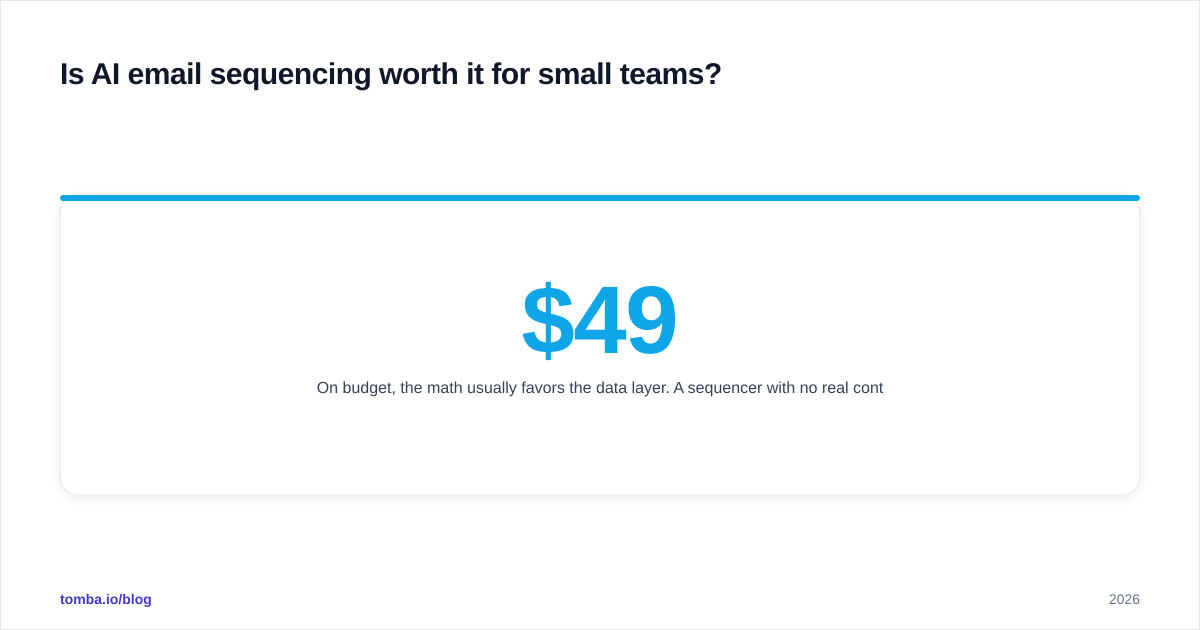
On budget, the math usually favors the data layer. A sequencer with no real contacts is a sports car with no fuel. Tomba's Free tier gives you 25 searches a month to test the workflow end to end, and the Starter plan at $49/mo (not the $39 you'll see misquoted elsewhere) covers most small-team outbound volumes before you need to step up to Growth at $99/mo. Compare that to leaving deals on the table because follow-up #4 never went out.
What's the right way to start?#
Start with one tightly-defined segment, real verified data, and a four-touch sequence — then let AI optimize from there. Don't boil the ocean. Pick 200 ideal-customer accounts, source and verify the contacts, write your touches, and turn the AI layer on for timing and branching only. Measure reply rate against your baseline. Once it's working, widen the funnel and hand more of the copy to the model.
The teams that get burned are the ones that flip every AI switch on day one against a scraped list. The teams that win treat AI as an amplifier on a foundation they've already validated by hand.
That foundation is data. Before you automate a single send, make sure every address is real, attributed to the right person, and enriched with the context your AI needs to sound human. That's exactly what Tomba Email Finder is built for — verified professional emails by domain, name, or company, with verification and enrichment in the same workflow. Start free with 25 searches, feed clean contacts into your sequencer, and let the AI do what it's actually good at: never missing a follow-up. Your sequence is only as smart as the data underneath it — so start there.
// get started
Find, verify and enrich your first contacts today
Start on the free plan with 25 searches a month, then scale when your team is ready.
Free plan · No credit card required · GDPR & CCPA
// about the author