AI for ABM in 2026: How to Scale Account-Based Marketing
AI for ABM turns slow, manual account targeting into a real-time engine. Here's how to use it to pick accounts, personalize outreach, and prove pipeline in 2026.
TL;DR
- AI for ABM is the use of machine learning to pick target accounts, read buying intent, and personalize outreach at a scale humans can't match manually.
- The biggest wins are in three places: account selection (ICP scoring), signal detection (intent + engagement), and 1:1 personalization at 1:many cost.
- AI does not replace your ABM strategy — it removes the grunt work (list building, research, drafting) so your team spends time on accounts that are actually in-market.
- Clean contact data is the fuel. AI personalization is worthless if the email bounces or the title is wrong.
- Start small: one tier-1 account list, one AI-assisted play, one clear pipeline metric. Then scale what works.
Account-based marketing has always made sense on paper and hurt in practice. The idea is simple: stop spraying the whole market and concentrate effort on the accounts most likely to buy. The pain is that doing it well — researching each account, mapping the buying committee, writing genuinely relevant messages — does not scale with a normal team. AI for ABM is what finally closes that gap.
This guide breaks down where AI actually helps in an ABM program, what to ignore, the tools and data you need, and a practical 2026 playbook you can run this quarter.
What is AI for ABM?#
AI for ABM is the conclusion first: it's applying machine learning to the three slowest parts of account-based marketing — choosing accounts, reading intent signals, and personalizing outreach — so a small team can run plays that used to require an army.
Think of traditional ABM like a tailor hand-stitching a suit for every customer. Beautiful, but you can only make a few a week. AI for ABM is the tailor who keeps the hand-finished feel but uses a machine to cut the cloth, take the measurements, and prep the materials. The craft stays; the bottleneck disappears.
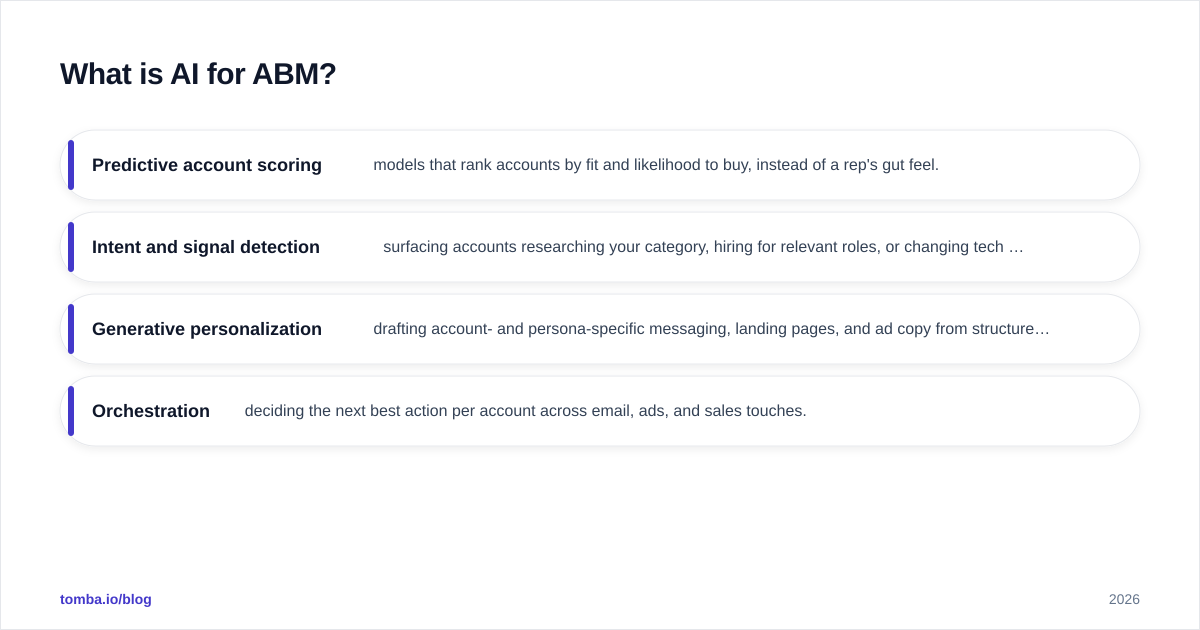
Concretely, "AI for ABM" shows up as:
- Predictive account scoring — models that rank accounts by fit and likelihood to buy, instead of a rep's gut feel.
- Intent and signal detection — surfacing accounts researching your category, hiring for relevant roles, or changing tech stacks.
- Generative personalization — drafting account- and persona-specific messaging, landing pages, and ad copy from structured data.
- Orchestration — deciding the next best action per account across email, ads, and sales touches.
This sits squarely inside modern revenue operations — it's the connective tissue between marketing intent and sales execution.
Why does ABM need AI in the first place?#
Because the math of doing ABM by hand never worked. A rep can deeply research maybe 5–10 accounts a day. If your ICP has 4,000 accounts and a buying committee of 6–10 people each, that's tens of thousands of contacts to map, prioritize, and message. Manual ABM forces a brutal trade-off: go narrow and miss pipeline, or go wide and lose the personalization that makes ABM work at all.
AI removes the trade-off by collapsing research time. What took an SDR 30 minutes per account — pulling firmographics, recent news, tech stack, headcount trends, and likely pain points — becomes near-instant. That frees humans to do the part machines are bad at: judgment, relationship, and the final layer of personal touch.
)
The second reason is timing. Most accounts are out-of-market at any given moment — research consistently shows only about 5% of B2B buyers are actively buying in a given quarter. AI intent detection tells you which 5%, so you stop wasting effort on accounts that won't respond no matter how good the copy is.
Where does AI actually help in an ABM program?#
Not everywhere. Here's the honest breakdown of high-leverage vs overhyped uses.
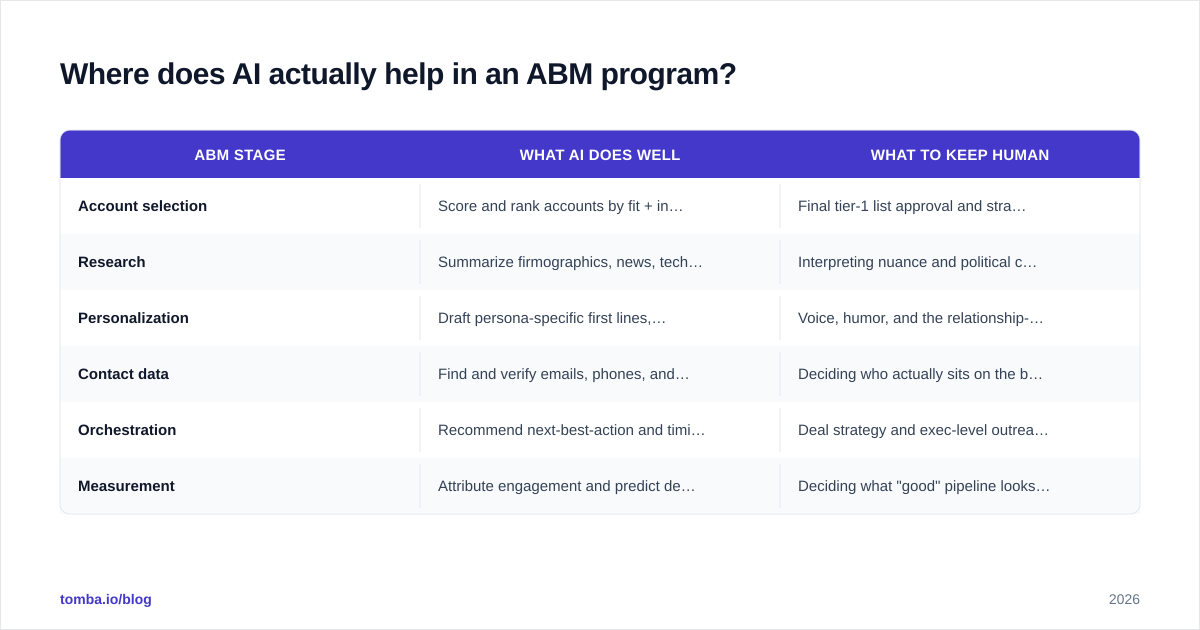
| ABM stage | What AI does well | What to keep human |
|---|---|---|
| Account selection | Score and rank accounts by fit + intent across thousands of signals | Final tier-1 list approval and strategic bets |
| Research | Summarize firmographics, news, tech stack, org changes in seconds | Interpreting nuance and political context |
| Personalization | Draft persona-specific first lines, ad copy, landing page variants | Voice, humor, and the relationship-defining moments |
| Contact data | Find and verify emails, phones, and roles at scale | Deciding who actually sits on the buying committee |
| Orchestration | Recommend next-best-action and timing per account | Deal strategy and exec-level outreach |
| Measurement | Attribute engagement and predict deal progression | Deciding what "good" pipeline looks like |
The pattern is clear: AI is excellent at volume, retrieval, and pattern-matching. It's weak at judgment, taste, and relationships. Design your program so AI handles the first category and your people own the second.
Account selection and scoring#
This is the highest-ROI use of AI for ABM. Instead of a static ICP filter ("companies with 200+ employees in SaaS"), predictive models weigh dozens of variables — funding, hiring velocity, tech adoption, web engagement, intent spikes — to produce a ranked list. You work the top of the list first. Tools like 6sense and Demandbase built their reputation here, and Tomba's B2B database gives you the underlying firmographic and contact layer to act on those scores.
Signal detection#
Intent data tells you an account is in motion. AI makes it usable by filtering noise and clustering signals into "this account is likely evaluating now." Combine third-party intent (category research) with first-party signals (website visits, content downloads, demo requests) for the clearest picture.
Generative personalization#
This is where 2026 differs from 2023. Generative models now write account-specific outreach that references real, current context — not "I saw your company is in the [industry] space." Feed the model structured account data and it produces a relevant first line, a tailored value prop, and a CTA. The catch: it's only as good as the data you feed it, which brings us to the part most teams get wrong.
What's the role of clean data in AI-driven ABM?#
Clean data is the whole game, and it's the step teams skip. The best AI personalization in the world is wasted if the email bounces, the contact left the company, or the model is reasoning off a wrong job title.
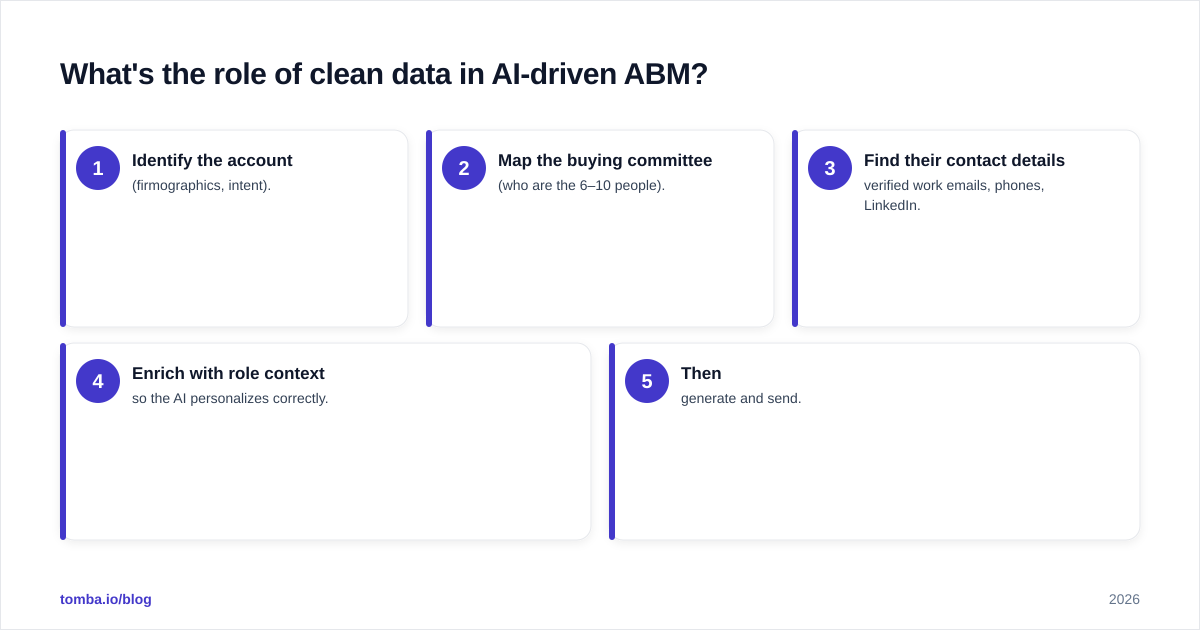
Here's the dependency chain nobody can shortcut:
- Identify the account (firmographics, intent).
- Map the buying committee (who are the 6–10 people).
- Find their contact details — verified work emails, phones, LinkedIn.
- Enrich with role context so the AI personalizes correctly.
- Then generate and send.
Steps 3 and 4 are where pipelines quietly leak. If your bounce rate is high, your sender reputation drops, and even your good messages stop landing in the inbox. This is why pairing AI for ABM with a reliable email finder and email verifier isn't optional — it's the foundation. For ABM specifically, domain search is the workhorse: feed it a target account's domain and pull the full set of role-based contacts to map the committee.
)
For high-volume programs, run your target account list through a bulk email finder and enrich the rest with data enrichment before a single message goes out. Garbage in, garbage out applies doubly when a machine is doing the writing.
How do you build an AI-for-ABM workflow in 2026?#
Conclusion first: start with one account tier, one play, one metric — then scale. Here's the sequence.
Step 1 — Define and score your account list. Start from your ICP, then layer AI scoring and intent so you're working a ranked tier-1 list of 50–100 accounts, not a spreadsheet of 4,000.
Step 2 — Map the buying committee. For each account, identify the economic buyer, champion, and influencers. Use domain search to pull verified contacts for those roles. Don't guess — a wrong contact wastes the whole sequence.
Step 3 — Enrich for context. Pull role, seniority, recent activity, and tech stack. This is the structured input your AI personalization layer needs.
Step 4 — Generate personalized assets. Use AI to draft per-persona messaging, ad copy, and landing page variants. Have a human edit for voice — the AI gets you to 80%, the human delivers the last 20% that earns a reply.
Step 5 — Orchestrate across channels. Coordinate email, LinkedIn, and ads so the account sees a consistent story. Sync everything to your CRM via an integration like HubSpot or Salesforce so sales and marketing share one view.
Step 6 — Measure pipeline, not activity. Track engaged accounts, meetings booked, and pipeline created. Vanity metrics (opens, impressions) tell you nothing about whether ABM is working.
Which AI ABM tools should you consider?#
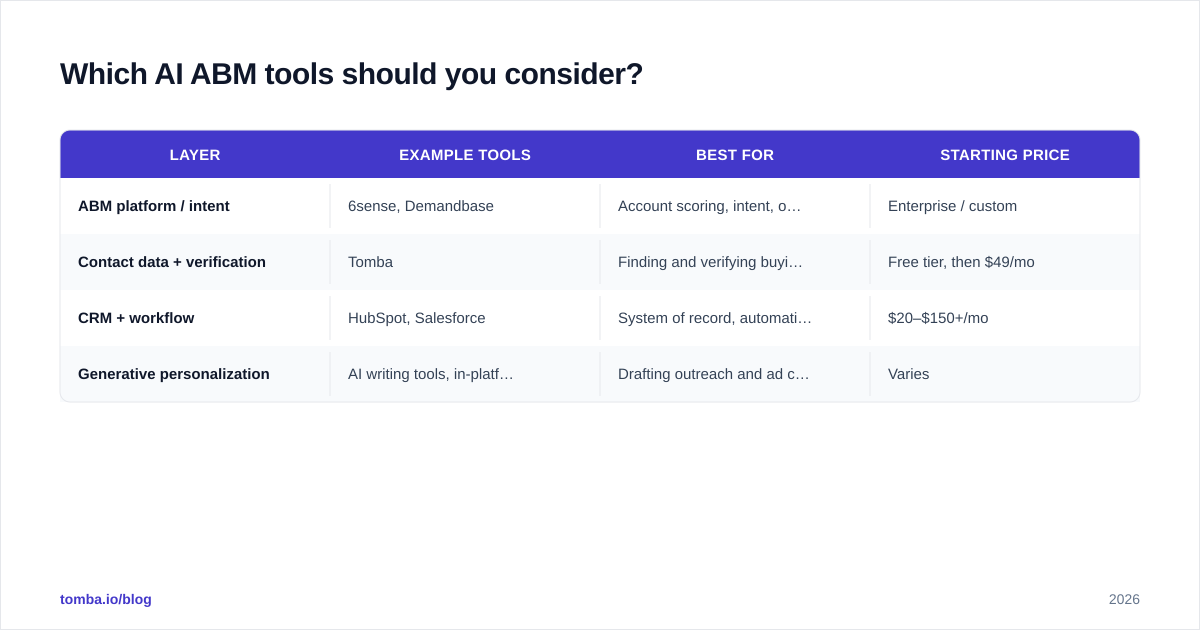
The market splits into platforms (orchestration + intent), data layers (contacts + enrichment), and personalization/automation tools. You'll likely combine all three.
| Layer | Example tools | Best for | Starting price |
|---|---|---|---|
| ABM platform / intent | 6sense, Demandbase | Account scoring, intent, orchestration | Enterprise / custom |
| Contact data + verification | Tomba | Finding and verifying buying-committee contacts | Free tier, then $49/mo |
| CRM + workflow | HubSpot, Salesforce | System of record, automation | $20–$150+/mo |
| Generative personalization | AI writing tools, in-platform AI | Drafting outreach and ad copy at scale | Varies |
A note on cost: the platforms are powerful but priced for enterprise. If you're a lean team, you can run a strong AI-for-ABM motion by combining a CRM you already own, a focused intent source, and a data layer. Tomba's pricing starts with a free tier (25 searches/mo), then Starter at $49/mo, Growth at $99/mo, and Pro at $249/mo — so the contact-data foundation scales with your account list rather than gating you behind an enterprise contract.
When evaluating any vendor, check independent reviews on G2 rather than the vendor's own case studies — fit varies wildly by company size and motion.
What mistakes kill AI-for-ABM programs?#
The failures are predictable, and almost all of them are about process, not technology.
- Skipping data hygiene. Personalizing off stale data sends confidently wrong messages. Verify first.
- Automating before strategy. AI scales whatever you point it at. Point it at a bad ICP and you get more bad outreach, faster.
- Over-personalizing the wrong way. Mentioning a random fact you scraped feels creepy, not relevant. Personalize on business context, not surveillance.
- Measuring activity instead of pipeline. "We sent 5,000 personalized emails" is not a result. "We created $400K in pipeline from 60 accounts" is.
- Treating AI output as final. The unedited AI draft is the floor, not the ceiling. Always add the human layer for tier-1 accounts.
- Ignoring deliverability. If you scale sends without managing sender reputation and verifying addresses, your domain lands in spam and the whole program stalls.
Is AI for ABM worth it for smaller teams?#
Yes — arguably more than for enterprises, because AI for ABM is the great equalizer. The thing that historically made ABM an enterprise-only motion was the labor cost of research and personalization. AI collapses that cost. A two-person revenue team in 2026 can run an account-based motion that would have needed a ten-person team in 2020.
The trick for small teams is ruthless focus: pick 30–50 accounts, get the contact data right, run one well-orchestrated play, and measure pipeline. Resist the urge to buy every platform. Start with a CRM, an intent signal, and a solid data layer, and add tools only when a specific bottleneck demands one.
The bottom line#
AI for ABM works when you treat it as an accelerator on top of a sound strategy and clean data — not as a replacement for either. Use AI to choose the right accounts, read intent, and personalize at scale, and keep humans on judgment, voice, and relationships. The teams winning at ABM in 2026 aren't the ones with the most tools; they're the ones who got the fundamentals — targeting and data — right, then let AI multiply them.
Your AI-for-ABM program is only as strong as the contacts feeding it. Before you automate a single message, make sure every account on your tier-1 list has verified, accurate buying-committee contacts. Start free with the Tomba Email Finder — find and verify the right decision-makers by domain, name, or company, then point your AI at data you can actually trust. Map the committee, enrich the context, and let the machine handle the volume while your team closes the deals.
// get started
Find, verify and enrich your first contacts today
Start on the free plan with 25 searches a month, then scale when your team is ready.
Free plan · No credit card required · GDPR & CCPA
// about the author