AI Outbound Strategy in 2026: The Complete Playbook
Spray-and-pray outbound is dead. Here's how to build an AI outbound strategy in 2026 that uses signals, enriched data, and automation to book more meetings with fewer touches.
Most "AI outbound" pitches in 2026 are just the old volume game with a chatbot bolted on. Sending 10,000 generic emails faster is not a strategy — it is a faster way to torch your domain. A real AI outbound strategy uses machine learning where it actually compounds: finding the right accounts, enriching them with accurate contact data, timing the reach to a buying signal, and personalizing at a level a human team could never sustain manually.
This playbook breaks down how to build that system from the ground up.
TL;DR#
- AI outbound strategy is signal-driven, not volume-driven. The win comes from targeting accounts showing intent and reaching the right person at the right moment — not from sending more.
- Data quality is the foundation. AI personalization is worthless if it is built on a stale list. Verified emails, enriched firmographics, and accurate phone numbers come first.
- Use AI for the three jobs it does best: account/contact selection, message drafting at scale, and reply triage. Keep humans on strategy and high-value conversations.
- Deliverability is a hard constraint. AI lets you send more, which makes warmup, list hygiene, and domain reputation more important, not less.
- Measure replies and pipeline, not send volume. A good AI outbound motion books more meetings from fewer, sharper touches.
What is an AI outbound strategy?#
An AI outbound strategy is a go-to-market motion that applies machine learning and large language models across the outbound funnel — sourcing, enrichment, sequencing, personalization, and analysis — so reps spend their time on conversations instead of admin.
Think of it like the difference between a fishing net and a fish finder. Traditional outbound drags a wide net and hopes. AI outbound reads the sonar first — who is in-market, what they care about, when they are most reachable — and then casts precisely. You catch more with less effort and less collateral damage to your sender reputation.
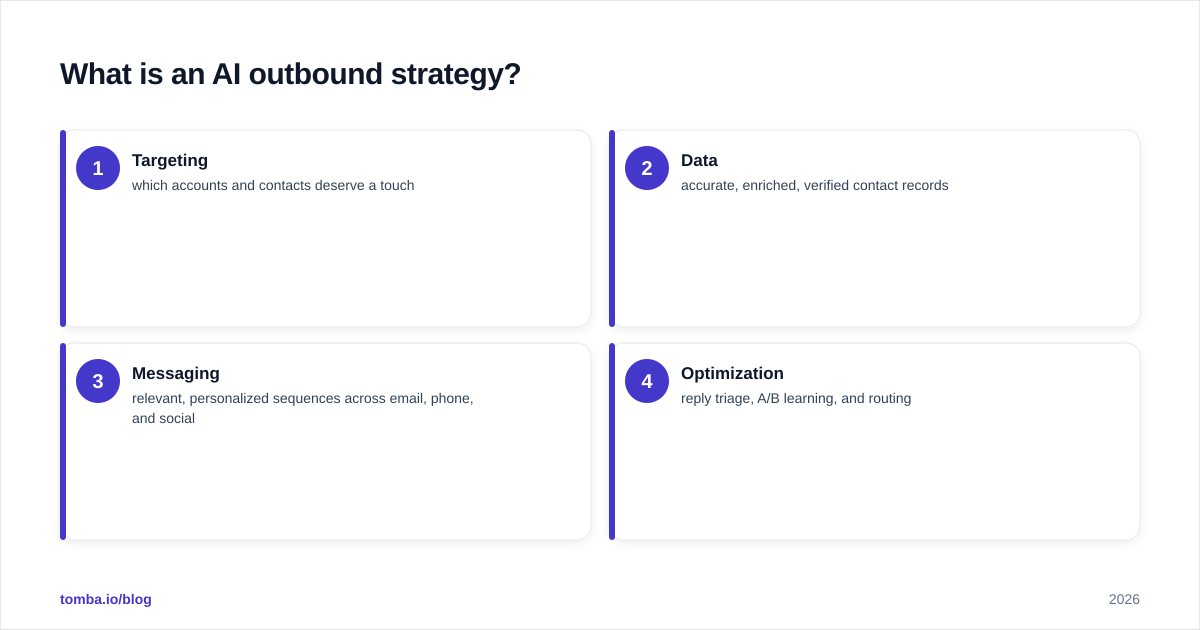
The strategy has four layers, and skipping any one of them breaks the rest:
- Targeting — which accounts and contacts deserve a touch
- Data — accurate, enriched, verified contact records
- Messaging — relevant, personalized sequences across email, phone, and social
- Optimization — reply triage, A/B learning, and routing
Why is traditional outbound failing in 2026?#
Three forces have collided. First, inboxes are smarter — Google and Microsoft now score sender behavior aggressively, so generic blasts land in spam faster than ever. Second, buyers ignore anything that does not speak to their specific context; according to HubSpot's sales research, relevance and timing drive response far more than persistence alone. Third, the sheer noise has gone up: everyone has access to the same AI copywriting tools, so "AI-written but generic" is the new baseline of mediocrity.
The teams winning right now did not just adopt AI to write faster. They re-pointed their effort. Instead of asking "how do we send more," they ask "how do we send only when we have a reason to."
That reason is almost always a signal: a new funding round, a job change into a buying role, hiring for a relevant team, adopting a competing tool, or visiting your pricing page. AI's job is to detect those signals and surface the accounts worth your reps' attention. For the underlying mechanics, our sales automation glossary entry covers where automation ends and strategy begins.
How do you build an AI outbound strategy step by step?#
Step 1 — Define your ICP in machine-readable terms#
AI can only target what you can specify. Translate your ideal customer profile into concrete filters: employee count, tech stack, region, department, seniority, and trigger events. Vague ICPs ("mid-market SaaS") produce vague lists. Sharp ones ("Series B–C SaaS, 50–500 employees, using a specific CRM, hiring SDRs") produce lists worth working.
Step 2 — Source and enrich the data#
This is where most AI outbound strategies quietly fail. You can have the best LLM in the world drafting your emails, but if the address bounces or the name is wrong, none of it matters. Start with a reliable email finder to get verified addresses by name and domain, then layer in data enrichment to fill firmographics, role, and seniority. For multi-channel plays, a phone finder gives reps a fallback when email goes quiet.
Step 3 — Segment by signal strength#
Not every contact gets the same treatment. Hot signals (page visits, competitor switching) warrant a fast, human-led touch. Warm signals (hiring, funding) fit a personalized AI sequence. Cold-but-fit accounts go into a lighter nurture. This tiering is what keeps your sending volume — and your reputation — under control.
Step 4 — Let AI draft, but you set the frame#
Use AI to generate first drafts personalized to each contact's signal and role. Give it the variables (trigger event, pain point, proof point) and let it write. Then have reps edit the top-tier ones. The model handles scale; the human handles judgment.
Step 5 — Automate sequencing and triage#
AI routes replies, classifies intent ("interested," "not now," "wrong person"), and books meetings. This is where reps reclaim hours — no more manually sorting an inbox of 200 replies.
What does the AI outbound stack look like?#
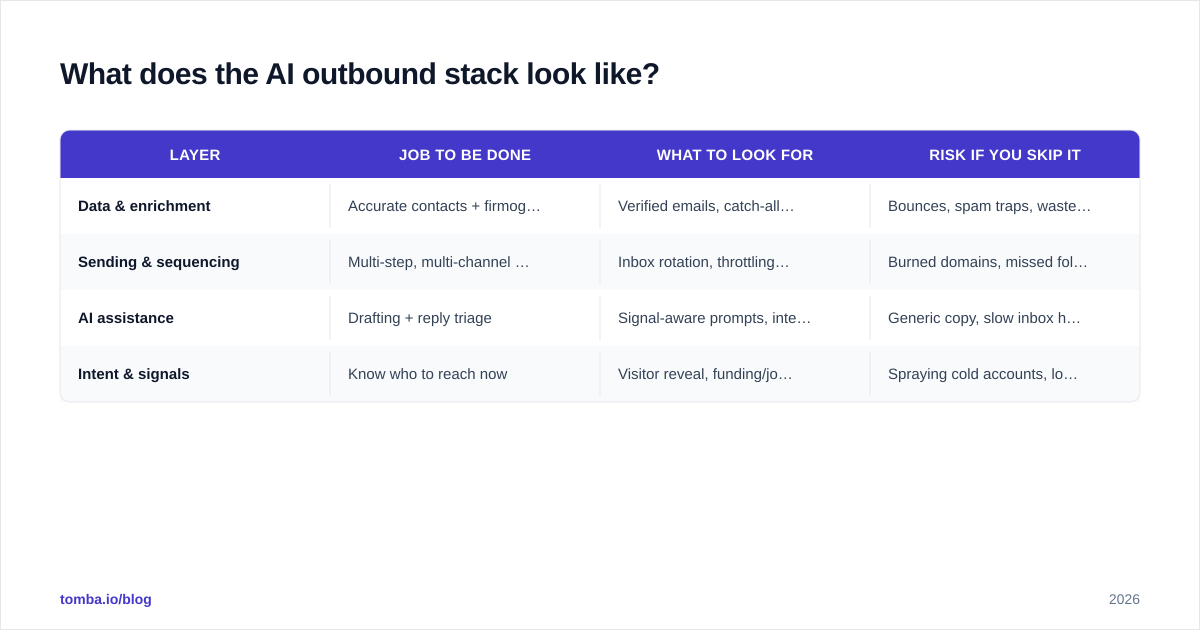
You do not need 15 tools. You need coverage across four jobs: data, sending, AI assistance, and intent. Here is how the categories compare on what actually matters.
| Layer | Job to be done | What to look for | Risk if you skip it |
|---|---|---|---|
| Data & enrichment | Accurate contacts + firmographics | Verified emails, catch-all handling, fresh enrichment | Bounces, spam traps, wasted AI personalization |
| Sending & sequencing | Multi-step, multi-channel cadence | Inbox rotation, throttling, A/B testing | Burned domains, missed follow-ups |
| AI assistance | Drafting + reply triage | Signal-aware prompts, intent classification | Generic copy, slow inbox handling |
| Intent & signals | Know who to reach now | Visitor reveal, funding/job-change triggers | Spraying cold accounts, low reply rates |
The data layer is the one teams under-invest in and the one that determines whether everything downstream works. Compare the cost trade-offs on the Tomba pricing page against what a stack of single-purpose tools would run you.
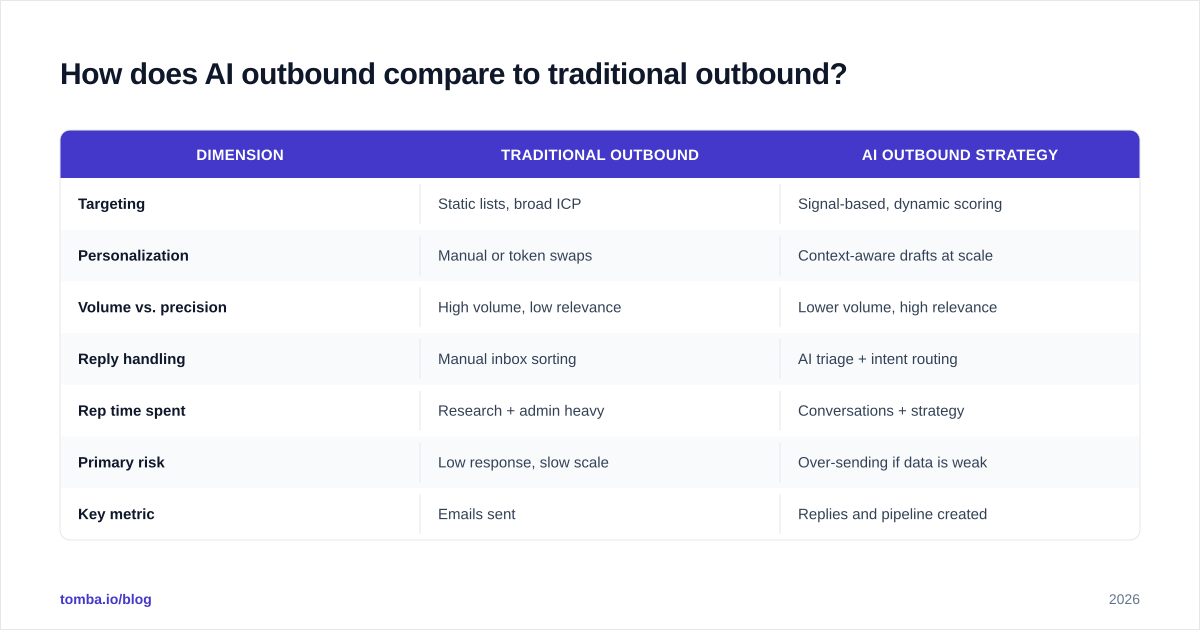
How does AI outbound compare to traditional outbound?#
| Dimension | Traditional outbound | AI outbound strategy |
|---|---|---|
| Targeting | Static lists, broad ICP | Signal-based, dynamic scoring |
| Personalization | Manual or token swaps | Context-aware drafts at scale |
| Volume vs. precision | High volume, low relevance | Lower volume, high relevance |
| Reply handling | Manual inbox sorting | AI triage + intent routing |
| Rep time spent | Research + admin heavy | Conversations + strategy |
| Primary risk | Low response, slow scale | Over-sending if data is weak |
| Key metric | Emails sent | Replies and pipeline created |
The headline difference: traditional outbound treats reps as data-entry clerks who occasionally sell. AI outbound flips that ratio. Reps become closers supported by a system that handles sourcing, enrichment, and triage.

Where should AI stay out of the loop?#
AI is a force multiplier, not an autopilot. Keep humans firmly in control of three things.
Strategy and offer. No model knows your roadmap, pricing flexibility, or which segment your founder wants to win this quarter. That is your call.
High-value conversations. Once a prospect replies with genuine interest, a human takes over. Buyers can tell when they are talking to a bot, and trust erodes fast.
Brand voice and claims. AI will happily invent a statistic or overpromise. Every outbound claim needs a human check. As Gartner's go-to-market research repeatedly notes, buyer trust is the scarcest resource in B2B — one fabricated claim costs more than a hundred sent emails save.
A simple rule: let AI handle the first draft and the last-mile triage, but never the commitment or the truth claims.
How do you protect deliverability when AI lets you send more?#
This is the trap. AI removes the manual friction that used to cap your volume, so it is suddenly easy to 10x your sends — and 10x your spam complaints. Volume without hygiene is how good domains die.
Guard it with four habits:
- Verify before you send. Run every list through verification to strip invalid and risky addresses. Bounces are the fastest way to tank sender reputation.
- Warm up and rotate inboxes. Spread volume across warmed sending addresses rather than blasting from one domain.
- Throttle by signal tier. Reserve high volume for warm, fit accounts. Cold sprays are exactly what mailbox providers penalize.
- Monitor reputation continuously. Track bounce rate, spam complaints, and reply rate as early-warning signals, not lagging ones.
Because AI increases throughput, list hygiene and warmup move from "nice to have" to "the thing standing between you and a blocklist." The more you automate sending, the more disciplined your data and warmup have to be.
What metrics prove an AI outbound strategy is working?#
Stop counting emails sent. That number goes up with effort, not effectiveness. Track the metrics that connect to revenue:
- Reply rate — the cleanest read on relevance and targeting
- Positive reply rate — replies that signal interest, not "unsubscribe"
- Meetings booked per 100 contacts — efficiency of the whole motion
- Pipeline created — the only number leadership actually cares about
- Bounce and spam rate — your deliverability guardrails
If reply rate climbs while volume holds flat or drops, your AI outbound strategy is doing its job: more outcome from less noise. If volume is climbing but replies are flat, you are spraying — pull back and tighten targeting. For benchmarks on what "good" looks like, G2's sales software category aggregates real buyer-reported results across tools.
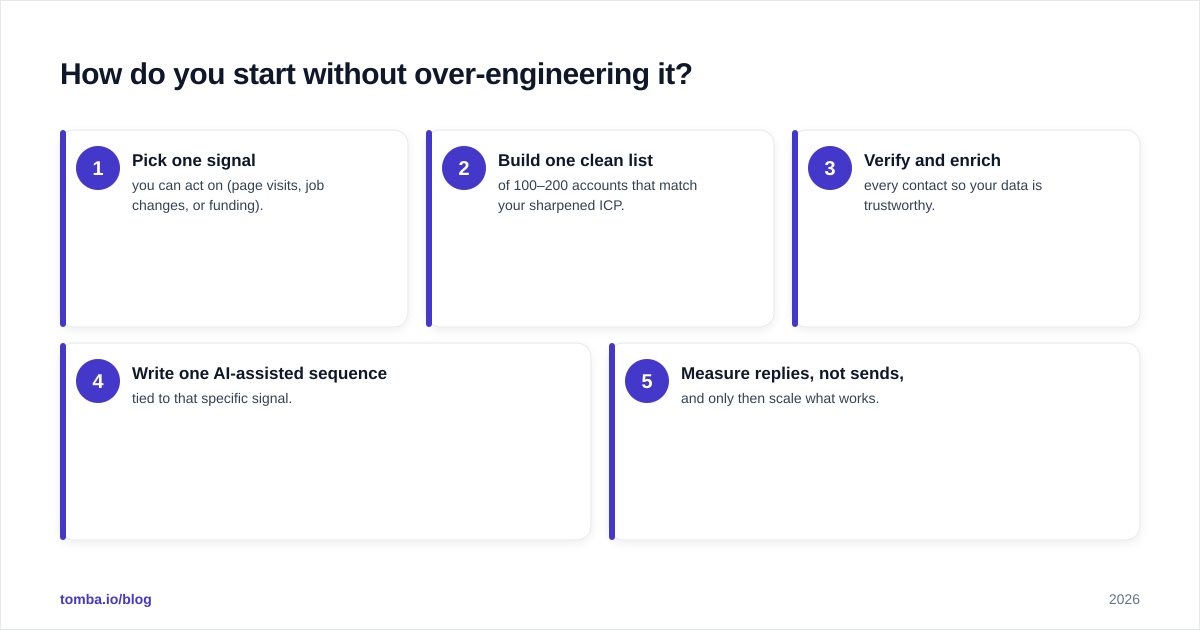
How do you start without over-engineering it?#
Resist the urge to buy a 12-tool stack on day one. Start narrow and prove the loop:
- Pick one signal you can act on (page visits, job changes, or funding).
- Build one clean list of 100–200 accounts that match your sharpened ICP.
- Verify and enrich every contact so your data is trustworthy.
- Write one AI-assisted sequence tied to that specific signal.
- Measure replies, not sends, and only then scale what works.
You will learn more from one tight, signal-based campaign than from a quarter of high-volume guessing. Once the loop produces replies reliably, layer in additional signals, channels, and automation. The strategy scales; the discipline stays the same.
The bottom line#
An AI outbound strategy in 2026 is not about sending more — it is about sending only when you have a reason, to the right person, with accurate data behind every touch. AI handles the heavy lifting of targeting, drafting, and triage. Humans own strategy, relationships, and truth. Data quality holds the whole thing together.
Get the foundation right before you automate. The fastest way to ruin an AI outbound program is to point sophisticated personalization at a dirty list. Start with verified, enriched contacts and the rest of the machine has something solid to run on.
Ready to build the data layer your AI outbound strategy depends on? Tomba Email Finder gives you verified professional emails by name, company, or domain — the accurate foundation that makes AI personalization actually land. Start free with 25 searches a month, then scale on the Starter plan at $49/mo as your signal-based campaigns prove out. Build the list once, build it right, and let your AI do the rest.
// get started
Find, verify and enrich your first contacts today
Start on the free plan with 25 searches a month, then scale when your team is ready.
Free plan · No credit card required · GDPR & CCPA
// about the author