AI Outreach vs Manual Outreach: Which Wins in 2026?
AI outreach scales to thousands of touches a day; manual outreach still books the hardest meetings. Here's exactly when to use each in 2026 — and how to blend them.
TL;DR
- AI outreach wins on volume and cost — you can research, write, and send thousands of personalized-looking touches a day for a fraction of the per-message cost of a human SDR.
- Manual outreach wins on depth — high-value accounts, multi-threaded deals, and anything where a generic-but-personalized message gets ignored.
- Reply rates are converging downward for pure AI sends as buyers learn to spot the patterns; pure manual doesn't scale past a few hundred prospects per rep per month.
- The winning model in 2026 is hybrid: AI handles data, drafting, and tier-3 volume; humans own tier-1 accounts and the final edit on everything that matters.
- Both approaches die without clean data. Accuracy of the underlying contact list moves reply rates more than the writing method ever will.
Sales teams keep framing this as a religious war. It isn't. AI outreach and manual outreach solve different problems, and the question that actually matters is which one for which prospect. This guide breaks down the real trade-offs — cost, reply rate, scale, and deliverability risk — then gives you a decision framework you can apply to your own list this week.
What is AI outreach vs manual outreach?#
Manual outreach is the classic motion: a rep researches a prospect, writes a message by hand, sends it, and follows up personally. Every touch costs human minutes. The ceiling is roughly 30–60 thoughtful, genuinely personalized emails per rep per day before quality collapses.
AI outreach uses software to do some or all of that work: scraping signals, generating first-line personalization, drafting full sequences, and sending at scale through automated sending tools. A single operator running an AI stack can put out thousands of touches a day. Tools like an AI cold email writer draft the body; sending platforms like Instantly or Apollo handle rotation and throttling.
The confusion starts because "AI outreach" spans a huge quality range. A lazy {{first_name}}, I loved your work at {{company}} blast and a sharp, signal-triggered message written by a fine-tuned model are both "AI outreach" — but they perform nothing alike.
How do AI and manual outreach compare head to head?#
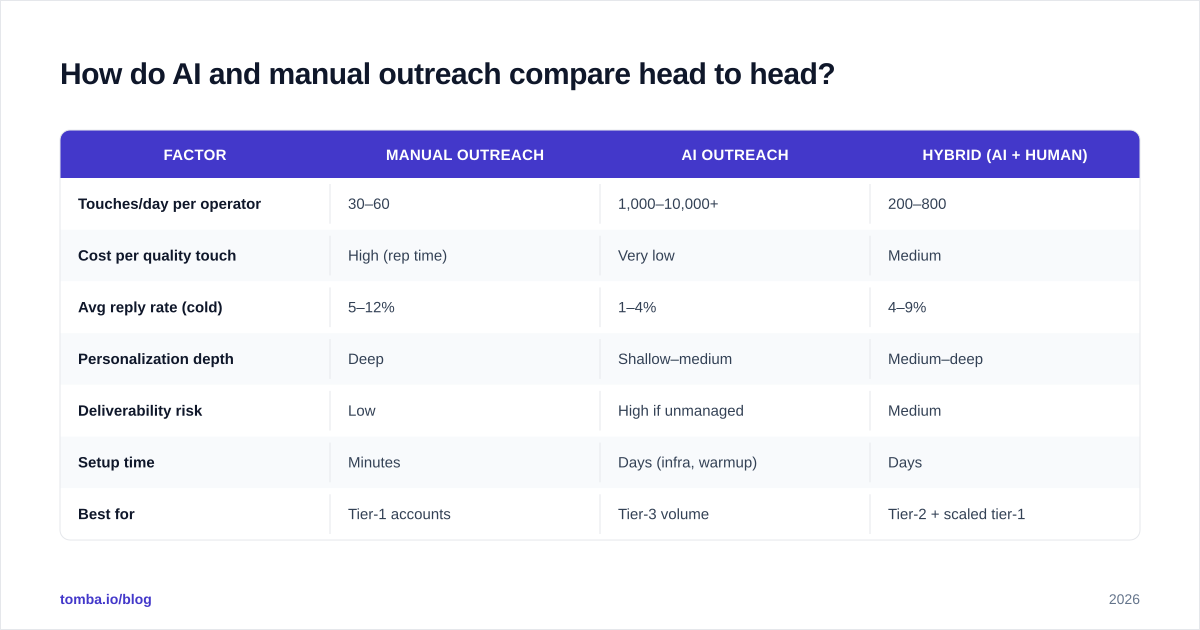
Here's the honest scorecard. No single column wins every row, which is the whole point.
| Factor | Manual outreach | AI outreach | Hybrid (AI + human) |
|---|---|---|---|
| Touches/day per operator | 30–60 | 1,000–10,000+ | 200–800 |
| Cost per quality touch | High (rep time) | Very low | Medium |
| Avg reply rate (cold) | 5–12% | 1–4% | 4–9% |
| Personalization depth | Deep | Shallow–medium | Medium–deep |
| Deliverability risk | Low | High if unmanaged | Medium |
| Setup time | Minutes | Days (infra, warmup) | Days |
| Best for | Tier-1 accounts | Tier-3 volume | Tier-2 + scaled tier-1 |
| Scales with headcount? | Linearly (expensive) | Almost free | Sub-linearly |
A few numbers deserve context. The reply-rate ranges assume a clean list and a relevant offer — change either and they collapse. Buyers in 2026 have seen millions of AI first-lines, so the "I noticed you recently..." opener now reads as a tell, not a compliment. Manual outreach holds its reply rate partly because it's rare.
For a deeper baseline on what "good" looks like, see how teams benchmark their email response rate before they blame the writing.
Is AI outreach better than manual outreach?#
For raw pipeline math at the top of the funnel, yes. For closing complex deals, no. The right answer depends on deal size and account tier.
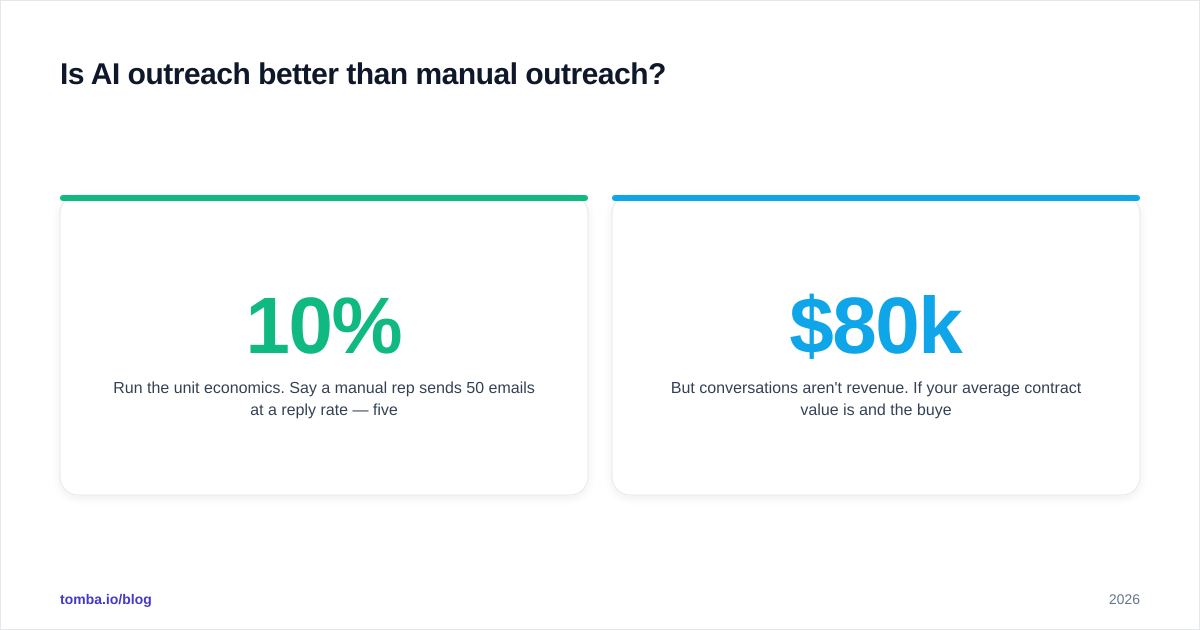
Run the unit economics. Say a manual rep sends 50 emails/day at a 10% reply rate — five conversations. An AI operator sends 3,000/day at a 2% reply rate — sixty conversations. On volume alone, AI buries manual.
But conversations aren't revenue. If your average contract value is $80k and the buyer expects a tailored, multi-threaded approach, the AI conversation that started with a generic line often stalls at "send me some info." The manual conversation, opened by a rep who clearly did the work, converts at multiples of the AI rate. HubSpot's sales research and Gartner's B2B buying studies both point the same direction: complex purchases reward human relevance, transactional ones reward reach.
So the real rule:
- Low ACV, high volume, simple product → AI outreach wins.
- High ACV, few accounts, complex buying committee → manual wins.
- Everything in the middle → hybrid, which is most of B2B.
What does the AI vs manual decision framework look like?#
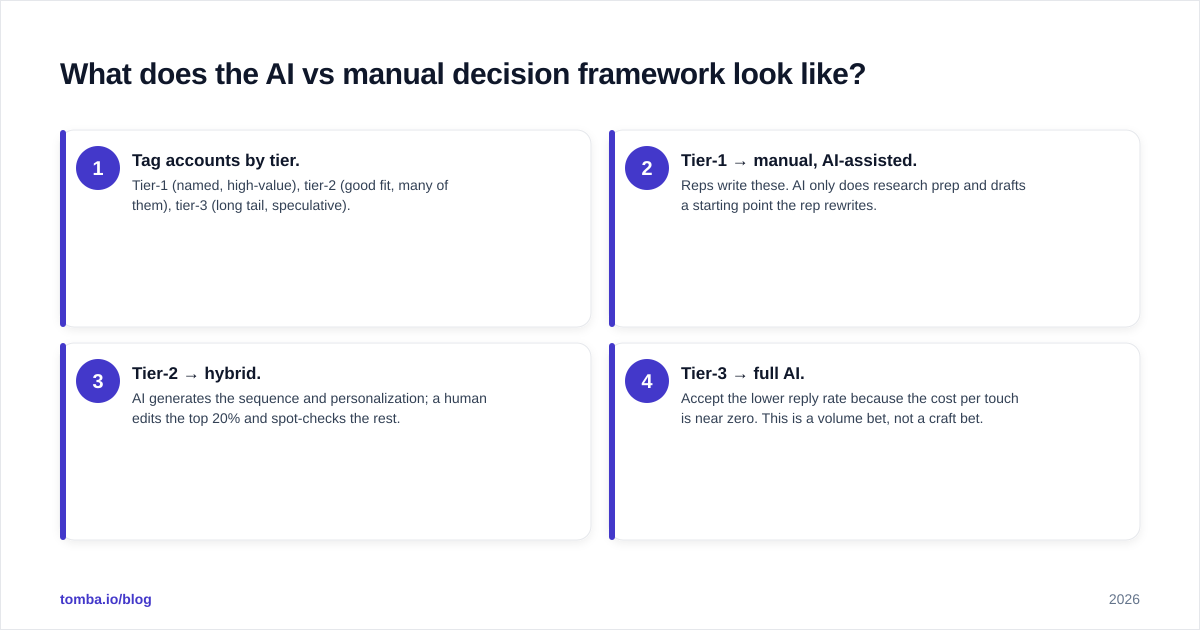
Score every segment of your list on three axes before you pick a method: account value, list size, and message specificity required. When all three are high, humans lead. When all three are low, automate. The diagram below maps the four quadrants.
Walk through it with a real list:
- Tag accounts by tier. Tier-1 (named, high-value), tier-2 (good fit, many of them), tier-3 (long tail, speculative).
- Tier-1 → manual, AI-assisted. Reps write these. AI only does research prep and drafts a starting point the rep rewrites.
- Tier-2 → hybrid. AI generates the sequence and personalization; a human edits the top 20% and spot-checks the rest.
- Tier-3 → full AI. Accept the lower reply rate because the cost per touch is near zero. This is a volume bet, not a craft bet.
This is also where most teams discover their bottleneck isn't writing at all — it's data. Which brings us to the part everyone skips.
Why does data quality decide the winner?#
Both methods fail on a bad list, but AI fails louder. A human sending to a wrong address wastes one message. An AI system sending to a list that's 30% invalid torches your domain reputation across thousands of sends at once.
Reply rate is a fraction: relevant message ÷ reachable, real person. AI optimizes the numerator. If the denominator is garbage — stale contacts, catch-all domains, role accounts — no amount of clever copy saves you. This is why deliverability collapses for teams that scale AI sending on scraped lists without verification.
Before any send, automated or manual, the non-negotiables are:
- Verified deliverability. Run the list through an email verifier and drop the risky and invalid addresses. This single step protects sender reputation more than any warmup trick.
- Accurate sourcing. Pull contacts from a method that actually returns the right person — an email finder keyed to name and domain beats guessing patterns.
- Enriched context. Title, seniority, company signals, and recent triggers are what make AI personalization land instead of read like a template. Feed your model real data via contact enrichment.
For high-volume AI motions specifically, a bulk email finder plus verification step is the difference between a 2% reply rate and a blacklisted domain. The writing method is downstream of this. Get it backwards and you'll A/B test subject lines while your real problem is that a third of your list never existed.
What are the risks of going all-in on AI outreach?#
Three failure modes show up repeatedly, and all three are getting worse, not better, in 2026.
Deliverability blowups. Sending thousands of cold emails from under-warmed domains is the fastest way to land in spam. Mailbox providers now weight engagement heavily; low open and reply rates from AI blasts signal "unwanted" and tank your placement. You can check your standing with a sender reputation checker before and during a campaign.
Pattern fatigue. Buyers and spam filters both learned the AI tells: the fake-casual opener, the "quick question," the three-sentence rhythm. G2 reviews and sales communities are full of buyers screenshotting obvious AI sequences. What worked in 2023 now actively signals "ignore me." Independent tool reviews on G2 make the saturation obvious.
Compliance and brand risk. AI that hallucinates a detail about a prospect's company — or scrapes data it shouldn't — creates legal and reputational exposure that one bad manual email never would, because it happens at scale.
None of these kill AI outreach. They argue for governed AI outreach: verified lists, warmed infrastructure, human review on anything customer-facing, and conservative volume ramps.
How do you build a hybrid outreach motion?#
Let AI do the labor, let humans own the judgment. The split that works for most teams:
- AI does: list building, verification triage, enrichment, signal monitoring, first-draft sequences, follow-up scheduling, and reply classification.
- Humans do: account selection for tier-1, the final edit on high-value messages, live objection handling, multi-threading the buying committee, and anything that requires reading between the lines.
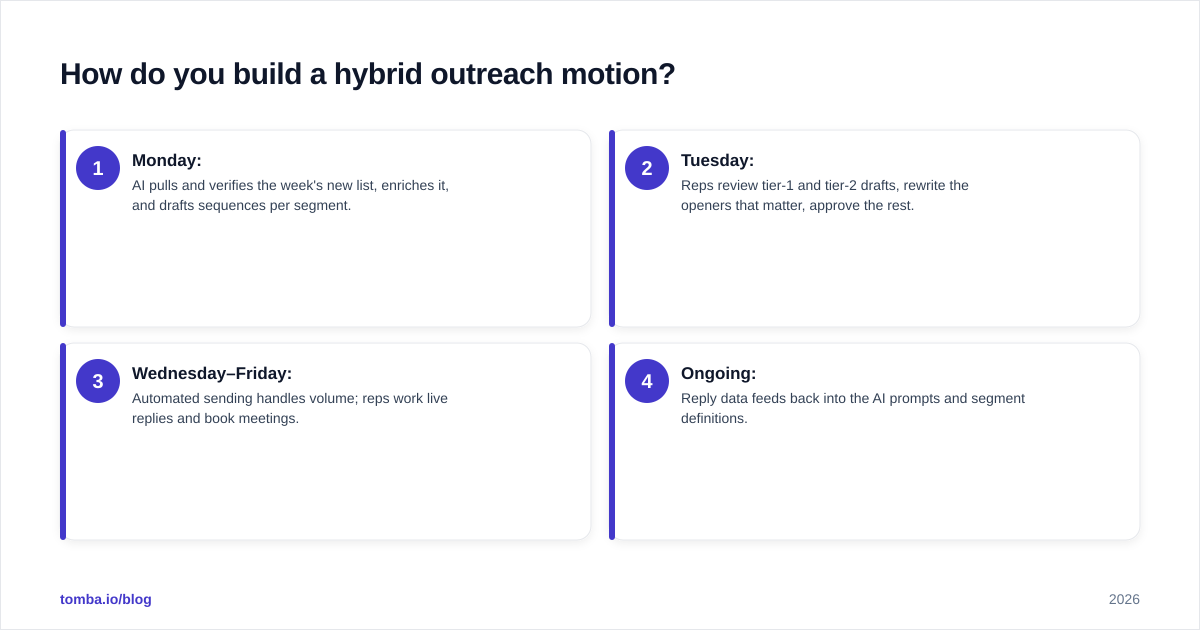
A practical weekly cadence:
- Monday: AI pulls and verifies the week's new list, enriches it, and drafts sequences per segment.
- Tuesday: Reps review tier-1 and tier-2 drafts, rewrite the openers that matter, approve the rest.
- Wednesday–Friday: Automated sending handles volume; reps work live replies and book meetings.
- Ongoing: Reply data feeds back into the AI prompts and segment definitions.
This is why hybrid beats both extremes on the scorecard above: it captures most of AI's cost advantage while keeping the human relevance that actually closes. The teams winning in 2026 aren't choosing AI or manual — they're choosing which tasks each is best at and refusing to let either touch the wrong tier.
Which approach should you choose?#
Start from your numbers, not your preferences. Map your pipeline against three questions:
- What's your average deal size? Under ~$10k ACV, lean AI-heavy. Over ~$50k, lean manual-heavy. In between, build the hybrid.
- How big is your addressable list? A few hundred named accounts means manual is feasible and probably correct. Tens of thousands means you need automation just to cover it.
- How clean is your data right now? If you don't know, that's your first project — not your copy, not your tool stack.
Whichever way you lean, the foundation is identical: a verified, enriched, accurately sourced contact list. AI can't personalize data it doesn't have, and a rep can't book a meeting with an email that bounces. Start by building a list of real, reachable decision-makers with the Tomba Email Finder — find verified professional emails by name, company, or domain, then run them through verification before a single message goes out. Pair it with bulk lookup for your AI volume tiers and enrichment for the context that makes any message — human or machine — actually land. Compare what fits your stage on the Tomba pricing page; the free tier covers 25 searches a month to test the workflow before you commit.
The outreach-method debate will keep raging. The data-quality requirement won't change. Win that, and both AI and manual start working — separately, and far better together.
// get started
Find, verify and enrich your first contacts today
Start on the free plan with 25 searches a month, then scale when your team is ready.
Free plan · No credit card required · GDPR & CCPA
// about the author