AI People Search in 2026: Tools, Accuracy, and Real Use Cases
AI people search turns a single name or email into a full profile in seconds. Here's how the tech actually works, where it's accurate, and which tools to use in 2026.
TL;DR
- AI people search uses machine learning to match a partial identifier — a name, email, phone number, or company domain — against billions of public records and return a unified profile in seconds.
- The best tools blend several data layers (public records, professional profiles, web crawl data, and verified email/phone signals) instead of relying on one source.
- Accuracy varies wildly by use case: B2B contact discovery is now 90%+ reliable, while consumer "background" lookups remain noisier and carry legal limits (FCRA, GDPR).
- For sales and recruiting, a B2B-focused engine with built-in verification beats a generic people-finder because it returns work emails you can actually send to.
- Tomba's email finder and enrichment tools sit on the B2B side of this map: name + domain in, verified business contact out.
What is AI people search?#
AI people search is a lookup engine that takes one piece of information about a person and returns a structured profile of everything else it can confidently link to them. Think of it like a librarian who, given only a book's first sentence, walks the entire library and hands you the title, author, edition, and every review ever written — except the "library" is the public internet plus licensed data sets, and the "librarian" is a model trained to score how likely two records describe the same human.
The "AI" part matters because the hard problem isn't storing data — it's entity resolution. There are thousands of people named "David Chen." Deciding which David Chen owns dchen@acme.com, which LinkedIn profile, and which phone number is a probabilistic matching task. Older directories did this with rigid rules; modern tools use machine-learning models that weigh dozens of weak signals (shared employer, overlapping timeline, email pattern, geographic clustering) into a single confidence score.
That shift is why a query that returned three stale phone numbers in 2019 now returns a verified work email, a current job title, and a LinkedIn URL in 2026.
How does AI people search actually work?#
Under the hood, almost every serious tool runs the same four-stage pipeline. Understanding it tells you why results differ between vendors.
- Ingestion. The engine pulls from many sources: public records, company websites, professional networks, news, web-crawl data, and licensed B2B databases. Coverage breadth here is the single biggest predictor of hit rate.
- Normalization. Raw records are messy — "Acme Inc.", "Acme, Incorporated", and "acme.com" all need to collapse into one canonical company. Names, titles, and locations get standardized.
- Entity resolution. The model clusters records it believes belong to the same person and assigns a confidence score. This is where AI earns its keep.
- Verification. The best platforms don't stop at "we think this email exists" — they run a live SMTP or pattern check before showing it to you. This is the difference between a guess and a deliverable address.
That last stage is why we separate finding from verifying. A people-search tool that skips verification hands you bounces. If you want to understand the verification half in depth, our breakdown of email verification walks through SMTP checks, catch-all handling, and risk scoring.
What can you actually find with AI people search?#
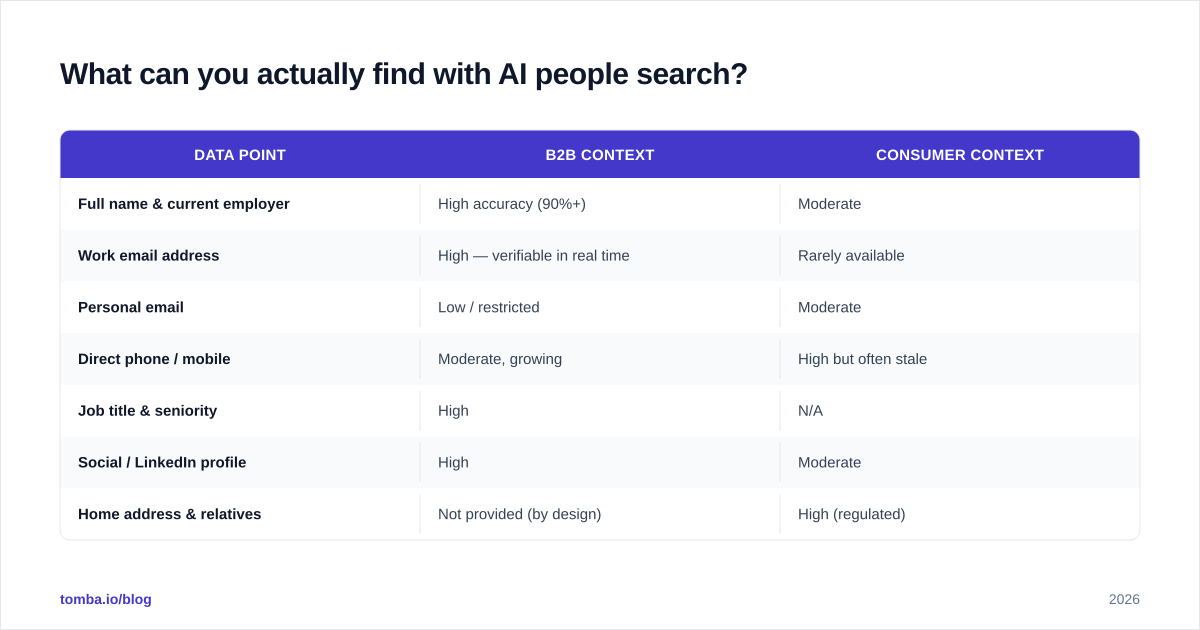
The honest answer: it depends on whether you're searching in a B2B or consumer context. They draw from different data and live under different rules.
| Data point | B2B context | Consumer context |
|---|---|---|
| Full name & current employer | High accuracy (90%+) | Moderate |
| Work email address | High — verifiable in real time | Rarely available |
| Personal email | Low / restricted | Moderate |
| Direct phone / mobile | Moderate, growing | High but often stale |
| Job title & seniority | High | N/A |
| Social / LinkedIn profile | High | Moderate |
| Home address & relatives | Not provided (by design) | High (regulated) |
| Legal / background records | Not provided | High (FCRA-gated) |
The takeaway: if your goal is reaching a decision-maker at a company, a B2B engine is both more accurate and more legally comfortable. If your goal is locating a long-lost relative, a consumer people-finder is the right tool — but it comes with compliance strings attached, which we cover below.
Is AI people search better than manual research?#
Yes, for any volume above a handful of contacts — and it's not close.
A skilled researcher can find a verified work email manually: check the company site for the email pattern, confirm the person's name and role on LinkedIn, then test the address. Done well, that's three to eight minutes per contact. An AI people search tool does the same chain — pattern detection, role confirmation, live verification — in under two seconds, and it doesn't get tired on contact number 400.
Where humans still win is judgment: deciding whether a borderline match is really your prospect, or whether a title like "VP, Special Projects" maps to the buying role you care about. The 2026 best practice is a hybrid — let the tool do the retrieval and verification, and spend your human minutes on targeting and messaging instead of data entry.
This is also why generic search engines don't replace these tools. Google can surface a profile, but it won't resolve entities, score confidence, or hand you a deliverable email. For B2B teams, a purpose-built email finder closes that gap by going straight from name and company to a verified address.
Which AI people search tools should you compare in 2026?#
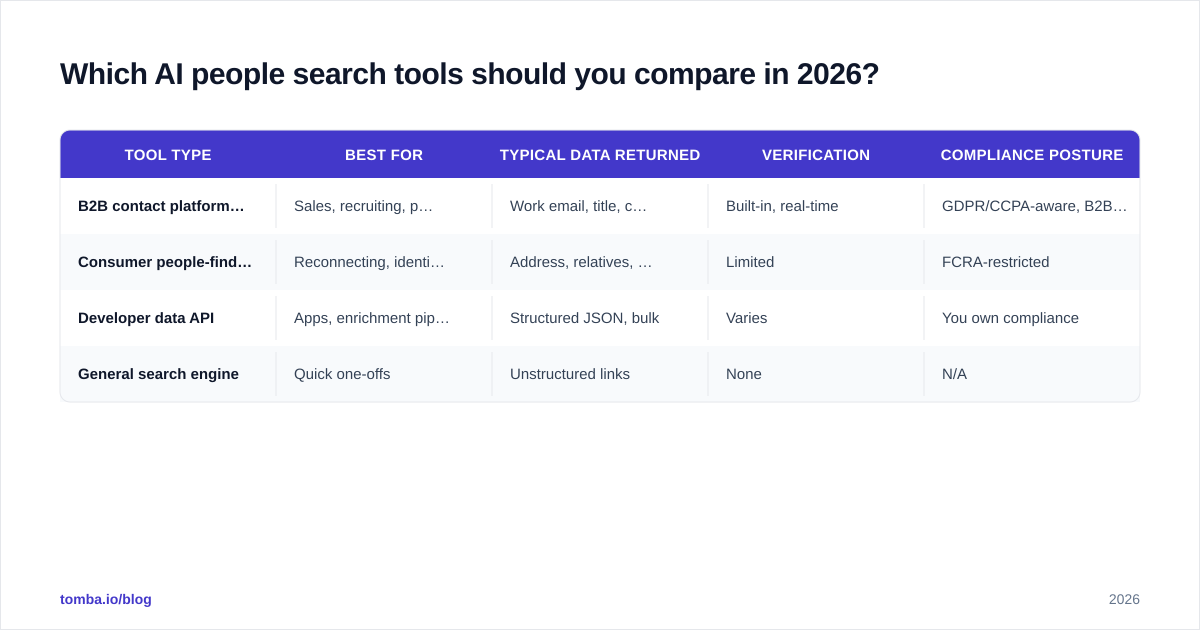
The market splits into three rough camps: B2B contact platforms, consumer people-finders, and developer data APIs. Picking the wrong camp is the most common mistake — a recruiter using a consumer tool gets home addresses they can't legally use, while a genealogist using a B2B tool finds nothing.
| Tool type | Best for | Typical data returned | Verification | Compliance posture |
|---|---|---|---|---|
| B2B contact platform (e.g., Tomba) | Sales, recruiting, partnerships | Work email, title, company, phone | Built-in, real-time | GDPR/CCPA-aware, B2B basis |
| Consumer people-finder (e.g., Spokeo) | Reconnecting, identity checks | Address, relatives, personal contact | Limited | FCRA-restricted |
| Developer data API | Apps, enrichment pipelines | Structured JSON, bulk | Varies | You own compliance |
| General search engine | Quick one-offs | Unstructured links | None | N/A |
For B2B specifically, the attributes that separate winners from also-rans are data freshness, real-time verification, and clean enrichment. Tomba's approach leans on transparent data sources and a verification layer so the contact you export is one you can actually send to. You can compare plans on the Tomba pricing page — the free tier gives 25 searches a month to test accuracy before you commit.
If you want third-party validation rather than vendor claims, cross-check categories like email finders and sales intelligence on G2 where reviews are public and tied to verified users.

How accurate is AI people search?#
Accuracy is best understood as two separate numbers that vendors often blur together: coverage (did it find anyone?) and precision (is the person it found the right one, with correct, current data?).
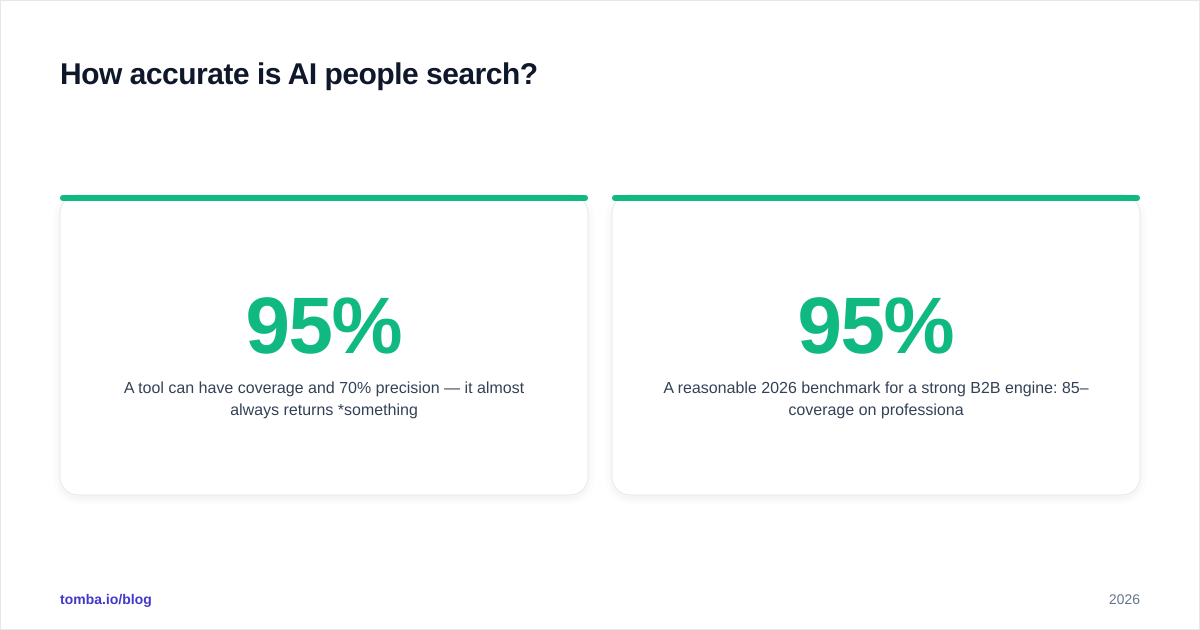
A tool can have 95% coverage and 70% precision — it almost always returns something, but a chunk of those somethings are wrong or stale. For outreach, precision is the number that protects your sender reputation, because sending to wrong or dead addresses drives bounces and spam complaints. That's why the verification stage isn't optional; if you skip it, see how bounces erode sender reputation and why deliverability suffers.
Three things move accuracy in 2026:
- Recency of the underlying crawl. Job changes are the enemy. People switch roles every two to three years, so a database refreshed monthly badly beats one refreshed yearly.
- Catch-all handling. Many corporate domains accept every address, defeating naive SMTP checks. Tools that flag and specially handle catch-alls — like a dedicated catch-all verifier — report honest confidence instead of false greens.
- Multi-source corroboration. A title confirmed by three independent sources is far likelier to be current than one scraped from a single stale page.
A reasonable 2026 benchmark for a strong B2B engine: 85–95% coverage on professional targets, with verified-email precision in the same range once you discard the low-confidence results the tool itself flags.
Is AI people search legal and ethical?#
Mostly yes for B2B, with real guardrails for consumer use — and the distinction is the whole ballgame.
In a B2B context, processing business contact data (work email, title, employer) for legitimate outreach is broadly permitted under frameworks like GDPR's "legitimate interest" and the CCPA, provided you honor opt-outs and disclose your identity. This is the lane Tomba operates in. The general principle, as summarized on Wikipedia's GDPR overview, is that you need a lawful basis and must respect data-subject rights.
Consumer people-search carries heavier rules. In the US, using results for hiring, tenant screening, or credit decisions triggers the Fair Credit Reporting Act (FCRA), and most consumer tools explicitly prohibit those uses unless they're a licensed consumer-reporting agency. Major CRM and data vendors publish their own compliance guidance — HubSpot's data privacy resources are a practical starting point for outreach teams.
Ethical floor, regardless of jurisdiction:
- Only collect what you have a business reason to use.
- Always offer a clear way to opt out.
- Never use people-search data for harassment, stalking, or discrimination.
- Keep enriched data secure and delete it when the basis expires.
How do you choose the right tool for your use case?#
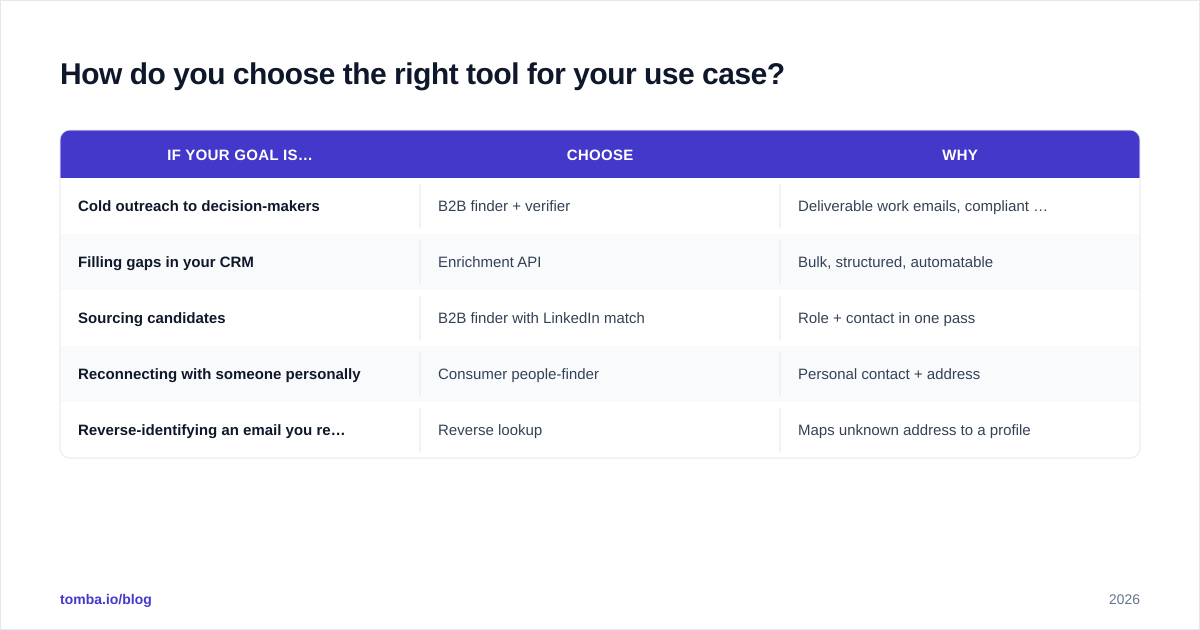
Match the tool to the job, then weight by data quality. Here's the decision shortcut.
| If your goal is… | Choose | Why |
|---|---|---|
| Cold outreach to decision-makers | B2B finder + verifier | Deliverable work emails, compliant basis |
| Filling gaps in your CRM | Enrichment API | Bulk, structured, automatable |
| Sourcing candidates | B2B finder with LinkedIn match | Role + contact in one pass |
| Reconnecting with someone personally | Consumer people-finder | Personal contact + address |
| Reverse-identifying an email you received | Reverse lookup | Maps unknown address to a profile |
For most readers of this blog — sales, marketing, and recruiting — the answer lands on the B2B side. Two Tomba tools cover the common workflows: enrich leads when you already have a list and need to fill in titles and verified emails, and reverse email lookup when you've got an address but no name. Both share the same verification layer, so what you export is what you can actually use.
A practical buying checklist:
- Does it verify emails in real time, or just guess from a pattern?
- How often is the underlying data refreshed?
- Does it expose a confidence score so you can filter aggressively?
- Is there a free tier to benchmark accuracy on your target accounts before paying?
- Does the compliance posture match how you'll actually use the data?
Where does this go next?#
The near-term trajectory is less "search" and more "agent." Instead of you typing a name, AI agents will increasingly pull contact and context automatically the moment a lead enters your pipeline, enrich it, verify it, and route it — all before a human looks. The retrieval problem is largely solved; the 2026 frontier is integrating clean, verified people data directly into the systems where work happens, from your CRM to your outreach sequencer.
That raises the bar on data quality, not lowers it. An agent acting on bad data fails silently and at scale. So the durable advantage isn't the flashiest interface — it's the boring discipline of fresh sources and honest verification underneath.
Start with verified B2B contact data#
If your version of "AI people search" means reaching the right person at the right company with an email that lands, start with the tool built for exactly that. The Tomba Email Finder takes a name and a domain and returns a verified business email with a confidence score — no scraping, no guesswork, and no bounces eating your sender reputation. Test it on your own target accounts with the free tier's 25 monthly searches, then scale into the Starter plan at $49/mo once the accuracy proves itself on real prospects. Find people you can actually reach, and spend your time on the conversation instead of the lookup.
// get started
Find, verify and enrich your first contacts today
Start on the free plan with 25 searches a month, then scale when your team is ready.
Free plan · No credit card required · GDPR & CCPA
// about the author