AI Sales Content Generation in 2026: A Practical Playbook
AI sales content generation can flood inboxes with generic noise or compress hours of writing into minutes. The difference is your data and your workflow. Here's how to do it right in 2026.
TL;DR
- AI sales content generation means using large language models to draft emails, sequences, call scripts, LinkedIn messages, and one-pagers — at speed and scale.
- The tools are commoditized. Your edge is the data layer (who you're writing to and why) and the review workflow (how you keep quality high).
- Generic AI output gets ignored. Personalized AI output — grounded in real prospect signals — converts because it reads like a human did the homework.
- A repeatable system beats a clever prompt: research → draft → personalize → QA → send → measure.
- Start small. Pick one asset type, wire in verified contact data, and measure reply rate before you scale to your whole motion.
What is AI sales content generation?#
AI sales content generation is the practice of using AI models to produce the written assets your sales team sends every day: cold emails, follow-up sequences, call scripts, LinkedIn DMs, proposal blurbs, and objection-handling snippets.
Think of it like a sous-chef in a busy kitchen. The chef (your rep) still owns the dish and plates it for the customer, but the sous-chef handles the prep — chopping, measuring, getting the base sauce ready. AI does the prep work of writing so your reps spend their time on judgment, relationships, and closing.
Technically, these tools wrap a model (GPT, Claude, Gemini, or an open-weight equivalent) in a sales-specific interface: prompt templates, CRM context injection, brand-voice settings, and sequence builders. The model predicts the next most likely tokens; the wrapper makes that prediction useful for a quota-carrying human.
The catch: a model with no context writes plausible, polished, forgettable copy. The whole game in 2026 is feeding it the right context.
Why does AI sales content matter in 2026?#
Buyers are drowning. The average B2B decision-maker gets more cold outreach than ever, and most of it is obviously machine-made. According to HubSpot's sales research, personalization and relevance are the top drivers of reply rates — and that's exactly where lazy AI fails.
So there's a paradox. AI makes it trivial to send 10,000 mediocre emails, which makes mediocre email worthless. The same technology, pointed at quality instead of quantity, lets a small team produce genuinely tailored outreach at a volume that used to require ten SDRs.
Gartner's go-to-market research has tracked this shift toward AI-augmented selling for several years: the winners aren't the teams that automate the most, they're the teams that automate the boring parts and reinvest the saved time into relevance.

That's the opportunity. AI sales content generation matters because it changes the unit economics of personalized outreach — but only if you treat output quality as the constraint, not output volume.
How does AI sales content generation actually work?#
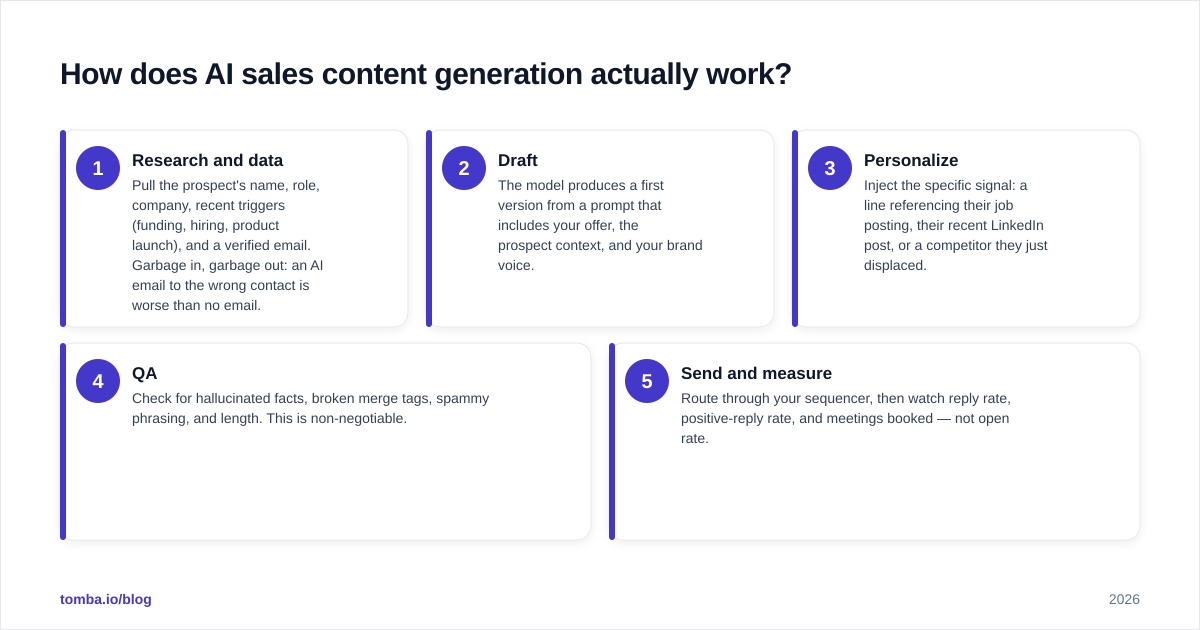
A production-grade workflow has five stages. Skip any one and quality collapses.
- Research and data — Pull the prospect's name, role, company, recent triggers (funding, hiring, product launch), and a verified email. Garbage in, garbage out: an AI email to the wrong contact is worse than no email.
- Draft — The model produces a first version from a prompt that includes your offer, the prospect context, and your brand voice.
- Personalize — Inject the specific signal: a line referencing their job posting, their recent LinkedIn post, or a competitor they just displaced.
- QA — Check for hallucinated facts, broken merge tags, spammy phrasing, and length. This is non-negotiable.
- Send and measure — Route through your sequencer, then watch reply rate, positive-reply rate, and meetings booked — not open rate.
The data stage is where most teams quietly fail. You can't personalize at scale if you don't have clean, current contact data. That's why the workflow starts with an email finder and data enrichment before a single word gets generated. The AI is only as smart as the record you hand it.
What types of sales content can AI generate well?#
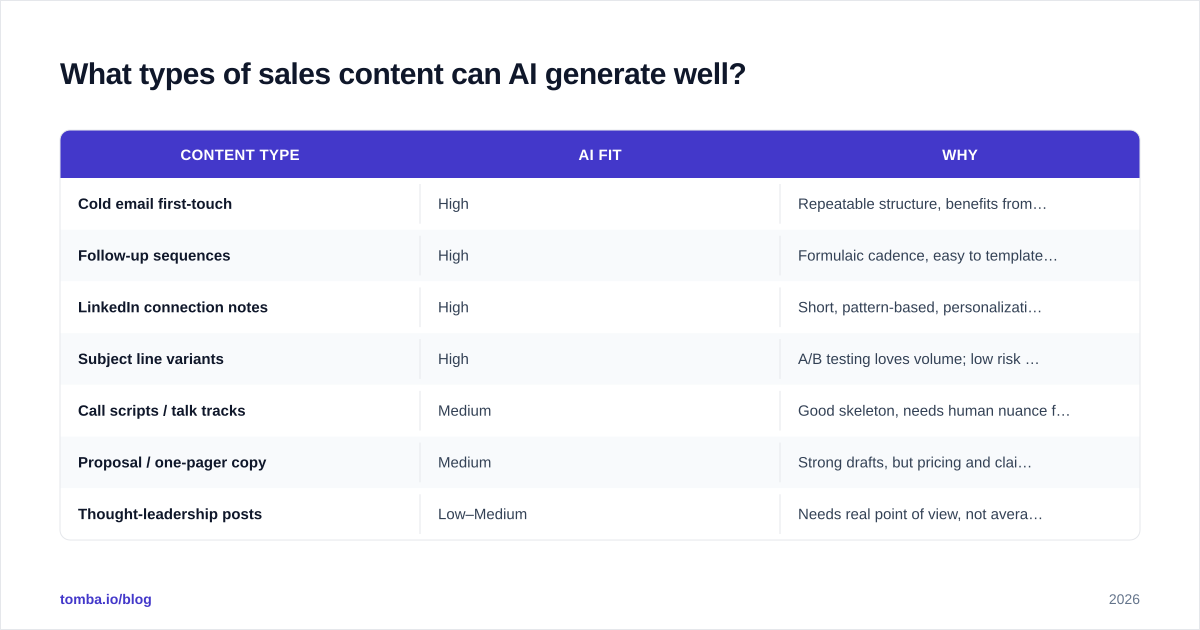
Not every asset is a good fit. AI excels at high-volume, pattern-heavy writing and struggles with anything that needs deep, current, proprietary insight.
| Content type | AI fit | Why |
|---|---|---|
| Cold email first-touch | High | Repeatable structure, benefits from volume + variants |
| Follow-up sequences | High | Formulaic cadence, easy to template and vary |
| LinkedIn connection notes | High | Short, pattern-based, personalization-friendly |
| Subject line variants | High | A/B testing loves volume; low risk per line |
| Call scripts / talk tracks | Medium | Good skeleton, needs human nuance for objections |
| Proposal / one-pager copy | Medium | Strong drafts, but pricing and claims need review |
| Thought-leadership posts | Low–Medium | Needs real point of view, not averaged consensus |
| Technical / compliance claims | Low | Hallucination risk is unacceptable here |
The pattern: the more a piece depends on structure, the better AI does. The more it depends on truth and originality, the more human oversight you need. Use AI to draft your cold email templates and follow-ups; use humans to vet anything a buyer could hold you to.
If you're standardizing your team's library, pairing AI drafts with a vetted set of cold email templates gives the model a proven skeleton to riff on instead of inventing structure from scratch.
Is AI-generated sales content better than human-written?#
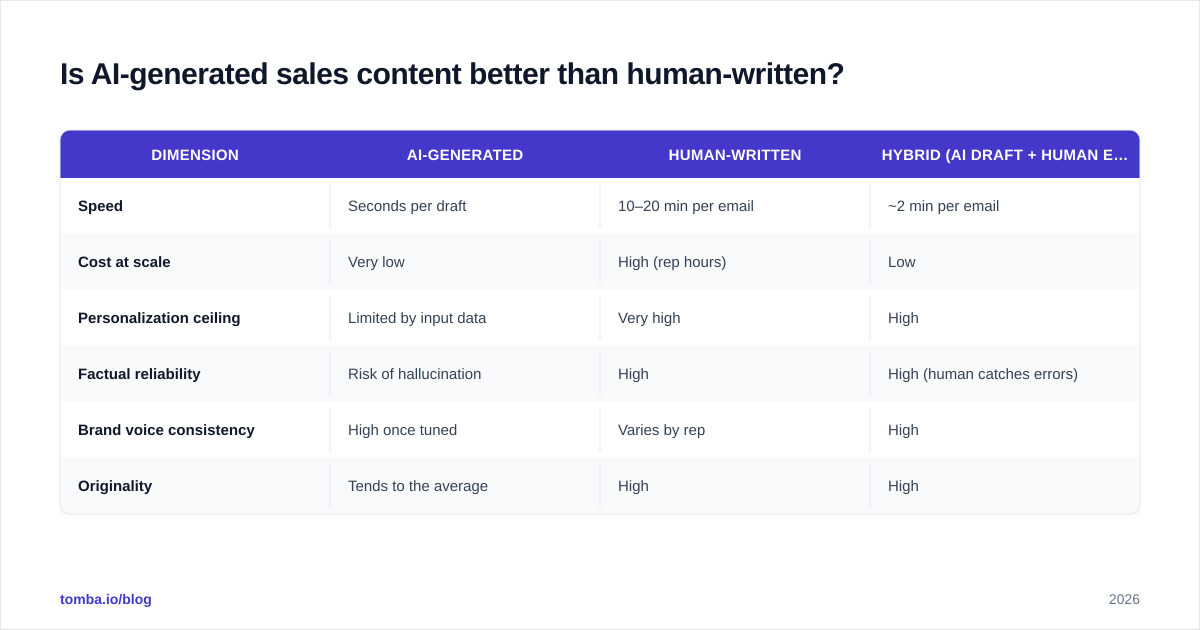
Short answer: neither wins alone — the hybrid wins. The best results come from AI drafting and a human editing, not from picking a side.
Here's the honest trade-off across the dimensions that matter:
| Dimension | AI-generated | Human-written | Hybrid (AI draft + human edit) |
|---|---|---|---|
| Speed | Seconds per draft | 10–20 min per email | ~2 min per email |
| Cost at scale | Very low | High (rep hours) | Low |
| Personalization ceiling | Limited by input data | Very high | High |
| Factual reliability | Risk of hallucination | High | High (human catches errors) |
| Brand voice consistency | High once tuned | Varies by rep | High |
| Originality | Tends to the average | High | High |
The hybrid model is the practical answer. Let AI handle the 80% that's structural — opening, value prop framing, CTA — and have a human spend 90 seconds adding the one specific, true detail that makes the prospect feel seen. That single line is usually the difference between a reply and a delete.
A note on tone: AI loves filler. "I hope this email finds you well," "In today's fast-paced world," "I wanted to reach out." Strip all of it. The fastest quality win in AI sales content is a hard editing pass that deletes every sentence that doesn't earn its place.
What should you look for in an AI sales content tool?#
The market is crowded, and most tools share the same underlying models. Differentiation comes from the surrounding system, not the raw text generation. Evaluate on these:
- Data integration — Does it connect to verified contact data and your CRM, or do you paste context manually? This is the single biggest quality lever.
- Brand voice control — Can you train it on your past winning emails and tone samples?
- Sequence-native — Does it generate whole cadences with logical step-to-step progression, or just one-off emails?
- Deliverability awareness — Spam-word checks, length limits, and plain-text formatting matter as much as the words.
- Human-in-the-loop — Is there a real review step, or does it push to send automatically?
- Measurement — Does it tie content variants back to reply and meeting metrics?
Compare a few options on G2 before committing — the category churns fast, and the right pick depends on whether you're a one-person founder-led motion or a 40-rep team.
For the actual writing step, a focused tool like Tomba's cold email AI generates drafts you can refine, and a subject line generator gives you variants to test. But remember the order of operations: the tool that generates the words is downstream of the tool that finds and verifies the contact.
How do you keep AI sales content from sounding like spam?#
Five rules, in order of impact:
- Ground every email in a real signal. No personalization token is a substitute for a genuine observation. "Saw you're hiring three AEs" beats "Hi {{FirstName}}, I hope you're well."
- Verify the contact first. Sending AI-perfect copy to a stale or guessed address torches your deliverability. Run addresses through an email verifier before the sequence starts.
- Cut length by half. AI over-writes. If the draft is six sentences, two of them are filler. Delete them.
- Vary at the structural level. Identical templates with swapped names trip spam filters. Rotate openings, CTAs, and sentence shapes across your list.
- Lead with the prospect, not your product. The first line should be about them. The pitch comes after you've earned three seconds of attention.
Deliverability is a system, not a setting. Even great copy fails if your domain reputation is poor, so pair your content workflow with proper warmup, SPF/DKIM, and verified lists. Clean data feeds both relevance and inbox placement.
A simple 30-day rollout plan#
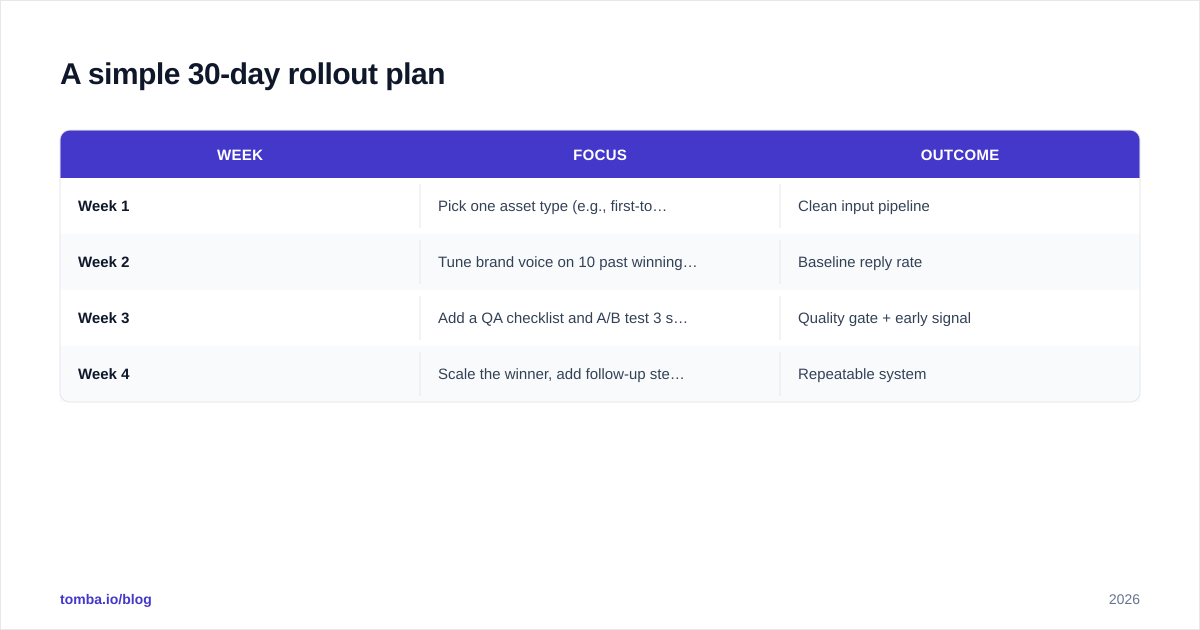
Don't boil the ocean. Pilot, measure, then expand.
| Week | Focus | Outcome |
|---|---|---|
| Week 1 | Pick one asset type (e.g., first-touch cold email) and wire in verified contact data | Clean input pipeline |
| Week 2 | Tune brand voice on 10 past winning emails; draft 50 personalized emails | Baseline reply rate |
| Week 3 | Add a QA checklist and A/B test 3 subject-line variants | Quality gate + early signal |
| Week 4 | Scale the winner, add follow-up steps, document the workflow | Repeatable system |
By day 30 you'll know your real reply rate, which variants work, and whether the motion is worth scaling — all on evidence, not vibes.
The bottom line#
AI sales content generation is no longer a competitive edge by itself — everyone has the same models. The edge in 2026 is the system around the model: verified data going in, ruthless human editing in the middle, and reply-rate measurement coming out. Treat AI as the sous-chef, not the chef, and you'll send fewer, better, more personal messages that actually book meetings.
Before you generate a single word, fix the input. The most "personalized" email in the world is worthless if it lands in the wrong inbox or bounces. Start with verified, enriched contact data from the Tomba Email Finder — find the right person by name, company, or domain, confirm the address is deliverable, and hand your AI a record worth writing to. Better data in means better content out. Spin up a free Tomba account (25 searches a month, no card) and feed your AI the one thing it can't invent: the truth about who you're emailing.
// get started
Find, verify and enrich your first contacts today
Start on the free plan with 25 searches a month, then scale when your team is ready.
Free plan · No credit card required · GDPR & CCPA
// about the author