AI Sales Lead Generation in 2026: The Complete Playbook
AI sales lead generation turns scattered signals into ranked, ready-to-call pipeline. Here's the 2026 stack, workflow, and metrics that actually move revenue.
TL;DR
- AI sales lead generation is the practice of using machine learning to source, score, enrich, and route prospects — replacing guesswork and bought lists with ranked, intent-backed pipeline.
- The winning 2026 stack is layered: signal capture, an enrichment and verification layer, an AI scoring model, and an automated routing engine. No single tool does all four well.
- AI does not replace your reps. It removes the 60% of selling time wasted on research, list cleaning, and chasing dead contacts.
- Garbage in, garbage out still rules: AI scoring built on stale or unverified contact data produces confident, expensive mistakes.
- You can start small. A verified data foundation plus one scoring rule beats a half-configured "AI SDR" that emails the wrong people faster.
Most teams think they have a lead generation problem. They actually have a lead prioritization problem. You have more raw contacts than your reps can ever call — what you lack is a reliable way to know which 50 to work today. That is the exact gap AI sales lead generation closes, and in 2026 the tooling is finally good enough to trust with real quota.
What is AI sales lead generation?#
AI sales lead generation is the use of machine learning and large language models to automate the four jobs that used to eat your SDRs alive: finding prospects, judging which ones are worth pursuing, filling in missing data, and getting them to the right rep at the right moment.
Think of it like the difference between a fishing net and a sonar-guided boat. The old way — buy a list, blast it, hope — is the net: you drag everything up and sort the catch from the trash by hand. AI is the sonar. It tells you where the fish are, how big they are, and whether they're hungry, before you ever cast.
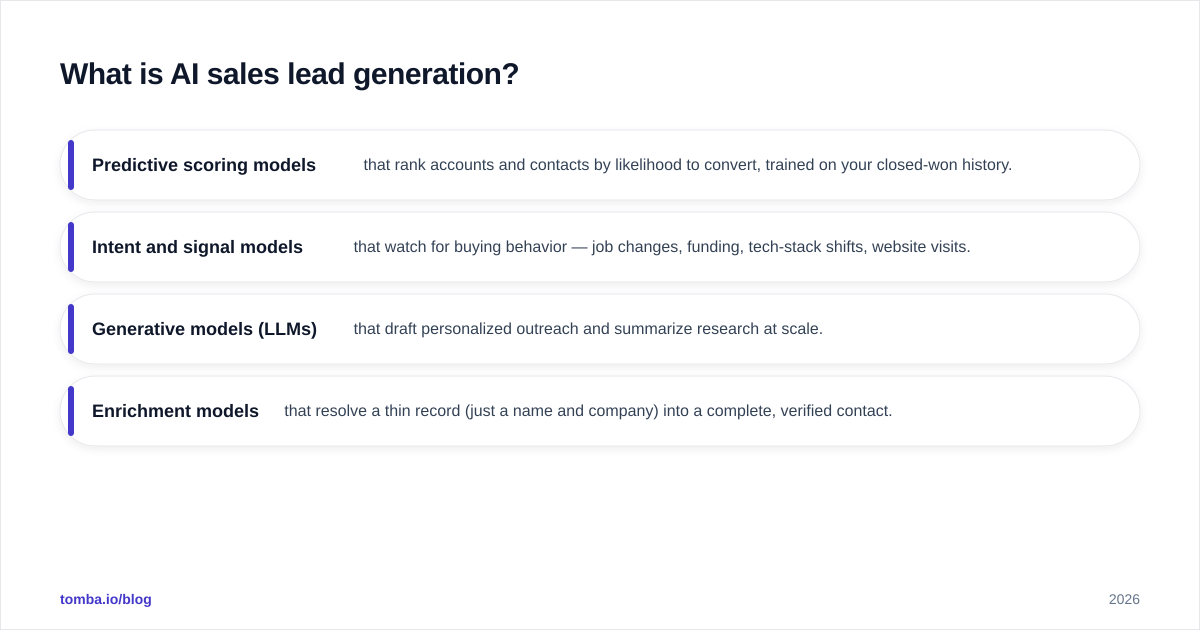
Technically, that breaks into a few distinct model types working together:
- Predictive scoring models that rank accounts and contacts by likelihood to convert, trained on your closed-won history.
- Intent and signal models that watch for buying behavior — job changes, funding, tech-stack shifts, website visits.
- Generative models (LLMs) that draft personalized outreach and summarize research at scale.
- Enrichment models that resolve a thin record (just a name and company) into a complete, verified contact.
The mistake is treating "AI lead gen" as one purchase. It is a pipeline. Each stage has a best-in-class layer, and the value compounds only when they connect.
Why is AI sales lead generation different from buying lists?#
Because a bought list is a snapshot of the past, and AI lead generation is a read on the present.
A purchased list is decaying the moment it's sold. B2B contact data goes stale at roughly 22–30% per year — people change jobs, companies rebrand, domains move. By the time a static list reaches your reps, a meaningful slice already bounces. Worse, everyone else bought the same list, so your "prospects" are getting hammered by ten other vendors with identical templates.
AI-driven generation flips the model in three ways:
- It's signal-triggered, not batch-dumped. Instead of 10,000 names at once, you get the 40 accounts that did something this week worth reacting to.
- It's verified at the point of use. Modern workflows re-check an email's deliverability before sending, not months earlier. (This is why pairing a finder with an email verifier matters more than raw list size.)
- It's personalized at scale. An LLM can read a prospect's last three LinkedIn posts and draft a relevant opener — something no list vendor sells.

The honest caveat: AI does not invent demand. If nobody in your market wants what you sell, no model fixes that. AI makes a good motion efficient. It makes a bad motion fail faster and louder.
What does the AI sales lead generation stack look like in 2026?#
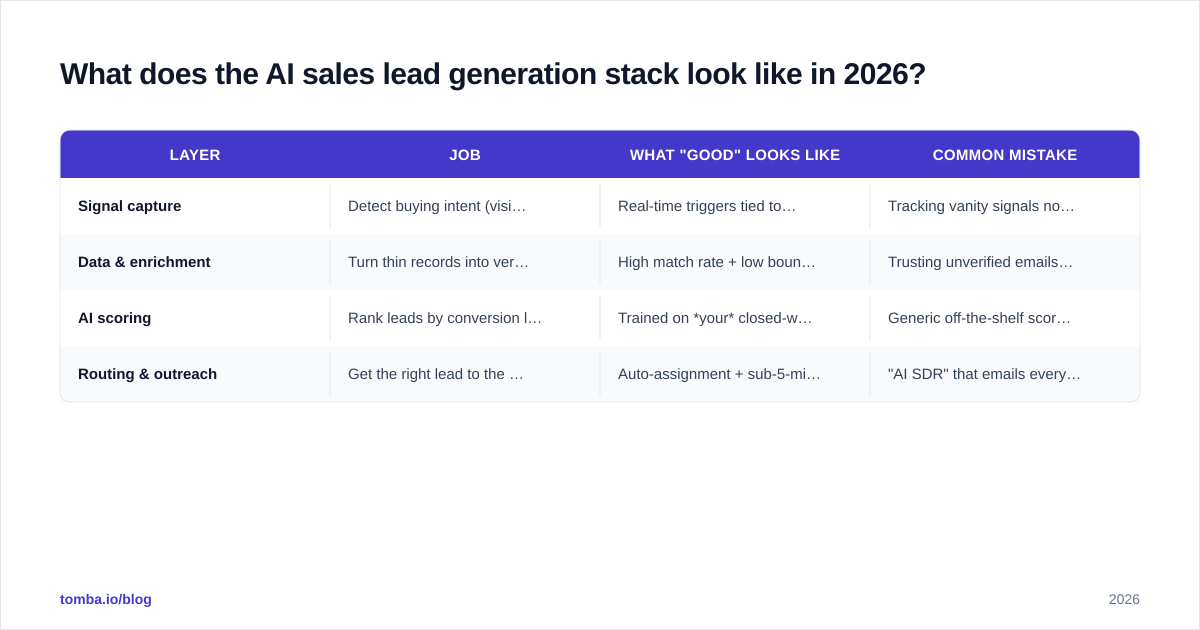
Four layers. You can buy them bundled or assemble best-of-breed, but every functional pipeline has all four.
| Layer | Job | What "good" looks like | Common mistake |
|---|---|---|---|
| Signal capture | Detect buying intent (visits, funding, hiring, tech changes) | Real-time triggers tied to your ICP | Tracking vanity signals nobody acts on |
| Data & enrichment | Turn thin records into verified, complete contacts | High match rate + low bounce rate | Trusting unverified emails from one source |
| AI scoring | Rank leads by conversion likelihood | Trained on your closed-won data | Generic off-the-shelf score nobody trusts |
| Routing & outreach | Get the right lead to the right rep, fast | Auto-assignment + sub-5-min speed-to-lead | "AI SDR" that emails everyone instantly |
The layer teams most often underinvest in is the second one — data and enrichment. It's unglamorous. But your scoring model is only as smart as the data underneath it, and your outreach only lands if the email address resolves. A model that confidently ranks a contact whose email bounces is worse than no model, because it spends a rep's trust along with their time.
This is where a dedicated finder-plus-verifier foundation pays off. Tools like the Tomba Email Finder and bulk data enrichment sit at this layer: you feed in a name and domain, get back a verified, deliverable contact, and then let your scoring model do its job on clean inputs.
How do you actually build an AI lead generation workflow?#
Start with the loop, not the tools. The workflow below is vendor-agnostic — map your stack onto it.
1. Define the trigger. Decide what "a lead worth our time" looks like as a signal. A site visit to your pricing page. A Series B announcement. A new VP of Sales hire. Without a trigger you're back to batch-and-blast.
2. Enrich and verify. The instant a signal fires, resolve the account into named, verified contacts. This is the step that determines whether everything downstream works. An unverified email poisons the score and wastes the send.
3. Score and rank. Run the enriched lead through your model. The output isn't a yes/no — it's a priority order. Your reps work the list top-down.
4. Route with speed. Research is brutal on this: contacting a lead within five minutes versus thirty minutes can change qualification odds by an order of magnitude. AI's job here is to assign instantly, not to add a delay while it "thinks."
5. Measure and retrain. Feed outcomes back. Which scored-high leads actually closed? The model that doesn't learn from your results is just an expensive guess.

A practical starting point: don't automate all five steps on day one. Nail enrichment and verification first, add one scoring rule you trust, and route by hand until the data earns your confidence. Teams that flip on a full "autonomous AI SDR" before their data is clean don't get more pipeline — they get more apologies.
Does AI sales lead generation replace SDRs?#
No — and any vendor who tells you otherwise is selling you the dream, not the product.
Here's the math that matters. Sales reps spend only about a third of their time actually selling; the rest goes to research, admin, list hygiene, and chasing contacts who turn out to be unreachable. AI doesn't replace the seller. It deletes the other two-thirds.
What changes is the SDR's job description:
- Before AI: build the list, find the emails, guess who's worth calling, write each message from scratch.
- With AI: review a ranked, enriched queue; approve or tweak AI-drafted openers; spend the saved hours on live conversations and discovery.
The roles that shrink are the purely mechanical ones — manual list-building, copy-paste research. The roles that grow are judgment-heavy: which signal matters, how to handle a nuanced objection, when to break the script. AI is a leverage tool for good reps, not a replacement for them. According to HubSpot's research on sales AI adoption, the teams seeing gains use AI to augment reps' prospecting, not to remove the human from the loop.
What metrics prove AI lead generation is working?#
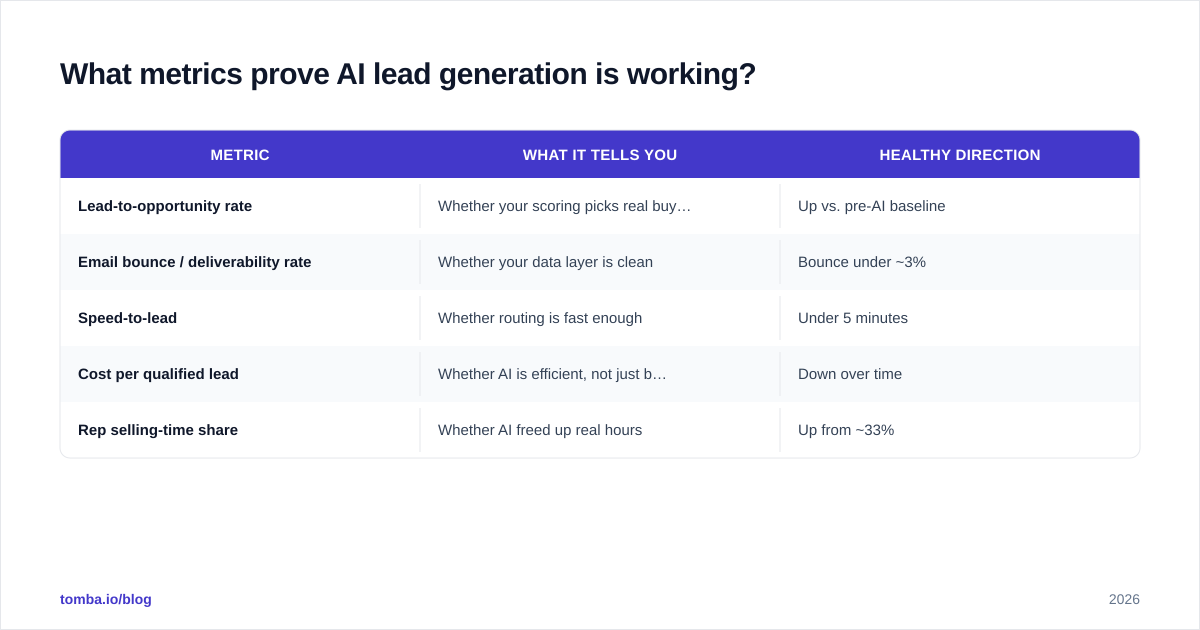
Track the funnel, not the activity. It's easy to celebrate "10x more emails sent" while pipeline flatlines. These are the metrics that actually indicate the model is earning its keep:
| Metric | What it tells you | Healthy direction |
|---|---|---|
| Lead-to-opportunity rate | Whether your scoring picks real buyers | Up vs. pre-AI baseline |
| Email bounce / deliverability rate | Whether your data layer is clean | Bounce under ~3% |
| Speed-to-lead | Whether routing is fast enough | Under 5 minutes |
| Cost per qualified lead | Whether AI is efficient, not just busy | Down over time |
| Rep selling-time share | Whether AI freed up real hours | Up from ~33% |
If you're tracking only send volume and reply counts, you're measuring activity, not outcomes. The point of AI sales lead generation is a higher marketing qualified lead-to-close rate at lower cost — not a bigger pile of emails. Pull these numbers from your CRM monthly and compare against your pre-AI baseline. No baseline, no proof.
What are the biggest mistakes to avoid?#
The failure modes are predictable, and almost all of them trace back to skipping the unglamorous data work.
- Automating outreach before verifying data. The fastest way to torch your sending domain is to let an AI blast unverified addresses. Verify first, send second. Lean on a bulk verify pass before any large campaign.
- Trusting a black-box score. If your reps don't understand why a lead scored 90, they won't work it. Demand explainable scoring or build it from your own closed-won data.
- Confusing personalization with mail-merge. "Hi {{FirstName}}" is not AI personalization. Real personalization references something specific and current. If the LLM has nothing real to say, the line should be cut, not faked.
- Ignoring data decay. Re-enrich and re-verify on a schedule. A contact verified eight months ago is a coin flip today.
- Buying the platform before the process. A tool can't fix an undefined ICP or a missing trigger. Define the motion on paper first.
For deeper background on how the underlying field works, G2's category data on lead intelligence software and Gartner's sales technology research are useful neutral references when you're building a shortlist.
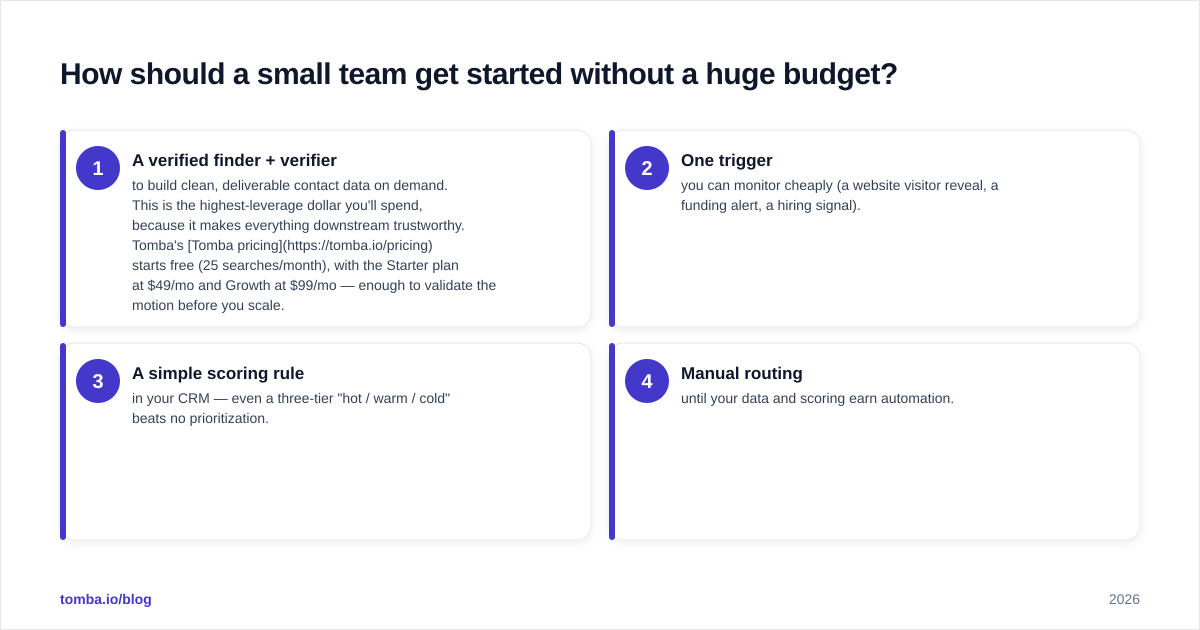
How should a small team get started without a huge budget?#
Start with the data foundation, prove one motion, then expand. You do not need a six-figure platform to get the core benefit.
A lean, effective starting stack:
- A verified finder + verifier to build clean, deliverable contact data on demand. This is the highest-leverage dollar you'll spend, because it makes everything downstream trustworthy. Tomba's Tomba pricing starts free (25 searches/month), with the Starter plan at $49/mo and Growth at $99/mo — enough to validate the motion before you scale.
- One trigger you can monitor cheaply (a website visitor reveal, a funding alert, a hiring signal).
- A simple scoring rule in your CRM — even a three-tier "hot / warm / cold" beats no prioritization.
- Manual routing until your data and scoring earn automation.
Once that loop produces measurable lift — higher lead-to-opp rate, lower bounce — you reinvest the gains into more signals and tighter automation. That's how you build AI lead generation that compounds, instead of buying a platform that gathers dust.
The bottom line#
AI sales lead generation in 2026 isn't a magic button — it's a disciplined pipeline: capture a real signal, enrich and verify the contact, score it against your own win data, route it fast, and learn from the outcome. Skip the data layer and the whole thing produces confident, expensive noise. Get the data layer right and every model above it gets sharper.
Start where the leverage is highest: clean, verified contact data. The Tomba Email Finder gives you deliverable, professional emails by name, domain, or company — the verified foundation your scoring model and outreach depend on. Spin up the free tier, feed your first trigger list through it, and see how much sharper your pipeline gets when the inputs are actually correct. Your AI is only as smart as the data you give it.
// get started
Find, verify and enrich your first contacts today
Start on the free plan with 25 searches a month, then scale when your team is ready.
Free plan · No credit card required · GDPR & CCPA
// about the author