AI Sales Outreach in 2026: Tools, Tactics & ROI Guide
AI sales outreach can 3x rep capacity or torch your domain reputation. Here's how to deploy it in 2026 without sounding like a robot or hitting spam folders.
AI sales outreach is no longer a novelty bolted onto your sequencer — it is the default way modern teams research, personalize, and follow up at scale. The problem is that most teams turn it on, blast 10,000 generic "I noticed you're the VP of..." emails, and wonder why their reply rate cratered and their domain landed on a blocklist. Used well, AI compresses a day of manual prospecting into minutes. Used lazily, it industrializes spam.
This guide separates the two.
TL;DR#
- AI sales outreach means using machine learning to research accounts, draft personalized messages, decide timing, and handle replies — not just spinning the same template a thousand ways.
- The biggest 2026 shift is from volume automation to signal automation: AI that acts on intent data, job changes, and product usage instead of static lists.
- Personalization that references real, verifiable context beats AI-generated flattery every time. Garbage data in = confidently wrong outreach out.
- Deliverability is the silent killer. Clean data, verified emails, and proper warmup matter more than clever copy.
- Keep a human in the loop for strategy, qualification, and any reply that signals real buying intent.
What is AI sales outreach, really?#
AI sales outreach is the use of AI models to automate or augment the steps a sales rep takes to start and sustain conversations with prospects: finding the right people, understanding their context, writing the first touch, sequencing follow-ups, and triaging responses.
Think of it like a GPS for a road trip. The old way was a paper map and your gut — you guessed the route, missed exits, and re-planned constantly. AI outreach is the GPS: it still needs you to pick the destination and decide when to take the scenic route, but it handles the turn-by-turn busywork and recalculates when conditions change. The destination (a qualified meeting) is yours. The routing is automated.
Technically, "AI sales outreach" bundles several distinct capabilities that people lump together:
- Research & enrichment — pulling firmographic, technographic, and contact data on an account.
- Message generation — drafting first-touch and follow-up copy conditioned on that data.
- Timing & orchestration — deciding when and on which channel to reach out.
- Reply handling — classifying responses (interested, not now, wrong person, unsubscribe) and routing or auto-responding.
Most tools are strong at one or two of these and mediocre at the rest. Knowing which layer you're buying is half the battle.
Why did AI outreach change so much going into 2026?#
The short answer: buyers got wise to template spam, and inbox providers got aggressive. Google and Yahoo's bulk-sender requirements pushed authentication and low complaint rates from "nice to have" to "you don't deliver without it." At the same time, a flood of identical AI-written emails trained prospects to delete anything that opens with "I came across your profile and was impressed by..."
So the bar moved. In 2025, AI outreach competed on volume and speed. In 2026, it competes on relevance and restraint. The winning play is fewer, sharper touches triggered by a real signal — a funding round, a new hire in the buying role, a competitor's product showing up in their tech stack — not a bigger list hammered more often.
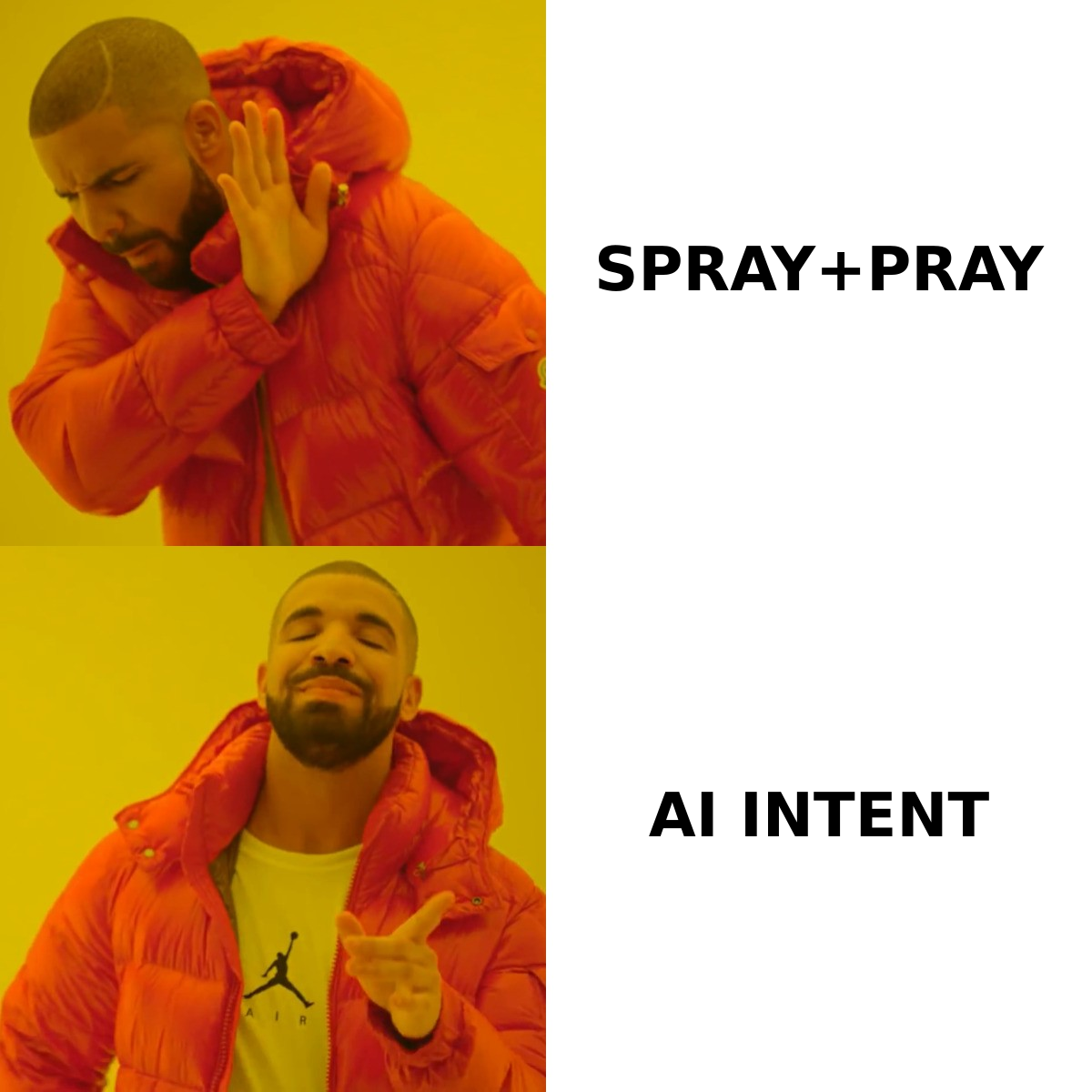
This is also why data quality became the whole ballgame. An AI that personalizes off a stale title or a guessed email address doesn't just waste a send — it actively damages your sender reputation and your brand. Personalization amplifies whatever data you feed it, including the wrong data.
What should you automate vs. keep human?#
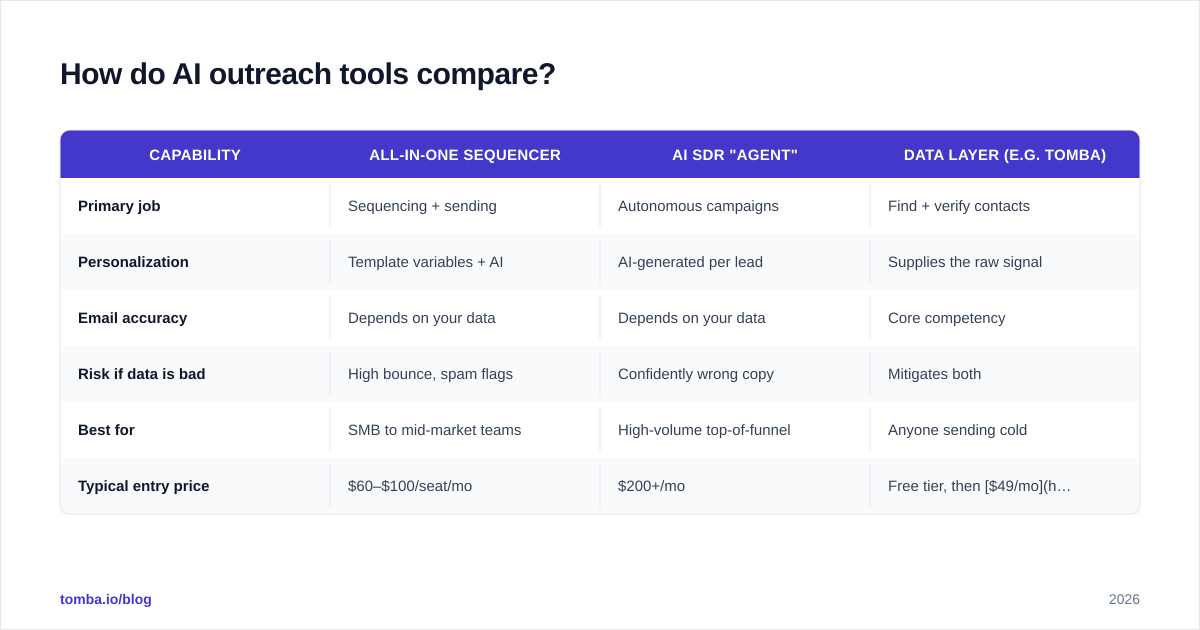
Not every step deserves AI, and not every step should stay manual. Here's the practical split most high-performing teams land on.
| Outreach step | Automate with AI | Keep human | Why |
|---|---|---|---|
| List building & enrichment | Yes | — | Machines beat humans at scale and freshness |
| Email verification | Yes | — | Pure data task, no judgment needed |
| First-touch drafting | Draft only | Review/edit | AI drafts, human approves the angle |
| Follow-up sequencing | Yes | Set the rules | Timing logic is deterministic once defined |
| Reply classification | Yes | Spot-check | Triage at volume, human catches edge cases |
| Handling buying-intent replies | — | Yes | Real deals need a real person, fast |
| Account strategy & targeting | Assist | Yes | Judgment, not pattern-matching |
The rule of thumb: automate the mechanical, human the meaningful. AI should clear the busywork so reps spend their hours on the 5% of conversations that actually move pipeline. The moment a prospect says something that hints at budget, timeline, or pain, a human takes the wheel.
How do AI outreach tools compare?#
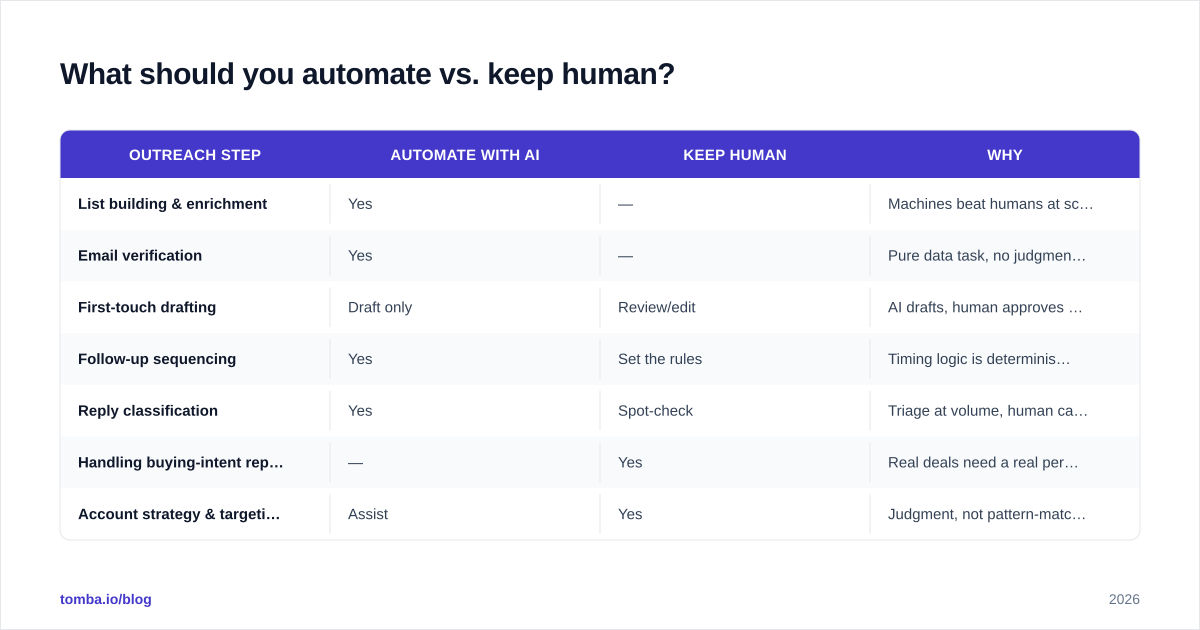
The market splits into roughly three buckets: all-in-one sequencers with AI bolted on, AI-native SDR "agents" that run autonomous campaigns, and data-layer tools that feed the others. You almost always need a data layer regardless of which sequencer you pick — that's where an accurate email finder and email verifier earn their keep.
| Capability | All-in-one sequencer | AI SDR "agent" | Data layer (e.g. Tomba) |
|---|---|---|---|
| Primary job | Sequencing + sending | Autonomous campaigns | Find + verify contacts |
| Personalization | Template variables + AI | AI-generated per lead | Supplies the raw signal |
| Email accuracy | Depends on your data | Depends on your data | Core competency |
| Risk if data is bad | High bounce, spam flags | Confidently wrong copy | Mitigates both |
| Best for | SMB to mid-market teams | High-volume top-of-funnel | Anyone sending cold |
| Typical entry price | $60–$100/seat/mo | $200+/mo | Free tier, then $49/mo |
Notice the pattern: every sequencer and every AI SDR is only as good as the contact data underneath it. A beautifully written, perfectly timed message to a bounced or wrong address is worse than no message — it's a deliverability liability. This is why teams that obsess over copy but ignore data accuracy keep hitting a ceiling.
For a vendor-neutral look at how buyers rate these categories, G2's sales engagement grid is a reasonable starting point, and HubSpot's research on AI in sales tracks adoption trends across team sizes.
What does a good AI outreach workflow look like?#
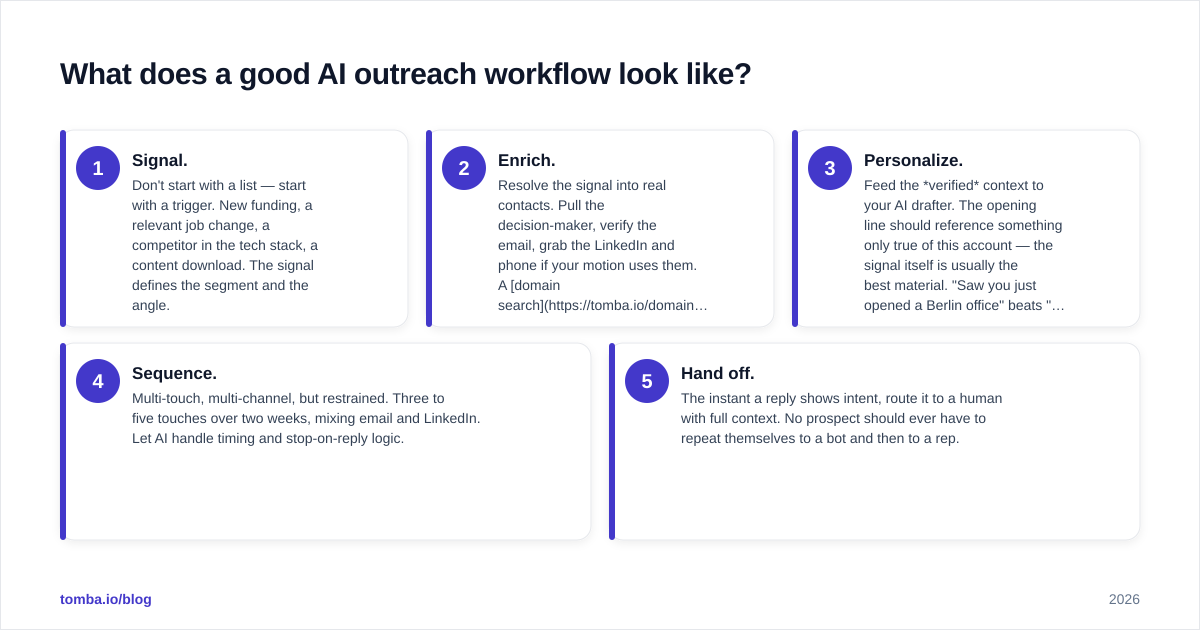
Here's a concrete, signal-driven sequence you can actually run. The framework diagram above maps to these five stages.
- Signal. Don't start with a list — start with a trigger. New funding, a relevant job change, a competitor in the tech stack, a content download. The signal defines the segment and the angle.
- Enrich. Resolve the signal into real contacts. Pull the decision-maker, verify the email, grab the LinkedIn and phone if your motion uses them. A domain search turns "this company looks like a fit" into "here are the three people who own this problem and their verified addresses."
- Personalize. Feed the verified context to your AI drafter. The opening line should reference something only true of this account — the signal itself is usually the best material. "Saw you just opened a Berlin office" beats "I was impressed by your background."
- Sequence. Multi-touch, multi-channel, but restrained. Three to five touches over two weeks, mixing email and LinkedIn. Let AI handle timing and stop-on-reply logic.
- Hand off. The instant a reply shows intent, route it to a human with full context. No prospect should ever have to repeat themselves to a bot and then to a rep.
The trap most teams fall into is skipping stage 1 and 2 — they jump straight to "personalize and sequence" on a stale list. That's how you get AI confidently telling a prospect you admire their work at a company they left eight months ago. Start with fresh signal and verified data, and the AI has something true to say.
How do you keep AI outreach out of the spam folder?#
Deliverability is where good campaigns quietly die. The copy can be perfect and still never get seen. Protect it on three fronts.
Data hygiene. Every address you send to should be verified first. High bounce rates are the fastest way to tank sender reputation and trip provider filters. Run lists through an email verifier before they ever touch your sequencer, and handle catch-all domains deliberately rather than guessing.
Authentication & warmup. Set up SPF, DKIM, and DMARC correctly, warm up new sending domains gradually, and keep daily volume per inbox sane. AI lets you scale sends — which means it also lets you scale mistakes. A cold domain blasting 500 AI emails on day one is a blocklist waiting to happen.
Engagement signals. Inbox providers reward replies and opens and punish deletes and complaints. This is the deliverability argument for relevance: a tightly targeted campaign that earns replies improves your reputation, while a broad one that gets ignored erodes it. Quality outreach is good deliverability, not a tradeoff against it.
The uncomfortable truth: most "AI outreach isn't working" complaints are actually deliverability problems wearing a copywriting costume. Fix the data and the infrastructure first.
How do you measure if AI outreach is actually working?#
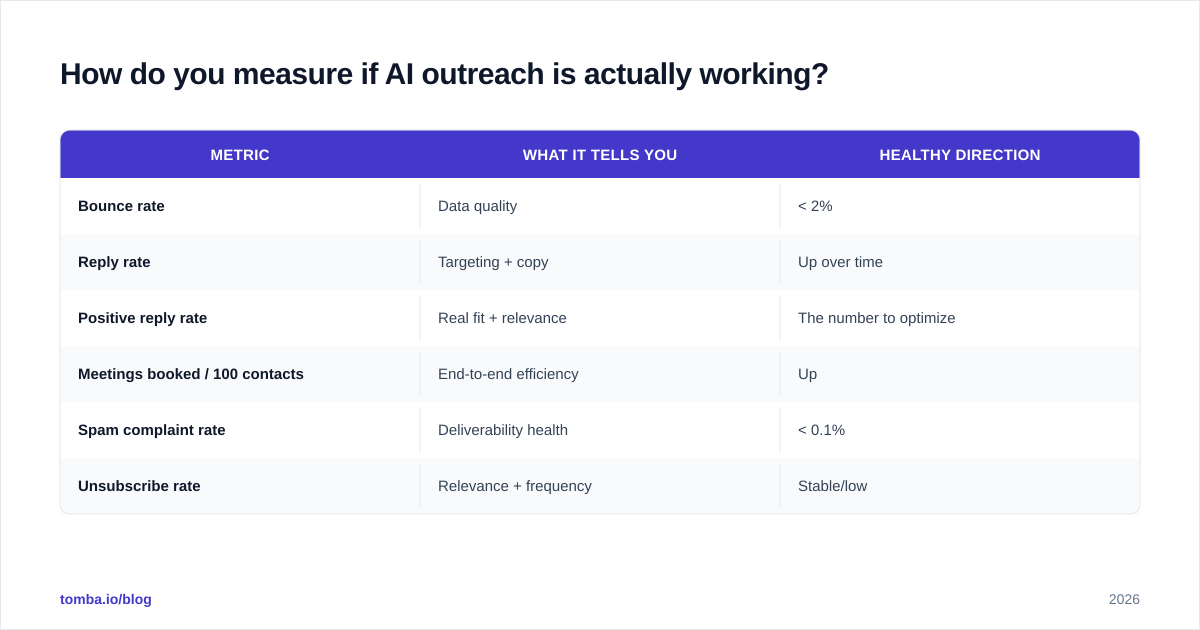
Reply rate and positive-reply rate are the metrics that matter — not sends, not opens (which are increasingly unreliable post-Apple Mail Privacy). Track these:
| Metric | What it tells you | Healthy direction |
|---|---|---|
| Bounce rate | Data quality | < 2% |
| Reply rate | Targeting + copy | Up over time |
| Positive reply rate | Real fit + relevance | The number to optimize |
| Meetings booked / 100 contacts | End-to-end efficiency | Up |
| Spam complaint rate | Deliverability health | < 0.1% |
| Unsubscribe rate | Relevance + frequency | Stable/low |
If your bounce rate is above a couple percent, stop everything and fix your data before touching anything else. No amount of AI copywriting overcomes sending to addresses that don't exist. A high bounce rate isn't just wasted sends — it's an active signal to inbox providers that you're a spammer.
The teams winning with AI outreach in 2026 aren't the ones sending the most. They're the ones with the cleanest data, the sharpest signals, and the discipline to let a human close. AI is a force multiplier — and a multiplier works on whatever you point it at, including bad data and bad judgment.
Where should you start?#
Start at the data layer, because everything else compounds on top of it. Before you invest in a fancy AI SDR or a premium sequencer, make sure the contacts feeding them are real, current, and verified. That's the foundation that makes every downstream AI decision worth making.
Tomba's Email Finder gives your AI outreach something true to work with: accurate, verified professional emails found by name, company, or domain — with verification built in so bad addresses never reach your sequencer. Start on the free tier (25 searches a month), and scale to a paid plan when your pipeline does. Point your AI at clean data, keep a human on the meaningful replies, and let automation handle the rest.
Ready to find emails that actually work?
Join 150,000+ professionals who stopped guessing and started sending. Free credits on signup — no credit card required.
Get the Tomba newsletter
Practical outbound tactics and product updates — once every two weeks.
About the author