AI Sales Role Play in 2026: Train Reps Faster and Win More
AI sales role play lets reps rehearse real objections with a tireless AI buyer. Here is how it works, what to look for in a tool, and how it stacks up against live training.
TL;DR
- AI sales role play puts a rep across the table from a realistic AI buyer that objects, stalls, and asks hard questions — so practice happens before live calls, not during them.
- It compresses ramp time, standardizes coaching, and gives managers scorecards instead of gut feel.
- The best tools simulate voice, persona, and objection paths; the weak ones are glorified chatbots reading from a script.
- Role play improves delivery, but it cannot fix a bad list. Accurate contact data still decides whether your reps reach a real buyer at all.
- Use the buyer's-journey framework below to design scenarios that map to where your deals actually break.
Sales reps used to "practice" on live prospects. That is expensive practice — every fumbled discovery call and every botched objection is a real pipeline opportunity burned for the sake of learning. AI sales role play changes the economics of that learning curve. Instead of rehearsing on the people you are trying to close, your reps rehearse against a machine that never gets tired, never goes easy on them, and logs every move for review.
This guide breaks down what AI sales role play is, how it works, which features matter, and where it fits in a modern sales stack.
What is AI sales role play?#
AI sales role play is a training method where a rep conducts a simulated sales conversation — discovery, demo, objection handling, negotiation, or cold call — against an AI that plays the buyer. The AI adopts a persona (skeptical CFO, busy founder, technical evaluator), responds dynamically to what the rep says, and pushes back the way a real prospect would.
Think of it like a flight simulator for sellers. A pilot does not learn to handle engine failure by waiting for a real engine to fail at 30,000 feet. They practice the emergency a hundred times in a simulator until the response is automatic. AI role play gives reps that same safe, repeatable environment for the moments that decide deals: the price objection, the "send me an email" brush-off, the competitor comparison.
Technically, these tools combine a large language model (for the conversation), a persona and scenario layer (to keep the buyer consistent and on-script for the lesson), and a scoring engine (to grade the rep on things like talk ratio, discovery questions asked, and objection resolution). Better platforms add voice synthesis and speech recognition so the rep actually talks, the way they would on a real call.
Why does AI sales role play matter in 2026?#
Three forces made this category go from novelty to standard.
First, ramp time is a board-level metric. According to industry analysis from Gartner, the cost of slow rep onboarding shows up directly in missed quota coverage. Every week you shave off ramp is revenue pulled forward.
Second, hybrid and remote teams broke the old apprenticeship model. Reps used to learn by sitting next to a top performer and absorbing the rhythm of a good call. That side-by-side osmosis mostly disappeared. AI role play fills the gap by making deliberate practice available on demand, from anywhere.
Third, the models got good enough to be uncomfortable. A 2024-era chatbot folded the moment a rep pushed back. A 2026-era AI buyer holds its position, raises a follow-up objection, and stays in character — which is exactly what makes the practice valuable. If the simulated buyer is easy, the rep learns nothing.
How does AI sales role play actually work?#
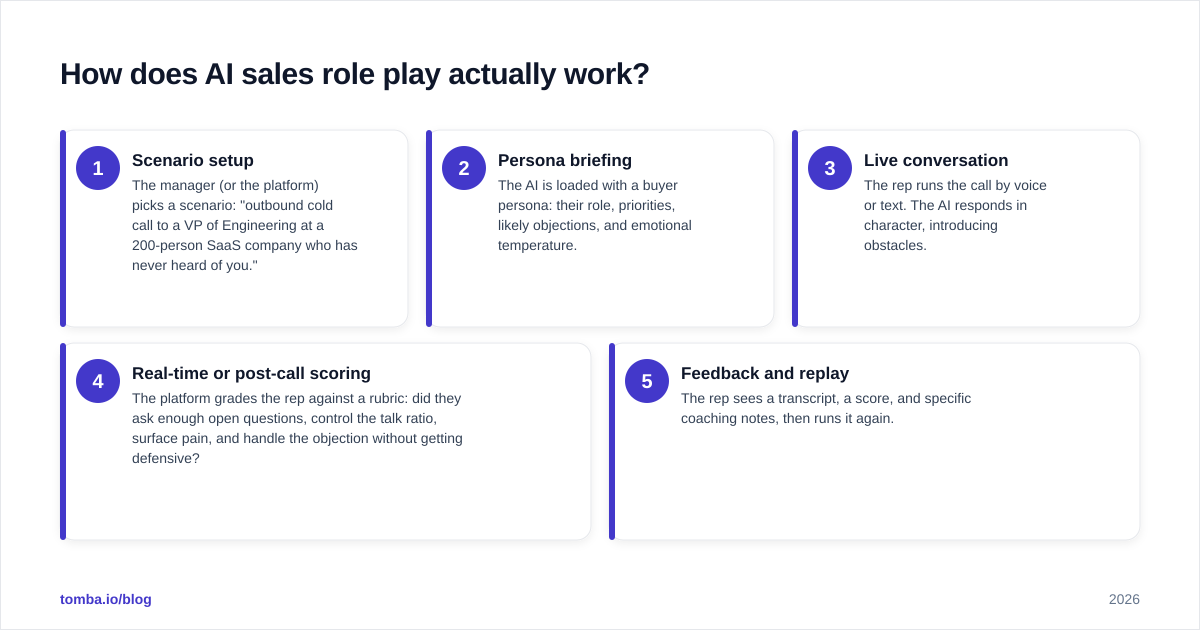
A typical session follows a predictable loop, and understanding it helps you design better training.
- Scenario setup — The manager (or the platform) picks a scenario: "outbound cold call to a VP of Engineering at a 200-person SaaS company who has never heard of you."
- Persona briefing — The AI is loaded with a buyer persona: their role, priorities, likely objections, and emotional temperature.
- Live conversation — The rep runs the call by voice or text. The AI responds in character, introducing obstacles.
- Real-time or post-call scoring — The platform grades the rep against a rubric: did they ask enough open questions, control the talk ratio, surface pain, and handle the objection without getting defensive?
- Feedback and replay — The rep sees a transcript, a score, and specific coaching notes, then runs it again.
The replay loop is where the compounding happens. A rep can run the same brutal price objection ten times in an afternoon and watch their score climb. You cannot get ten live reps from prospects in a single day — and you certainly cannot get ten identical ones to measure improvement against.
What should you look for in an AI sales role play tool?#
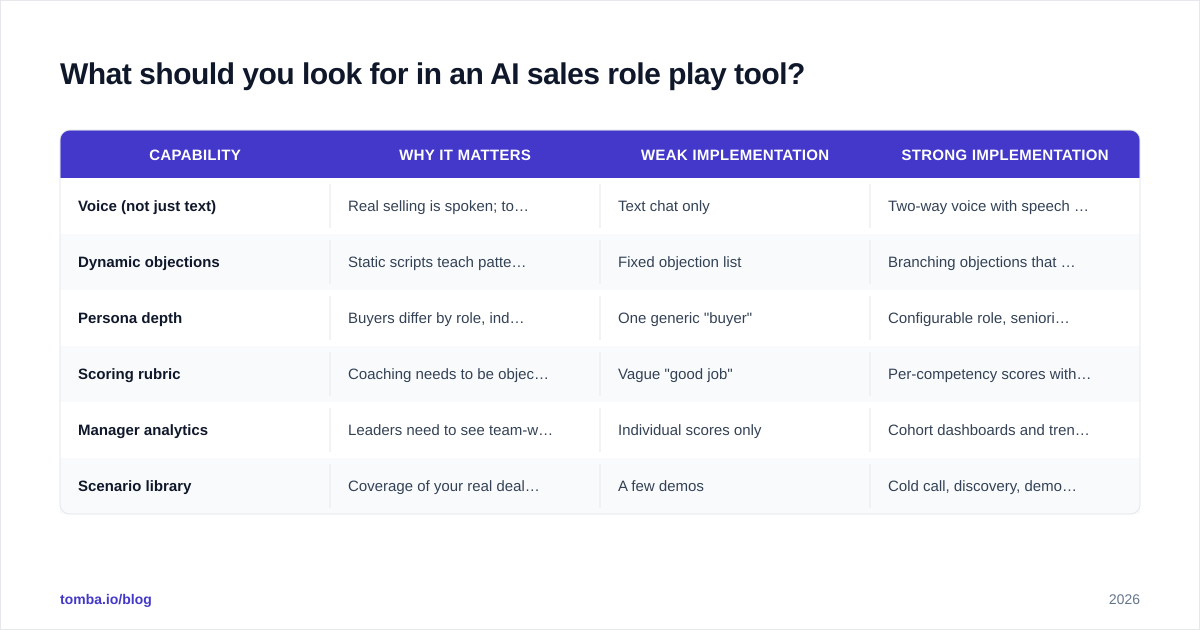
Not all platforms are equal. The gap between a useful simulator and an expensive toy comes down to a handful of capabilities.
| Capability | Why it matters | Weak implementation | Strong implementation |
|---|---|---|---|
| Voice (not just text) | Real selling is spoken; tone and pacing matter | Text chat only | Two-way voice with speech analysis |
| Dynamic objections | Static scripts teach pattern memorization, not adaptability | Fixed objection list | Branching objections that react to the rep |
| Persona depth | Buyers differ by role, industry, and mood | One generic "buyer" | Configurable role, seniority, and temperament |
| Scoring rubric | Coaching needs to be objective and consistent | Vague "good job" | Per-competency scores with transcript evidence |
| Manager analytics | Leaders need to see team-wide gaps | Individual scores only | Cohort dashboards and trend lines |
| Scenario library | Coverage of your real deal-breaking moments | A few demos | Cold call, discovery, demo, negotiation, renewal |
If you are evaluating vendors, read real practitioner reviews on a site like G2 rather than trusting vendor demos. Demos are run on the happy path; reviews tell you what breaks.
Is AI sales role play better than live human role play?#
It depends on what you are optimizing for — and the honest answer is that you want both.
AI wins on volume, consistency, and psychological safety. A nervous new rep will try things against a machine that they would never risk in front of their manager. The AI is available at midnight, never judges, and grades everyone on the same rubric.
Human role play wins on nuance, relationship realism, and edge cases the model has not seen. A skilled manager playing a buyer can read a rep's body language, throw an improvised curveball, and coach on the intangible "feel" of a call.
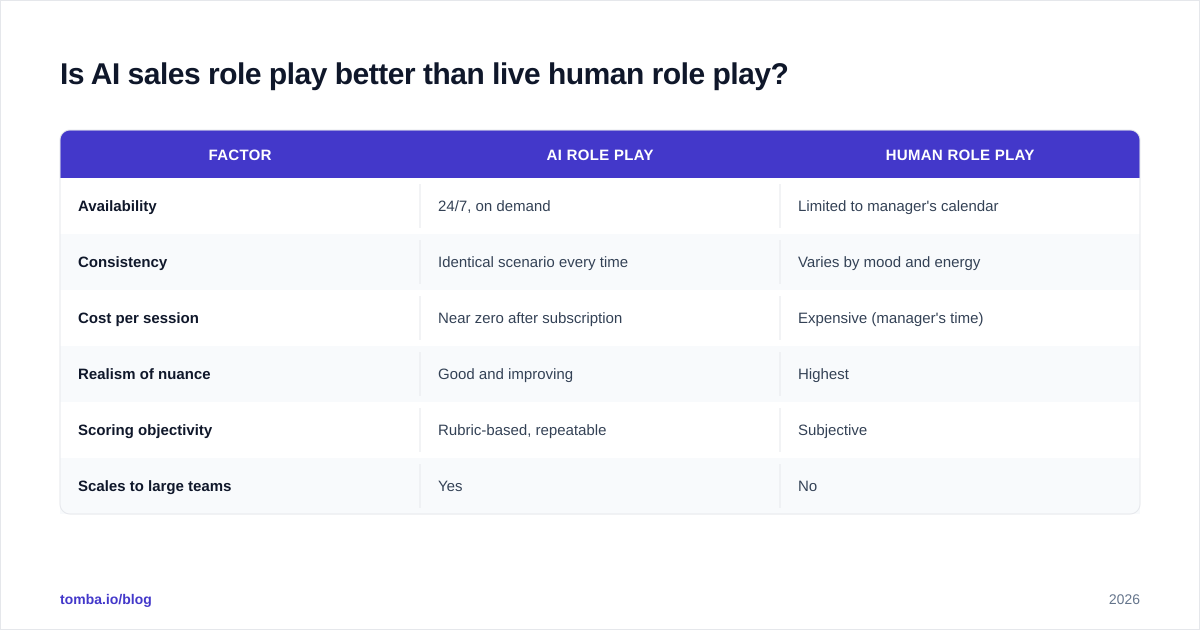
| Factor | AI role play | Human role play |
|---|---|---|
| Availability | 24/7, on demand | Limited to manager's calendar |
| Consistency | Identical scenario every time | Varies by mood and energy |
| Cost per session | Near zero after subscription | Expensive (manager's time) |
| Realism of nuance | Good and improving | Highest |
| Scoring objectivity | Rubric-based, repeatable | Subjective |
| Scales to large teams | Yes | No |
The right model is a blend: AI for high-volume reps and skill drilling, humans for final certification and the judgment calls a rubric cannot capture. Treat AI role play as the practice field and human role play as the scrimmage before game day.

How do you design scenarios that actually move win rate?#
Generic scenarios produce generic improvement. To move your win rate, build scenarios from your own deal data.
Start by finding where deals actually die. Pull your closed-lost reasons. If 40% of losses cite price, your reps need price-objection reps — a lot of them. If deals stall in discovery, drill discovery question depth. Map each scenario to a real failure point in your funnel instead of practicing what is comfortable.
Then layer in difficulty. Run the first pass with a cooperative buyer so the rep builds confidence, then escalate to a hostile, time-pressured, or technically expert persona. The escalation is the lesson — a rep who can only handle the friendly version has not actually learned the skill.
Finally, tie scoring to behaviors you can coach. "Be more persuasive" is useless. "Ask at least three open-ended discovery questions before pitching" is measurable, repeatable, and improvable. Resources like the HubSpot Sales Blog are a good source for the underlying methodologies — discovery frameworks, objection-handling structures — that your rubric should enforce.
Where does AI role play fit in the broader sales stack?#
Here is the uncomfortable truth that role-play vendors will not lead with: role play makes a rep better at the conversation, but it does nothing about whether the conversation happens at all.
A perfectly trained rep dialing a disconnected number or emailing a bounced address closes zero deals. The simulator polishes delivery; it cannot manufacture a reachable buyer. That is a data problem, not a skills problem, and the two have to be solved together.
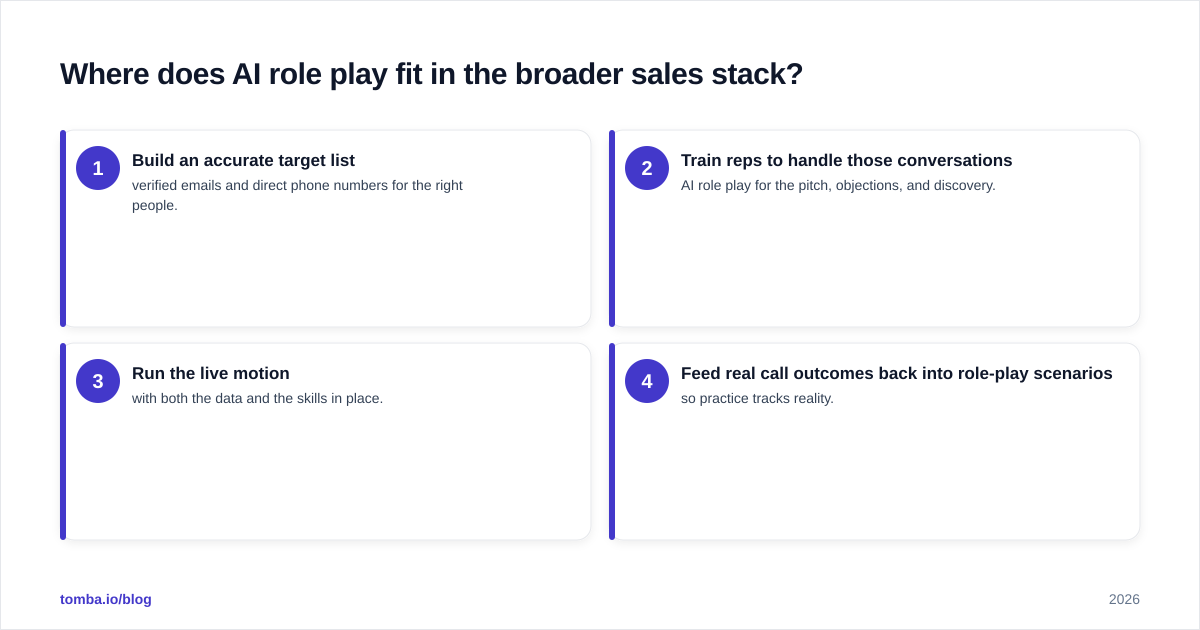
In practice, a healthy outbound motion looks like this:
- Build an accurate target list — verified emails and direct phone numbers for the right people.
- Train reps to handle those conversations — AI role play for the pitch, objections, and discovery.
- Run the live motion — with both the data and the skills in place.
- Feed real call outcomes back into role-play scenarios — so practice tracks reality.
Steps 2 and 4 are role play. Step 1 is data. If you are pouring money into coaching while your reps work off a stale list, you are sharpening the blade on a saw with no teeth.
That is where contact accuracy earns its keep. Reps trained on objection handling still need a verified address to land the first touch — which is why teams pair role-play platforms with a reliable email finder and a phone finder for direct dials. Practice the call; then make sure there is a real person on the other end of it. You can review plan options on the Tomba pricing page to see how data and outreach volume scale together.
What does an AI role play rollout cost and how do you measure ROI?#
Pricing across the category generally tracks team size and feature depth. Entry tiers cover text-based practice for small teams; mid-tiers add voice and analytics; enterprise tiers add custom personas, integrations, and admin controls.
To justify the spend, measure four things before and after rollout:
- Ramp time — days to first closed deal for new hires.
- Objection-handling score — average rubric score on your hardest scenario.
- Talk ratio — most teams want reps listening more than talking in discovery.
- Win rate on the deal stage you drilled.
If ramp time drops and win rate on drilled stages rises, the program pays for itself quickly — onboarding is one of the most expensive line items in any sales org, and shaving weeks off it is real money.
What are the limits and risks of AI sales role play?#
Be clear-eyed about three failure modes.
Overfitting to the rubric. Reps can learn to game the score — checking boxes ("asked three questions") without genuine curiosity. Rotate scenarios and have humans certify the final pass to catch this.
Model brittleness on edge cases. Even strong models occasionally break character or give an unrealistic response. Treat the AI as a sparring partner, not gospel, and let reps flag bad simulations.
Practice replacing real coaching. Role play is a tool inside a coaching culture, not a substitute for managers who care. The platform generates the data; humans still have to act on it.
None of these are reasons to skip AI role play. They are reasons to deploy it deliberately, with human oversight, as one layer in a complete enablement program.
The bottom line#
AI sales role play is the most efficient way yet invented to turn a nervous new rep into someone who can hold the line on a price objection and run a clean discovery call. It is cheaper than live practice, infinitely more available, and — when the scenarios map to your real deal-breakers — measurably effective at moving ramp time and win rate.
But coaching the conversation is only half the equation. A trained rep is only as good as the list they are working. Before you scale a role-play program, make sure your reps are reaching real, verified buyers — start with the Tomba Email Finder to build accurate, up-to-date contact lists by name, company, or domain, so every polished pitch lands in front of a person who can actually say yes. Train the rep, then give them someone worth calling.
// get started
Find, verify and enrich your first contacts today
Start on the free plan with 25 searches a month, then scale when your team is ready.
Free plan · No credit card required · GDPR & CCPA
// about the author