AI SDR Automation in 2026: The Complete Playbook & Tools
AI SDR automation promises pipeline on autopilot. Here's what actually works in 2026, where it breaks, and how to build a stack that books real meetings.
TL;DR
- AI SDR automation handles the repeatable parts of outbound — sourcing, enrichment, research, first-draft copy, sequencing, and reply triage — so human reps spend time on live conversations, not data entry.
- It is not a replacement for a sales team. The tools that work treat the AI as a tireless junior researcher, not a closer.
- The single biggest failure point is bad input data. A fully automated SDR firing emails at unverified, stale contacts just burns your domain faster.
- A realistic 2026 stack costs less than one human SDR's monthly salary and runs 24/7 — but only after you've fixed data quality and deliverability.
- Start with one narrow workflow (e.g., enrich-and-verify before send), measure reply rate, then expand. Do not buy an "autonomous AI SDR" and point it at a raw list.
What is AI SDR automation?#
AI SDR automation is the use of AI agents and software to perform the work of a Sales Development Representative: finding the right accounts, identifying contacts, researching them, writing personalized outreach, sending sequences, and handling early replies — with minimal human keystrokes.
Think of it like a self-checkout lane at a grocery store. The machine doesn't replace the store; it absorbs the repetitive scanning so staff can handle the cases that need judgment. An AI SDR scans thousands of prospects and drafts the first touch, but a human still steps in for the conversations that actually move revenue.
The category exploded because the SDR role is expensive, high-churn, and full of mechanical tasks. Research from sales-tech analysts at Gartner has repeatedly flagged how little of an SDR's day is spent actually selling. Automation targets exactly that gap.
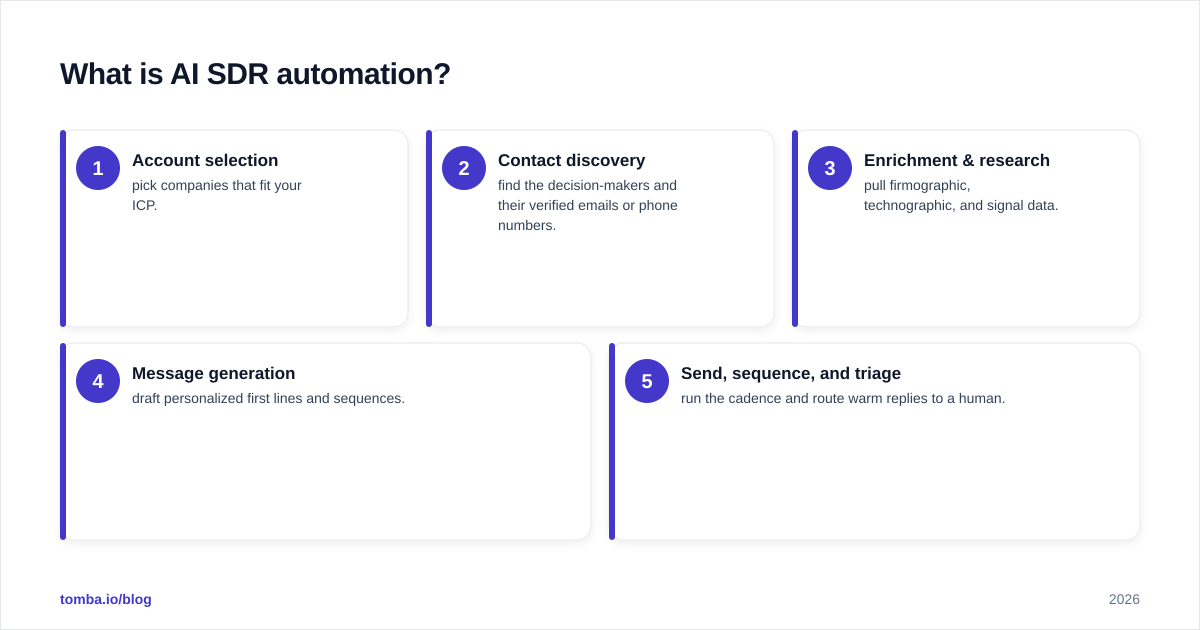
A modern AI SDR workflow usually chains five jobs:
- Account selection — pick companies that fit your ICP.
- Contact discovery — find the decision-makers and their verified emails or phone numbers.
- Enrichment & research — pull firmographic, technographic, and signal data.
- Message generation — draft personalized first lines and sequences.
- Send, sequence, and triage — run the cadence and route warm replies to a human.
Why is AI SDR automation suddenly everywhere in 2026?#
Short answer: the cost of the underlying models dropped, and the data tooling caught up. Three things converged.
First, language models got good enough to write outreach that doesn't read like a template — when fed real context. Second, agentic frameworks let those models call tools (search, enrichment, CRM writes) in sequence instead of producing one-shot text. Third, B2B data APIs made it trivial to feed those agents verified contact data programmatically.
The result is that a workflow which used to need three people and four tools can now run as one orchestrated pipeline. But "can run" is doing heavy lifting in that sentence. The teams getting results are disciplined about inputs; the teams getting spam complaints are not.
What can an AI SDR actually do well — and what can't it?#
Be honest about the boundary. AI SDRs are excellent at volume-with-context and terrible at genuine relationship nuance.
Does well:
- Researching a prospect's company, funding, and tech stack in seconds.
- Writing a competent, personalized first line at scale.
- Keeping a sequence on schedule without forgetting follow-ups.
- Classifying replies (interested / not now / unsubscribe / out-of-office) and routing them.
- Logging everything to the CRM without nagging.
Does poorly:
- Reading subtle buying signals in a live thread.
- Negotiating, handling objections, or building rapport over multiple touches.
- Knowing when not to send (the human instinct to hold back).
- Recovering gracefully from bad data — it will confidently email "Dear {first_name}".
This is why "autonomous AI SDR" marketing oversells. The reliable pattern in 2026 is human-in-the-loop: AI does 90% of the mechanical work, a person approves edge cases and owns the actual conversation. The closer you get to a fully hands-off agent blasting cold contacts, the faster your sender reputation degrades.
How do I build an AI SDR automation stack?#
You assemble it in layers, and the order matters. Most teams build top-down (buy the flashy sequencer first) and then wonder why reply rates are flat. Build bottom-up instead — data first.
Layer 1: Verified contact data#
Everything downstream inherits the quality of this layer. An AI SDR that personalizes brilliantly to a bounced email achieves nothing. Use a dedicated email finder to source contacts by domain or name, then run every address through an email verifier before it ever enters a sequence. For large lists, a bulk email finder plus enrichment keeps the pipeline fed.
Layer 2: Enrichment & signals#
Layer firmographic and technographic context on top of raw contacts so the AI has something to personalize with. Data enrichment turns a name and email into a full profile the model can reason over.
Layer 3: Orchestration & messaging#
This is where the LLM drafts copy and an agent runs the sequence. Most teams wire this together with an email finder API feeding a sequencer.
Layer 4: Send infrastructure & deliverability#
The most ignored layer. Warm up domains, authenticate (SPF, DKIM, DMARC), throttle volume, and monitor email deliverability. No model fixes a blacklisted domain.
What does an AI SDR stack cost in 2026?#
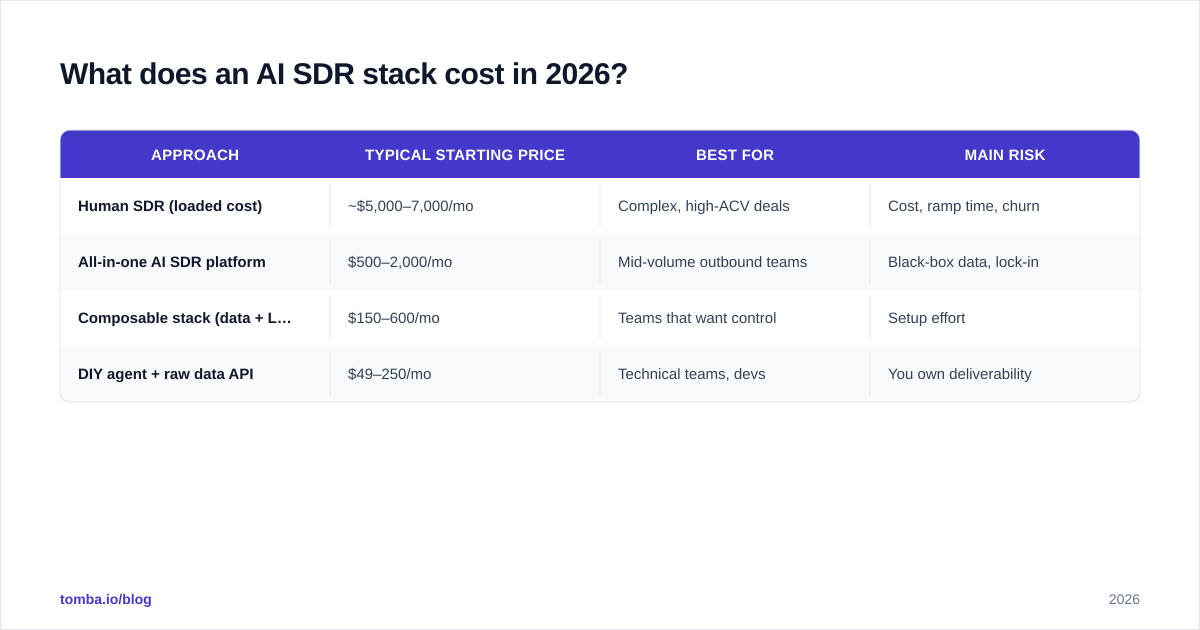
Here's a realistic comparison of common approaches. Prices are representative starting tiers, not exhaustive quotes — always check the vendor's current pricing.
| Approach | Typical starting price | Best for | Main risk |
|---|---|---|---|
| Human SDR (loaded cost) | ~$5,000–7,000/mo | Complex, high-ACV deals | Cost, ramp time, churn |
| All-in-one AI SDR platform | $500–2,000/mo | Mid-volume outbound teams | Black-box data, lock-in |
| Composable stack (data + LLM + sequencer) | $150–600/mo | Teams that want control | Setup effort |
| DIY agent + raw data API | $49–250/mo | Technical teams, devs | You own deliverability |
For the data layer specifically, Tomba pricing starts with a free tier (25 searches/mo), then Starter at $49/mo, Growth at $99/mo, and Pro at $249/mo — which slots into the composable and DIY rows above without forcing you into an all-in-one contract.
The headline math: a composable AI SDR stack often runs cheaper than 10% of a single human SDR's fully loaded cost, while operating around the clock. The catch is that the human still closes — so this is augmentation economics, not replacement economics.
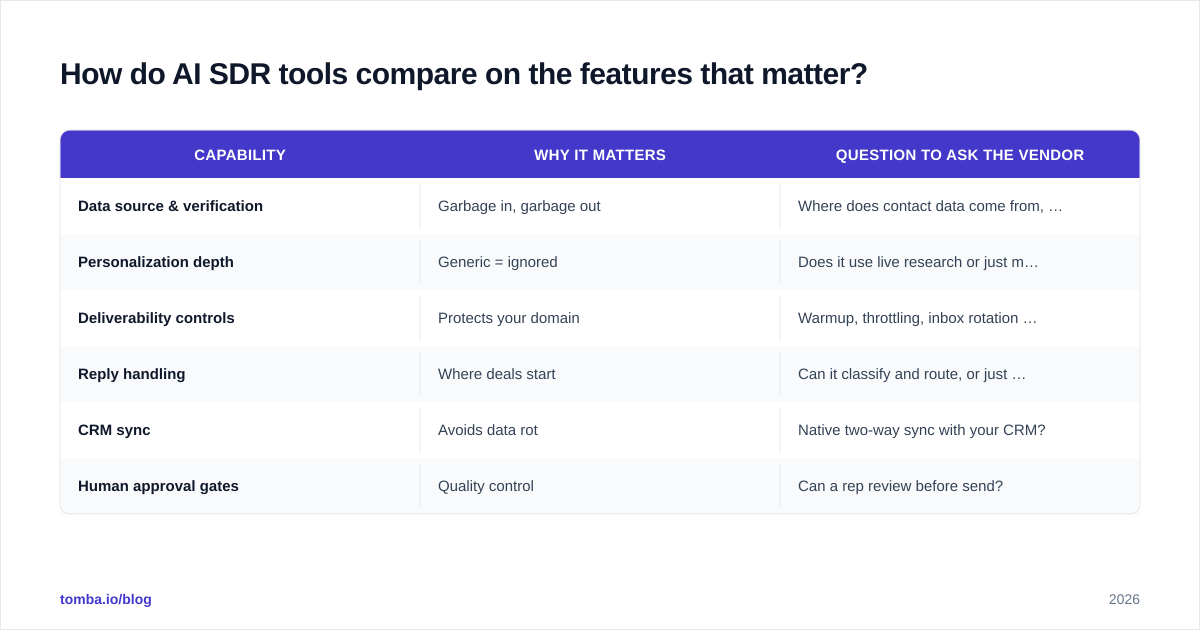
How do AI SDR tools compare on the features that matter?#
When you evaluate platforms, ignore the demo polish and score them on these dimensions. Cross-reference reviews on a neutral marketplace like G2 before committing.
| Capability | Why it matters | Question to ask the vendor |
|---|---|---|
| Data source & verification | Garbage in, garbage out | Where does contact data come from, and is it verified at send time? |
| Personalization depth | Generic = ignored | Does it use live research or just merge tags? |
| Deliverability controls | Protects your domain | Warmup, throttling, inbox rotation built in? |
| Reply handling | Where deals start | Can it classify and route, or just send? |
| CRM sync | Avoids data rot | Native two-way sync with your CRM? |
| Human approval gates | Quality control | Can a rep review before send? |
A quick analogy: choosing an AI SDR tool is like hiring a contractor. The slick portfolio (the UI) tells you less than whether they source good materials (data) and clean up after themselves (deliverability + CRM hygiene).
Where does AI SDR automation go wrong most often?#
Four failure modes account for most disappointing results.
1. Pointing automation at raw data. The fastest way to torch a domain is to let an AI agent send to unverified addresses. Bounces spike, spam traps fire, and your response rate collapses. Verify first, always.
2. "Personalization" that's actually mail-merge. Inserting {company} into a generic template isn't personalization — prospects pattern-match it instantly. Real personalization needs research signals fed to the model.
3. No human gate on edge cases. Fully autonomous agents will email the wrong persona, misread a tone, or follow up after someone clearly declined. A lightweight approval step catches the embarrassing 5%.
4. Ignoring deliverability as a system. Teams obsess over copy and forget warmup, authentication, and volume throttling. The best email in the world doesn't matter from the spam folder. HubSpot's guidance on cold email and deliverability is a solid baseline here.
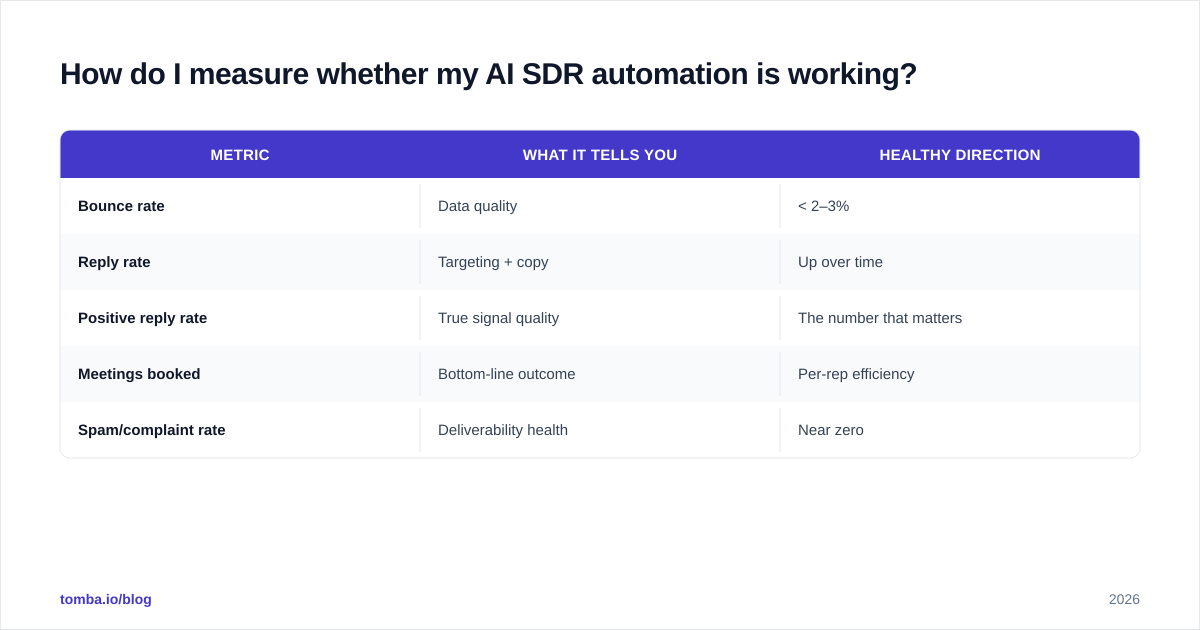
How do I measure whether my AI SDR automation is working?#
Track leading and lagging indicators separately, and don't let vanity volume metrics fool you. "We sent 50,000 emails" is not a result.
| Metric | What it tells you | Healthy direction |
|---|---|---|
| Bounce rate | Data quality | < 2–3% |
| Reply rate | Targeting + copy | Up over time |
| Positive reply rate | True signal quality | The number that matters |
| Meetings booked | Bottom-line outcome | Per-rep efficiency |
| Spam/complaint rate | Deliverability health | Near zero |
The decisive metric is positive reply rate, not open or send volume. If automation lets you 5x send volume but positive replies stay flat, you've automated noise. The goal is more qualified conversations per rep, which ties directly to overall win rate.
Will AI replace SDRs entirely?#
No — and any vendor claiming otherwise is selling, not forecasting. The realistic 2026 trajectory is role compression, not elimination. One SDR augmented by automation does the sourcing-and-sequencing work that used to take three, and spends the recovered hours on live conversations and qualification.
The skills that gain value are the ones AI can't fake: discovery questioning, objection handling, reading intent, and knowing when to push or pause. The tasks that disappear are the mechanical ones — list building, manual research, copy-pasting into the CRM. That's a good trade for most reps, who didn't take the job to do data entry.
Treat AI SDR automation the way a power drill relates to a carpenter: it doesn't replace the craftsperson, it removes the exhausting repetition so the skilled work gets more attention.
Getting started: a 30-day rollout#
- Week 1 — Fix the data. Audit your list. Verify everything. Establish a clean sourcing pipeline before automating anything.
- Week 2 — Automate one workflow. Pick enrich-and-verify-before-send. Measure bounce rate improvement.
- Week 3 — Add AI drafting with a human gate. Have reps approve the first 100 AI-written first lines; tune the prompt.
- Week 4 — Layer in sequencing and reply triage. Keep humans on positive replies. Review metrics, then scale the parts that worked.
The teams that win don't buy the biggest "autonomous SDR." They build a clean, verified, well-instrumented pipeline and let AI handle the volume inside guardrails.
Build your AI SDR on data you can trust#
Every AI SDR workflow lives or dies on contact data quality — automation only amplifies what you feed it. Start at the foundation: use the Tomba Email Finder to source verified professional emails by domain, name, or company, then plug it into your sequencer via the Tomba API. The free tier gives you 25 searches to test the workflow before you commit, and the $49/mo Starter plan scales it into a real outbound engine. Fix the data layer first, and the rest of your AI SDR stack finally has something worth automating.
// get started
Find, verify and enrich your first contacts today
Start on the free plan with 25 searches a month, then scale when your team is ready.
Free plan · No credit card required · GDPR & CCPA
// about the author