AI SDR for SMB and Enterprise: The 2026 Buyer's Guide
AI SDRs promise pipeline on autopilot — but the right pick differs wildly by company size. Here's how SMBs and enterprises should evaluate, budget for, and deploy an AI SDR in 2026.
TL;DR
- An AI SDR is software that automates prospecting, research, personalization, and first-touch outreach — but "best" depends entirely on whether you're a 10-person SMB or a 2,000-seat enterprise.
- SMBs should optimize for speed-to-value, flat pricing, and a single tool that books meetings without a RevOps team. Enterprises should optimize for data governance, CRM integration, and human-in-the-loop control.
- The biggest hidden cost isn't the AI SDR subscription — it's the data feeding it. Garbage contacts mean garbage outreach at scale.
- A realistic SMB budget starts near $200–$500/mo all-in; enterprise deployments routinely cross $50k–$150k/yr once data and seats are counted.
- Whatever you buy, pair it with an accurate email finder and verification layer — the AI can write, but it can't fix bad addresses.
What is an AI SDR, and why does company size change the answer?#
An AI SDR (Sales Development Representative) is software that does the repetitive top-of-funnel work a junior rep used to do: build a target list, research each account, draft a personalized message, send it across email or LinkedIn, and follow up until someone replies or opts out. Think of it as a tireless intern who reads every prospect's website at 3 a.m. and never forgets to follow up — except it scales to thousands of contacts a week.
The catch is that "AI SDR for SMB and enterprise" is really two different products wearing the same label. An SMB wants meetings on the calendar next week with minimal setup. An enterprise wants the same outcomes, but inside strict guardrails: approved messaging, CRM hygiene, territory rules, security reviews, and audit trails. Buy the wrong shape for your size and you'll either drown in configuration you don't need or hit a ceiling you can't break through.
Before you compare logos, get clear on which of those two problems you actually have. The rest of this guide is organized around that split.
How does an AI SDR actually work under the hood?#
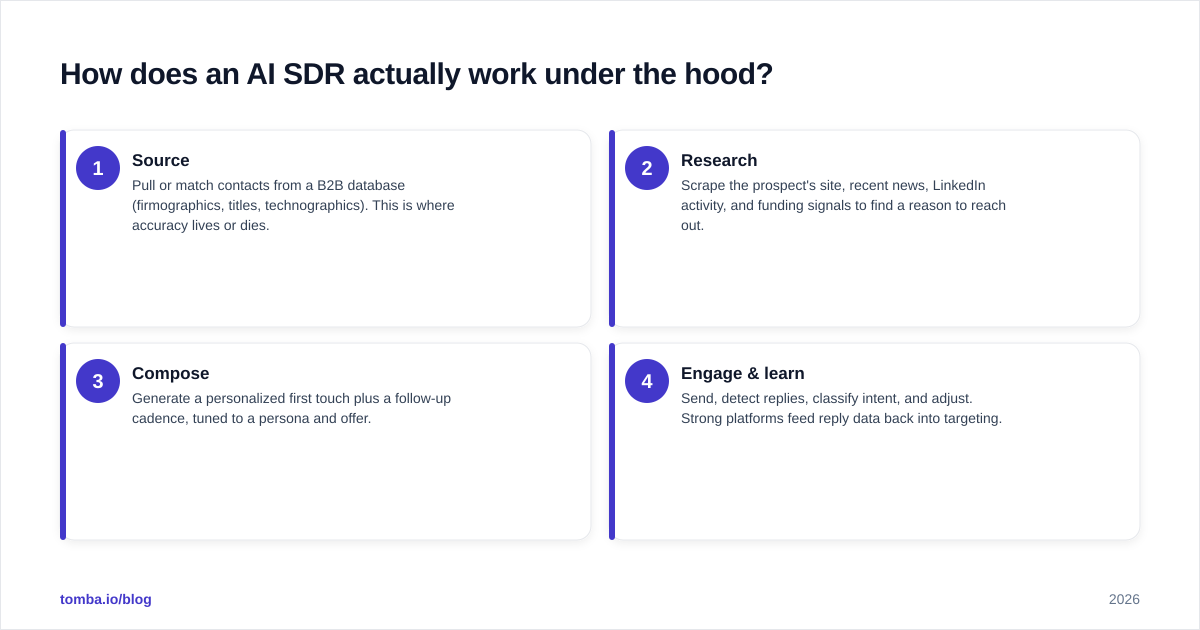
Most AI SDR platforms run the same four-stage loop, regardless of price. Understanding the loop tells you where quality is won or lost.
- Source — Pull or match contacts from a B2B database (firmographics, titles, technographics). This is where accuracy lives or dies.
- Research — Scrape the prospect's site, recent news, LinkedIn activity, and funding signals to find a reason to reach out.
- Compose — Generate a personalized first touch plus a follow-up cadence, tuned to a persona and offer.
- Engage & learn — Send, detect replies, classify intent, and adjust. Strong platforms feed reply data back into targeting.
Here's the uncomfortable truth: the AI writing is now a commodity. Every vendor uses similar large language models, so the prose quality converges. The differentiator is the data layer — whether the contact exists, whether the email is valid, and whether the role is current. An AI SDR firing beautifully written messages at stale or guessed addresses just damages your sender reputation faster. That's why teams pair their AI SDR with a dedicated email verifier and enrichment step instead of trusting one vendor's "verified" badge blindly.
Is an AI SDR better than a human SDR?#
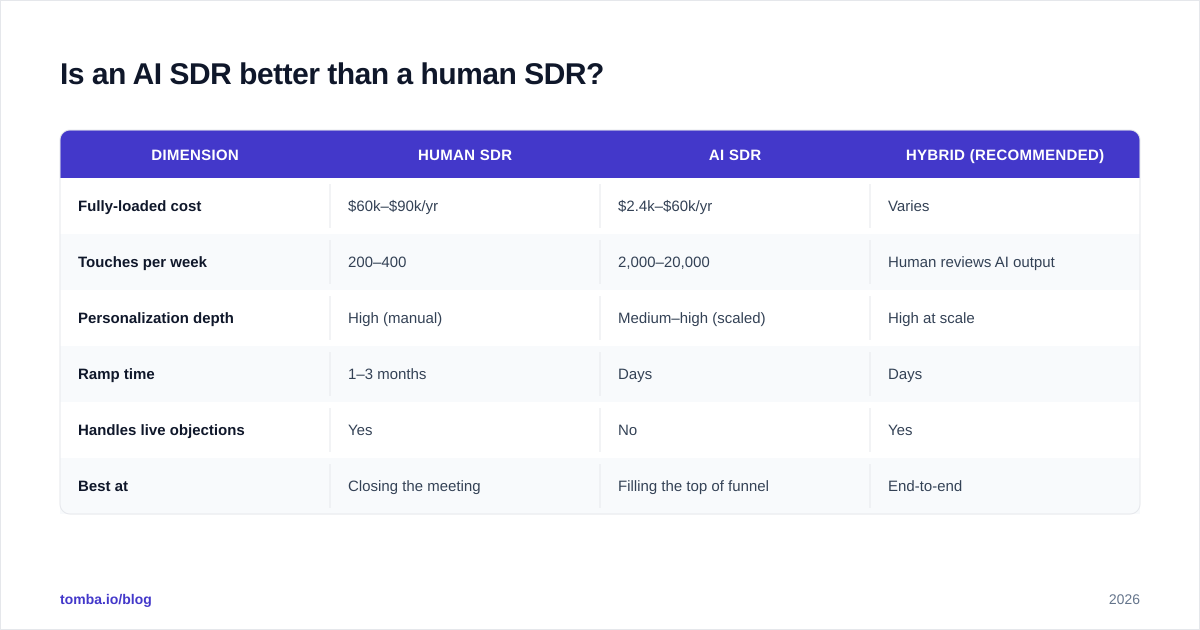
Not better — different, and best when combined. A human SDR brings judgment, objection handling, and relationship nuance. An AI SDR brings volume, consistency, and 24/7 coverage at a fraction of the cost per touch.
| Dimension | Human SDR | AI SDR | Hybrid (recommended) |
|---|---|---|---|
| Fully-loaded cost | $60k–$90k/yr | $2.4k–$60k/yr | Varies |
| Touches per week | 200–400 | 2,000–20,000 | Human reviews AI output |
| Personalization depth | High (manual) | Medium–high (scaled) | High at scale |
| Ramp time | 1–3 months | Days | Days |
| Handles live objections | Yes | No | Yes |
| Best at | Closing the meeting | Filling the top of funnel | End-to-end |
For most teams the answer is hybrid: let the AI SDR handle research and first touches, and route warm replies to a human to book and qualify. According to Gartner and analyst commentary across the category, buyers who treat AI SDRs as augmentation rather than replacement see better retention of both reps and customers.
What should an SMB look for in an AI SDR?#
If you're under ~200 employees, your scarcest resource is time and headcount — not budget approvals. Optimize ruthlessly for time-to-first-meeting.
- Flat, predictable pricing. Avoid per-credit pricing that punishes you for scaling. You want to forecast cost like a SaaS line item, not a metered utility bill.
- Setup measured in hours, not weeks. If onboarding requires a solutions engineer, it's built for enterprise.
- Built-in data, or a cheap data source. SMBs rarely have a separate data budget. A tool that finds and verifies contacts inline saves a second subscription — or pair a lightweight AI SDR with an affordable bulk email finder and export lists directly.
- Native sending or simple inbox connection. Gmail/Outlook OAuth, basic warmup guidance, and deliverability defaults that won't get you blacklisted.
- One dashboard. You don't have a RevOps person to stitch six tools together.
A practical SMB stack looks like: an AI SDR for cadence + writing, an accurate email-finding and verification layer, and your existing CRM. That's it. Resist the urge to buy the enterprise platform "to grow into" — you'll pay for governance features you'll never configure.
A quick reality check on data spend: many SMBs discover their AI SDR's bundled contacts are thin in their niche. Budgeting separately for verified contact data — see typical Tomba pricing tiers, which start free at 25 searches/mo and scale to $49/mo Starter and $99/mo Growth — is usually cheaper and more accurate than paying enterprise data fees inside an all-in-one suite.
What should an enterprise look for in an AI SDR?#
Above ~500 employees, the buying criteria flip. Speed matters less than control, compliance, and clean integration with systems of record.
- CRM-native sync. Bi-directional, field-level mapping with Salesforce or HubSpot — not a nightly CSV. Bad sync creates duplicate records and territory chaos.
- Human-in-the-loop approvals. Messaging must pass brand and legal review. Look for draft queues, approval gates, and message libraries.
- Data governance & security. SOC 2 Type II, SSO/SAML, role-based access, data residency options, and GDPR/CAN-SPAM handling. Procurement will ask; have answers.
- Territory & routing logic. Respect account ownership, segments, and ABM lists so reps don't collide.
- Auditability. Who sent what, to whom, approved by whom. Enterprises get burned by AI sending off-message at scale.
- API depth. You'll want to enrich and dedupe inside your own pipelines. A robust email finder API and enrichment endpoints let data engineering build governance around the AI SDR rather than trusting a black box.
Enterprises also need to budget for change management. The tool is the easy part; getting 200 reps to trust and use AI-drafted outreach — and getting legal comfortable — is the real project.
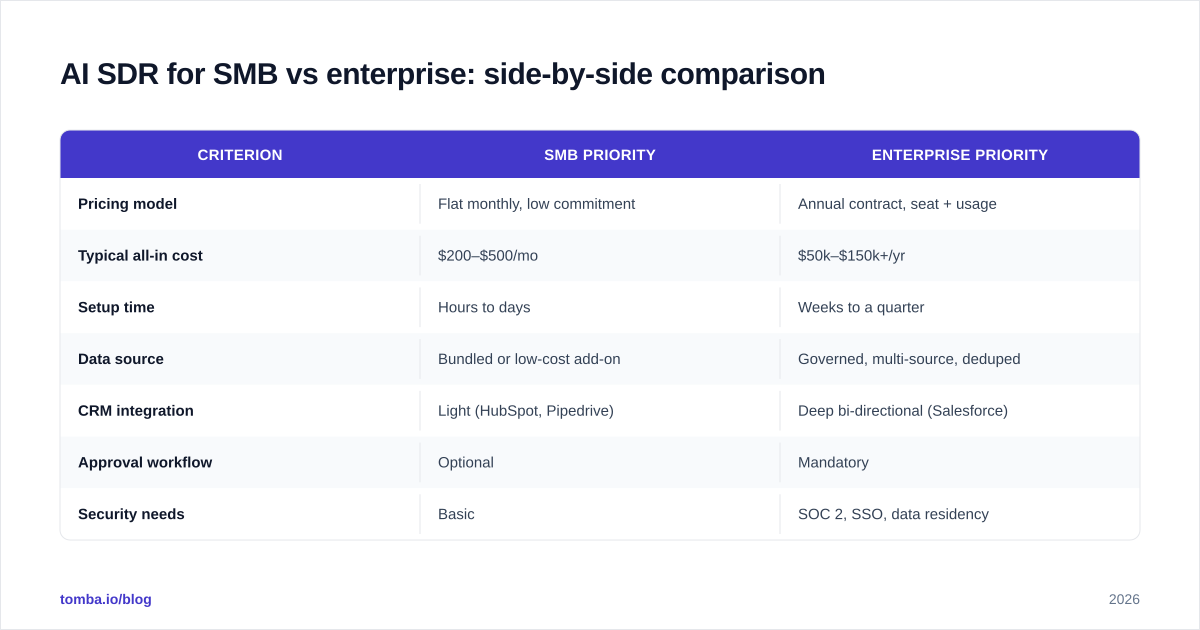
AI SDR for SMB vs enterprise: side-by-side comparison#
Use this to sanity-check whether a vendor's pitch matches your size.
| Criterion | SMB priority | Enterprise priority |
|---|---|---|
| Pricing model | Flat monthly, low commitment | Annual contract, seat + usage |
| Typical all-in cost | $200–$500/mo | $50k–$150k+/yr |
| Setup time | Hours to days | Weeks to a quarter |
| Data source | Bundled or low-cost add-on | Governed, multi-source, deduped |
| CRM integration | Light (HubSpot, Pipedrive) | Deep bi-directional (Salesforce) |
| Approval workflow | Optional | Mandatory |
| Security needs | Basic | SOC 2, SSO, data residency |
| Primary risk | Deliverability damage | Brand/compliance at scale |
| Who owns it | Founder / first AE | RevOps + enablement |
The single thread connecting both columns is data accuracy. Whether you send 500 or 50,000 emails, a high bounce rate tanks deliverability and burns the domain. That's why a verification step — including catch-all verification for risky domains — belongs in every AI SDR workflow regardless of size.
How do you measure AI SDR ROI in 2026?#
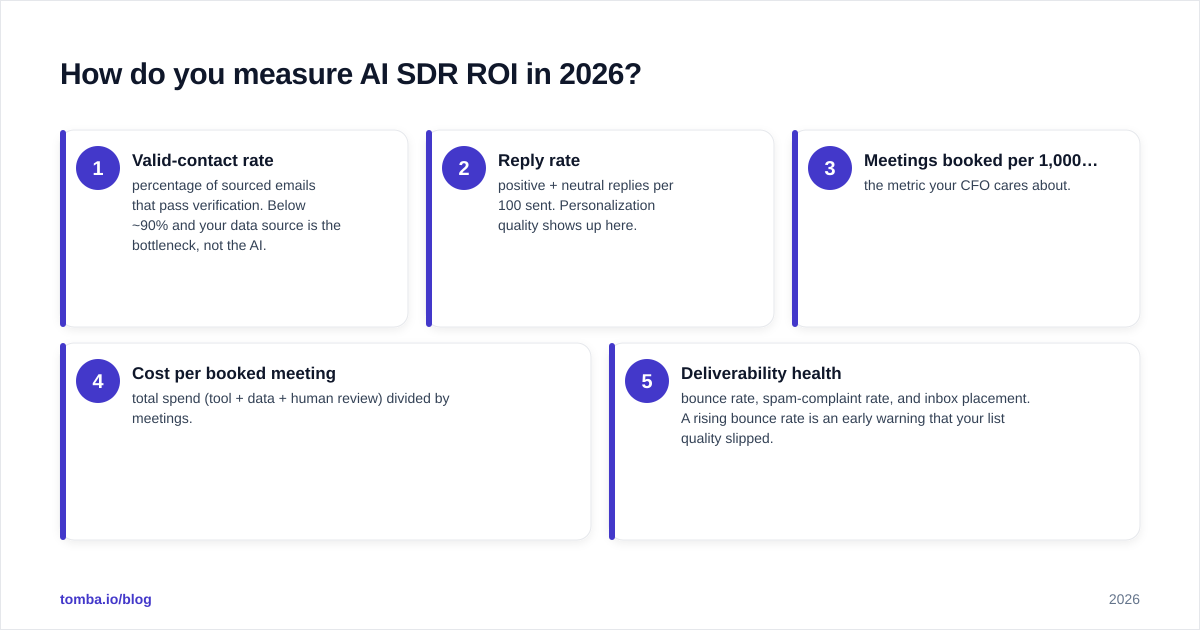
Track these five numbers from day one, and compare them against your pre-AI baseline:
- Valid-contact rate — percentage of sourced emails that pass verification. Below ~90% and your data source is the bottleneck, not the AI.
- Reply rate — positive + neutral replies per 100 sent. Personalization quality shows up here.
- Meetings booked per 1,000 contacts — the metric your CFO cares about.
- Cost per booked meeting — total spend (tool + data + human review) divided by meetings.
- Deliverability health — bounce rate, spam-complaint rate, and inbox placement. A rising bounce rate is an early warning that your list quality slipped.
Public benchmarks on review sites like G2 are a useful sanity check, but your own valid-contact rate is the leading indicator. Fix data first; everything downstream improves. Teams that audit their lists with a reverse-lookup or data enrichment pass before launching campaigns consistently report lower bounce rates and cleaner CRM records.
What are the common ways AI SDR deployments fail?#
- Buying enterprise complexity as an SMB. You spend the first month configuring features you don't need and never send a real campaign.
- Trusting bundled data blindly. "Verified" inside a suite often means "verified months ago." Re-verify before sending.
- Skipping warmup and deliverability hygiene. Blasting 10,000 cold emails from a cold domain is the fastest way to a blacklist.
- No human in the loop at scale. AI will confidently send a wrong-persona message to 3,000 people. One reviewer prevents a brand incident.
- Measuring sends instead of meetings. Volume is vanity; booked meetings are the point.
Avoid all five and you're ahead of most teams adopting AI SDRs this year.
Which AI SDR setup is right for you?#
If you're an SMB, start lean: a flat-priced AI SDR, a connected inbox with warmup, and a reliable contact-data layer you control. Prove the motion on one segment before expanding. If you're an enterprise, lead with integration and governance: pick the platform your RevOps team can wire into Salesforce cleanly, gate every message through approval, and build your enrichment and verification on an API you own.
Both paths share one dependency. The most sophisticated AI SDR on the market is only as good as the addresses it sends to. Before you scale outreach, build your list and validate it with Tomba's Email Finder — find professional emails by name, domain, or company, verify them, and enrich the records — so your AI SDR spends its volume on real people instead of bouncing into the void. Start free with 25 searches a month, then scale to the plan that matches your pipeline. Get the data right, and the AI does the rest.
Ready to find emails that actually work?
Join 150,000+ professionals who stopped guessing and started sending. Free credits on signup — no credit card required.
Get the Tomba newsletter
Practical outbound tactics and product updates — once every two weeks.
About the author