AI SDR Pricing in 2026: What These Tools Actually Cost
AI SDR tools promise pipeline on autopilot — but pricing ranges from $0 to $5k/mo with hidden per-meeting fees. Here's how the models really break down.
AI SDR Pricing in 2026: What These Tools Actually Cost
You shopped for an "AI SDR" expecting one number and got a maze: flat monthly fees, per-seat licenses, per-meeting bounties, credit packs, and an "enterprise — let's talk" wall. The sticker price is rarely what you pay. This guide breaks down every AI SDR pricing model in 2026, what drives the real cost, and how to compare offers without getting buried in usage fees.
TL;DR#
- AI SDR pricing in 2026 spans roughly $0 to $5,000+/month, clustering at three tiers: light automation ($50–$500/mo), full agentic SDRs ($1,000–$3,000/mo), and enterprise platforms (custom, often $5k+).
- Four pricing models dominate: flat subscription, per-seat, per-meeting/per-outcome, and usage/credit-based. Most vendors blend two of them.
- The advertised price excludes data. Email finding, verification, and enrichment credits are frequently billed separately — budget for them up front.
- Per-meeting pricing looks safe but scales badly once volume climbs; flat fees win at scale, usage models win for spiky workloads.
- A "build" stack (your own sequencer + a data provider like Tomba) often undercuts a packaged AI SDR by 60–80% if you already have an SDR or RevOps owner.
What is an AI SDR and why is pricing so confusing?#
An AI SDR is software that performs the top-of-funnel work a human sales development rep does: finding prospects, researching them, writing personalized outreach, sending sequences across email and LinkedIn, handling replies, and booking meetings. Think of it as hiring a rep who never sleeps — except instead of a salary, you pay a software bill that's been sliced into a dozen line items.
Pricing is confusing because vendors are pricing three different things at once: the software (the agent and its workflows), the data (contacts, emails, enrichment), and the outcomes (meetings booked). A human SDR bundles all of that into one salary. AI SDR vendors unbundle it, then re-bundle it differently from each other, so a $99/mo plan and a $1,500/mo plan can deliver nearly identical work depending on what's included.
That layering is the single most important thing to understand before you compare quotes. A cheap agent with no data included is not cheap. A "free" tier that charges per verified email is not free once you send volume.
What are the four AI SDR pricing models?#
Almost every vendor uses one of these four structures, or a hybrid of two.
1. Flat subscription#
You pay a fixed monthly or annual fee for a defined scope — a set number of active campaigns, sending mailboxes, or monthly contacts. Predictable, easy to budget, and your favorite once volume is high. The risk: paying for capacity you don't use in slow months.
2. Per-seat#
Priced per user, like most SaaS. Common with tools that started as human-rep platforms and bolted on AI. Fine for a 2-person team; punishing when you want the AI to do the work of five reps but you're charged as if five humans logged in.
3. Per-meeting / per-outcome#
You pay only when the AI books a qualified meeting — often $50–$200 per meeting, sometimes a revenue share. Feels low-risk because cost tracks results. But "qualified" is defined by the vendor, disputes are common, and at 40+ meetings a month the math flips against you fast.
4. Usage / credit-based#
You buy credits consumed by actions: emails sent, contacts enriched, AI generations, LinkedIn touches. Best for spiky or seasonal outreach. Worst for forecasting — a good month can blow the budget.
How much do AI SDR tools cost in 2026? (Comparison table)#
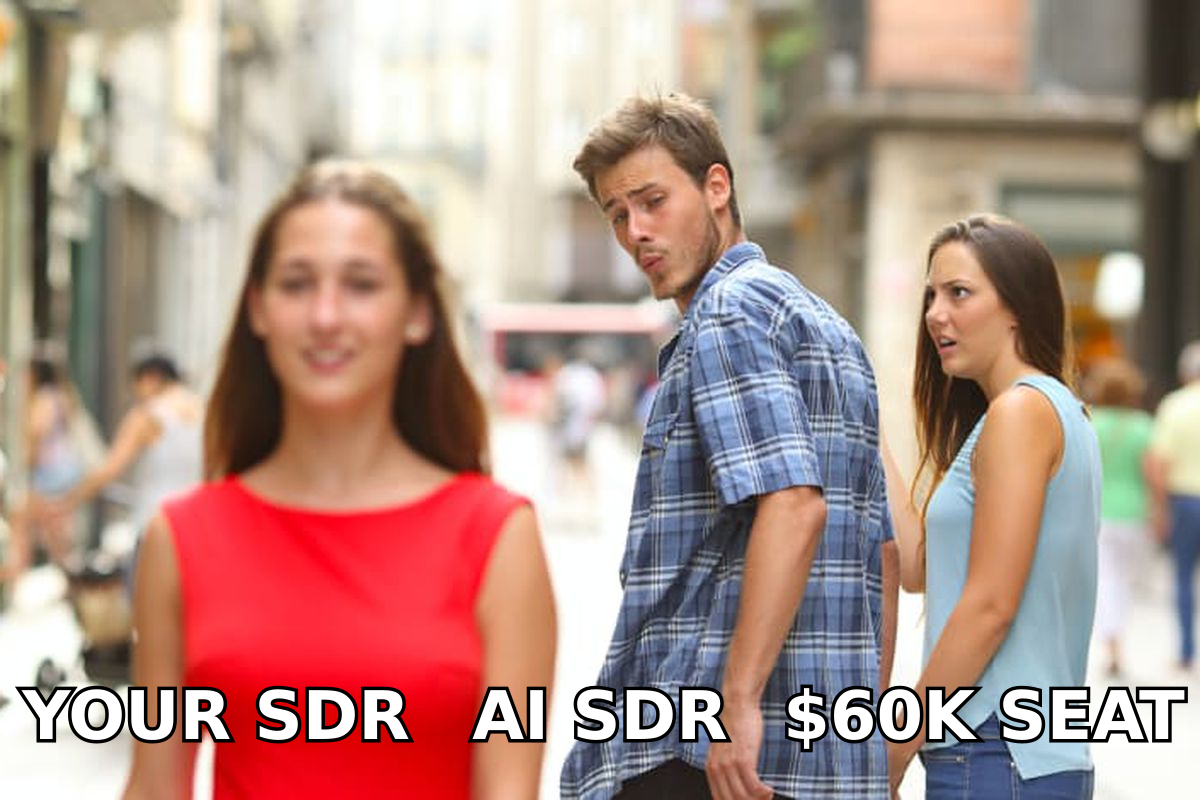
Here's how representative pricing shakes out across the market in 2026. Figures are typical published rates for the entry-to-mid tier; enterprise is almost always custom-quoted.
| Pricing model | Typical entry cost | What's usually included | Data/contacts included? | Best for |
|---|---|---|---|---|
| Flat subscription | $1,000–$3,000/mo | Agent, sequencing, inbox management | Sometimes capped | Teams sending 5k+ emails/mo |
| Per-seat | $75–$250/seat/mo | Sequencer + AI assist per user | Rarely | Small human-led teams adding AI |
| Per-meeting | $50–$200/meeting | Full done-for-you outreach | Usually yes | Pilots, low-volume testing |
| Usage / credits | $49–$500/mo + overages | Pay-as-you-go actions | Charged per action | Spiky or seasonal campaigns |
| DIY stack | $49–$200/mo total | Your sequencer + a data API | You buy credits directly | Teams with a RevOps owner |
The DIY row is the one most buyers overlook. If you pair a low-cost sequencer with a dedicated data provider, you replicate 80% of a packaged AI SDR for a fraction of the price — and you control the data quality directly. That last point matters more than the software, because an AI SDR sending to bad addresses just automates bounces.
What hidden costs inflate AI SDR pricing?#
The quote is the floor, not the ceiling. Watch for these.
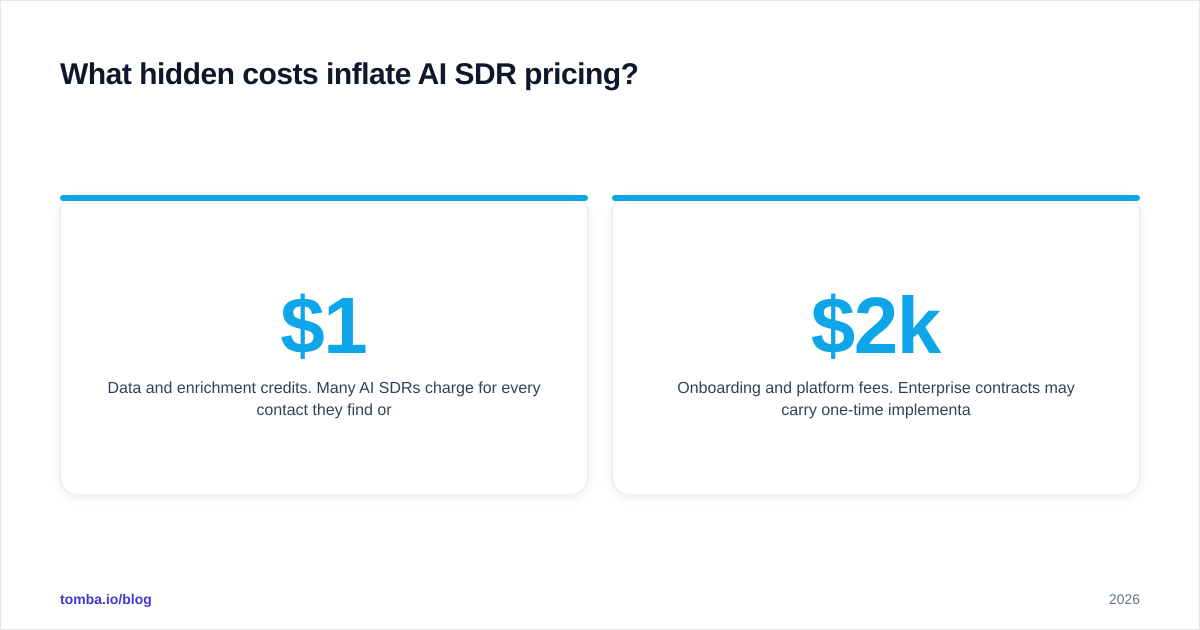
Data and enrichment credits. Many AI SDRs charge for every contact they find or enrich. If a vendor quotes "$1,500/mo" but meters enrichment, your bill can double once campaigns ramp. This is why a transparent, standalone source of contact data is worth pricing separately — you can verify the per-contact cost instead of accepting an opaque bundle. A dedicated email finder with clear per-search pricing makes that line item legible.
Verification and bounce costs. Sending to unverified emails wrecks your sender reputation and gets your domain throttled. Some platforms include verification; many don't. Running addresses through an email verifier before send is non-negotiable, and if it's not bundled, that's a real cost.
Mailbox and warmup fees. AI SDRs that send at volume need multiple sending mailboxes plus warmup. That's often a separate per-inbox charge.
Overage cliffs. Usage plans frequently have steep overage rates once you cross the included tier. Read the per-unit cost above the cap, not just the headline.
Onboarding and platform fees. Enterprise contracts may carry one-time implementation fees of $2k–$10k that never appear on the pricing page.
Is an AI SDR cheaper than hiring a human SDR?#
Short answer: yes on raw cost, but not always on outcome — and the gap is closing.
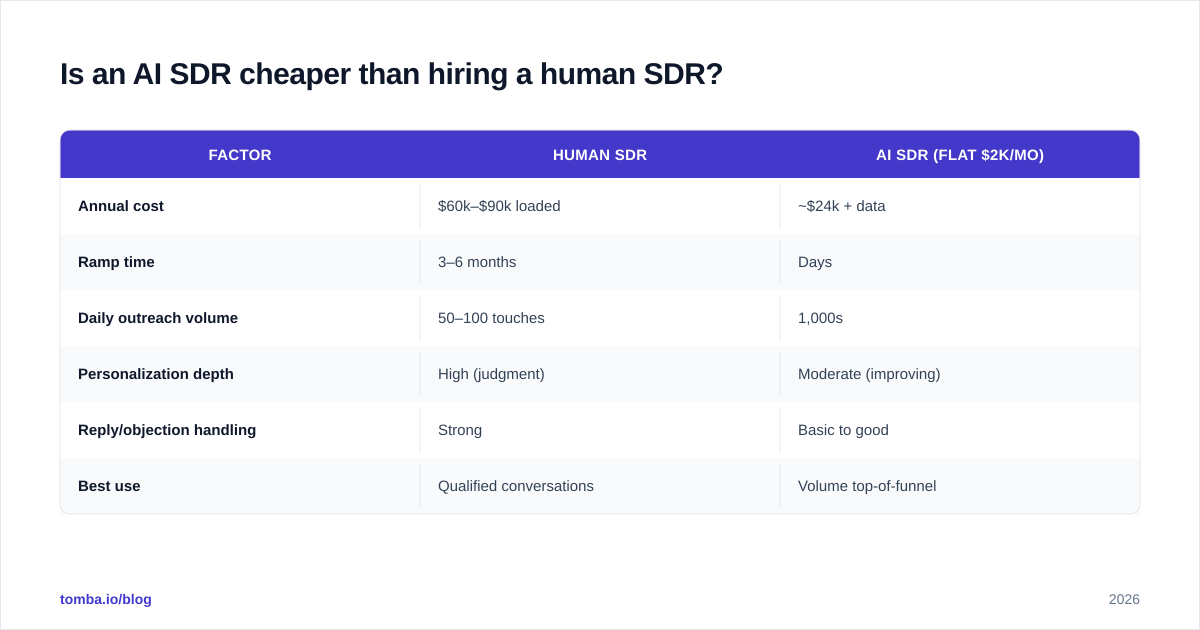
A fully-loaded human SDR in North America runs roughly $60,000–$90,000/year once you add salary, commission, benefits, tooling, and ramp time. An AI SDR at $2,000/mo is $24,000/year. On a spreadsheet, the AI wins by a wide margin.
But the human books meetings the AI can't: complex deals, nuanced objection handling, relationship selling. The right framing isn't "replace the human" — it's "let the AI handle volume top-of-funnel so the human works qualified conversations." In that model you're comparing the AI's cost against the marginal rep you'd otherwise hire, and the AI usually wins.
| Factor | Human SDR | AI SDR (flat $2k/mo) |
|---|---|---|
| Annual cost | $60k–$90k loaded | ~$24k + data |
| Ramp time | 3–6 months | Days |
| Daily outreach volume | 50–100 touches | 1,000s |
| Personalization depth | High (judgment) | Moderate (improving) |
| Reply/objection handling | Strong | Basic to good |
| Best use | Qualified conversations | Volume top-of-funnel |
According to category research from analysts like Gartner and peer reviews on G2, buyers consistently report that AI SDRs lift activity volume but require human oversight on quality — so the cost comparison should assume a blended team, not a full replacement.
How do you calculate the real cost per meeting?#
Ignore the sticker price and compute cost per booked meeting. That's the only number that compares vendors fairly across models.
The formula:
Total monthly spend (software + data + verification + mailboxes) ÷ qualified meetings booked = true cost per meeting.
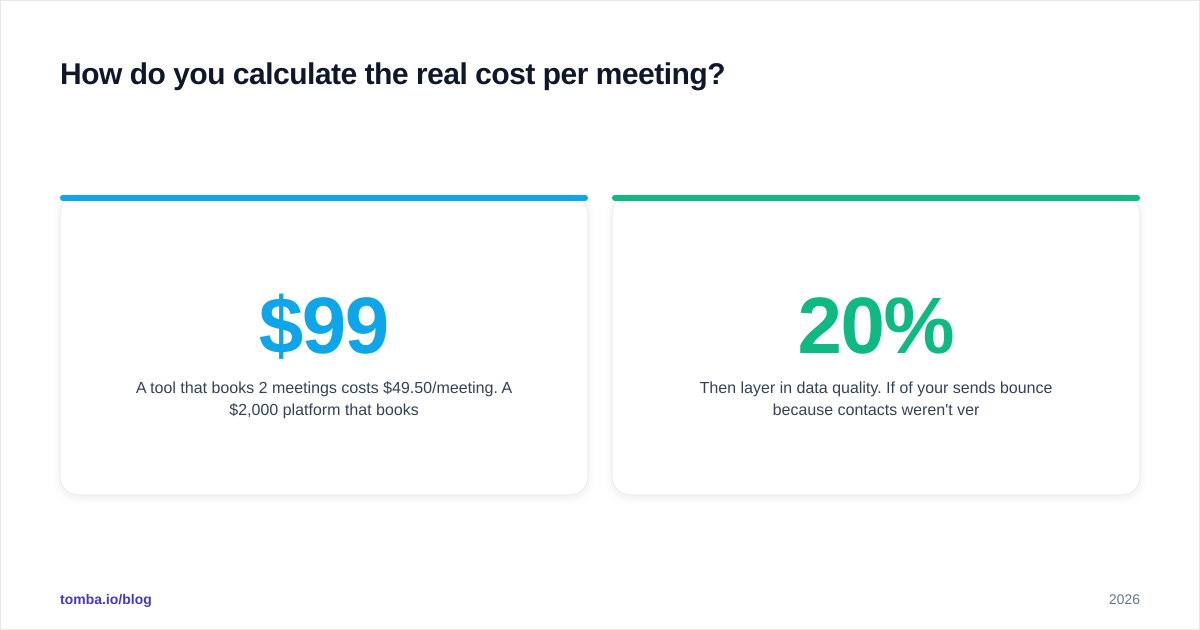
A $99/mo tool that books 2 meetings costs $49.50/meeting. A $2,000/mo platform that books 30 meetings costs $66/meeting — but it scales, and the cheap tool likely won't. Run this math at your expected volume, not the vendor's best-case demo numbers.
Then layer in data quality. If 20% of your sends bounce because contacts weren't verified, your effective cost per meeting jumps and your domain reputation erodes. This is where controlling your own data pipeline pays off: pulling verified contacts through domain search and checking Tomba pricing for transparent per-credit costs lets you model the data line item exactly instead of guessing.
Which AI SDR pricing model should you choose?#
Match the model to your stage and volume.
- Just testing the channel? Start with per-meeting or a usage/credit plan. Low commitment, costs track results, easy to kill if it flops.
- Sending consistent high volume (5k+ emails/mo)? Flat subscription wins — predictable and the per-action cost drops as you scale.
- Small human team wanting AI assist, not replacement? Per-seat is fine; you're augmenting people, not running an autonomous agent.
- Have a RevOps or growth owner? Build the stack. A capable sequencer plus a dedicated data provider for finding and verifying contacts is the cheapest path to quality pipeline, and you keep full control of data accuracy.
Whatever you pick, decouple the data decision from the software decision. The agent is replaceable; bad contact data poisons every send regardless of how smart the AI is. Vendors with strong consumer reviews on Capterra almost always score on data quality, not feature count.
Frequently asked questions#
How much does an AI SDR cost per month in 2026? Most teams pay between $1,000 and $3,000/month for a full agentic AI SDR, plus separate data and verification costs. Light automation tools start near $50/month, and enterprise platforms are custom-quoted, often above $5,000/month.
Is per-meeting pricing better than a flat fee? For pilots and low volume, yes — you only pay for results. Once you book more than ~30–40 meetings a month, flat-fee pricing is usually cheaper because per-meeting rates stack up fast.
What costs are hidden in AI SDR pricing? Data enrichment credits, email verification, additional sending mailboxes, warmup, overage rates above usage caps, and one-time onboarding fees. These can double the advertised price.
Can I build my own AI SDR cheaper? Often yes. Pairing a low-cost sequencer with a transparent data provider for finding and verifying contacts can cost under $200/month total, versus $2,000+ for a packaged tool — if you have someone to run it.
The bottom line#
AI SDR pricing in 2026 isn't one number — it's three layers (software, data, outcomes) wrapped in four models. Compute your true cost per booked meeting at realistic volume, watch the data and verification line items, and never let an opaque bundle hide what you're actually paying per contact.
Whichever AI SDR you choose, the engine only runs on accurate contacts. Start by controlling that layer directly: use the Tomba Email Finder to source and verify the prospect data your outreach depends on — with transparent pricing from a free tier up to plans that scale with your pipeline, so the one cost you can pin down stays under your control.
// get started
Find, verify and enrich your first contacts today
Start on the free plan with 25 searches a month, then scale when your team is ready.
Free plan · No credit card required · GDPR & CCPA
// about the author