AI SDR Pricing Comparison 2026: Real Costs of 8 Tools
AI SDR tools advertise low monthly fees, then bill you for data, sending, and seats. Here is the real 2026 cost breakdown across 8 platforms.
AI SDR tools are the fastest-growing line item in most 2026 outbound budgets, and also the most confusing to price. The sticker number on the homepage almost never matches the invoice. This is an honest ai sdr pricing comparison built for people who have to defend the spend, not just trial it.
TL;DR#
- Headline AI SDR pricing ($1,000–$3,000/mo) rarely includes data, email sending, or warmup — budget 1.5x to 2x the advertised price.
- Per-tool list prices range from roughly $600/mo (entry automation) to $5,000+/mo (fully managed AI SDR), with most "agentic" tools landing at $2,000–$4,000/mo.
- A loaded human SDR costs ~$84,000/year all-in; a single AI SDR seat is cheaper, but you still need data and deliverability tooling underneath it.
- The biggest hidden cost is bad data: paying an AI SDR to email invalid addresses burns sending reputation and credits at the same time.
- Pair any AI SDR with an accurate email source like the Tomba Email Finder and a separate email verifier to keep the real cost-per-meeting down.
What is an AI SDR, and why is pricing so messy?#
An AI SDR is software that does the repetitive parts of a sales development rep's job: building lists, researching accounts, writing first-touch emails, sequencing follow-ups, and sometimes booking the meeting. Think of it as a junior rep who works 24/7, never asks for PTO, and only does exactly what you configured.
Pricing is messy because vendors bundle three very different things under one logo:
- The AI layer — the agent that writes and decides.
- The data layer — contact records, emails, and enrichment.
- The delivery layer — mailboxes, warmup, and sending infrastructure.
Some tools sell all three as one price. Others sell you the brain and quietly expect you to bring your own data and mailboxes. That single distinction explains most of the sticker-shock you will hit on the invoice.
)
What does an AI SDR actually cost in 2026?#
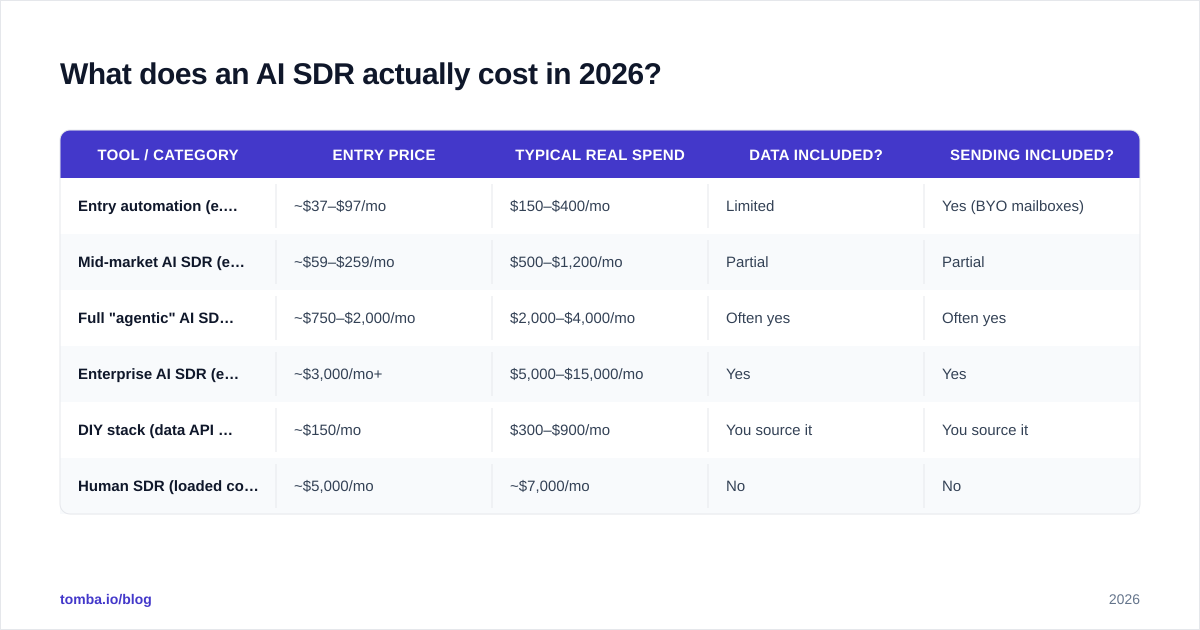
Here is the part nobody puts on the homepage: the advertised monthly fee is the floor, not the ceiling. Below is a representative ai sdr pricing comparison across common tool categories. Prices are list prices as of mid-2026 and are rounded; always confirm with the vendor because annual contracts and "agent" usage tiers move these numbers.
| Tool / category | Entry price | Typical real spend | Data included? | Sending included? |
|---|---|---|---|---|
| Entry automation (e.g. Instantly, Saleshandy) | ~$37–$97/mo | $150–$400/mo | Limited | Yes (BYO mailboxes) |
| Mid-market AI SDR (e.g. Reply.io AI) | ~$59–$259/mo | $500–$1,200/mo | Partial | Partial |
| Full "agentic" AI SDR (e.g. AiSDR, Artisan) | ~$750–$2,000/mo | $2,000–$4,000/mo | Often yes | Often yes |
| Enterprise AI SDR (e.g. 11x, Qualified) | ~$3,000/mo+ | $5,000–$15,000/mo | Yes | Yes |
| DIY stack (data API + sequencer + warmup) | ~$150/mo | $300–$900/mo | You source it | You source it |
| Human SDR (loaded cost) | ~$5,000/mo | ~$7,000/mo | No | No |
Two things jump out. First, the gap between entry price and real spend widens as you move up the stack. Second, the DIY stack — buy accurate data, plug it into a sequencer, run your own warmup — is often the cheapest credible option if you have someone to operate it.
For the data layer specifically, you can see published Tomba pricing as a reference point: a free tier with 25 searches/mo, Starter at $49/mo, Growth at $99/mo, and Pro at $249/mo. That is the kind of line item the "all-in-one" AI SDR vendors are marking up and reselling inside their bundle.
Is an AI SDR cheaper than a human SDR?#
Short answer: on paper yes, in practice it depends on data quality.
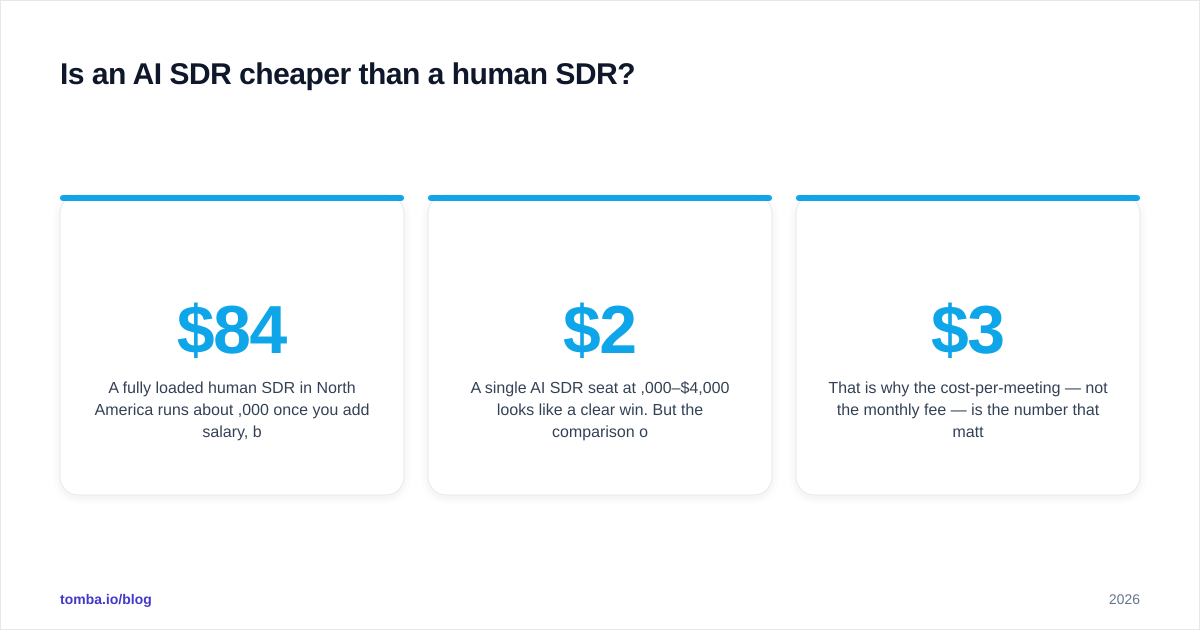
A fully loaded human SDR in North America runs about $84,000/year once you add salary, benefits, tooling, and management overhead — roughly $7,000/month. According to compensation benchmarks published by industry sources like Gartner and peer-review data on G2, even mid-market SDR comp keeps climbing.
A single AI SDR seat at $2,000–$4,000/month looks like a clear win. But the comparison only holds if the AI SDR is emailing real people at valid addresses. An AI agent sending 1,000 emails a day to a list that is 30% invalid does three expensive things at once:
- Burns sending credits on bounces.
- Damages your domain's sender reputation, which suppresses every future campaign.
- Produces meeting numbers so weak you conclude "AI SDRs don't work" when the real problem was the data.
That is why the cost-per-meeting — not the monthly fee — is the number that matters. A $3,000/mo tool that books 12 meetings ($250/meeting) is more expensive than a $1,200/mo tool that books 10 ($120/meeting), even though it costs more upfront.
What hidden costs should you budget for?#
When you build the budget, add these line items before you sign anything. They are the difference between the demo price and the renewal invoice.
Data and enrichment. Many AI SDRs cap "verified" contacts per tier or charge per enrichment. If you scale volume, this becomes the dominant cost. Bringing your own accurate source via an email finder API or bulk lead generation is frequently cheaper than the vendor's per-contact rate.
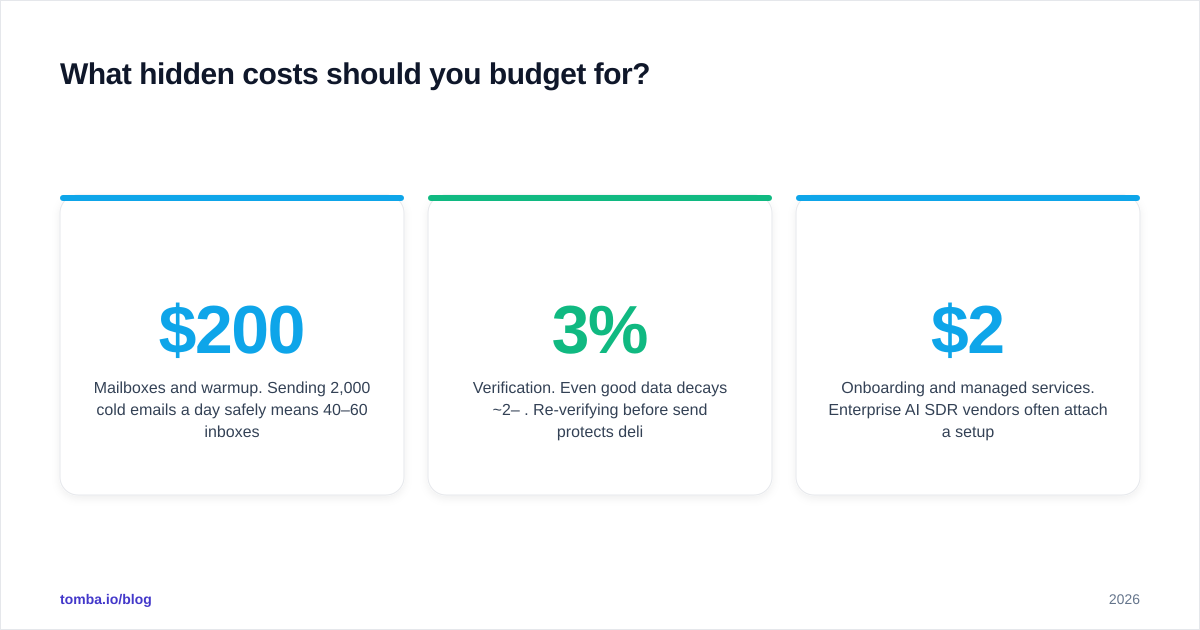
Mailboxes and warmup. Sending 2,000 cold emails a day safely means 40–60 inboxes across multiple domains, each warmed. Some AI SDRs include this; others quietly assume you'll pay a separate $200–$600/mo for sending infrastructure.
Verification. Even good data decays ~2–3% per month. Re-verifying before send protects deliverability. A standalone email verification pass is cheap insurance against bounce-driven reputation damage.
Seats and overage. "Per agent" pricing scales linearly. Three AI SDRs is three times the bill, and most overage rates are punitive.
Onboarding and managed services. Enterprise AI SDR vendors often attach a setup or "strategist" fee of $2,000–$10,000 that doesn't appear on the pricing page at all.
)
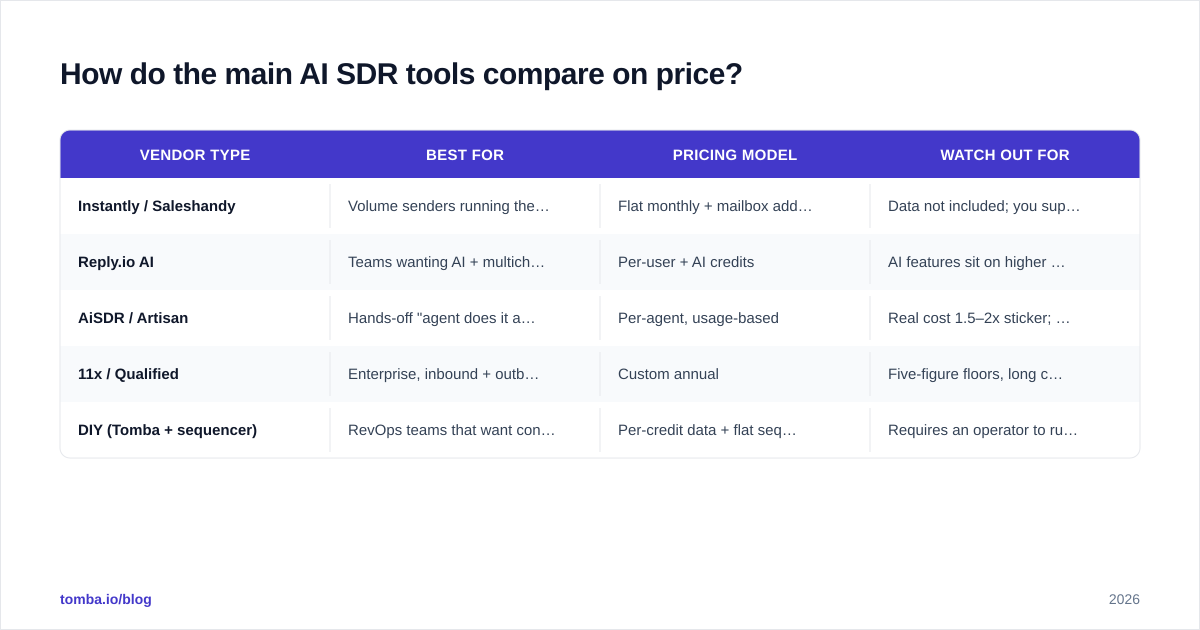
How do the main AI SDR tools compare on price?#
Below is a closer look at how the major categories price themselves and where the asterisks hide. Treat this as a starting map, not gospel — vendors reprice constantly and most now gate real numbers behind a demo.
| Vendor type | Best for | Pricing model | Watch out for |
|---|---|---|---|
| Instantly / Saleshandy | Volume senders running their own data | Flat monthly + mailbox add-ons | Data not included; you supply contacts |
| Reply.io AI | Teams wanting AI + multichannel | Per-user + AI credits | AI features sit on higher tiers |
| AiSDR / Artisan | Hands-off "agent does it all" | Per-agent, usage-based | Real cost 1.5–2x sticker; data caps |
| 11x / Qualified | Enterprise, inbound + outbound | Custom annual | Five-figure floors, long contracts |
| DIY (Tomba + sequencer) | RevOps teams that want control | Per-credit data + flat sequencer | Requires an operator to run it |
If you are evaluating named tools, check the vendor's own pricing page and cross-reference real user reports on G2 or Capterra before you trust the headline number. For deeper context on automating the workflow itself, our primer on sales automation walks through what should and shouldn't be handed to an agent.
How should you budget for an AI SDR stack?#
Work backward from pipeline, not forward from features. Here is a simple framework that keeps the ai sdr pricing comparison honest.
Step 1 — Set a target cost-per-meeting. If a closed deal is worth $10,000 and you close 1 in 5 meetings, you can afford up to ~$400/meeting and still print money. Most healthy outbound motions target $80–$250.
Step 2 — Estimate volume. Decide how many qualified contacts per month you need to hit pipeline goals. This sizes your data and sending needs more than your AI choice does.
Step 3 — Price the three layers separately. Even if you buy a bundle, force the vendor to show you what you'd pay for AI, data, and sending standalone. This is the single best negotiation lever you have.
Step 4 — Add a 1.5x buffer. Overage, verification, extra mailboxes, and onboarding reliably push real spend above the quote.
Step 5 — Decide build vs. buy. If you have a RevOps owner, a DIY stack — accurate data via domain search and the email finder, a sequencer, and warmup — usually wins on cost-per-meeting. If you don't, a managed AI SDR buys you time at a premium.
For teams formalizing this, our revenue operations glossary entry covers how to make the build-vs-buy call a repeatable process rather than a one-off argument.
Is the cheapest AI SDR the best value?#
No — and this is where most buyers get burned. The cheapest tool is rarely the lowest cost-per-meeting, because the savings usually come from cutting the data or deliverability layer, which are the two things that actually determine whether your emails land and convert.
A useful rule: spend less on the AI brain and more on the data feeding it. The writing quality of AI SDRs has converged — they all produce competent first-touch copy in 2026. What separates a profitable campaign from a reputation disaster is whether the contacts are real, current, and reachable. You can swap the AI; you cannot un-burn a domain.
That means your money is best allocated roughly like this:
- 40% data accuracy (finding and verifying real contacts)
- 25% sending infrastructure (mailboxes, warmup, monitoring)
- 25% the AI SDR / sequencing layer
- 10% reporting and attribution
Notice the AI itself is a minority of the budget. If a vendor's pricing inverts that — charging you premium rates for the agent while shipping mediocre data — you are paying for the wrong layer.
Frequently asked questions#
How much does an AI SDR cost per month in 2026? Most fall between $1,000 and $4,000/month for a single agent, but entry automation tools start near $40–$100/month and enterprise platforms exceed $5,000/month. Real spend typically runs 1.5x to 2x the advertised price once data and sending are added.
Are AI SDRs cheaper than hiring a rep? Usually yes on raw cost — a human SDR runs roughly $84,000/year loaded versus $24,000–$48,000/year for an AI SDR seat. But the AI only wins on cost-per-meeting if it's fed accurate, verified data.
What's the biggest hidden cost in AI SDR pricing? Data. Per-contact enrichment caps and overage fees, plus the deliverability damage from emailing invalid addresses, quietly dominate the real bill.
Can I run an AI SDR motion without an all-in-one vendor? Yes. A DIY stack — a data source like Tomba, a sequencer, and a warmup tool — often beats bundled AI SDRs on cost-per-meeting if you have someone to operate it.
The bottom line on AI SDR pricing#
Stop comparing homepage prices. Compare cost-per-meeting, and force every vendor to itemize the AI, data, and sending layers so you can see what you're actually paying for. In nearly every honest ai sdr pricing comparison, the deciding factor isn't the cleverness of the agent — it's whether the contacts underneath it are real.
That's the layer to get right first. Before you commit thousands a month to any AI SDR, make sure the data feeding it is accurate: use the Tomba Email Finder to source verified, professional email addresses by name, domain, or company, then plug that clean data into whichever AI SDR you choose. It's the cheapest way to lower your cost-per-meeting — and the fastest way to stop paying premium AI rates to email people who don't exist.
// get started
Find, verify and enrich your first contacts today
Start on the free plan with 25 searches a month, then scale when your team is ready.
Free plan · No credit card required · GDPR & CCPA
// about the author