AI SDR Software in 2026: Best Tools, Pricing & Real ROI
AI SDR software promises to automate prospecting, research, and outreach. Here's what these AI sales agents actually do, what they cost, and where they still need a human in 2026.
AI SDR software is the most over-promised category in B2B sales right now — and also one of the few that actually moves pipeline when you deploy it correctly. The trick is knowing what these tools really automate, what still needs a human, and which vendor fits your motion before you sign an annual contract.
TL;DR#
- AI SDR software automates the repetitive top-of-funnel work — list building, research, personalization, sending, and reply triage — but it does not replace a closer or a skilled human rep on complex deals.
- The best tools in 2026 fall into two camps: fully autonomous AI sales agents (Artisan, 11x, AiSDR) and AI-assisted human workflows (Apollo, Outreach, Salesloft with AI layers).
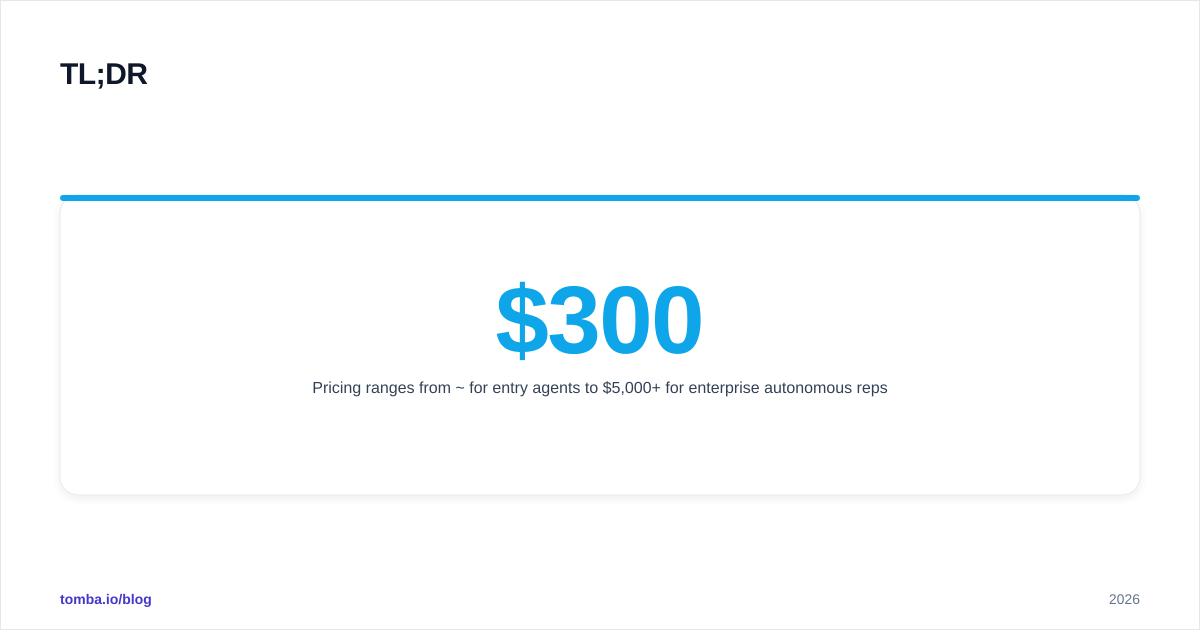
- Pricing ranges from ~$300/mo for entry agents to $5,000+/mo for enterprise autonomous reps — far cheaper than a $70k+ fully-loaded human SDR, but only if your data and targeting are clean.
- Garbage data kills AI SDRs faster than humans. An autonomous agent emailing bad addresses burns your domain reputation at scale. Verified contact data is non-negotiable.
- Best ROI comes from a hybrid: AI handles volume and research, humans handle judgment, objection-handling, and booked meetings.
What is AI SDR software?#
An AI SDR (Sales Development Representative) is software that performs the prospecting tasks a junior human rep would normally do: finding accounts, identifying contacts, researching each prospect, writing personalized outreach, sending it across email and LinkedIn, and handling early replies.
Think of it like hiring an eager intern who never sleeps, reads every prospect's LinkedIn in two seconds, and drafts a tailored first email for each one — but who needs a manager to check the work and step in the moment a real conversation starts.
Technically, modern AI SDR platforms chain together a few capabilities: a B2B data source for contacts, an enrichment layer, an LLM for research and copy generation, a sending engine with deliverability controls, and a reply classifier that routes interested leads to a human.
The categories matter. "AI SDR" gets used for two very different products:
- Autonomous AI sales agents — you give them an ICP and they run the whole top-of-funnel loop with minimal input (Artisan's Ava, 11x's Alice, AiSDR).
- AI-assisted sales engagement — a human still drives, but AI writes copy, scores leads, and suggests next steps (Apollo AI, Outreach, Salesloft Rhythm).
Pick the wrong category for your team and you'll either over-automate a complex sale or under-use a tool you're paying a premium for.
What does AI SDR software actually automate?#
Here's the honest breakdown of where AI SDRs are strong versus where they still stumble in 2026.
Strong:
- Building target account and contact lists from an ICP description
- Enriching contacts with role, company, and intent data
- Researching each prospect (recent news, funding, job changes, tech stack)
- Drafting personalized first-touch and follow-up emails at scale
- Multi-channel sequencing across email and LinkedIn
- Classifying replies (interested / not now / unsubscribe / out-of-office)
Still weak:
- Reading nuance in a lukewarm reply and adapting the pitch
- Handling pricing objections or multi-threaded enterprise deals
- Knowing when a "no" is really a "not yet" worth nurturing
- Judging whether an account is genuinely a fit beyond firmographic filters
This is why the strongest deployments treat AI SDR software as a pipeline-volume engine feeding qualified, interested replies to human AEs — not as a full replacement for the sales team.
Best AI SDR software in 2026 compared#
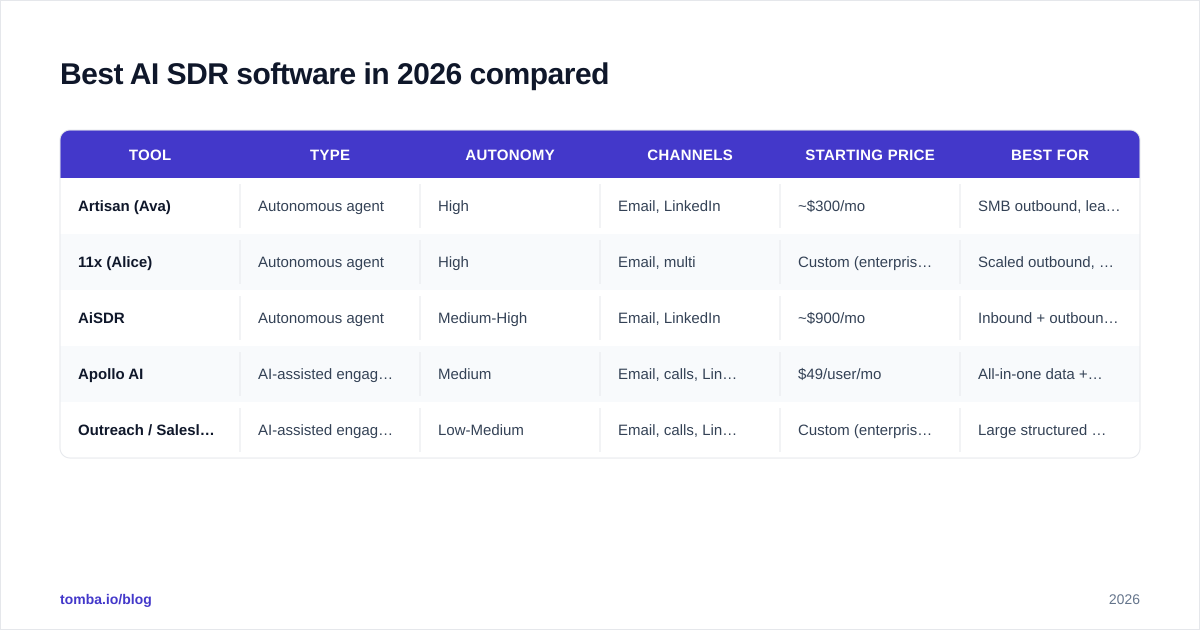
No single tool wins for everyone. Below is a like-for-like comparison of the main options by motion, autonomy level, and starting price. Prices are approximate entry tiers as published by each vendor — always confirm current pricing before buying.
| Tool | Type | Autonomy | Channels | Starting price | Best for |
|---|---|---|---|---|---|
| Artisan (Ava) | Autonomous agent | High | Email, LinkedIn | ~$300/mo | SMB outbound, lean teams |
| 11x (Alice) | Autonomous agent | High | Email, multi | Custom (enterprise) | Scaled outbound, RevOps-led |
| AiSDR | Autonomous agent | Medium-High | Email, LinkedIn | ~$900/mo | Inbound + outbound blend |
| Apollo AI | AI-assisted engagement | Medium | Email, calls, LinkedIn | $49/user/mo | All-in-one data + outreach |
| Outreach / Salesloft | AI-assisted engagement | Low-Medium | Email, calls, LinkedIn | Custom (enterprise) | Large structured sales orgs |
A few notes that don't fit in a table:
- Autonomous agents charge per "rep," not per seat. That flips the unit economics — you're effectively renting an FTE, so compare against a loaded SDR salary, not a software seat.
- AI-assisted platforms keep humans in control, which is safer for complex or regulated sales but caps how much volume one rep can run.
- Data is usually a separate line item. Most agents bundle a contact database, but coverage and accuracy vary wildly by region and seniority. Budget for a dedicated verification layer regardless.
If you want a deeper buyer's lens on the broader category, G2's sales engagement grid is a useful third-party reference for current user ratings.
How much does AI SDR software cost vs a human SDR?#
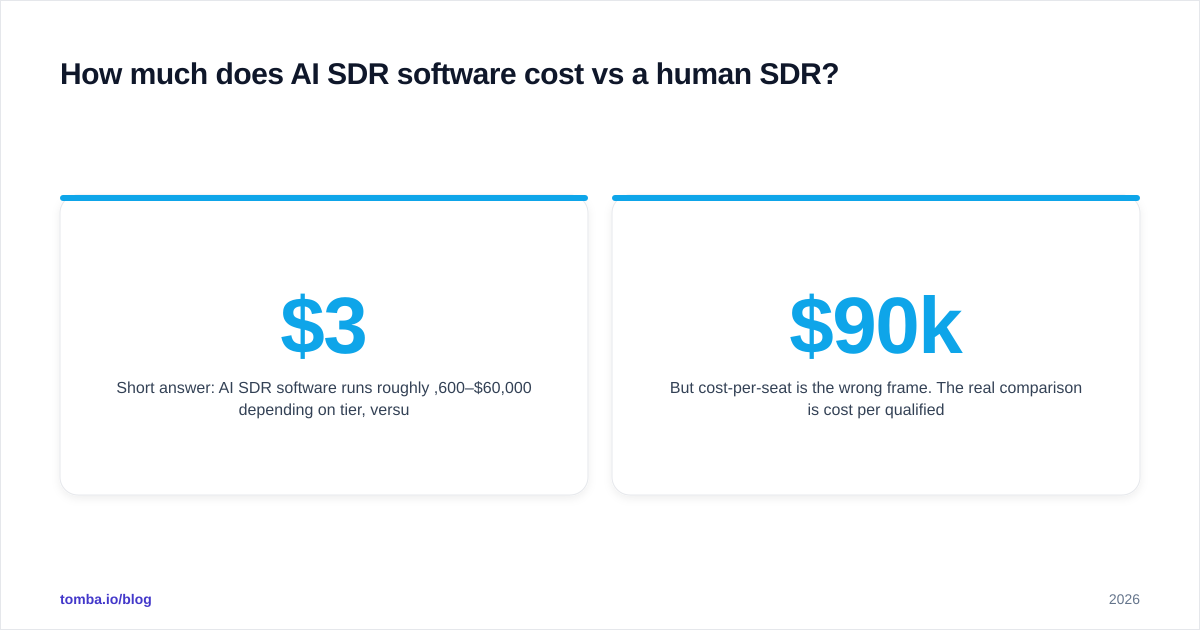
Short answer: AI SDR software runs roughly $3,600–$60,000 per year depending on tier, versus $70,000–$110,000 fully loaded for a human SDR in North America once you add salary, benefits, tooling, ramp time, and management overhead.
But cost-per-seat is the wrong frame. The real comparison is cost per qualified meeting booked. A human SDR who books 15 quality meetings a month at $90k loaded costs about $500 per meeting. An autonomous AI agent at $900/mo that books 10 quality meetings costs $90 per meeting — if the data and targeting are good.
That "if" is the entire game. Feed an AI agent a stale list and it will send 2,000 emails to dead inboxes, tank your domain reputation, and cost you far more than a human ever would. Which brings us to the part most vendor demos skip.
Why does data quality decide whether AI SDR software works?#
Because an AI SDR amplifies whatever you feed it — including mistakes. A human rep emailing a bad address catches it after a few bounces and stops. An autonomous agent will keep firing at scale until your sender reputation is wrecked.
Three data problems sink most AI SDR deployments:
- Invalid emails. Bounces above ~2% start hurting deliverability. At AI-SDR volume, an unverified list torches your domain in days.
- Catch-all uncertainty. Many B2B domains accept every address, so a "valid" result may still be undeliverable. You need real catch-all verification, not a green checkmark.
- Stale enrichment. Job changes happen constantly; emailing someone who left the company two roles ago is an instant credibility hit.
The fix is to put a verification and enrichment step between your data source and your AI SDR. Before any address enters a sequence, it should be checked with an email verifier, and net-new contacts should be sourced through a reliable email finder rather than scraped lists of unknown provenance. Clean inputs are what let the AI's volume advantage actually compound instead of backfire.
For the deliverability mechanics behind why this matters, Google's own sender guidelines spell out the bounce and spam thresholds that will get bulk senders throttled — and AI SDRs are, by definition, bulk senders.
Is AI SDR software better than a human SDR?#
It depends on the deal complexity and the stage of the funnel — neither wins outright.
AI SDR software wins on: speed, volume, cost-per-touch, consistency, 24/7 operation, and research depth per prospect. It never has a bad day, never forgets a follow-up, and can personalize 1,000 emails as easily as 10.
Human SDRs win on: judgment, rapport, objection handling, creative problem-solving, multi-threading complex accounts, and reading the emotional subtext of a reply. They earn trust in ways a generated email still can't fully replicate on a six-figure deal.
The mature 2026 answer is a hybrid model:
- AI handles list building, research, first-touch personalization, and follow-up cadence.
- AI classifies replies and only surfaces genuinely interested prospects.
- Humans take over the moment a real conversation starts — qualification calls, objection handling, and booking the meeting.
This division of labor is where teams report the strongest numbers: AI removes the soul-crushing volume work, and humans spend their hours only on conversations that can actually close. If you want to see how the underlying tasks map to specific tooling, the Tomba data enrichment and domain search workflows cover the sourcing half that every AI SDR sits on top of.
How do you evaluate AI SDR software before buying?#
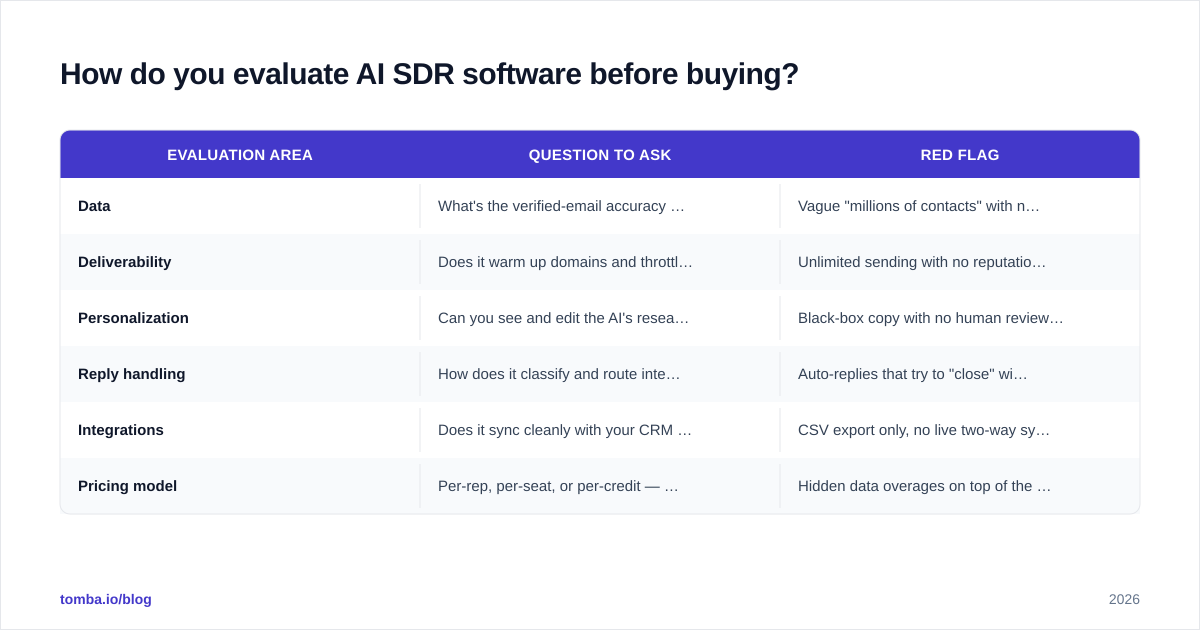
Run every shortlisted tool through these questions before committing to an annual contract:
| Evaluation area | Question to ask | Red flag |
|---|---|---|
| Data | What's the verified-email accuracy and how is it measured? | Vague "millions of contacts" with no accuracy number |
| Deliverability | Does it warm up domains and throttle sends automatically? | Unlimited sending with no reputation controls |
| Personalization | Can you see and edit the AI's research before it sends? | Black-box copy with no human review option |
| Reply handling | How does it classify and route interested leads? | Auto-replies that try to "close" without a human |
| Integrations | Does it sync cleanly with your CRM and existing stack? | CSV export only, no live two-way sync |
| Pricing model | Per-rep, per-seat, or per-credit — and what's the data cost? | Hidden data overages on top of the base fee |
Two practical tips:
- Pilot with your own list, not the vendor's. Demos always look perfect on cherry-picked accounts. Test the AI against contacts you can independently verify.
- Start narrow. Run one well-defined ICP segment for 60 days, measure cost-per-meeting against your human baseline, then scale what works.
If a vendor won't give you an accuracy figure or won't let you see the research behind a generated email, treat both as disqualifying. You're trusting this tool with your domain reputation and your brand voice at scale.
What's the smartest way to start with AI SDR software?#
Start with the foundation, not the agent. The single highest-leverage move before you deploy any AI SDR is making sure the contact data flowing into it is real, verified, and current — because that's the variable that decides whether automation multiplies your results or your mistakes.
Whether you adopt a fully autonomous agent or layer AI onto your existing reps, you still need to find and verify the right contacts first. Tomba's Email Finder lets you source professional emails by domain, name, or company and verify them before they ever enter a sequence — the clean-input layer that keeps your AI SDR from burning your sender reputation. Pair it with the email verifier for ongoing list hygiene, and check current Tomba pricing (free tier with 25 searches/mo, Starter at $49/mo) to see where it fits your stack. Get the data right, and the AI does the rest.
// get started
Find, verify and enrich your first contacts today
Start on the free plan with 25 searches a month, then scale when your team is ready.
Free plan · No credit card required · GDPR & CCPA
// about the author